- 23
- Episodes
- Monthly
- Cadence
- 2026
- First episode
About Nightnight at Laura's
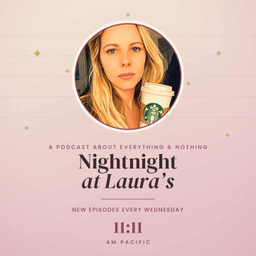
Nightnight at Laura's is a podcast about everything and nothing, which means I find the everything hiding inside the nothing. Each episode I take something new, or small and overlooked and pull on it until it becomes about being human. Some episodes are backed by real research. Some are just me and a story. Some are conversations with my people—my brother, old friends, new ones. It's warm, it's a little unfiltered, and it's for anyone who's ever felt slightly out of place and wanted to feel less alone about it. New episodes every Wednesday at 11:11am Pacific. Stay for the next one? Hi everyone! nightnightatlauras.substack.com (https://nightnightatlauras.substack.com?utm_medium=podcast)
- Publisher
- Laura G.
- Category
- society & culture · society & culture
- Language
- en
- Explicit
- No
- First episode
- 9 Jun 2026
- Latest episode
- 21 Oct 2026
Latest episodes
23 episodes in the feed.
21 Oct 2026
When Did Everyone Become So F*ing Offended?
I was going to record this one in Italian. I started, froze, and realized there’s probably something interesting to unpack there eventually. But not today. Because something else was pushing harder: when did having a conversation become so f*****g complicated? I grew up in Italy, where two people can interrupt each other, raise their voices, tell each other to f**k off and be amici come prima five minutes later. Then I moved to America, where someone can suggest getting coffee and apparently not mean actual coffee. It took some adjusting. Living between the two has made me fascinated by how much meaning we attach to everyday interactions. A delayed reply becomes rejection. A disagreement becomes disrespect. A different tone becomes hostility. And sometimes, before anyone bothers to ask “Hey, are you mad?”, we’re already fighting about an argument that never needed to happen. Then social media took that tendency and turned it into content. Someone says something. Someone reacts. Someone reacts to the reaction. Another person explains why the reaction was problematic. Somewhere in the comments, a complete stranger demands accountability. And we’ve somehow become incredibly good at prosecuting people based on thirty-second clips and incredibly bad at asking, “Wait—what did you mean?” So this episode is about that increasingly blurry line between being harmed and being uncomfortable. About disagreement, cultural differences, outrage, freedom of expression, and our apparent inability to tolerate the possibility that another person might see something differently. And, naturally, I somehow get Dante involved. Because if we’re going to argue about people refusing to take a side, the ignavi were sitting right there. Are we actually becoming too easily offended? Or are people finally refusing to tolerate things they used to let slide? Probably both. Come argue with me. I promise I can take it. While I wait… Good night. — L. P.S. Yes, I’m fully aware of the irony of using the internet to complain about what the internet has done to us. I’m not anti-social media—I’m literally here, using it to publish a podcast about how social media affects the way we communicate. The point isn’t that the internet is inherently bad. It’s that maybe we should be able to use something, enjoy parts of it, and still question what it’s doing to us. If anything, participating in it probably makes that conversation more necessary, not less. Also, if this post makes someone angry enough to share it, I suppose the algorithm and I both win. This Substack is reader-supported. To receive new posts and support my work, consider becoming a free or paid subscriber. Thanks for reading! This post is public so feel free to share it. Get full access to Laura G. at nightnightatlauras.substack.com/subscribe (https://nightnightatlauras.substack.com/subscribe?utm_medium=podcast&utm_campaign=CTA_4)
14 Oct 2026
Where the F* did humanity go?
The Black Eyed Peas asked Where Is the Love? I’m asking where the f**k humanity went. And before anyone tells me that people have always enjoyed watching other people suffer — I’m Italian. I know history. We had gladiators. I’m aware this isn’t exactly a new hobby for humankind. I recently came across a news post about an execution, and the comments genuinely disturbed me. People were excited. Popcorn was mentioned. Apparently, the possibility of watching someone die is entertainment now. Meanwhile, we live in a society that can’t go five minutes without talking about empathy. Empathy at work, empathy in relationships, empathy in leadership. We’ve practically turned it into a marketing strategy. And somehow, we’ve become incredibly good at discussing something we’re increasingly terrible at practicing. Which, naturally, got me thinking about Hollywood. Because apparently, my brain can connect a public execution to Girl, Interrupted in under thirty seconds. Welcome to my world. I’ve been fascinated by the way movies portray emotional suffering for years. I watched Girl, Interrupted when I was younger and remember wondering why Winona Ryder’s character was even in a psychiatric hospital. She seemed sad, overwhelmed, sure. But Angelina Jolie’s character? Now that looked like someone who belonged there. Which tells you quite a lot about what I thought mental illness was supposed to look like. Years later, after studying psychology and cinema, I started revisiting those films with different eyes. Fatal Attraction. Silver Linings Playbook. Eternal Sunshine of the Spotless Mind. Brain on Fire. Different stories, different decades, but the same fascination with people whose emotions don’t fit neatly into what society considers acceptable. Hollywood loves a breakdown. The obsessive girlfriend, the explosive husband, the unstable ex. Give someone an intense emotional reaction and you’ve got yourself a plot. Give them a particularly spectacular meltdown and congratulations, you’ve got a thriller. And look, I’m a screenwriter. I understand conflict. Nobody wants to watch two hours of people communicating perfectly, respecting boundaries, and going to bed at nine. Although, personally, I’d watch that movie. Sounds peaceful. What brought all this back recently was I Love You Forever. I actually watched it because of a discussion I came across on social media, which is rather ironic considering what happened next. The film explores an emotionally abusive relationship, but what fascinated me was how quickly the conversation around it became a psychological investigation. Suddenly, everyone seemed to know what was wrong with the characters, what diagnosis explained their behavior, and what that supposedly revealed about the real people viewers associated with the story. And I thought: when did watching a movie become a group diagnostic session? Because we’ve been doing something similar in real life. Your ex was selfish? Narcissist. Your girlfriend needed reassurance? Borderline. Your boyfriend struggled to communicate? Avoidant. Someone remembers an argument differently? Gaslighting. At this point, I’m surprised nobody has diagnosed their refrigerator with an attachment disorder because it doesn’t respond when they talk to it. The problem is that some of the psychology being shared online is perfectly legitimate. The terminology exists for a reason. But knowing a psychological concept doesn’t make you qualified to apply it to a stranger, much less someone you’ve only heard about through another person’s breakup story. And yet there are people building entire businesses around telling you exactly what’s wrong with your ex. Five signs you’re dating a narcissist. Seven ways to identify an avoidant. Ten red flags you missed. And if you’re still confused, don’t worry — there’s a course for that. Probably discounted if you subscribe before midnight. Here’s something I wish we’d all sit with for a moment: someone who hurts you doesn’t need a psychiatric diagnosis for your pain to be valid. You can recognize that a relationship was unhealthy, establish boundaries, and leave without turning the other person into a clinical case study. Sometimes people are selfish. Sometimes they’re overwhelmed. Sometimes they’re incompatible. Sometimes they’re abusive. Those things aren’t interchangeable, and attaching a diagnosis doesn’t automatically make your interpretation more accurate. This is where Hollywood and social media make a particularly interesting couple. Movies have spent decades giving us recognizable character types. Social media has turned those characters into checklists. We watch the obsessive girlfriend on screen, then scroll through a video explaining which personality disorder she supposedly has, and suddenly we’re applying the same logic to people whose entire lives we know absolutely nothing about. Except real people don’t have screenwriters deciding their motivations. They don’t have editors choosing which moments we get to see. And they certainly don’t have a conveniently timed flashback explaining why they behaved the way they did. There’s another part of this that bothers me. Think about Good Will Hunting, BoJack Horseman, or The Bear. We spend time understanding these men’s emotional struggles, their childhood experiences, their grief, their fear. We’re given context. Meanwhile, emotionally intense women are so often remembered as crazy, needy, obsessive, or unstable. I’m not saying this happens in every movie — we don’t deal in absolutes in this household — but I do wonder which characters we’re encouraged to understand and which ones we’re encouraged to fear. And then there’s emotional dysregulation itself, which has become another one of those expressions people throw around without necessarily understanding. It isn’t a diagnosis. It can be associated with psychiatric or neurological conditions, but it can also happen when someone is grieving, exhausted, burned out, going through a divorce, dealing with chronic stress, or simply having a terrible f*****g year. Sometimes people struggle to manage their emotions because life is overwhelming. Sometimes an intense emotional response is entirely appropriate. And feeling something intensely doesn’t automatically tell us how someone will behave. Which brings me to the thing I keep wishing Hollywood would show us more often: the next scene. The one after the breakdown. After the relationship ends. After someone realizes they’ve hurt another person. Where’s the character who spends two years in therapy and learns to respond differently? The one who still feels everything intensely but has stopped letting every emotion dictate their behavior? The person who grows, changes, and builds a meaningful life while remaining beautifully, inconveniently human? Those stories exist too. And as a writer, I’d love to see more of them. Because we spend an extraordinary amount of time telling people to work on themselves, go to therapy, become more self-aware, and grow. But when someone actually changes, are we willing to recognize it? Or have we already decided who they are based on their worst moment? Nobody owes anyone forgiveness, and change doesn’t erase harm. But if we genuinely believe in personal growth, we have to believe that people are capable of becoming different from who they used to be. I think that’s what connects all these seemingly unrelated things for me. The execution comments. The movies. The relationship influencers. The diagnoses thrown around like insults. We’ve become incredibly comfortable reducing human beings to whatever makes them easiest to judge, dismiss, or categorize. And the more certain we become about who everyone else is, the less curious we seem to be about what we might not know. Hollywood created the character. Social media supplied the diagnosis. And somewhere along the way, the human being disappeared. I’d like to put them back. So tonight, it’s just me, a microphone, a few movies, some actual research, and a considerable amount of frustration with the social media psychology circus. If you’ve ever watched a movie and wondered why we’re so quick to label people, or scrolled past another influencer who apparently knows your ex better than you do, this one’s for you. If there’s one thing I hope you take away from this episode, it’s something I think we could all practice a little more often. Be curious before you’re certain. That’s it for now, from Nightnight at Laura’s — a podcast about everything and nothing… Good night. Further Reading & References For those interested in exploring the research and psychology behind this episode, here are a few resources worth reading. 1. Mental Health Misinformation on TikTok — Journal of Medical Internet Research (2025) Navigating the Maze of Social Media Disinformation on Psychiatric Illness (https://www.jmir.org/2025/1/e64225?utm_source=chatgpt.com) The study I reference in the episode. Researchers analyzed 1,000 TikTok videos across 26 mental health topics and found that 15.7% contained misinformation, 6.3% were classified as disinformation, and only 20.7% were reference-based. Particularly relevant to the discussion about personality disorders and online diagnoses. 2. Addressing Mental Health Misinformation — American Psychological Association (2024) Addressing Misinformation About Mental Health With Patients (https://www.apa.org/topics/journalism-facts/misinformation-mental-health?utm_source=chatgpt.com) An examination of how misleading psychological information spreads online, why people believe it, and how it can interfere with understanding mental health conditions and seeking appropriate care. 3. Understanding Borderline Personality Disorder — National Institute of Mental Health Borderline Personality Disorder: Overview, Symptoms, and Treatment (https://www.nimh.nih.gov/health/topics/borderline-personality-disorder?utm_source=chatgpt.com) A clinical overview of BPD, emotional regulation difficulties, and treatment. Useful context for understanding why casually assigning psychiatric diagnoses to fictional characters or former partners can be misleading. 4. The Psychology of Misinformation — American Psychological Association Using Psychological Science to Understand and Fight Health Misinformation (https://www.apa.org/pubs/reports/health-misinformation?utm_source=chatgpt.com) A research-based examination of how misinformation spreads, why repeated claims can become persuasive, and what psychological science tells us about recognizing unreliable information. This Substack is reader-supported. To receive new posts and support my work, consider becoming a free or paid subscriber. Get full access to Laura G. at nightnightatlauras.substack.com/subscribe (https://nightnightatlauras.substack.com/subscribe?utm_medium=podcast&utm_campaign=CTA_4)
7 Oct 2026
Coincidences and Burning Man with Jay
Jahan and I hadn’t seen each other in six years, since right when the pandemic started, back when I was renting his mom’s pool house. We drifted, the way people do. And then, this year, his mom sent a text meant for his girlfriend, who is also named Laura, to me, accidentally. When the world shut down, Jahan — living alone, watching every friend he had in Burbank pack up and move back to wherever they’d come from — did the thing a lot of us didn’t: he got in a Subaru Outback he wasn’t even sure he liked, and circumnavigated half the western United States for an entire summer. He traces the restlessness back further than the pandemic, actually — to 2015, a serious breakup, and a decision that if the people in his plans weren’t there anymore, the plans still were. He stopped waiting for someone to come explore the world with him and just went. That’s how he found the festival and rave scene — generators towed into the desert, DJ equipment hooked up in the middle of nowhere, and what he calls one of the best nights of his life. He’s about to turn 47, still chasing new music instead of romanticizing old music, which he says is the thing that separates him from a lot of people his age: the ones who show up to a party still playing what was popular thirty-five years ago and call it the good stuff. He wants the new stuff. He still goes looking for it. Then there’s the story about the Burning Man ticket he turned down in 2004. A friend — an actual original burner from the early scene — tried to sell him on it with a slideshow at a work lunch meeting, and somehow made the pitch almost entirely about the porta-potties overflowing by day three. Jahan said no. Twenty-some years later, he still hasn’t gone, and he counts it as a real regret, not just because he missed the party, but because he missed the version of it that existed before it became what it is now. Which took us somewhere I keep landing on this show no matter who’s sitting across from me: money, access, and the human factor. Jahan’s take was more generous than mine: he doesn’t think a tech millionaire showing up to Burning Man ruins anything, he thinks closing the door on anyone, including people you disagree with, is how nothing ever changes. Fair. But I pushed back anyway, because a ticket that costs thousands of dollars isn’t really an open door, it’s a very polite “you can’t afford to be here.” He didn’t disagree with that part either. He just pointed out there’s another layer most people never see: the crew, the vendors, the people who live entirely outside the festival circuit and travel from one to the next just to build the thing for everyone else. That’s where he thinks the real counterculture still survives. Not in the ticket line. In the people who never bought one. We never even got to how we originally met until the end: his cousin, who was my colleague at the time, told us we should be friends cuz I just moved to Los Angeles and didn’t know anybody, and so, we started talking thanks to his family. Fitting, honestly, because always through family, that’s how we reconnected recalling the good old days pre-pandemic. Thank you, Jahan. And thank you Josephine, Jay’s mom! Miss you both. Good night. — L. Get full access to Laura G. at nightnightatlauras.substack.com/subscribe (https://nightnightatlauras.substack.com/subscribe?utm_medium=podcast&utm_campaign=CTA_4)
Contact Nightnight at Laura's
- Guest appearances
- Books guests
Based on episode analysis; this does not confirm that the show is currently accepting guests.
Host of Nightnight at Laura's?
Claim your podcast to manage its listing and keep your show details accurate.
Pod Engine is an independent podcast discovery and analytics service and is not affiliated with or endorsed by this podcast. Artwork and show content belong to their owners. Full legal notice.
Explore this show
Podcast research with Pod Engine