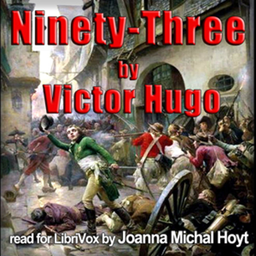
- The new revolutionary government of France is laboring mightily to end injustice and bring in an ideal new age of liberty, equality, and brotherhood, beginning by killing those obnoxious persons who don't appreciate their ideals. In Vendée a force of peasants, strongly supported by imperial England, is laboring mightily to overthrow the revolutionary government and restore Christianity, family, honor and decency, beginning by killing those obnoxious persons who fail to appreciate those noble phenomena. The exiled Marquis de Lantenac returns from England to lead the Vendéan revolt, to institute a take-no-prisoners policy, and to win a series of bloody victories.<br /><br />Lantenac is opposed with some success by his great-nephew the Revolutionary officer Captain Gauvain. Gauvain's superiors in Paris admire his courage and tactical skill, but they disapprove of his belief that the principle of brotherhood requires him to show mercy to his enemies. They send their man Cimourdain, whose unyielding principles they trust, to make sure that Gauvain's reactionary mercies and his family loyalty are not causing him to betray the Republic--and to have Gauvain killed if that proves to be the case. They don't realize that Cimourdain, who was once a priest and Gauvain's tutor, loves Gauvain like a son--loves him, perhaps, as much as he once loved God and as he now loves the Revolution.<br /><br />Meanwhile, the Breton peasant Michele Flechard, who has just lost her home and her husband in a war which she experiences an incomprehensible nightmare, is simply trying to keep her young children alive and get them to some place that won't collapse in blood and fire. Under the circumstances, this appears about as difficult as bringing about either version of the Just Kingdom.<br /><br />Note: A listener interested in the story, and not in a long excursus on the architecture and the notable names of the French Revolution, could skip the very long Section 27, The Convention, without becoming confused or losing any of the plot. (Summary by Joanna Michal Hoyt)

Ninety-Three by Victor Hugo (1802 - 1885)
Claim This Podcastby ciesse
Podcast Authority
Beta
Podcast Overview
1793. The new revolutionary government of France is laboring mightily to end injustice and bring in an ideal new age of liberty, equality, and brotherhood, beginning by killing those obnoxious persons who don't appreciate their ideals. In Vendée a force of peasants, strongly supported by imperial England, is laboring mightily to overthrow the revolutionary government and restore Christianity, family, honor and decency, beginning by killing those obnoxious persons who fail to appreciate those noble phenomena. The exiled Marquis de Lantenac returns from England to lead the Vendéan revolt, to institute a take-no-prisoners policy, and to win a series of bloody victories.<br /><br />Lantenac is opposed with some success by his great-nephew the Revolutionary officer Captain Gauvain. Gauvain's superiors in Paris admire his courage and tactical skill, but they disapprove of his belief that the principle of brotherhood requires him to show mercy to his enemies. They send their man Cimourdain, whose unyielding principles they trust, to make sure that Gauvain's reactionary mercies and his family loyalty are not causing him to betray the Republic--and to have Gauvain killed if that proves to be the case. They don't realize that Cimourdain, who was once a priest and Gauvain's tutor, loves Gauvain like a son--loves him, perhaps, as much as he once loved God and as he now loves the Revolution.<br /><br />Meanwhile, the Breton peasant Michele Flechard, who has just lost her home and her husband in a war which she experiences an incomprehensible nightmare, is simply trying to keep her young children alive and get them to some place that won't collapse in blood and fire. Under the circumstances, this appears about as difficult as bringing about either version of the Just Kingdom.<br /><br />Note: A listener interested in the story, and not in a long excursus on the architecture and the notable names of the French Revolution, could skip the very long Section 27, The Convention, without becoming confused or losing any of the plot. (Summary by Joanna Michal Hoyt)
Language
🇺🇲
Publishing Since
1/21/2025
Unlock The Full Podcast Authority Score Report
See how your podcast performs across key metrics
Podcast Authority
Beta
Recommendations available
Unlock the full report to see detailed tips
Recommendations available
Unlock the full report to see detailed tips
Unlock comprehensive insights including:
- • YouTube presence analysis
- • Social media reach metrics
- • RSS compliance scoring
- • Podcast 2.0 features
- • Technical standards
Detailed Analytics
- Complete breakdown of all 19 authority metrics
- Personalized recommendations for each metric
- Industry benchmarks and comparisons
- Technical RSS feed analysis and compliance scoring
Growth Strategies
- Step-by-step action plans for improvement
- Quick wins to boost your score immediately
- Pro tips from successful podcasters
See how your show performs across every key metric
High authority scores make your podcast more attractive to industry leaders and influencers who want to appear on credible shows.
Sponsors look for podcasts with proven authority and engagement. Your score demonstrates your podcast's value to potential partners.
Understanding your strengths and weaknesses helps you make data-driven decisions to expand your listener base effectively.
1 verified contact email on file for Ninety-Three by Victor Hugo (1802 - 1885)
Pitch yourself as a guest, propose sponsorships, or reach out directly to the host.
Recent Episodes

January 21, 2025
Part 3, Book 5: In Daemone Deus. Ch 1: Found, But Lost

January 21, 2025
3/5/2: From The Door Of Stone To That Of Iron

January 21, 2025
3/2/14 What The Imânus Is Doing
77 total episodes available
Deep-dive analytics for Ninety-Three by Victor Hugo (1802 - 1885)
Frequently asked questions
Have a different question and can't find the answer you're looking for? Reach out to our support team by sending us an email and we'll get back to you as soon as we can.
- What is Ninety-Three by Victor Hugo (1802 - 1885)?
- How often does this podcast release new episodes?
This podcast updates daily.
- Where can I listen to this podcast?
This podcast is available on 4 platforms including Apple Podcasts, Spotify, and more. You can also use the RSS feed directly.
- Does this podcast accept guests?
Information about guest appearances is not available.
Legal Disclaimer
Pod Engine is not affiliated with, endorsed by, or officially connected with any of the podcasts displayed on this platform. We operate independently as a podcast discovery and analytics service.
All podcast artwork, thumbnails, and content displayed on this page are the property of their respective owners and are protected by applicable copyright laws. This includes, but is not limited to, podcast cover art, episode artwork, show descriptions, episode titles, transcripts, audio snippets, and any other content originating from the podcast creators or their licensors.
We display this content under fair use principles and/or implied license for the purpose of podcast discovery, information, and commentary. We make no claim of ownership over any podcast content, artwork, or related materials shown on this platform. All trademarks, service marks, and trade names are the property of their respective owners.
While we strive to ensure all content usage is properly authorized, if you are a rights holder and believe your content is being used inappropriately or without proper authorization, please contact us immediately at hey@podengine.ai for prompt review and appropriate action, which may include content removal or proper attribution.
By accessing and using this platform, you acknowledge and agree to respect all applicable copyright laws and intellectual property rights of content owners. Any unauthorized reproduction, distribution, or commercial use of the content displayed on this platform is strictly prohibited.