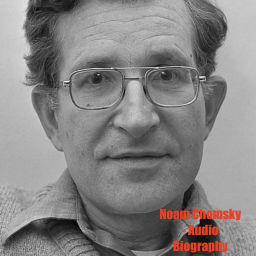
Podcast thumbnail for Noam Chomsky - Audio Biography

Noam Chomsky - Audio Biography

Claim This Podcast

by Inception Point AI

5.0(2 reviews)
75 episodes
Updated Weekly
Accepts GuestsHas SponsorsLocation 🇺🇸

Podcast Overview

Noam Chomsky Early Life and Education Avram Noam Chomsky was born on December 7, 1928, in Philadelphia, Pennsylvania. His parents, William Chomsky and Elsie Simonofsky, were Jewish immigrants from Eastern Europe. Chomsky's father was a Hebrew scholar, and his mother was a teacher. This academic environment fostered Chomsky's early interest in learning, particularly in linguistics and politics.Chomsky attended an experimental elementary school where he was encouraged to develop his own ideas and interests. He later attended Central High School in Philadelphia, known for its rigorous academic standards. In 1945, Chomsky entered the University of Pennsylvania, where he initially studied philosophy and logic. His interest in linguistics was sparked by meeting Zellig Harris, a leading linguist, who became his mentor.Academic Career and Contributions to Linguistics Chomsky's academic career began in earnest at the Massachusetts Institute of Technology (MIT), where he started teaching in 1955 and remained for the majority of his career. His groundbreaking work, "Syntactic Structures" (1957), revolutionized the field of linguistics by introducing the theory of transformational-generative grammar. This theory proposed that the ability to generate and understand sentences in a language is rooted in an innate, universal grammar shared by all humans. Chomsky's theories challenged the prevailing behaviorist views of language acquisition, which posited that language learning was based on habit formation and environmental stimuli. Instead, Chomsky argued that humans are born with an inherent ability to understand the structure of language, a concept he termed the "language acquisition device." His subsequent work, including "Aspects of the Theory of Syntax" (1965) and "The Minimalist Program" (1995), further developed his ideas on universal grammar and syntax. Chomsky's contributions to linguistics have had a profound impact on the field, influencing not only linguistics but also cognitive science, psychology, and philosophy. Political Activism and Criticism In addition to his work in linguistics, Chomsky is renowned for his political activism and criticism of U.S. foreign policy. His political engagement began in earnest during the Vietnam War, when he became a vocal critic of U.S. involvement. His 1967 essay, "The Responsibility of Intellectuals," argued that intellectuals had a moral duty to speak out against government actions that they believed to be wrong. Chomsky's critiques extend beyond specific policies to a broader critique of power structures and propaganda. In "Manufacturing Consent: The Political Economy of the Mass Media" (1988), co-authored with Edward S. Herman, Chomsky developed the propaganda model of media, arguing that media serves the interests of elite groups in society. Throughout his career, Chomsky has written extensively on issues such as imperialism, capitalism, and human rights. His books, lectures, and interviews have made him one This content was created in partnership and with the help of Artificial Intelligence AI.

Language

🇺🇲

Publishing Since

6/19/2024

2 verified contact emails on file for Noam Chomsky - Audio Biography

Pitch yourself as a guest, propose sponsorships, or reach out directly to the host.

Recent Episodes

Episode thumbnail for Biography Flash Noam Chomsky Silent Voice Loud Echo at 96

June 16, 2026

Biography Flash Noam Chomsky Silent Voice Loud Echo at 96

Noam Chomsky Biography Flash a weekly Biography. Noam Chomsky remains physically absent from public life this week, but his presence continues to ripple across media, scholarship, and political commentary in ways that matter for his long‑term biography. The most consequential continuing development is his health: according to multiple recent summaries of his life and work, Chomsky suffered a massive stroke in June 2023 and, at 96, is no longer able to speak in public, effectively ending new lectures and live interviews and cementing his vast back catalog as his primary voice going forward. This marks a clear biographical turning point, transitioning him from active dissident to largely archival figure whose influence runs through reissues, citations, and the people he inspired. In the past few days, much of the Chomsky activity has been secondhand but still revealing. Harvard University Press is being promoted as publisher of a new work of political thought that explicitly sets Chomsky alongside Gore Vidal as a key twentieth‑century dissident intellectual, according to Inside Story, underscoring how mainstream academic culture is now formalizing his status as a canonical critic of American power rather than a fringe radical. On social media, book‑centered Instagram posts are pushing collections like Imperial Ambitions and Chronicles of Dissent, presented as essential reading on the post‑9/11 world and U.S. imperial policy, a sign that Chomsky’s antiwar and anti‑empire framework is being actively repackaged for a younger, algorithm‑driven audience. Other Instagram and Facebook posts are recycling classic Chomsky lines about questioning everything, media manipulation, and manufactured enemies, often without new context, but keeping his name in daily circulation and reinforcing his brand as the archetypal skeptical intellectual. In academic and political discourse, articles and teaching materials continue to foreground his linguistic revolution and his nativist theory of an innate language acquisition device, while political revision notes for students highlight his childhood anti‑fascist writing and lifelong media criticism. Current Affairs and similar outlets are still invoking Manufacturing Consent as the definitive left‑wing analysis of corporate media power when discussing oligarchy and billionaires, showing that his framework remains the default reference for structural critiques of democracy and wealth. There are no verified reports in the last 24 hours of new Chomsky statements, business ventures, or fresh health bulletins, and any online speculation about private communications or behind‑the‑scenes political advice remains unconfirmed and should be treated as conjecture rather than fact. For now, the story is that Noam Chomsky’s living voice is quiet, but the echo of his work is getting louder as publishers, educators, and influencers continue to recirculate and institutionalize his ideas. Thank you for listening, and be sure to subscribe so you never miss an update on Noam Chomsky, and search the term Biography Flash for more great biographies. Thanks for listening. This has been a Quiet Please production. Get the best deals https://amzn.to/3ODvOta

Episode thumbnail for Biography Flash Noam Chomsky Legacy Health Crisis and AI Linguistics Debate

June 13, 2026

Biography Flash Noam Chomsky Legacy Health Crisis and AI Linguistics Debate

Noam Chomsky Biography Flash a weekly Biography. Noam Chomsky remains physically absent from public life this week, but his presence is everywhere, refracted through news, scholarship, and a steady stream of social media nostalgia and controversy. The most consequential biographical fact underpinning everything right now is his ongoing serious health condition following a devastating stroke; according to a widely shared post highlighted by Films For Action on Facebook, Chomsky is currently incapacitated and cannot speak for himself, with his wife stepping in via a written statement that many readers have treated as an apology and clarification of his position and associations. That health reality means there are no new verified public appearances, interviews, or fresh writings from Chomsky himself in the past few days; everything we see is reinterpretation, citation, or criticism orbiting the existing body of work. On the intellectual front, his long shadow over linguistics continues: a new paper on arXiv titled Large Language Models as Modal Models in Linguistics explicitly positions current AI research in dialogue with the Chomskyan tradition on language structure and competence, underscoring his enduring relevance to how researchers conceptualize grammar and meaning in the age of GPT-style systems. On social media, recent Instagram posts from education and philosophy accounts are resurfacing his core ideas: one widely circulated post explains his universal grammar claim, that children are born with an internal language structure rather than merely imitating speech, while another promotes his book What Kind of Creatures Are We as a powerful exploration of how mass media manufactures consent and shapes political discourse. In the political and media sphere, Chomsky is being invoked rather than speaking. A recent Substack essay by analyst Trita Parsi cites Chomsky’s praise for Parsi as one of the most distinguished scholars on Iran, using that endorsement to frame current debates over Iran and shifting Middle East strategy. Commentary and news discussion around Jeffrey Epstein’s network still periodically drags in Chomsky’s past social contact with Epstein; a Facebook post discussing recent Epstein-related coverage stresses that Chomsky’s incapacitation means he cannot respond personally, and that his wife’s statement is, for now, the closest we have to his side of the story. Those pieces have a gossip-page tone but are grounded in earlier reporting about his meetings and flights; any new insinuations or motives being floated this week should be considered speculative unless backed by primary documents or major outlets. Meanwhile, his image as a radical conscience of American foreign policy is being repackaged: Instagram and YouTube clips contrast Chomsky with figures like Robert McNamara and Bill Clinton, using archival footage and quotes to pit efficiency versus humanity in war, or security versus strategy in foreign policy. These are not new positions from Chomsky, but they keep his critiques alive for a younger algorithm-driven audience and may shape how the next generation’s biographies frame him: as the archival moral counter-voice to technocratic power. There are no major verified headlines in the last 24 hours announcing new projects, business activities, or statements from Chomsky himself; biographically, the significant developments are the continued confirmation of his serious health limitations, the institutionalization of his ideas in cutting-edge AI and linguistic research, and the ongoing reputational tug-of-war over his past associations. Together they mark a transition from the era of Noam Chomsky as an active participant to Noam Chomsky as a contested legacy. Thank you for listening, and be sure to subscribe so you never miss an update on Noam Chomsky, and search the term Biography Flash for more great biographies. Thanks for listening. This has been a Quiet Please production. Get the best deals https://amzn.to/3ODvOta

Episode thumbnail for Biography Flash Noam Chomsky Living Legend Offstage Stroke Recovery and Enduring Legacy

June 6, 2026

Biography Flash Noam Chomsky Living Legend Offstage Stroke Recovery and Enduring Legacy

Noam Chomsky Biography Flash a weekly Biography. In the past few days, the story around Noam Chomsky has been less about new public appearances and more about the ongoing biographical arc of a towering intellectual in a quieter, medically fragile stage of life. The most consequential development, from a long term biographical standpoint, remains the confirmation earlier this year by his wife, Valeria Wasserman, that Chomsky suffered a serious stroke in 2023 and has since been focusing on recovery away from public life, as reported by outlets such as Folha de S.Paulo in Brazil and picked up by international press. That health update continues to frame how scholars and journalists talk about his legacy, because it effectively closes the chapter on his decades long role as a constant presence in live debates, interviews, and campus events. In the last few days, there have been no verified reports from major news organizations of new Chomsky authored articles, new books, or fresh on camera interviews. Instead, what we see is the echo field of his past work. University departments and political commentary sites have continued to circulate earlier conversations with him on US foreign policy, the Israel Palestine conflict, and the state of American democracy, often labeling them as still relevant or “more timely than ever.” Where some social media users on X and Reddit have speculated about his current condition or suggested he may have quietly given private briefings, those claims are unconfirmed and not backed by any reputable outlet; they remain pure speculation at this point. No major headlines in the last 24 hours from leading publications like The New York Times, The Guardian, or the BBC have announced new activity from Chomsky; when his name appears, it is usually in retrospective pieces, academic discussions of linguistics, or as a quoted authority in analyses of propaganda and media, drawing on work from Manufacturing Consent and his classic essays. That pattern itself is biographically significant: Chomsky is now functioning in the public sphere primarily as a reference point and a source of enduring texts, rather than as an active, constantly commenting public intellectual. On social platforms, the most notable mentions in the past few days are anniversary style posts highlighting his early work in generative grammar and his Vietnam era activism, again leaning on older interviews and speeches available through outlets like Democracy Now! and various university archives, rather than anything truly new. There is, as of now, no credible reporting of fresh business ventures, institutional moves, or new appointments involving Chomsky. That is where the Noam Chomsky story stands this week: a living legend largely offstage, with the world arguing over and amplifying a lifetime of ideas while genuine news about the man himself remains scarce and tightly controlled by his family. Thank you for listening, and be sure to subscribe so you never miss an update on Noam Chomsky, and search the term Biography Flash for more great biographies. Thanks for listening. This has been a Quiet Please production. Get the best deals https://amzn.to/3ODvOta

75 total episodes available

Deep-dive analytics for Noam Chomsky - Audio Biography

Frequently asked questions

Have a different question and can't find the answer you're looking for? Reach out to our support team by sending us an email and we'll get back to you as soon as we can.

What is Noam Chomsky - Audio Biography?

Noam Chomsky Early Life and Education Avram Noam Chomsky was born on December 7, 1928, in Philadelphia, Pennsylvania. His parents, William Chomsky and Elsie Simonofsky, were Jewish immigrants from Eastern Europe. Chomsky's father was a Hebrew scholar, and his mother was a teacher. This academic environment fostered Chomsky's early interest in learning, particularly in linguistics and politics.Chomsky attended an experimental elementary school where he was encouraged to develop his own ideas and interests. He later attended Central High School in Philadelphia, known for its rigorous academic standards. In 1945, Chomsky entered the University of Pennsylvania, where he initially studied philosophy and logic. His interest in linguistics was sparked by meeting Zellig Harris, a leading linguist, who became his mentor.Academic Career and Contributions to Linguistics Chomsky's academic career began in earnest at the Massachusetts Institute of Technology (MIT), where he started teaching in 1955 and remained for the majority of his career. His groundbreaking work, "Syntactic Structures" (1957), revolutionized the field of linguistics by introducing the theory of transformational-generative grammar. This theory proposed that the ability to generate and understand sentences in a language is rooted in an innate, universal grammar shared by all humans. Chomsky's theories challenged the prevailing behaviorist views of language acquisition, which posited that language learning was based on habit formation and environmental stimuli. Instead, Chomsky argued that humans are born with an inherent ability to understand the structure of language, a concept he termed the "language acquisition device." His subsequent work, including "Aspects of the Theory of Syntax" (1965) and "The Minimalist Program" (1995), further developed his ideas on universal grammar and syntax. Chomsky's contributions to linguistics have had a profound impact on the field, influencing not only linguistics but also cognitive science, psychology, and philosophy. Political Activism and Criticism In addition to his work in linguistics, Chomsky is renowned for his political activism and criticism of U.S. foreign policy. His political engagement began in earnest during the Vietnam War, when he became a vocal critic of U.S. involvement. His 1967 essay, "The Responsibility of Intellectuals," argued that intellectuals had a moral duty to speak out against government actions that they believed to be wrong. Chomsky's critiques extend beyond specific policies to a broader critique of power structures and propaganda. In "Manufacturing Consent: The Political Economy of the Mass Media" (1988), co-authored with Edward S. Herman, Chomsky developed the propaganda model of media, arguing that media serves the interests of elite groups in society. Throughout his career, Chomsky has written extensively on issues such as imperialism, capitalism, and human rights. His books, lectures, and interviews have made him one

This content was created in partnership and with the help of Artificial Intelligence AI.

How often does this podcast release new episodes?

This podcast updates weekly.

Where can I listen to this podcast?

This podcast is available on 8 platforms including Apple Podcasts, Spotify, and more. You can also use the RSS feed directly.

Does this podcast accept guests?

Yes, this podcast regularly features guests.

Legal Disclaimer

Pod Engine is not affiliated with, endorsed by, or officially connected with any of the podcasts displayed on this platform. We operate independently as a podcast discovery and analytics service.

All podcast artwork, thumbnails, and content displayed on this page are the property of their respective owners and are protected by applicable copyright laws. This includes, but is not limited to, podcast cover art, episode artwork, show descriptions, episode titles, transcripts, audio snippets, and any other content originating from the podcast creators or their licensors.

We display this content under fair use principles and/or implied license for the purpose of podcast discovery, information, and commentary. We make no claim of ownership over any podcast content, artwork, or related materials shown on this platform. All trademarks, service marks, and trade names are the property of their respective owners.

While we strive to ensure all content usage is properly authorized, if you are a rights holder and believe your content is being used inappropriately or without proper authorization, please contact us immediately at hey@podengine.ai for prompt review and appropriate action, which may include content removal or proper attribution.

By accessing and using this platform, you acknowledge and agree to respect all applicable copyright laws and intellectual property rights of content owners. Any unauthorized reproduction, distribution, or commercial use of the content displayed on this platform is strictly prohibited.