- 5
- Episodes
- Bi-weekly
- Cadence
- 2026
- First episode
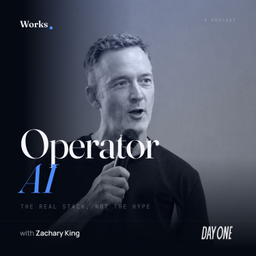
About Operator AI with Zachary King
How real operators actually use AI. Every fortnight, Zachary King sits down with founders, operators, and builders and gets them to show, screen-share and all, exactly how they use AI to run the real parts of their business. The workflows they've installed, the prompts they run, and the stuff that broke on the way. No theory. No futurism. Just what actually works.
- Publisher
- Day One
- Category
- business · business · technology
- Language
- en
- Explicit
- No
- First episode
- 26 Aug 2026
- Latest episode
- 26 Oct 2026
Latest episodes
5 episodes in the feed.
26 Oct 2026
Mark Deacon's Marketing Hub: AI Revenue Engine
Canibuild's sales team used to record personalised prospect videos by hand. Each one took 15 to 20 minutes, so reps did them in bursts, when they had spare time. Mark Deacon replaced that routine with a system that scripts, produces and tracks the videos, and he opens his screen to show every step. Mark is Chief AI Officer at Canibuild. He has spent his career leading sales, marketing and customer success teams, and he does not write code. He built the Marketing Hub, an internal platform where Canibuild's teams serve themselves instead of queuing for engineering. The outreach video tool is the centrepiece. A rep enters a prospect's website, or imports a list from a CSV or a HubSpot segment. The system scrapes the site, writes a script and produces a video of about a minute. It opens on the prospect's own website, then moves into the Canibuild product and ends on a call to action. Each video features an AI avatar of the account's real rep, with a HeyGen face and an ElevenLabs voice. Mark said reps supplied short recordings to set these up, and a personalised landing page goes out with the video. Mark was direct about the results. By his account, conversion is roughly on par with videos reps record themselves. The gain is volume: a handful a month before, and potentially a thousand now, at about $4 a video. Video watches trigger Slack alerts and HubSpot tasks; demo bookings create deals, so reps do not need to live in the Marketing Hub. The build-versus-buy split is useful. Mark said Canibuild's tools split roughly 50/50. It buys anything customer-facing that needs near-perfect uptime, such as its 11x AI SDR. It builds internal tools where a day of downtime is an inconvenience, not a crisis. He also showed an early version of a newsletter builder. It reads the engineering team's Jira roadmap and industry news, scores what matters for a chosen segment, and publishes through HubSpot. Mark noted that it still needs a person to pick articles and images. Automatic segment-by-segment sending is the next step. The second half widens out. Every Canibuild tool starts as a flow tested in the terminal, then gets an interface so the team can run it without waiting on Mark. Staff build dashboards and apps in VS Code using shared skills. Those skills apply templates, scan for leaked API keys, push to a central GitHub and register each tool on a master dashboard, so nothing disappears when its builder leaves. Mark described his role as enablement. He wants the people with domain expertise to build, inside guardrails, without turning his team into a new engineering queue. His advice for beginners: start with Claude Code or Codex in the terminal, tie the first build to a real business problem, and keep humans on the first 20 per cent (thinking) and the last 20 per cent (review) of the work. About Mark Deacon Mark Deacon is Chief AI Officer at Canibuild. He is a revenue leader whose background spans sales, marketing, customer success and go-to-market strategy. He runs a growing set of internal AI tools for Canibuild's teams and posts about what he is building on LinkedIn. Chapters 00:00 Cold open and intro 01:50 Why manual Loom videos did not scale 04:20 Terminal first, then a self-serve interface 05:18 From prospect website to scripted video 07:06 AI avatars, cloned voices and landing pages 12:15 Conversion parity, volume and cost per video 14:35 Watches become Slack alerts, HubSpot tasks and deals 17:43 Build versus buy: the AI SDR and enrichment 20:10 A revenue leader building without engineers 22:45 Newsletter builder fed by the product roadmap 27:22 Guardrails so everyone can build 32:22 Chief AI Officer: enablement, not a new bottleneck 38:58 Rapid fire 43:35 How to start, and the 20/60/20 rule Links and resources Mark Deacon on LinkedIn: https://www.linkedin.com/in/markpdeacon/ (https://www.linkedin.com/in/markpdeacon/) Canibuild: https://canibuild.com/ (https://canibuild.com/) HubSpot: https://www.hubspot.com (https://www.hubspot.com) HeyGen: https://www.heygen.com (https://www.heygen.com) ElevenLabs: https://elevenlabs.io (https://elevenlabs.io) 11x: https://www.11x.ai (https://www.11x.ai) FullEnrich: https://fullenrich.com (https://fullenrich.com) Astro: https://astro.build (https://astro.build) About the host Zachary King is the founder of Works, where he installs AI into how Australian companies operate. He has worked at the commercial pointy end of AI for almost twenty years and runs his own company largely from the command line. About the show Operator AI is the show where real operators open their screens and show exactly how they run the real parts of their business with AI. The real stack, not the hype. If you want AI installed into how your business actually operates, learn more at https://workshq.com.au/ (https://workshq.com.au/) or book a time with Zachary King at https://savvycal.com/Zachary-King/zac-at-works-30 (https://savvycal.com/Zachary-King/zac-at-works-30). Operator AI is part of Day One Network, the podcast and media network from W2D1 Media: https://dayone.fm/ (https://dayone.fm/).
9 Oct 2026
The AI Nomad: How Nathan Clark Switches Tools Without Losing the Work
Nathan Clark runs three clients on three different AI stacks. One has standardised on Claude, the next on ChatGPT, and he doesn't have the luxury of picking just one. So he built a system that lets him move between models and agent apps without starting over each time. Nathan Clark, founder of ReadyGTM, helps companies sharpen and scale their go-to-market motion, with a growing focus on AI implementation. On screen, he opens the file system underneath his work and hands a live piece of client work from one tool to another, showing exactly where the handoff still gets messy. The system is a folder structure on an always-on Mac Studio, reachable from his laptop, iPad and phone through Tailscale. The folders follow how Nathan runs his business: plan, market, sell, deliver, operate. Each client gets an AGENTS.md file, and a job that runs at 10pm each night sweeps his messages and files to keep those client files current, but it's only allowed to touch low-risk files. A centralised skills library is symlinked into every tool he uses, so the same skills are available whichever agent he's in. For the demo, Nathan works from a synthetic client, Acme Inc. He opens a sales diagnostic built in Codex, his daily driver, and explains why he delivers client reports as web pages rather than slide decks: clients are paying for clarity, and the evidence behind every number sits one click away. When he doesn't like parts of the design, he hands the same folder to Claude Code in the terminal and dictates the brief: strip the eyebrows and page numbers, add a dark-mode toggle. While that runs, he shows GrokBot answering client questions from the same underlying files. The change lands, dark mode works, and he goes back to Codex to push it live. The back half covers how Nathan picks tools. Codex does around 80% of his paid work because it follows precise instructions literally. Claude handles visual work and reads intent from looser prompts. Solo runs multi-agent builds for hours while he's elsewhere, and Amp's cloud-based Orbs keep environment and context intact without anything running on his desktop. Then the rough edges: memory drift in his file system, and agents that have pushed changes live when told not to. Nathan wants proper per-agent permissions rather than instructions an agent may or may not follow. It closes with a quick-fire round and Nathan's advice for anyone starting out: be more ambitious about what you ask AI to do, and when it names something you don't know, ask what it is and ask it to walk you through doing it. As he puts it, it's prompts all the way down. Nathan Clark is the founder of ReadyGTM, where he helps companies sharpen and scale their go-to-market motion and put AI to work in ways that move the numbers. He also works with Works. Chapters 00:00 Cold open 01:03 Meet Nathan Clark 01:48 What "AI nomad" actually means 02:52 Why most operators should go deep on one tool 05:34 What needs to live outside the apps 06:00 Inside the Nathan Brain: a durable file system in plain text 09:13 The 10pm sweep, AGENTS.md and a centralised skills library 15:50 The demo: Acme Inc. and the Codex diagnostic 18:21 Why reports are web pages, not slide decks 21:17 Handing off to Claude Code for a dark-mode fix 22:42 GrokBot for client management on the move 26:04 Dark mode lands, and pushing live 29:14 Ranking the tools: Codex, Claude, Solo, Amp 37:10 Where it breaks: drift and permissions 38:52 Quick-fire round 43:30 Where Nathan gets his alpha 44:52 Advice for beginners: prompts all the way down 46:07 Where to find Nathan Resources Nathan Clark: https://readygtm.com (https://readygtm.com) Nathan on LinkedIn: https://linkedin.com/in/nathancjclark (https://linkedin.com/in/nathancjclark) Nathan on X: https://x.com/nathanclark_ (https://x.com/nathanclark_) Solo: https://soloterm.com (https://soloterm.com) Amp: https://ampcode.com (https://ampcode.com) Tailscale: https://tailscale.com (https://tailscale.com) OpenCode Go: https://opencode.ai (https://opencode.ai) Lorikeet (Steve Hind): https://www.lorikeetcx.ai (https://www.lorikeetcx.ai) About the host Zachary King is the founder of Works, where he installs AI into how Australian companies operate. He has worked at the commercial pointy end of AI for almost twenty years and runs his own company largely from the command line. About the show Operator AI is the show where real operators open their screens and show exactly how they run the real parts of their business with AI. The real stack, not the hype. If you want AI installed into how your business actually operates, learn more at https://workshq.com.au/ (https://workshq.com.au/) or book a time with Zachary King at https://savvycal.com/Zachary-King/zac-at-works-30 (https://savvycal.com/Zachary-King/zac-at-works-30). Operator AI is part of Day One Network, the podcast and media network from W2D1 Media: https://dayone.fm/ (https://dayone.fm/).
24 Sept 2026
The Mad Men Era of Knowledge Work: Inside Román Olivera's Agent Brain
Román Olivera runs his company on files and folders. No database, no CRM platform — a fractal system he calls Flatfish, built from plain text and a set of rules an agent reads before it does anything else. On this episode of Operator AI, he opens it up and shows exactly how it works. Román Olivera, from Orban Labs, walks Zachary King through the system live. Every folder that matters is a "node," and every node carries the same four things: rules for how to behave there, a current-state file for what's true now, an append-only log for what happened, and a registry so an agent can find its way around without being briefed from scratch. Román built it after losing track of one too many half-finished projects scattered across folders he couldn't remember the naming convention for. The demo is the receipt. By voice, from his phone, Román creates a CRM entry for a contact met at the local pub, in Codex running on a remote machine. Codex then builds an HTML presentation in Román's own design system. Then Claude Code, a different tool running a different model, picks up the same context in a fresh harness. It uploads the deck to AWS S3, shortens the link, and drafts two follow-up emails: one to Zac in English, one to the new contact in Spanish. Nobody told it to switch languages. It read the contact's file, which noted where he was from, and made the call itself. That portability is deliberate. Román turns platform memory off on his agents, on purpose, because an agent with its own memory tends to skip reading the rules and shortcut toward an answer. He'd rather own the context outright than rent it from whichever platform is trending: he uses APIs over MCPs so he can control the process, and keeps his skills in a plain folder rather than a config file, so nothing locks him into one tool. The conversation lands on an analogy Román coins mid-episode, on the record, timestamped live by Zac: AI is bringing back the Mad Men era of knowledge work, where the job is to direct rather than to do. The advertising executive never touched the filing cabinet — he told someone where a letter should go and trusted it would be there when he asked for it. Román argues that's the discipline AI now demands: be specific about what you want and where things belong, and the system holds up the rest. Román also draws a line most operators haven't hit yet. Files and folders work brilliantly for a business of one, or close to it. Once client work moves into enterprise environments, the same logic has to move into databases — a challenge he's already started tackling with clients on platforms like Azure. Before Orban Labs, Román spent more than a decade in the energy sector across field engineering, project delivery, and operational leadership — work that shaped his insistence that speed only matters once a system is reliable enough to trust with real work. Resources Román Olivera — https://linkedin.com/in/romanolivera Orban Labs — https://orbanlabs.com Codex — https://chatgpt.com/codex Claude Code — https://www.anthropic.com/claude-code Cursor — https://cursor.com VS Code — https://code.visualstudio.com AWS S3 — https://aws.amazon.com/s3/ Cloudflare — https://www.cloudflare.com OpenRouter — https://openrouter.ai Kimi — https://www.kimi.com GPT-5.6 — https://openai.com/index/previewing-gpt-5-6-sol/ How I AI with Claire Vo — https://www.chatprd.ai/how-i-ai Works — https://workshq.com.au/ Book time with Zachary King — https://savvycal.com/Zachary-King/zac-at-works-30 Day One Network — https://dayone.fm/ About the host: Zachary King is the founder of Works, where he installs AI into how Australian companies operate. He has worked at the commercial pointy end of AI for almost twenty years and runs his own company largely from the command line. About the show: Operator AI is the show where real operators open their screens and show exactly how they run the real parts of their business with AI. The real stack, not the hype. If you want AI installed into how your business actually operates, learn more at https://workshq.com.au/ or book a time with Zachary King at https://savvycal.com/Zachary-King/zac-at-works-30. Operator AI is part of Day One Network, the podcast and media network from W2D1 Media: https://dayone.fm/.
9 Sept 2026
Marketing at the Speed of AI: Luke Marshall's One-Man Growth Machine
Luke Marshall, CEO at GradEngage runs growth marketing from a single Claude Code instance — hosted on a cloud VM so he can reach it from any device, tied to a running knowledge archive, and extended into everything from lead generation to his own workout tracker. GradEngage helps companies keep graduate hires warm and prepared in the months between accepting an offer and actually starting the job. Luke, who describes himself as the growth marketing automation lead among his co-founding team, opens his screen to show the system behind it: a landing page and product video rebuilt with Claude Code and shipped to WordPress, and a lead-generation workflow that scrapes public prospect data to auto-generate personalised landing pages and email previews for each target company. The setup starts with infrastructure. Luke hosts Claude Code on a cloud VM synced to Dropbox, so it's reachable from any device, and pairs it with a skill that finds his latest reference notes without him re-explaining context each time. From there, he walks through a standalone Convex database built to track GradEngage's roughly 6,500-company target market — kept deliberately separate from the CRM so early-stage prospects can be nurtured slowly, without cluttering the pipeline tools the sales team relies on day to day. Judgement still sits with Luke throughout. He explains why he switches between typing and voice dictation depending on the task, and why he pushed back on a cold pitch offering to run his marketing on full autopilot. That judgement call gets tested directly in the episode's most useful failure: an outreach automation tool re-messaged the same contacts with no response, burning leads before Luke caught it. The fix wasn't more automation — it was less. AI now runs read-only on outbound messaging, tracking open threads for a human to action rather than sending anything itself. The system extends past work, too. Luke shows a custom workout generator that pushes Claude Code output to his phone and watch, and a from-scratch AI assistant he built for his wife to handle weather, tasks, and a shopping list — settling on a cheaper model to keep it running affordably day to day. Luke Marshall works in growth and marketing automation at GradEngage. Chapters: 0:00 Cold open: a look at Luke's AI stack 0:55 Meet Luke Marshall and GradEngage 2:34 Rebuilding a landing page and demo video with Claude Code 7:29 Running Claude Code from a cloud VM for lead gen 13:00 A standalone database for the entire target market 17:25 Voice versus typing: planning out loud 19:29 Planning mode and a clarifying-questions skill 22:47 Personal builds: a workout generator and an AI assistant for his wife 27:41 When automated outreach went wrong 31:07 Rapid-fire round 32:00 Where to find Luke and how he sources new ideas Resources: Luke Marshall: (https://lukemarshall.net/)https://lukemarshall.net/ (https://lukemarshall.net/) | (https://www.linkedin.com/in/marshwah/)https://www.linkedin.com/in/marshwah/ (https://www.linkedin.com/in/marshwah/) Claude Code: (https://claude.com/product/claude-code)https://claude.com/product/claude-code (https://claude.com/product/claude-code) Convex: (https://www.convex.dev/)https://www.convex.dev/ (https://www.convex.dev/) Apify: (https://apify.com/)https://apify.com/ (https://apify.com/) Superwhisper: (https://superwhisper.com/)https://superwhisper.com/ (https://superwhisper.com/) HeyReach: (https://www.heyreach.io/)https://www.heyreach.io/ (https://www.heyreach.io/) Beeper: (https://www.beeper.com/)https://www.beeper.com/ (https://www.beeper.com/) wger: (https://wger.de/)https://wger.de/ (https://wger.de/) Grill Me: https://github.com/mattpocock/skills/blob/main/docs/productivity/grill-me.md (https://github.com/mattpocock/skills/blob/main/docs/productivity/grill-me.md) Readwise Reader: (https://read.readwise.io/)https://read.readwise.io (https://read.readwise.io) OpenRouter: (https://openrouter.ai/)https://openrouter.ai/ (https://openrouter.ai/) About the host: Zachary King is the founder of Works, where he installs AI into how Australian companies operate. He has worked at the commercial pointy end of AI for almost twenty years and runs his own company largely from the command line. About the show: Operator AI is the show where real operators open their screens and show exactly how they run the real parts of their business with AI. The real stack, not the hype. If you want AI installed into how your business actually operates, learn more at https://workshq.com.au/ or book a time with Zachary King at https://savvycal.com/Zachary-King/zac-at-works-30. Operator AI is part of Day One Network, the podcast and media network from W2D1 Media: https://dayone.fm/.
26 Aug 2026
How Paul Rowsthorn Runs Airguides With an AI Co-Founder Named Amelia
When his co-founder announced she was going on maternity leave, Airguides co-founder Paul Rowsthorn realised he was about to lose the operational knowledge holding his tourism business together. So he set out to replace it — not with a hire, but with an AI agent. Paul Rowsthorn, co-founder of Airguides and co-founder of AI installation company HubMind, joins Zachary King to show how that agent, Amelia, ended up running far more than he expected: performance marketing, external agency management, staff training, and Airguides' entire product-launch process. Rowsthorn describes deciding early on to build one "super-agent" rather than a network of specialised bots, after reading advice warning that multiple agents lose context talking to each other. Amelia — who Rowsthorn treats and pitches as a co-founder in her own right — spawns sub-agents as needed but keeps one continuous memory of the business. On screen, Rowsthorn walks through Amelia researching Meta's Ad Library for top-performing ads from similarly priced tourism operators, pulling in Airguides' brand voice, and assembling a ready-to-run ad set in Airtable, then messaging the external agency directly without Rowsthorn writing a report or reviewing a deck first. A similar pipeline rebuilt Airguides' product-launch process: work that used to take two to four weeks and a $500-a-month SaaS subscription now moves from brief to a live, branded Shopify listing in about a day. Rowsthorn is careful to describe this as management by exception rather than removing humans from the loop — he and his staff still review Amelia's output, more so early on than now. He shares an early misstep where Amelia sent a client an email he hadn't approved, and the guardrail he built afterward: full autonomy inside his own company, far more caution with client work at HubMind. That gap between confident enough to hand off more and not confident enough to remove review is the same thing Rowsthorn now sells. He and co-founders Chad and Rich started HubMind to compress the roughly seven months it took him to get Amelia working into a matter of weeks for other CEOs — installing what he calls a "company brain," one operational problem at a time. Paul Rowsthorn is co-founder of Airguides, a tourism company that partners with wildlife and adventure photographers on trips around the world, and co-founder of HubMind, which installs AI systems for CEOs of small and mid-sized businesses. Chapters: 00:00 Cold open: the moment Amelia earned her seat 00:34 Welcome to Operator AI 01:25 Airguides, and the problem Amelia was built to solve 03:44 Meet Amelia: one super-agent, not a swarm 07:15 Training Amelia into repeatable skills 08:39 Handing external agencies straight to Amelia 09:58 Cracking tourism's lead-attribution problem 12:38 The first OpenClaw win: automated agency reporting 14:53 The founder unlock: training staff instead of gatekeeping 18:58 Ad creative at scale: from ad-library research to a ready ad set 23:39 From three-week product launches to one day 27:02 Under the hood: hardware, model switches, and near-quitting 34:16 Founding HubMind to install this for other CEOs 41:22 Rapid fire, alpha sources, and advice for getting started Links and resources: Paul Rowsthorn: https://au.linkedin.com/in/paul-rowsthorn (https://au.linkedin.com/in/paul-rowsthorn) Airguides: https://airguides.com (https://airguides.com) OpenClaw: https://openclaw.ai (https://openclaw.ai) About the host: Zachary King is the founder of Works, where he installs AI into how Australian companies operate. He has worked at the commercial pointy end of AI for almost twenty years and runs his own company largely from the command line. About the show: Operator AI is the show where real operators open their screens and show exactly how they run the real parts of their business with AI. The real stack, not the hype. If you want AI installed into how your business actually operates, learn more at https://workshq.com.au/ (https://workshq.com.au/) or book a time with Zachary King at https://savvycal.com/Zachary-King/zac-at-works-30 (https://savvycal.com/Zachary-King/zac-at-works-30) Operator AI is part of Day One Network, the podcast and media network from W2D1 Media: https://dayone.fm/ (https://dayone.fm/)
Contact Operator AI with Zachary King
- Guest appearances
- Books guests
Based on episode analysis; this does not confirm that the show is currently accepting guests.
Host of Operator AI with Zachary King?
Claim your podcast to manage its listing and keep your show details accurate.
Pod Engine is an independent podcast discovery and analytics service and is not affiliated with or endorsed by this podcast. Artwork and show content belong to their owners. Full legal notice.
Explore this show
Podcast research with Pod Engine