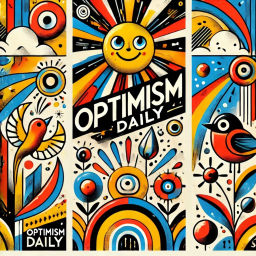
Welcome to Optimism Daily, your go-to podcast for uplifting news and positive stories that brighten your day! Join us as we share inspiring tales, heartwarming moments, and success stories from around the world. Each episode is filled with motivational content designed to bring a smile to your face and a boost to your spirit. Whether you need a dose of daily optimism, are looking to start your day on a positive note, or simply want to be reminded of the good in the world, Optimism Daily is here for you. Tune in and let us help you see the brighter side of life!
- Inspiring Stories: Real-life accounts of perseverance, kindness, and success.
- Positive News: Highlighting the good happening around the globe.
- Motivational Content: Encouraging words and thoughts to keep you motivated.
- Daily Dose of Happiness: Quick, feel-good episodes to start your day right.
Subscribe to Optimism Daily on your favorite podcast platform and join our community dedicated to spreading positivity and joy!
Keywords: uplifting news, positive stories, motivational podcast, inspiring tales, daily optimism, feel-good podcast, heartwarming moments, success stories, positive news podcast, motivational content, daily dose of happiness, inspiring podcast.
This content was created in partnership and with the help of Artificial Intelligence AI.
# Your Brain Is a Bad Accountant: How to Balance Your Mental Books
# The Gratitude Gap: Why Your Brain Needs a Positivity Accountant
Your brain is essentially a medieval chronicler, diligently recording every slight, danger, and disappointment while treating positive experiences like Post-it notes in a windstorm. This "negativity bias" kept your ancestors alive when forgetting which berries were poisonous meant certain death, but in modern life, it mostly means you'll remember the one critical email and forget the nine compliments you received.
Here's the intellectually satisfying part: you can hack this system.
Psychologists have discovered what they call the "gratitude gap"—the space between what happens to us and what we remember happened to us. Our brains are terrible accountants, systematically under-reporting deposits and over-reporting withdrawals. But unlike your actual finances, you can cook these books in your favor, ethically and effectively.
The trick isn't forcing yourself to "think positive" like some sort of cognitive fascist. Instead, try becoming a more accurate historian of your own life. Spend two minutes each evening writing down three specific good things that happened—and here's the crucial part—*why* they happened. "I had a great conversation with my colleague because I asked about their weekend" is infinitely more powerful than "good day."
The "why" component is where the magic lives. It trains your brain to spot patterns of agency and connection rather than random luck. You're not just passively receiving good things; you're participating in their creation. This subtle shift from passenger to co-pilot changes everything.
Neuroscientist Rick Hanson suggests we "take in the good" by dwelling on positive experiences for 10-20 seconds, long enough for them to transfer from short-term to long-term memory. It's like giving your brain's filing clerk explicit instructions: "This one matters. Put it somewhere I'll find it again."
The beautiful paradox? This isn't self-deception—it's self-accuracy. You're not inventing good things; you're correcting for your brain's built-in pessimism filter. You're balancing the books to reflect reality rather than your neural system's apocalyptic assumptions.
Start today. When something good happens—someone holds the door, you solve a tricky problem, you notice the perfect slant of afternoon light—pause. Feel it. Name it. Remember it. You're not being Pollyanna; you're being a scientist correcting for measurement error.
Your brain has spent millions of years perfecting the art of pessimism. Give optimism at least two minutes.
21 Jun 2026
# Optimism Isn't Naive—It's Neuroscience: Rewire Your Brain for Success
# The Optimism Advantage: Why Your Brain Is Wired for Hope
Here's something delightfully counterintuitive: pessimism isn't realism—it's actually a cognitive distortion. While pessimists often pride themselves on seeing the world "as it really is," neuroscience suggests that moderate optimists are actually better calibrated to reality. It's the deeply pessimistic and clinically depressed who see things most accurately, a phenomenon psychologists cheerfully call "depressive realism." So if you're choosing between accuracy and happiness, you might as well choose happiness—you'll be wrong either way, but at least you'll enjoy the ride.
The real magic of optimism lies not in denying difficulties but in how it reshapes what you do with them. Research by psychologist Carol Dweck shows that optimistic people don't experience fewer setbacks; they simply interpret them differently. When an optimist fails, they see a temporary setback caused by specific circumstances. When a pessimist fails, they see permanent evidence of their inadequacy. Same event, radically different story—and that story determines whether you try again or give up.
Consider the concept of "tragic optimism," coined by psychiatrist Viktor Frankl after surviving Nazi concentration camps. This isn't naive positivity; it's the sophisticated belief that meaning can be found even in suffering, that growth can emerge from pain, and that hope remains rational even when circumstances are dire. It's optimism with a PhD in reality.
Here's your practical homework: start collecting what researcher Shawn Achor calls "positive data points." Your brain has a negativity bias—an evolutionary feature that helped your ancestors survive by obsessing over threats. But you're not being chased by predators anymore. You're scrolling through emails and worrying about deadlines. That same brain now needs retraining.
Each evening, write down three specific good things that happened, no matter how small. The neuroscience here is solid: this practice literally rewires your brain's pattern recognition software. After just three weeks, people who do this show increased optimism that lasts for months.
The beautiful paradox? Optimism isn't about ignoring reality—it's about recognizing that reality includes possibility. Every situation contains multiple futures, and your attention helps determine which one you'll inhabit. The pessimist sees only what can go wrong. The optimist sees multiple paths forward. Both are looking at the same reality, but only one is looking at *all* of it.
So choose optimism not because it's naive, but because it's intelligent. Because it's the more complete picture. Because it works.
20 Jun 2026
# Optimism Isn't Naive—It's Mathematically Smart
# The Optimist's Paradox: Why Expecting Good Things Makes You Smarter
Here's something delightfully counterintuitive: optimism isn't about being naive—it's about being mathematically savvy.
Consider this brain teaser. You're facing a hundred doors, behind which lie various outcomes ranging from mediocre to magnificent. A pessimist opens five doors, finds three disappointing results, and concludes the whole hallway is a waste of time. An optimist opens those same five doors and thinks, "Interesting data set—I've got ninety-five more chances, and now I know what *not* to look for."
The pessimist thinks they're being realistic. The optimist is actually being statistical.
Scientists have a term for the optimist's approach: "Bayesian updating." It's how we rationally revise our expectations based on new evidence without throwing out our priors entirely. When you maintain a positive baseline expectation while incorporating negative information appropriately, you're not being foolish—you're being mathematically sophisticated.
But here's where it gets really interesting. Research in cognitive psychology shows that optimistic people aren't necessarily wrong about their predictions more often than pessimists. Instead, they're simply more willing to act despite uncertainty. And action—glorious, sometimes clumsy action—is the only thing that generates new information about what's actually possible.
Think of pessimism as a lossy compression algorithm. It shrinks your reality down to fit past patterns, discarding outliers and anomalies as noise. Optimism is like lossless compression—it maintains faith that those weird, beautiful exceptions to the rule might actually be signals pointing toward something new.
Every morning, you wake up in a universe that has consistently surprised our species. We've split atoms, landed on the moon, and taught computers to dream. We've created music that didn't exist, solved problems that seemed insoluble, and loved people we hadn't yet met. The baseline probability of surprising good fortune in human life is *demonstrably non-zero*.
So here's your intellectual permission slip for optimism: betting on positive outcomes isn't childish—it's probabilistically defensible given humanity's track record.
Tomorrow, when you're tempted toward cynicism, remember you're a consciousness piloting a skeleton wrapped in meat, on a rock hurtling through space, capable of abstract thought and possibly inventing something that doesn't exist yet.
The odds were already impossible. Why not stay open to more impossibilities?
The universe has been surprising us for millennia. It seems almost intellectually lazy to assume it's going to stop now.
Reach and audience
Public platform figures. Ratings count people who left a rating, not total listeners.
Apple Podcasts (US)
1.0 / 5
2 ratings
Spotify
1.0 / 5
1 ratings
Podcast Authority Score: 55 / 100
A composite of feed quality, social presence, YouTube performance and engagement. Read the methodology.
Quality
98
Social presence
0
YouTube
0
Engagement
27
Contact Optimism Daily
Guest appearances
Books guests
Based on episode analysis; this does not confirm that the show is currently accepting guests.
Host of Optimism Daily?
Claim your podcast to manage its listing and keep your show details accurate.
Pod Engine is an independent podcast discovery and analytics service and is not affiliated with or endorsed by this podcast. Artwork and show content belong to their owners. Full legal notice.
Explore this show Podcast research with Pod Engine