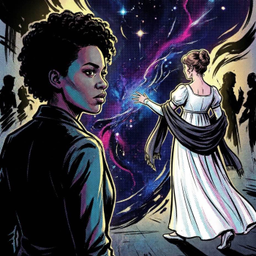
About Outsider Visions: How the Marginalized Imagined Tomorrow
A history of science fiction podcast that centers the voices of those who used the genre to imagine liberation - from Mary Shelley's warning about unchecked power to Octavia Butler's visions of survival, revealing how outsiders have always used sci-fi to challenge the present by reimagining the future.
Hosted on Acast. See acast.com/privacy (https://acast.com/privacy) for more information.
H.G. Wells was the son of a lady's maid and a failed shopkeeper-cricketer, educated on a scholarship, a committed socialist whose views predated and exceeded his later, turbulent membership in the Fabian Society (which he joined in 1903, eight years after The Time Machine was published, and resigned in disgust around 1908). The Time Machine is his class war novel disguised as adventure fiction: travel 800,000 years into the future and find that capitalism has literally split humanity into two species — the beautiful, passive Eloi fed and clothed by the underground Morlocks, who have evolved to eat them. The surface/underground divide maps directly onto Victorian London's class geography. Wells wrote the novel during the founding years of the Independent Labour Party (1893–1895), at the peak of labor agitation. This episode examines how Wells used far-future speculation to make the present's class violence visible, and why his warning connects directly to today's billionaire bunkers and service economy.
SPOILERS! Please note that due to the nature of this podcast, each episode describes a novel in detail, including plot spoilers.
Hosted on Acast. See acast.com/privacy (https://acast.com/privacy) for more information.
29 Sept 2026
Gold Fame Citrus: California's Stolen Water
When Claire Vaye Watkins published Gold Fame Citrus in 2015, California was four years into a historic drought. The novel imagines the endpoint: a southern California fifty years into a drought that never breaks, its reservoirs gone, a growing dune sea called the Amargosa grinding east from Los Angeles toward Las Vegas. Those who stayed are Mojavs — internal climate refugees whose greener neighbors cage in internment camps. At the novel's center is Luz Dunn, a former conservation-campaign poster child with Chicana roots who steals a child named Ig from a bad party and runs east into the dunes, where a charismatic dowser named Levi leads a nomadic colony on promises of hidden water. The cult dynamics echo Watkins's own biography: her father was Paul Watkins, Charles Manson's chief lieutenant, who broke away, testified at the Tate-LaBianca trial, and raised his daughters in Death Valley. The novel's political target is the architecture of Western water — Owens Valley drained for Los Angeles, the 1922 Colorado River Compact built on inflated river-flow numbers, agricultural water priced at a fraction of what cities pay. Watkins refuses survivalist flattery: her characters find no clever exit, no heroic rebuild. The collapse she depicts is already measurable — in fallowed cropland, sinking valley floors, and falling reservoir lines — because it was always the logical end of a state engineered on a lie about how much water exists.
SPOILERS! Please note that due to the nature of this podcast, each episode describes a novel in detail, including plot spoilers.
Hosted on Acast. See acast.com/privacy (https://acast.com/privacy) for more information.
25 Sept 2026
The Drowned World: Ballard's Heat Death of Civilization
J.G. Ballard's The Drowned World (1962) is the founding text of climate fiction. Solar radiation has melted the ice caps; London is a lagoon of steaming water and tropical vegetation; the few remaining humans are retreating toward the poles. But Ballard's protagonist, Dr. Kerans, does not want to escape — he is drawn deeper into the heat and the primordial swamp, experiencing a kind of devolutionary bliss. Ballard was a British writer who spent part of his childhood interned in a Japanese civilian camp in Shanghai, and his fiction is saturated with the experience of civilization's collapse as both horror and liberation. The Drowned World is a deliberately anti-survivalist climate novel: it asks whether the human response to ecological catastrophe might be not resistance but surrender. This episode examines the novel's prophetic geography (the specific flooding of London), its psychological argument about entropy and desire, and its place as the origin point of climate fiction.
SPOILERS! Please note that due to the nature of this podcast, each episode describes a novel in detail, including plot spoilers.
Hosted on Acast. See acast.com/privacy (https://acast.com/privacy) for more information.
Contact Outsider Visions: How the Marginalized Imagined Tomorrow
Guest appearances
Does not typically book guests
Based on episode analysis; this does not confirm that the show is currently accepting guests.
Host of Outsider Visions: How the Marginalized Imagined Tomorrow?
Claim your podcast to manage its listing and keep your show details accurate.
Pod Engine is an independent podcast discovery and analytics service and is not affiliated with or endorsed by this podcast. Artwork and show content belong to their owners. Full legal notice.
Explore this show Podcast research with Pod Engine