- 9
- Episodes
- Monthly
- Cadence
- 2026
- First episode
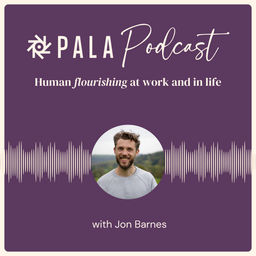
About Pala Podcast
Human flourishing at work and in life
- Publisher
- Jon Barnes
- Category
- business
- Language
- en
- Explicit
- No
- First episode
- 24 Feb 2026
- Latest episode
- 5 Oct 2026
Latest episodes
9 episodes in the feed.
5 Oct 2026
How Self-Managed Teams Are Transforming Social Care with Helen Sanderson
Jon chats here with Helen Sanderson, about her journey into self-management and the creation of wellbeing teams. Helen's experience emphasises the importance of trust, autonomy, and person-centered approaches in health and social care. Helen shares her experiences transitioning from traditional management to self-managed teams, highlighting the challenges and successes of implementing these changes. The conversation explores the challenges and successes of implementing self-management in home care, focusing on the experiences of Helen and her team in navigating inspections, metrics, and the impact of their approach on both staff and clients. It highlights the importance of relational care, community engagement, and the need for systemic change in how care is commissioned and evaluated. The conversation explores innovative approaches to meetings and team dynamics, emphasising the importance of designing interactions that foster relationships and efficiency. We also delve into the significance of confirmation practices in performance management and the impact of volunteering on workplace wellbeing. Takeaways Self-management transforms teams Value-based recruitment is essential Self-management enhances care quality Systemic change needed for sustainability Transforming meetings enhances relationships Volunteering significantly boosts wellbeing Chapters 00:00 Introduction to Helen's Journey 03:07 The Shift to Self-Management 06:04 Creating Wellbeing Teams 09:01 Recruitment Revolution: Values First 12:14 Learning from Burt's Org Model 14:55 Challenges in Home Care Industry 18:11 Building Relationships in Care 21:05 Growth and Expansion of Wellbeing Teams 24:13 Revolutionizing Home Care Practices 27:00 Achievements and Recognition 29:50 Facing the CQC Inspection Challenge 32:30 Success Metrics and Wellbeing Teams 34:50 Expanding the Self-Management Model 37:38 Financial Challenges in Home Care 40:47 The Need for Holistic Healthcare Approaches 43:40 Creating Meaningful Connections in Care 48:56 Current State of Wellbeing Teams 51:00 Balancing Structure and Relationships in Teams 57:13 Transforming Meetings for Better Engagement 57:29 Cultural Dynamics in Meetings 58:57 The Cost of Meetings and Value Creation 01:00:59 Team Agreements and Governance Structures 01:01:55 Policies, Procedures, and Playbooks 01:06:02 Confirmation Practices in Performance Management 01:12:34 The Role of Volunteering in Wellbeing
8 Sept 2026
Unpacking the Psychology and Paradoxes of Self-Management with Lisa Gill
In this podcast episode, Lisa Gill (https://www.linkedin.com/in/lisa-gill-23815a4/)discusses her journey into self-management, the state of the self-management movement, and the importance of engineering and psychology in self-management. The conversation explores the fluctuations in the self-management movement over the past 10 years and emphasises the significance of inner work and relational dynamics in self-management. The conversation delves into the psychological challenges of self-management and the pendulum swing in organisational transformation. We explore the need to address the psychology of individuals in self-management and the potential pitfalls of swinging too far in the opposite direction during organisational transformation. We also delve into the complexity of self-management, the paradox it presents, and the cultural considerations that impact its implementation. Exploring the fear of colonising and the importance of cultural sensitivity in the context of self-management. Additionally, we discuss the dynamics of individual vs. collective accountability, the reimagining of accountability, and effective routes to self-management transformation. Takeaways Self-management movement has seen fluctuations over the past 10 years The importance of inner work and relational dynamics in self-management Psychological challenges in self-management The pendulum of doom in organisational transformation Self-management is not a quick fix Different cultures have different starting points for self-management Chapters 00:00 Introduction to Lisa Gill and Self-Management 05:50 Lisa Gill's Journey into Self-Management 14:10 The State of Self-Management Movement 28:02 Engineering vs. Psychology in Self-Management 30:47 Psychological Challenges in Self-Management 41:17 The Pendulum of Doom in Organisational Transformation 55:56 The Complexity of Self-Management 57:21 The Paradox of Self-Management 58:25 Cultural Considerations in Self-Management 01:01:09 Fear of Colonising and Cultural Sensitivity 01:04:29 Individual vs. Collective Accountability 01:09:27 Reimagining Accountability 01:17:19 Effective Routes to Self-Management Transformation
20 Aug 2026
Self-management & Leadership Buffets with Matthias Hoffman
In this episode of the Pala Podcast Matthias Hoffmann (https://www.linkedin.com/in/matthesho/?locale=en), founder of Grubengold (https://grubengold.io/), discusses the vision for transformation and innovation, the transition to self-management, challenges and trade-offs, the leadership buffet, roles, and decision-making within the organisation. The conversation provides insights into the unique approach of Grubengold and the complexities of self-management in a consultancy setting. The conversation delves into the intricacies of organizational decision-making, the tension between hierarchy and self-management, the role of leadership and self-reflection, the use of board game design as a metaphor for organizational structure, and the trade-offs of self-management. Takeaways Self-management challenges and trade-offs Leadership buffet and autonomy Organisational decision-making involves multiple layers of discussion and governance, leading to a complex process. The tension between hierarchy and self-management requires self-awareness, coaching, and a shift in default decision-making processes. Chapters 00:00 Introduction to Grubengold 02:59 The Vision for Transformation and Innovation 05:48 Transition to Self-Management 08:23 Challenges and Trade-Offs of Self-Management 11:33 Leadership Buffet and Autonomy 26:49 Roles and Decision-Making 29:35 Organizational Decision Making 31:26 Defaulting to Hierarchy vs. Self-Management 37:16 Leadership and Self-Reflection 42:14 Board Game Design as a Metaphor for Organizational Structure 52:14 Trade-Offs of Self-Management
6 Jul 2026
The 4 Day Week with Dr Charlotte Rae
Dr. Charlotte Rae discusses her research on the four-day working week (https://sussex4dayweek.co.uk/) and its impact on mental health and brain activity. The study methodology, objective measures, and findings related to the default mode network and creativity are explored in detail. The importance of balancing default mode network activity and the impact of time use on mental health are also highlighted. The conversation explores the impact of a four-day workweek on mental health, productivity, and sleep quality. It delves into the analysis of inflammatory markers, stress, and the interconnectedness of mind, brain, and body. The challenges and downsides of a four-day week are discussed, along with practical advice for implementing it. Time management techniques and boundaries are highlighted, and the project website for participation is shared. Takeaways The four-day working week has a significant impact on mental health and brain activity. Balancing default mode network activity is crucial for creativity and mental well-being. Impact of a four-day workweek on mental health and burnout Practical advice for implementing a four-day week Chapters 00:00 Introduction and Background 05:38 Trial Phase and Data Measurement 12:13 The Default Mode Network and Creativity 18:03 Balancing Default Mode Network Activity 25:06 Time Use and Restorative Activities 30:35 Inflammatory Markers and Stress 36:15 Productivity Measurement and Goal Attainment 43:32 Advice for Implementing a Four-Day Week 53:00 Project Website and Participation
15 Jun 2026
Conflict Intelligence with Beccie D'Cunha
Welcome to our conversation with Beccie D'Cunha. In this episode we cover: • Beccie's journey from social justice campaigning to founding Courage Lab • Her experience in the Middle East • The importance of conflict intelligence • The importance of psychological safety in organisations • How we can normalise conflict • The value of humility • Learning to argue in public The conversation explores the dynamics of conflict resolution, emotional expression, leadership in team settings and delves into the importance of empowerment, understanding emotions, and creating conditions for open dialogue. Beccie shares her insights in regards to the role of leaders in coaching and supporting teams through conflict and change, highlighting the transformative impact of emotional expression and conflict resolution on team dynamics and organizational culture. You can find out more about Courage Lab at: https://www.couragelab.co/ (https://www.couragelab.co/) And you can follow Beccie on Linkedin here: https://www.linkedin.com/in/becciedcunha/ (https://www.linkedin.com/in/becciedcunha/) Enjoy 🙏 Chapters 00:00 Introduction and Background 05:39 Experience in the Middle East 13:17 Conflict Intelligence and Psychological Safety 20:34 Creating a Culture of Open-Heartedness 29:40 Learning to Argue in Public 43:57 Empowerment and Supportive Roles 49:29 Moving Towards Problem-Solving 55:05 Mining for Conflict and Emotional Expression 01:00:43 Exploring Best and Worst Case Scenarios 01:07:12 Normalizing Emotional Expression 01:12:43 Conflict as a Signal for Change
30 Apr 2026
Polymorphic Organisations with Perry Timms
In this conversation, Perry Timms discusses the concept of a Polymorphic Organization, emphasizing adaptability, fluidity, and the role of hierarchy as stewardship. The discussion covers: • the role of a Polymorphic Organisation and its malleability • organizational oscillation • the phases of expansion and consolidation • detaching from dogmas • and the role of hierarchy and taxonomies in organizations The conversation delves into the concepts of servant leadership, polymorphic thinking, and organizational change. It explores the importance of aligning leadership with the mission, the role of self-management and democratic principles, the significance of meaning-making and organizational purpose, and the practical application of the flywheel approach to change. Chapters 00:00 Hierarchy and Taxonomies in Organizations 27:15 Servant Leadership and the Mission 34:42 Self-Management and Democratic Principles 41:31 Meaning-Making and Organizational Purpose 47:24 The Flywheel Approach to Change
14 Apr 2026
Intrinsic Education with Emmett Fitzgerald
Hello there 👋 Emmett Fitzgerald shares his journey from traditional education to humanitarian work and alternative education, highlighting the impact of autonomy, mastery, and purpose in his career decisions. Emmett shares his journey from working in humanitarian response to becoming an economics guide at a Montessori school, emphasizing the importance of empathy, critical thinking, and independent learning. The conversation delves into the importance of media literacy and critical thinking, the role of facilitation in education, and the constructivist approach to learning. It also explores the concept of autonomy in the workplace and the significance of community and collaboration in a learning environment. Takeaways Autonomy, mastery, and purpose play a significant role in career decisions. Transition from traditional education to humanitarian work and alternative education. Empathy and critical thinking are essential skills for young people to develop. The Montessori approach to education focuses on independent learning and social responsibility. Media literacy and critical thinking are essential skills for navigating and understanding the news media. Facilitation in education involves creating an environment that fosters autonomy, collaboration, and self-discovery. To find out more about Emmett's work, visit https://www.newsroom.me.uk/ (https://www.newsroom.me.uk/) If you want to find out more about how to set your teams free, visit https://teampala.co.uk (https://teampala.co.uk) Enjoy 🙏 Chapters 00:00 Exploring Alternative Education and Pedagogy 13:02 Finding Purpose and Transitioning to Humanitarian Work 22:46 Experience in Humanitarian Work and Mastery 29:24 Journey from Humanitarian Response to Education 40:23 Transition to Montessori Education 57:05 Relational Skills and Cognitive Skills 01:03:01 Facilitation in Education and Autonomy 01:17:48 Autonomy in the Workplace and Community in Learning Environment
27 Feb 2026
Introducing the Pala Podcast
Hello everybody 👋 Welcome to the Pala Podcast. I'm your host Jon Barnes, co-founder of Pala, and I want to introduce you to what we're trying to do here. We help teams and organisations becoming self-managing and in this podcast we'll be exploring this by speaking to people from diverse fields. The podcast will help people to learn about self-management and but more broadly it will explore human flourishing in work and life with a balance between work-related and tangential topics, inviting guest speakers to share diverse perspectives and inspire new ways of thinking. We hope you enjoy it and if you have any ideas for amazing speakers from the world of self-management or more broadly from related fields such as decentralised economics, child-led education, psychology, philosophy or more, please get in touch on Linkedin: https://www.linkedin.com/in/jonbarnesdotme/ (https://www.linkedin.com/in/jonbarnesdotme/) Take care, Team Pala
24 Feb 2026
Kindfulness with Graham Allcott
In this episode we speak to Graham Allcott the author of award winning book "Kind: The Quiet Power Of Kindness At Work". The conversation delves into the importance of kindness at work, the shift from productivity to kindness, the value of 'kindfulness' in the workplace, the role of psychological safety in team success, and the distinction between safety and comfort in fostering growth and innovation. The conversation explores the concept of kindness and its application in various contexts. It delves into the principles of kindness, the impact of scarcity mindset, personal experiences, and the role of curiosity and humility in addressing polarization. The importance of slowing down and the challenges of kindness in the face of disagreement are also discussed. As Graham says, you can buy 'Kind' in "all good book stores, and in the bad one". If you want to know more here's a link: https://www.grahamallcott.com/orderkind (https://www.grahamallcott.com/orderkind) And if you want to find out more about Pala, visit: https://teampala.co.uk (https://teampala.co.uk) Finally, if you have any guests you'd like to introduce us to, get in touch on linkedin: https://www.linkedin.com/in/jonbarnesdotme/ (https://www.linkedin.com/in/jonbarnesdotme/) Speak soon, Jon 👍 Takeaways Psychological safety is crucial for team success The distinction between safety and comfort is important in fostering growth and innovation Kindness starts with you Slowing down is essential for kindness Curiosity and humility are key to addressing polarization Chapters 00:00 Safety vs. Comfort in the Workplace 40:38 The Principle of Kindfulness 46:33 The Value of Receiving and Giving 54:16 The Impact of Rushing on Kindness 01:01:27 Kindness with Disagreement
Contact Pala Podcast
- Guest appearances
- Books guests
Based on episode analysis; this does not confirm that the show is currently accepting guests.
Host of Pala Podcast?
Claim your podcast to manage its listing and keep your show details accurate.
Pod Engine is an independent podcast discovery and analytics service and is not affiliated with or endorsed by this podcast. Artwork and show content belong to their owners. Full legal notice.
Explore this show
Podcast research with Pod Engine