- 18
- Episodes
- Weekly
- Cadence
- 2026
- First episode
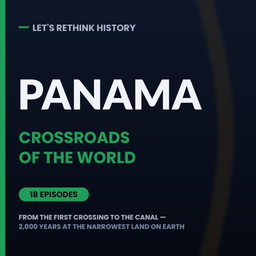
About Panama: Crossroads of the World
The complete history of the Isthmus of Panama in 18 episodes — from the indigenous nations who first mapped the crossing, through Spanish silver, pirate raids, the Gold Rush railroad, the French catastrophe and the American canal, the long fight over the Canal Zone, the Noriega years and the 1989 invasion, the 1999 handover, and Panama today. Narrated by AI voices from sourced, human-reviewed research.
- Publisher
- Nick Mackenzie
- Category
- education
- Language
- en
- Explicit
- No
- First episode
- 11 Jun 2026
- Latest episode
- 11 Jun 2026
Latest episodes
18 episodes in the feed.
11 Jun 2026
Panama Today: The Crossroads of the World, Contested Again
A century after the canal opened, who is Panama — and can it stay sovereign at the center of everyone else's ambitions? In this series finale, we take the measure of modern Panama: a glittering logistics-and-banking powerhouse, and a country wrestling with a tarnished name, a water crisis, and a new tug-of-war between Washington and Beijing. Episode 18 of Crossroads of the World (current as of mid-2026) covers the modern identity built on the canal and the Colón Free Zone; the 2016 Panama Papers and the surprising 2024 acquittal of the Mossack Fonseca defendants; the U.S. port-dredging boom the expansion triggered; and — handled even-handedly — the 2025–26 flashpoint over the canal's ports, as President Trump warned of Chinese control, CK Hutchison was pushed toward a BlackRock-led sale, and Panama's Supreme Court voided the concessions. We face the deepest modern threat — fresh water and drought — and the people on the front lines: the Guna, Emberá, and Ngäbe-Buglé, the climate relocation of Gardi Sugdub, and the fight over the Cobre Panamá mine. Then we synthesize the whole five-century journey and close on the question the series has circled from the start: what does it cost a small country to own the crossroads of the world?
11 Jun 2026
The Mega-Expansion: How Panama Bet $5 Billion on Its Canal — and Won
By the 2000s the canal Panama had fought a century to reclaim faced obsolescence — the world's giant ships no longer fit. So a country of four million made an audacious bet: it put a $5.25 billion plan to widen the canal to its own people in a referendum, and they said yes. How did Panama dig a third set of locks the size of a new canal — and reshape global trade doing it? Episode 17 of Crossroads of the World centers Alberto Alemán Zubieta, the engineer who ran the canal from 1996 to 2012 (and, by a quiet coincidence of this series, the narrator's classmate at the school the 1964 riots forced him to leave). We trace how he turned a break-even American utility into a business pouring billions into Panama's treasury; the 2006 referendum (78% yes); the nine-year build with its Italian-made rolling gates and water-recycling basins — and its bruising cost-overrun fight that briefly halted work in 2014; and the June 2016 opening, led by the COSCO Shipping Panama, that tripled capacity and sent U.S. ports scrambling to dredge. We end honestly, on the shadow over the triumph: the fresh water the canal drinks, and the droughts now threatening it.
11 Jun 2026
The Turnover: The Day Panama Took Back Its Canal — and Proved the World Wrong
For most of a century the United States ran a strip of Panama as if it owned it — and as the handover deadline neared, plenty of people in Washington were sure Panama would wreck the canal the day it got the keys. They were wrong. How did Panama rebuild from invasion, abolish its army, and take back the canal everyone said it couldn't run? Episode 16 of Crossroads of the World is the emotional summit of the series: the 1990s rebuilding under Endara, the 1994 constitutional abolition of the military (making Panama, like Costa Rica, a nation with no army), the creation of the autonomous Panama Canal Authority in 1997, and the training that put Panamanians in over 90% of the jobs. Then the day itself — and we get the dates right: the grand ceremony with Jimmy Carter and President Mireya Moscoso on December 14, 1999, and the quiet legal transfer at noon on December 31, ninety-six years after the 1903 treaty. We note the bittersweet detail that President Clinton stayed away, and that Moscoso was the widow of the president overthrown in 1968. The payoff: the Canal Zone vanished, Panama was whole again, and the canal ran flawlessly and profitably under Panamanian hands.
11 Jun 2026
Operation Just Cause: The 1989 U.S. Invasion of Panama — Rescue, Reckoning, and a Contested Death Toll
Just after midnight on December 20, 1989, 27,000 American troops fell on Panama in the largest U.S. combat operation since Vietnam — to capture one man, Manuel Noriega. Was it the rescue of a democracy from a tyrant, or a superpower invading a small nation it had controlled for a century? And how many Panamanians died? Episode 15 of Crossroads of the World is a measured account of Operation Just Cause: the 1988 indictments and sanctions, the failed Giroldi coup, the Dignity Battalions and the beating of Billy Ford, Noriega's "state of war" and the killing of Marine Lt. Robert Paz. We tell the rescue of American hostage Kurt Muse — a pirate-radio operator (and the narrator's Balboa High classmate) pulled off a prison roof by Delta Force in six minutes — and the fire that consumed the packed neighborhood of El Chorrillo, "Little Hiroshima." Above all we're honest about the dead: 23 Americans, a U.S. official count near 500 Panamanians, Physicians for Human Rights finding most were civilians, and the Ramsey Clark commission estimating over 3,000 — a number no one can verify, and that's part of the story. It ends with the surreal rock-music siege of the Vatican embassy, Noriega's surrender, and a hard question left open.
11 Jun 2026
The Rise of Noriega: How the CIA's Man in Panama Became America's Most Wanted Dictator
When Omar Torrijos died in a 1981 plane crash, the man who emerged from the shadows wasn't a charismatic leader — it was his spymaster, Manuel Noriega, a paid CIA asset who knew everyone's secrets. How did America's indispensable man in Panama become its most wanted dictator? Episode 14 of Crossroads of the World tells the Cold War noir of Noriega's rise (1981–1987): the bargain that made him, as Reagan traded Carter's human rights for anti-communist "secret wars" and Noriega helped the Contras with one hand while banking Medellín cartel cocaine money with the other; and the mask slipping — the 1985 torture-murder of his critic Dr. Hugo Spadafora, the spotlight of the Iran-Contra scandal, and the 1987 betrayal by his deputy Roberto Díaz Herrera that put 100,000 Panamanians in the streets. It ends with U.S. aid suspended and a 1988 drug indictment, the collision course toward 1989. We keep the Iran Hostage Crisis and Iran-Contra distinct, and correct a common error about the "Dignity Battalions."
11 Jun 2026
Torrijos and the New Treaties: How a General Talked America Into Giving the Canal Back
In 1968 a coup swept away Panama's old oligarchy, and a cigar-chewing general named Omar Torrijos turned the country's oldest grievance — the American Zone slicing through its heart — into a global crusade. How did a small country, unable to match U.S. firepower, talk a U.S. president into giving the canal back? Episode 13 of Crossroads of the World follows the Torrijos era (1968–1981): the populist reforms that built him a devoted base, the diplomacy and guerrilla-war bluff that cornered Washington, and the 1977 Torrijos–Carter Treaties that abolished the Canal Zone and set a hard handover date — December 31, 1999 — ratified by a razor-thin 68–32 Senate vote with the bitterly resented DeConcini reservation. We present the series' argument — that Carter's moral realism averted a war and was a historical anomaly — as a viewpoint, with a fair counterpoint, and we're honest about the other Torrijos: the dictator who shut the legislature, muzzled the press, and whose regime disappeared the priest Héctor Gallego and killed student leader Floyd Britton. It ends on the mystery of his 1981 death and the vacuum it left.
11 Jun 2026
Martyrs' Day 1964: How a Flag at a High School Doomed the Panama Canal Zone — An Eyewitness Account
On January 9, 1964, a dispute over which flag could fly outside a Canal Zone high school set off three days of rioting that left about two dozen Panamanians and four American soldiers dead, drove Panama to break relations with the United States, and renamed the border street the Avenue of the Martyrs. How did a flag become the day the Canal Zone was doomed? Episode 12 of Crossroads of the World — a measured, documentary episode — tells it through the record and through a rare firsthand account: a teenager living in the Zone, schooled in Panama City (where the textbooks called the U.S. "the powerful nation to the north"), who walked down to the border with his WWII-veteran father as U.S. troops fixed bayonets, then climbed Ancon Hill as the gunfire began. We keep the Panamanian martyrs — beginning with 19-year-old Ascanio Arosemena — at the center, and we're explicit that the death toll and who-fired-first remain disputed between U.S. and Panamanian accounts. This was the day the United States first accepted it would have to give the canal back — the road to the 1977 treaties.
11 Jun 2026
Sovereignty and the Canal Zone: A Country Cut in Two, and the U-Boats Off Colón
For half a century, a ten-mile-wide strip of the United States ran straight through the middle of Panama. Inside the Canal Zone, Americans built an orderly, green world they loved; outside it, Panamanians lived as outsiders in their own country. What does it do to a nation to have a piece of another country running through its center? Episode 11 of Crossroads of the World holds two truths at once — Zonian nostalgia and Panamanian grievance — across the years 1914 to the 1950s: the Zone that bisected the republic, the 1936 Hull–Alfaro Treaty that began to loosen the American grip (and the Senate that stalled it until 1939), and World War II, when the canal became the most important strategic asset in the hemisphere. We bring the war home with the threat that was very real: German U-boats sinking ships within sight of the Caribbean coast, Japan's giant I-400 submarines built to bomb the Gatún Locks, and a remembered account from the maternity ward of the Coco Solo Naval Hospital, where a woman heard the explosions and saw the smoke as ships went down beyond the breakwaters of Colón. We end on a nationalism the war did not satisfy — building toward 1964.
11 Jun 2026
The Big Ditch Opens: The Panama Canal, World War I, and the "Gold vs. Silver" Color Line
On August 15, 1914, the SS Ancon made the first official transit of the Panama Canal — and the world barely noticed, because Europe had just gone to war. Behind the engineering marvel was something uglier: a segregation system the U.S. government built into the Canal Zone from the first shovel. How did the "Gold Roll" and "Silver Roll" turn a payroll into Jim Crow on foreign soil? Episode 10 of Crossroads of the World centers the Black West Indian workers — roughly 150,000, mostly Jamaican and Barbadian — who actually dug the canal. We lay out the Gold/Silver caste system plainly: gold dollars, screened houses, and good hospitals for white Americans; poverty wages, crowded barracks, the deadliest work, and segregated fountains, schools, and graves for the "Silver" majority. We use the workers' own documented words from the 1963 firsthand accounts (Constantine Parkinson, Albert Banister), explain how the locks lifted the Ancon 85 feet over the mountains, and reckon with a death toll that fell overwhelmingly on the people the system was designed to erase. It was Jim Crow exported — and it lasted until the 1960s.
11 Jun 2026
Conquering the Jungle: How a Doctor Nobody Believed Won the Panama Canal
The French were destroyed by Panama's jungle. The Americans, from 1904, beat it in ten years. But the victory remembered as a triumph of engineering was first a triumph of medicine — and the doctor who won it was nearly fired for it. What actually beat the jungle that beat the French? Episode 9 of Crossroads of the World tells the construction story with an honest correction at its center: Dr. William Gorgas's war on the mosquitoes that carried yellow fever and malaria (and how his own bosses tried to remove him before Roosevelt backed him); John Stevens, the railroad man who stopped digging for nearly a year to build the infrastructure first, then talked a wavering Roosevelt out of de Lesseps's deadly sea-level dream and into a lock-and-lake canal; and Colonel George Goethals, who finished it in concrete. We're honest that the sanitation was racially unequal, and we include a dramatized scene of the Stevens–Roosevelt lock decision. The real lesson: the jungle was beaten by understanding it, not just brute force.
11 Jun 2026
The Plot to Carve a Nation: How the U.S. Manufactured Panama in 1903 — and the Treaty No Panamanian Signed
By 1903 Theodore Roosevelt wanted a canal across Panama — and Colombia, which owned Panama, had just refused to sell him the right. So a revolution was arranged. How did a French engineer, a $100,000 check, and a U.S. warship create a brand-new country in three days, and a treaty no Panamanian ever negotiated? Episode 8 of Crossroads of the World — the hinge of the series — follows the 1903 plot: Colombia's rejection of the Hay–Herrán Treaty, Philippe Bunau-Varilla's Waldorf-Astoria deal with Manuel Amador, the USS Nashville blocking Colombian troops, and the Hay–Bunau-Varilla Treaty signed two hours before the Panamanian delegation arrived — handing the U.S. a ten-mile Canal Zone "in perpetuity." We present the real debate fairly: Panama had a genuine century-old separatist streak, but its 1903 success depended on American power and was midwifed for a Frenchman's profit. We end on the long resentment that "in perpetuity" would breed — and Senator Hayakawa's later quip that America "stole it fair and square."
11 Jun 2026
De Lesseps and the French Fiasco: How the Hero of Suez Buried 22,000 People and Ruined 800,000 Investors
Ferdinand de Lesseps had cut the Suez Canal and become the most celebrated engineer-promoter on Earth. So when he turned to Panama in 1880, he was certain the jungle would yield like the desert. It did not. How did the hero of Suez lead 22,000 people to their deaths and 800,000 ordinary investors to ruin? Episode 7 of Crossroads of the World is a measured account of a triple catastrophe: de Lesseps's hubris in insisting on a sea-level canal against every warning; the medical disaster of an age that blamed "bad air" for yellow fever and malaria — so that French hospitals, with bed-legs standing in pans of water, bred the very mosquitoes that killed the patients; and the financial collapse of 1889 that wiped out 800,000 small investors and exploded into the Panama Scandal, with bribed legislators, a bought press, the prosecution of de Lesseps and Gustave Eiffel, and an ugly antisemitic backlash that foreshadowed the Dreyfus era. The disease would only be beaten a generation later — by the Americans and Dr. Gorgas.
11 Jun 2026
The Gold Rush Express: How Panama Became the Deadliest Shortcut in America — and a Blueprint for Segregation
Gold was found in California in 1848, and suddenly the fastest way across America ran through fifty miles of Panamanian jungle. How did a gold rush a continent away turn Panama into the deadliest engineering project of the 19th century — and lay the blueprint for the Canal Zone's segregation? Episode 6 of Crossroads of the World follows the "Argonauts" across the isthmus, the building of the Panama Railroad (1850–1855) — the first to link the oceans — and its staggering, uncounted human cost. We handle the toll carefully: the "a dead man for every railroad tie" story is a myth (there were 74,000 ties), but the real death toll ran into the thousands, with non-white workers barely counted. We tell the true tragedy of the Chinese laborers at Matachín (and correct the folklore about the name), the documented trade in pickled corpses, the racial hierarchy that became the "Gold Roll vs. Silver Roll," and the 1856 Watermelon Riot — a stolen slice of melon that triggered the first U.S. military landing in Panama.
11 Jun 2026
Independence and Bolívar's Dream: How Panama Freed Itself from Spain Without a Shot — and Was Left to Rot
In 1821 the most strategic strip of land on Earth severed itself from a dying Spanish Empire without firing a shot — its merchants simply paid the royalist garrison to sail home. Free and defenseless, Panama joined Simón Bolívar's grand new Republic of Gran Colombia. Bolívar himself had called the isthmus "the emporium of the world." So why did the next eighty years leave it neglected, taxed, and ignored? Episode 5 of Crossroads of the World traces the paradox of Panama's independence: the bloodless 1821 separation, Bolívar's soaring vision in the 1815 Jamaica Letter, the failed 1826 Congress of Panama, and the grim reality of rule from cold, faraway Bogotá — drained customs revenue, rotting trade roads, and economic depression. When Gran Colombia collapsed in 1830, Panama tried twice to break free (Espinar in 1830, the brutal Alzuru in 1831) and was dragged back both times, beginning an unhappy union with Colombia that would last until 1903.
11 Jun 2026
Pirates, Plunder, and the Scottish Fiasco: How Panama Burned a City and Broke a Kingdom
Twice in thirty years, the Isthmus of Panama destroyed those who reached for it. In 1671 the buccaneer Henry Morgan marched a starving army across the jungle and burned Panama City to ash. A generation later, Scotland bet a fifth of its entire wealth on a colony in the Darién — and roughly two thousand settlers died of fever. How did a pirate and an investment scheme both break themselves against this thin strip of land, and reshape two empires doing it? Episode 4 of Crossroads of the World is a measured account of two catastrophes: Morgan's sack of Panamá Viejo (and the still-disputed question of who set the fire, and whether he knew a peace treaty had just been signed), the rebuilding behind the walls of Casco Viejo, the slow death of the Portobelo silver fairs, and the Darien Scheme of 1698–1700 — Scotland's doomed "New Caledonia," whose collapse helped push the nation into the 1707 Act of Union that created Great Britain. Death tolls and capital figures are presented as the contested estimates they are.
11 Jun 2026
The City of Gold and Blood: How One Jungle Mule Trail Bankrolled the Spanish Empire
For 150 years, the silver that made Spain the richest power on Earth crossed a single fifty-mile neck of Panama jungle — carried on the backs of mules and enslaved men. How did one trail between the oceans become the logistical heart of an empire, and what did it cost the people forced to build and carry it? Episode 3 of Crossroads of the World is a measured look at the machine: Panama City and the fairs of Nombre de Dios and later Portobelo (founded 1597), the Camino Real and Camino de Cruces, and the torrent of Potosí silver. We say it plainly — this economy ran on the forced labor of enslaved Africans after disease destroyed the indigenous population — and we give full weight to those who resisted: King Bayano and the cimarrón communities, and their alliance with the English privateer Francis Drake, whose 1573 mule-train ambush exposed Panama as the empire's Achilles' heel. Silver figures are presented as contested estimates, since smuggling makes the true totals uncertain.
11 Jun 2026
Balboa and the Pacific: How a Stowaway Conquistador Redrew the Map of the World (1513)
In 1510 a bankrupt adventurer escaped his creditors hidden aboard a ship — and three years later he stood on a mountain in Panama and became the first European to see the Pacific Ocean. How did Vasco Núñez de Balboa's single glimpse of a "South Sea" prove the Americas were a new continent, not the edge of Asia? Episode 2 of Crossroads of the World runs on the toxic rivalry between Balboa — the rough, pragmatic survivor — and Pedrarias Dávila, the paranoid aristocrat known as the "Wrath of God" who was sent to replace him and ultimately had him beheaded in 1519. We trace Bastidas's first maps, Columbus's failed last voyage, the founding of the first lasting European town on the American mainland, and the brutal 1513 crossing to the Pacific. We don't romanticize it: Balboa was a conquistador who massacred indigenous people, including the war-dog killings at Quarequá, and we flag that our sources — the chroniclers Oviedo and Anghiera — had their own agendas. Plus the famous Keats line that names the wrong conquistador.
11 Jun 2026
The Land Before the Cross: Panama Before Columbus — The Bridge That Changed the World
Three million years ago a strip of jungle rose from the sea, rerouted the planet's oceans, and became both a bridge and a wall between two continents. Who lived on the Isthmus of Panama before Europe ever saw it — and why was this the most strategic land on Earth long before the canal? Episode 1 of Crossroads of the World opens with the land itself: the contested geological birth of the isthmus, the "biological firewall" that let some animals cross (the camels that became llamas) while stopping others — and that kept yellow fever and malaria out of the Americas until ships brought them after 1492. Then the people: the Cueva, annihilated within decades of contact; the Guna with their island democracy and mola textiles; and the Ngäbe-Buglé, who used the mountains as a fortress. Their gold and Colombian emeralds prove Panama was a trade crossroads two thousand years before the canal. We flag what scientists still debate — the exact closure date and the Gulf Stream link — and correct some popular myths along the way.
Contact Panama: Crossroads of the World
- Guest appearances
- Does not typically book guests
Based on episode analysis; this does not confirm that the show is currently accepting guests.
Host of Panama: Crossroads of the World?
Claim your podcast to manage its listing and keep your show details accurate.
Pod Engine is an independent podcast discovery and analytics service and is not affiliated with or endorsed by this podcast. Artwork and show content belong to their owners. Full legal notice.
Explore this show
Podcast research with Pod Engine