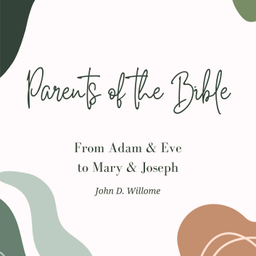
Parents of the Bible Podcast
From Adam & Eve to Mary & Joseph
5.0from 1 ratings
- 82
- Episodes
- 1
- Ratings
- Weekly
- Cadence
- 2024
- First episode
About Parents of the Bible Podcast
Parents of the Bible: From Adam & Eve to Mary & Joseph is a series of prayer journals focused on biblical characters as parents. If you are a parent looking for encouragement, this series might be for you. parentsofthebible.substack.com (https://parentsofthebible.substack.com?utm_medium=podcast)
- Publisher
- From Adam & Eve to Mary & Joseph
- Category
- kids & family · religion & spirituality
- Language
- en
- Explicit
- No
- First episode
- 2 Dec 2024
- Latest episode
- 24 Jan 2026
Latest episodes
82 episodes in the feed.
24 Jan 2026
Hagar
Genesis 16:1-16 (https://www.biblegateway.com/passage/?search=genesis%2016&version=NLT) (New Living Translation) 16 Now Sarai, Abram’s wife, had not been able to bear children for him. But she had an Egyptian servant named Hagar. 2 So Sarai said to Abram, “The Lord has prevented me from having children. Go and sleep with my servant. Perhaps I can have children through her.” And Abram agreed with Sarai’s proposal. 3 So Sarai, Abram’s wife, took Hagar the Egyptian servant and gave her to Abram as a wife. (This happened ten years after Abram had settled in the land of Canaan.) 4 So Abram had sexual relations with Hagar, and she became pregnant. But when Hagar knew she was pregnant, she began to treat her mistress, Sarai, with contempt. 5 Then Sarai said to Abram, “This is all your fault! I put my servant into your arms, but now that she’s pregnant she treats me with contempt. The Lord will show who’s wrong—you or me!” 6 Abram replied, “Look, she is your servant, so deal with her as you see fit.” Then Sarai treated Hagar so harshly that she finally ran away. 7 The angel of the Lord found Hagar beside a spring of water in the wilderness, along the road to Shur. 8 The angel said to her, “Hagar, Sarai’s servant, where have you come from, and where are you going?” “I’m running away from my mistress, Sarai,” she replied. 9 The angel of the Lord said to her, “Return to your mistress, and submit to her authority.” 10 Then he added, “I will give you more descendants than you can count.” 11 And the angel also said, “You are now pregnant and will give birth to a son. You are to name him Ishmael (which means ‘God hears’), for the Lord has heard your cry of distress. 12 This son of yours will be a wild man, as untamed as a wild donkey! He will raise his fist against everyone, and everyone will be against him. Yes, he will live in open hostility against all his relatives.” 13 Thereafter, Hagar used another name to refer to the Lord, who had spoken to her. She said, “You are the God who sees me.” She also said, “Have I truly seen the One who sees me?” 14 So that well was named Beer-lahai-roi (which means “well of the Living One who sees me”). It can still be found between Kadesh and Bered. 15 So Hagar gave Abram a son, and Abram named him Ishmael. 16 Abram was eighty-six years old when Ishmael was born. Genesis 17:18-27 (https://www.biblegateway.com/passage/?search=Genesis%2017&version=NLT) (New Living Translation) 18 So Abraham said to God, “May Ishmael live under your special blessing!” 19 But God replied, “No—Sarah, your wife, will give birth to a son for you. You will name him Isaac, and I will confirm my covenant with him and his descendants as an everlasting covenant. 20 As for Ishmael, I will bless him also, just as you have asked. I will make him extremely fruitful and multiply his descendants. He will become the father of twelve princes, and I will make him a great nation. 21 But my covenant will be confirmed with Isaac, who will be born to you and Sarah about this time next year.” 22 When God had finished speaking, he left Abraham. 23 On that very day Abraham took his son, Ishmael, and every male in his household, including those born there and those he had bought. Then he circumcised them, cutting off their foreskins, just as God had told him. 24 Abraham was ninety-nine years old when he was circumcised, 25 and Ishmael, his son, was thirteen. 26 Both Abraham and his son, Ishmael, were circumcised on that same day, 27 along with all the other men and boys of the household, whether they were born there or bought as servants. All were circumcised with him. Genesis 21:8-21 (https://www.biblegateway.com/passage/?search=Genesis%2021&version=NLT) (New Living Translation) 8 When Isaac grew up and was about to be weaned, Abraham prepared a huge feast to celebrate the occasion. 9 But Sarah saw Ishmael—the son of Abraham and her Egyptian servant Hagar—making fun of her son, Isaac. 10 So she turned to Abraham and demanded, “Get rid of that slave woman and her son. He is not going to share the inheritance with my son, Isaac. I won’t have it!” 11 This upset Abraham very much because Ishmael was his son. 12 But God told Abraham, “Do not be upset over the boy and your servant. Do whatever Sarah tells you, for Isaac is the son through whom your descendants will be counted. 13 But I will also make a nation of the descendants of Hagar’s son because he is your son, too.” 14 So Abraham got up early the next morning, prepared food and a container of water, and strapped them on Hagar’s shoulders. Then he sent her away with their son, and she wandered aimlessly in the wilderness of Beersheba. 15 When the water was gone, she put the boy in the shade of a bush. 16 Then she went and sat down by herself about a hundred yards[c (https://www.biblegateway.com/passage/?search=Genesis%2021&version=NLT#fen-NLT-530c)] away. “I don’t want to watch the boy die,” she said, as she burst into tears. 17 But God heard the boy crying, and the angel of God called to Hagar from heaven, “Hagar, what’s wrong? Do not be afraid! God has heard the boy crying as he lies there. 18 Go to him and comfort him, for I will make a great nation from his descendants.” 19 Then God opened Hagar’s eyes, and she saw a well full of water. She quickly filled her water container and gave the boy a drink. 20 And God was with the boy as he grew up in the wilderness. He became a skillful archer, 21 and he settled in the wilderness of Paran. His mother arranged for him to marry a woman from the land of Egypt. Dear God, This was such a difficult situation, and I cannot help but think that Hagar was set up for failure in some ways. Was she mean to Sarai? It seems so. But was she also, in essence, trafficked when Sarai gave her to Abram as his “wife.” Maybe. I will skip the whole discussion of what a mess Abram created by not waiting on you to fulfill your promise because that is a whole different thing to examine. Right now, I want to see what I notice about Hagar. ● She was a slave, which, in my mind, is abhorrent. And there is a lot here I do not know. Was she given any kind of choice when it came to having a child with Abram? Did any woman, including Sarai, have a choice when it came to something like that? ● I think she saw her opportunity for advancement when she got pregnant. This was her chance to be treated as more than a slave. This translation says that after Hagar became pregnant, she began to treat Sarai with contempt. Well, sure. And she probably did not feel like she should be at the servant level anymore. I have seen employees treat supervisors with contempt when they felt mistreated in the workplace. And I have seen those supervisors get really mad. There were a lot of emotions happening here, and I think it has probably been pretty easy for a lot of people to criticize Hagar without seeing this unfortunate situation from her perspective. ● The conflict with Sarai gets to the point where Hagar runs away, and it takes an angel visit to get her to go back. If she had not gone back, she and Ishmael (who was not yet born) likely would have died, and you obviously did not want Ishmael or Hagar to die. ● Hagar goes back and submits to Sarai. (I am sure that was awkward.) She has the baby, he grows, and then Isaac is born. There is conflict between Ishmael and Isaac—as there is between any siblings, including half-siblings—with Ishmael teasing Isaac. This resulted in Hagar having water and food strapped to her shoulders and being sent away. This seems brutal. As they were dying in the wilderness, Hagar was in despair. But you encouraged her with another angel visit, gave her access to water, and she pressed on in caring for her son. ● Ultimately, she raised him and arranged for him to marry a woman from Egypt. This slave girl/woman lived a difficult life, and she really had the cards stacked against her, but she was actually very faithful, especially to her son. I think Christians and Jewish people have probably been unmerciful towards her because she was mean to Sarai at the beginning and because she and Ishmael got sent away. But as I read this story, I see a slave forced into pregnancy who loved her child and spent her life trying to provide for him. Father, thank you for mothers. Thank you that you instituted something innate within most women to care for and love their children. Yes, sometimes it goes too far. Sometimes it is unhealthy. And sometimes they cannot let go when the time comes. But mothers are such a critical part of the provision you give to us, especially when we are young. Thank you for the instincts you give them to love us so well. I pray this in Jesus and with your Holy Spirit, Amen Get full access to Parents of the Bible at parentsofthebible.substack.com/subscribe (https://parentsofthebible.substack.com/subscribe?utm_medium=podcast&utm_campaign=CTA_4)
17 Jan 2026
Noah
Genesis 9:18-27 (https://www.biblegateway.com/passage/?search=genesis%209&version=NLT) (New Living Translation) 18 The sons of Noah who came out of the boat with their father were Shem, Ham, and Japheth. (Ham is the father of Canaan.) 19 From these three sons of Noah came all the people who now populate the earth. 20 After the flood, Noah began to cultivate the ground, and he planted a vineyard. 21 One day he drank some wine he had made, and he became drunk and lay naked inside his tent. 22 Ham, the father of Canaan, saw that his father was naked and went outside and told his brothers. 23 Then Shem and Japheth took a robe, held it over their shoulders, and backed into the tent to cover their father. As they did this, they looked the other way so they would not see him naked. 24 When Noah woke up from his stupor, he learned what Ham, his youngest son, had done. 25 Then he cursed Canaan, the son of Ham: “May Canaan be cursed! May he be the lowest of servants to his relatives.” 26 Then Noah said, “May the Lord, the God of Shem, be blessed, and may Canaan be his servant!27 May God expand the territory of Japheth!May Japheth share the prosperity of Shem, and may Canaan be his servant.” Dear God, This has always been a hard story for me. Even when I first read it as a child, I never liked it. But for the purposes of this series on parenthood, I think it is an important story for me to consider. We have a few things happening here. First, there is a passage of time—enough to grow grapes and then ferment them into wine. This obviously was not an immediate process. There was time for Noah and his family to struggle together. They struggled through building the ark. They struggled through the experience of living on the ark. Now they have struggled through the re-establishment of life. Did hard feelings develop over that time? The thing I see now is Ham relishing the idea of mocking his father. Knocking him down a peg or two. “Hey, guys. Wanna see dad drunk out of his mind and naked on the ground?” I think most fathers of children after a certain age have felt, at least once, disdain and bitterness from a child. As much as children might experience rejection at the hands of their father or mother, mothers and fathers have also felt rejection from their children. Sometimes the division seems insurmountable. I have never liked Noah’s response to Ham. It feels too harsh, especially to Canaan. But as I sit and think about this, how do you hurt the son who hurt you? You hurt his son. From a list of Ham’s children later, I assume Canaan was not the oldest because he is listed last (Genesis 10:6 (https://www.biblegateway.com/passage/?search=genesis%2010&version=NLT)). But maybe he was the youngest and Ham’s favorite. I don’t think this was about poor Canaan. It was about causing Ham as much pain as possible. We never really get any resolution to this story. Noah lived another 350 years after the flood. What were those years like between Ham and Noah? Between Canaan and Noah? Between Canaan and his dad, Ham? Did they ever reconcile? And why did the author give us this story? Was it to explain a superiority of their lineage over the Canaanites? When it comes to my own life, how do I respond to my children’s disrespect and/or anger? The ugly truth is that the answer is all over the map. Sometimes I have responded in love. Sometimes I gave them freedom to work through their feelings about me and waited for them to mature and see things (and me) a little differently. Sometimes. Most of the time, unfortunately, I responded as Noah did—with impetuous anger. It can be hard to see myself reflected in this story that I never liked. Father, help me to respect and honor my parents. Help me to love them with your love. Help me to see them with your eyes. And with my children, help me to patiently love them as they grow. Help me to see myself through their eyes and respond to them mercifully. Help me to reveal your character to them through my responses. Draw them closer to yourself. Please do not let me do anything to get in the way of your plan for them through my own foolishness, selfishness, or insecurity. I pray this in Jesus and with your Holy Spirit, Amen Get full access to Parents of the Bible at parentsofthebible.substack.com/subscribe (https://parentsofthebible.substack.com/subscribe?utm_medium=podcast&utm_campaign=CTA_4)
10 Jan 2026
Adam
Genesis 4:1-16, 25-26 (New Living Translation) (https://www.biblegateway.com/passage/?search=Genesis%204&version=NLT) 4 Now Adam had sexual relations with his wife, Eve, and she became pregnant. When she gave birth to Cain, she said, “With the Lord’s help, I have produced a man!” 2 Later she gave birth to his brother and named him Abel. When they grew up, Abel became a shepherd, while Cain cultivated the ground. 3 When it was time for the harvest, Cain presented some of his crops as a gift to the Lord. 4 Abel also brought a gift—the best portions of the firstborn lambs from his flock. The Lord accepted Abel and his gift, 5 but he did not accept Cain and his gift. This made Cain very angry, and he looked dejected. 6 “Why are you so angry?” the Lord asked Cain. “Why do you look so dejected? 7 You will be accepted if you do what is right. But if you refuse to do what is right, then watch out! Sin is crouching at the door, eager to control you. But you must subdue it and be its master.” 8 One day Cain suggested to his brother, “Let’s go out into the fields.” And while they were in the field, Cain attacked his brother, Abel, and killed him. 9 Afterward the Lord asked Cain, “Where is your brother? Where is Abel?” “I don’t know,” Cain responded. “Am I my brother’s guardian?” 10 But the Lord said, “What have you done? Listen! Your brother’s blood cries out to me from the ground! 11 Now you are cursed and banished from the ground, which has swallowed your brother’s blood. 12 No longer will the ground yield good crops for you, no matter how hard you work! From now on you will be a homeless wanderer on the earth.” 13 Cain replied to the Lord, “My punishment is too great for me to bear! 14 You have banished me from the land and from your presence; you have made me a homeless wanderer. Anyone who finds me will kill me!” 15 The Lord replied, “No, for I will give a sevenfold punishment to anyone who kills you.” Then the Lord put a mark on Cain to warn anyone who might try to kill him. 16 So Cain left the Lord’s presence and settled in the land of Nod, east of Eden. —- 25 Adam had sexual relations with his wife again, and she gave birth to another son. She named him Seth, for she said, “God has granted me another son in place of Abel, whom Cain killed.” 26 When Seth grew up, he had a son and named him Enosh. At that time people first began to worship the Lord by name. Dear God, We do not really get that much about either Adam or Eve from these stories. They were not the author’s point, I suppose. But they were there. They were talking with each other about their boys. They were talking with you. It is interesting that the author does not bother to tell us anything about Adam’s sacrificing habits. Did he bring you his best? What kind of an example was he? Assuming he was a good example, was there just only so much he could do to impart his values to his sons? As a dad, I have so many of my own failings. I would love it if I could only pass on what I consider to be the positive parts of who I am to my children and skip the selfish, carnal parts. And then there is my inability to protect them from the traumas I cannot control. The pain that life can bring. I try to imagine what it was like for Adam to experience Abel’s loss, respond to Cain, and comfort Eve. Then he had to parent Seth in a world where Cain has been exiled. How did he make sense of it all? Father, parenting is so much harder than I ever imagined. It has pushed, stretched, and even broken me in ways I never thought possible. But in my better moments I remember to bring the broken pieces of my heart to you for healing and redemption. Adam needed to feel your redemption for Cain and his actions. He needed to heal. He needed Seth. And he needed Eve. I too need you and my wife and others you put around me. And I need your Holy Spirit. Teach me to be the father you need me to be for my adult children. I pray this in Jesus and with your Holy Spirit, Amen Get full access to Parents of the Bible at parentsofthebible.substack.com/subscribe (https://parentsofthebible.substack.com/subscribe?utm_medium=podcast&utm_campaign=CTA_4)
Reach and audience
Public platform figures. Ratings count people who left a rating, not total listeners.
- Apple Podcasts (US)
- 5.0 / 5
- 1 ratings
Contact Parents of the Bible Podcast
- Guest appearances
- Does not typically book guests
Based on episode analysis; this does not confirm that the show is currently accepting guests.
Host of Parents of the Bible Podcast?
Claim your podcast to manage its listing and keep your show details accurate.
Pod Engine is an independent podcast discovery and analytics service and is not affiliated with or endorsed by this podcast. Artwork and show content belong to their owners. Full legal notice.
Explore this show
Podcast research with Pod Engine