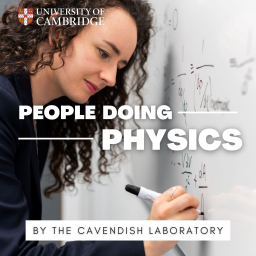
As fascinating as physics can be, it can also seem very abstract, but behind each experiment and discovery stands a real person trying to understand the universe. Join us at the Cavendish Laboratory on the first Thursday of every month as we get up close and personal with the researchers, technicians, students, teachers, and people that are the beating heart of Cambridge University’s Physics department. If you want to know what goes on behind the doors of a Physics department, are curious to know how people get into physics, or simply wonder what physicists think and dream about, listen in!
Join us on Twitter @DeptofPhysics using the hashtag #PeopleDoingPhysics.
This podcast uses the following third-party services for analysis:
OP3 - https://op3.dev/privacy
Each year, we invite the Cavendish Arts Science Fellow to join us for a conversation with one of the scientists whose ideas helped shape their time in Cambridge.
Today’s episode is one of those conversations, and I’m delighted to welcome artist Thulani Rachia and planetary geoscientist Oliver – Oli - Shorttle to the studio.
Thulani is the fifth Cavendish Arts Science Fellow. A South African artist working across moving image, performance, music composition and sculpture, he explores two closely connected ideas: critique and recovery. His work, which has been shown nationally and internationally, questions how communities can reclaim what colonial violence has erased or displaced.
Over the past year, Thulani has immersed himself in conversations with Cambridge scientists though the annual Cavendish Arts Science Fellowship (https://www.cavendish-artscience.org.uk/open-call/) at Girton College. One of the strongest connections to emerge was with Oli, sparked by a deceptively familiar material central to both their work: graphite.
Oli is Professor of Planetary Geoscience, working across the Institute of Astronomy (http://www.ast.cam.ac.uk/) and the Department of Earth Sciences (http://www.esc.cam.ac.uk/) at the University of Cambridge. Combining fieldwork, geochemical analysis and modelling, he investigates the chemical and dynamic processes unfolding within planetary interiors and crusts.
What follows is a conversation that begins with the graphite in a pencil and quickly expands…to darkness and light, lightning and deep time, the origins of life and the histories held within materials. Along the way, Thulani and Oli ask what artists and scientists can reveal to one another when they resist easy answers and follow a shared question… wherever it leads.
Useful Links:
Explore Thulani's work : obuyile - Thulani Rachia Studio (https://www.thulanirachiastudio.com/)
If you would like to learn more about Oli's Planetary Chemistry research visit Planetary Chemistry – University of Cambridge | Oliver Shorttle (https://www.shorttle.com/)
Learn more about the Cavendish Arts Science programme and fellowship at Cavendish Arts Science (https://www.cavendish-artscience.org.uk/)
Thulani refers to the project: RE Handle with care. Watch the videos: https://vimeo.com/1215845563 (https://eur03.safelinks.protection.outlook.com/?url=https%3A%2F%2Fvimeo.com%2F1215845563&data=05%7C02%7Cvb425%40cam.ac.uk%7C06ad4408ddea4380694008df1f16723b%7C49a50445bdfa4b79ade3547b4f3986e9%7C1%7C0%7C639263853407908501%7CUnknown%7CTWFpbGZsb3d8eyJFbXB0eU1hcGkiOnRydWUsIlYiOiIwLjAuMDAwMCIsIlAiOiJXaW4zMiIsIkFOIjoiTWFpbCIsIldUIjoyfQ%3D%3D%7C0%7C%7C%7C&sdata=fu5au4vca6SZhrqsnFVPfMYGZAkd%2FvIpO8fWXftSQVs%3D&reserved=0) and https://vimeo.com/1215854527 (https://eur03.safelinks.protection.outlook.com/?url=https%3A%2F%2Fvimeo.com%2F1215854527&data=05%7C02%7Cvb425%40cam.ac.uk%7C06ad4408ddea4380694008df1f16723b%7C49a50445bdfa4b79ade3547b4f3986e9%7C1%7C0%7C639263853407938001%7CUnknown%7CTWFpbGZsb3d8eyJFbXB0eU1hcGkiOnRydWUsIlYiOiIwLjAuMDAwMCIsIlAiOiJXaW4zMiIsIkFOIjoiTWFpbCIsIldUIjoyfQ%3D%3D%7C0%7C%7C%7C&sdata=IIk0a8yvL41KH%2F%2Bfo6Fo%2B8ju3hYc%2BPRLtmO6P1IP9PM%3D&reserved=0)
Share and join the conversation
Help us get better by taking our quick survey (https://forms.gle/GKiDPV2pmLjpmKHy9). Your feedback will help us understand how we can improve in the future. Thank you!
If you like this episode don’t forget to rate it and leave a review on your favourite podcast app. It really helps others to find us.
Any comment about the podcast or question you would like to ask our physicists, email us at podcast@phy.cam.ac.uk (mailto:podcast@phy.cam.ac.uk) or join the conversation on Twitter using the hashtag #PeopleDoingPhysics.
Episode credits
Hosts: Vanessa Bismuth
Recording and editing: Chris Brock
This podcast uses the following third-party services for analysis:
OP3 - https://op3.dev/privacy
4 Jun 2026
Didier Queloz: the importance of getting it wrong
Today, we have the privilege of being joined by one half of the team behind what is arguably one of humankinds’ epochal breakthroughs – the first observation of a planet outside our solar system. Both a professor at the University of Zurich and Jacksonian Professor of Natural Philosophy here at Cambridge, Didier Queloz began his research career by achieving the great aim of all PhD students; a publication in Nature. Since then, the techniques and instruments he pioneered have led to the identification of over 4,000 other exoplanets and revolutionised our understanding of planetary formation.
His more recent work looks into the detection of earth-like planets, understanding their habitability, and the search for universal life more widely. He is now Director of the Leverhulme Centre for Life in the Universe here at Cambridge – an interdisciplinary hub looking at how life emerges, evolves, and persists in the cosmos.
In the course of his career, he has published hundreds of papers and been recipient of numerous prestigious awards, including the unarguably most famous of all scientific awards – the Nobel Prize, which he shared with Michel Mayor and James Peebles in 2019 "for contributions to our understanding of the evolution of the universe and Earth’s place in the cosmos".
Together we talk about Didier's route into physics, his work looking at one of the profound questions of whether humankind is alone in the universe, and whether he replaced the bike that made him miss the call from the Nobel Prize committee.
Useful links:
To learn more about Didier's current research, visit Home | Leverhulme Centre for Life in the Universe (https://www.lclu.cam.ac.uk/)
Watch Didier's interviews for The Nobel Prize: Didier Queloz – Interview - NobelPrize.org (https://www.nobelprize.org/prizes/physics/2019/queloz/interview/)
Share and join the conversation
Help us get better by taking our quick survey (https://forms.gle/GKiDPV2pmLjpmKHy9). Your feedback will help us understand how we can improve in the future. Thank you!
If you like this episode don’t forget to rate it and leave a review on your favourite podcast app. It really helps others to find us.
Any comment about the podcast or question you would like to ask our physicists, email us at podcast@phy.cam.ac.uk (mailto:podcast@phy.cam.ac.uk) or join the conversation on Twitter using the hashtag #PeopleDoingPhysics.
Episode credits
Host: Jacob Butler
Recording and editing: Chris Brock
This podcast uses the following third-party services for analysis:
OP3 - https://op3.dev/privacy
7 May 2026
Montu Saxena: insights from a condensed-matter physicist
Today we are delighted to be joined by Siddharth Shanker Saxena, known to friends and colleagues as Montu, a condensed-matter physicist at the Cavendish Laboratory and head of the Cambridge Central Asia Forum. By Montu’s own admission, he was never able to pick a side, and so has spent his whole life exploring the world of superconductivity, all the while advocating for international relations and anthropology.
Together we talk about the moments that shape a scientific life: learning to believe you belong, the role of mentoring, and what “failure" can teach you. We also dig into the enduring puzzle of superconductivity: how to explain it simply, why it continues to captivate physicists, and how to stay comfortable saying “we don’t know.”
Useful Links:
Montu talked in depth about superconductivity in this podcast for Quanta Magazine: Will Better Superconductors Transform the World? | Quanta Magazine (https://www.quantamagazine.org/will-better-superconductors-transform-the-world-20240509/)
He was also recently featured in this Varsity article: Meet the Cambridge physicist who advocates for the humanities | Varsity (https://www.varsity.co.uk/science/31074)
To explore Montu's work : Siddharth Saxena | Jesus College in the University of Cambridge (https://www.jesus.cam.ac.uk/people/siddharth-saxena)
And finally, to learn more about the Cambridge Central Asia Forum, visit Cambridge Central Asia Forum | (https://centralasia.group.cam.ac.uk/)
Share and join the conversation
Help us get better by taking our quick survey (https://forms.gle/GKiDPV2pmLjpmKHy9). Your feedback will help us understand how we can improve in the future. Thank you!
If you like this episode don’t forget to rate it and leave a review on your favourite podcast app. It really helps others to find us.
Any comment about the podcast or question you would like to ask our physicists, email us at podcast@phy.cam.ac.uk (mailto:podcast@phy.cam.ac.uk) or join the conversation on Twitter using the hashtag #PeopleDoingPhysics.
Episode credits
Hosts: Charlotte Lane and Vanessa Bismuth
Recording and editing: Chris Brock
This podcast uses the following third-party services for analysis:
OP3 - https://op3.dev/privacy
Who has been a guest on People doing Physics
Names identified in recent episode analyses. Showing up to five guests.
Akeelah Bertram
Kevin Lim
Teuta Pilizota
Professor Russell Cowburn
Charlotte Simmonds
Reach and audience
Public platform figures. Ratings count people who left a rating, not total listeners.
YouTube views
45,834
Score snapshot 15 Sept 2025
Apple Podcasts (US)
5.0 / 5
2 ratings
Spotify
4.9 / 5
12 ratings
Podcast Authority Score: 43 / 100
A composite of feed quality, social presence, YouTube performance and engagement. Read the methodology.
Quality
24
Social presence
0
YouTube
76
Engagement
82
Contact People doing Physics
Guest appearances
Does not typically book guests
Based on episode analysis; this does not confirm that the show is currently accepting guests.
Questions about People doing Physics
Who hosts People doing Physics?
Vanessa Bismuth and Charlie Walker and Jacob Butler host the show. Published by Cavendish Laboratory.
How often do new episodes come out?
The show publishes monthly, based on its RSS feed.
Does People doing Physics take guests?
The show does not typically feature guests, based on episode analyses.
Host of People doing Physics?
Claim your podcast to manage its listing and keep your show details accurate.
Pod Engine is an independent podcast discovery and analytics service and is not affiliated with or endorsed by this podcast. Artwork and show content belong to their owners. Full legal notice.
Explore this show Podcast research with Pod Engine