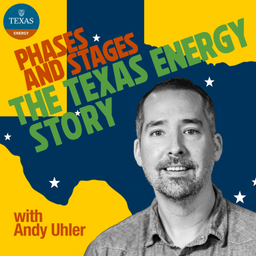
Everything is bigger in Texas, right down to the production, consumption, and transmission of all different kinds of energy. Phases and Stages tells stories beyond the boardrooms, shareholders, and CEOs that dominate the energy industry narrative. We're asking people in Texas towns where different kinds of energy production is happening, what struggles they face in keeping up with and adjusting to current and emerging realities, and discovering opportunities for laborers, inventors and entrepreneurs in this unique space.
Publisher
Andy Uhler, Fellow at the Energy Institute, UT Austin
9. Rio Grande Valley | Is Energy the Future at the Border?
When you think of the Rio Grande Valley, a diverse energy production mix probably isn't the first thing that pops into your mind. But maybe it should. The RGV is home to the largest wind farm in the state and a number of large-scale solar farms. But it's not just renewables. Next year, the Port of Brownsville will be home to a brand new liquefied natural gas facility. This has some asking the question: Is energy production the economic future of the Rio Grande Valley?
Learn more about Phases & Stages
Learn more about The Energy Institute at The University of Texas at Austin
23 Apr 2026
9. Austin | Full Circle
For the season finale, we're back where we started: Austin. But more than talking about how people in Austin feel about the energy transition and the energy industry more generally, we're considering how the proceedings in Austin affect the energy portfolio throughout Texas. We'll hear from lawmakers, lobbyists, experts, and utilities about how what happens in Austin, changes the state.
Voices from across Texas energy:
"We can argue philosophically about a lot of things, but the reality is this state today is hugely dependent upon the power generated by those forms of generation whether that's wind, solar, or batteries," said Texas State Rep. Drew Darby.
"We need to recognize that there are sacrifices that people in rural Texas have to make in order to provide those goods and services to people who want to live in cities," said Texas State Rep. Drew Darby.
"In Texas, I think very little have we seen people be opposed to a project because of politics," said Catlin Smith, Senior Vice President of Federal and Regulatory Affairs at Jupiter Power.
"When political scientists think about opposition to renewable energy and the energy transition, generally, they're of two minds: There's a group that thinks it's all about economics and economic self interest, and there's another group of people who are focusing on partisan polarization and the fact that the two parties are growing apart on renewable energy," said David Spence, professor of energy regulation at the University of Texas.
Learn more about Phases & Stages
Learn more about The Energy Institute at The University of Texas at Austin
13 Mar 2026
8. High Plains | What Does a Massive Solar Plant Mean for a Small Texas Town?
At more than 600 megawatts…the Frye Solar Plant has more power capacity than the town it operates in has official residents. Located on almost six square miles, about an hour north of Lubbock in Kress, Texas - population 592 - the project is a microcosm of the energy industry expansion occurring throughout the Lone Star State. In return for a lease to construct huge energy infrastructure projects, a few landowners get a nice pay day, but what benefit do they bring to the area as a whole? And what about electricity bills for the plant's residential neighbors? Surely those go down, right? All that and more on the next episode of Phases and Stages: The Texas Energy Story.
Learn more about Phases & Stages
Learn more about The Energy Institute at The University of Texas at Austin
7 Jan 2026
7. Matagorda County | Is Matagorda County the Energy Capital of Texas?
Matagorda County, with a population of a little more than 36,000 people, has a few working oil
and gas wells, but it's also home to a nuclear power plant, several wind and solar farms, and
could soon be the home of a hydrogen-based eFuels operation. It's less than a two-hour drive
from Houston, but some in town wanted to rebrand this part of the state "The Energy Capital of
Texas," and you can't really blame 'em.
Learn more about Phases & Stages
Learn more about The Energy Institute at The University of Texas at Austin
28 Oct 2025
6. Alice | 'Hub City of South Texas' and an Energy Powerhouse That Once Was
When wildcatters struck oil in Jim Wells County in the 1920s, politicians in Alice, Texas saw opportunity beyond the oil patch. The town, which legend has it was named after the daughter of Richard King, the founder of King Ranch, adopted the slogan, "The Hub City of South Texas" due to its proximity to San Antonio to the north, the port of Corpus Christi to the east, and Laredo and the Mexican border to the south. The branding worked. Throughout the 1960s and 70s, Alice was a distribution hub for supplies and construction materials throughout south Texas. Drilling and service companies set up oil rig yards in town, and employed locals.
But oil booms are always followed by busts. And Alice is a legacy oil town in every sense. When oil left in the 1980s, population and tax revenue dwindled. The fracking revolution brought industry back to town for a spell, but that boom proved short-lived, too. These days, residents reminisce about the old days when oil and gas employed just about everybody in town and contributed substantially to the local economy. And while those are just fond memories, there's an honest hope that even if oil and gas is no longer the bread and butter of this town's economy, Alice's location might be enough to spur different innovators in the energy sector to set up shop here.
Learn more about Phases & Stages
Learn more about The Energy Institute at The University of Texas at Austin (https://energy.utexas.edu/energy-literacy)
25 Jul 2025
5. Port Arthur | Can an Energy Expansion Bring a New Gilded Age Back to the Golden Triangle?
When you think of socialites taking in a performance featuring Ray Charles or James Brown, all the while rubbing elbows with the likes of Frank Sinatra and Dean Martin, the first U.S. city that comes to mind is probably New York, or maybe Los Angeles.
But what if I told you in its heyday, those things and more were happening in a town of some 55,000 people less than 10 miles from the Gulf of Mexico. For a time, Port Arthur was the place to be, and be seen. And the backdrop to all the energy and goings on in this southeast Texas town was petroleum.
Times have changed, and residents will be the first to tell you that Port Arthur isn't what it used to be, but there's hope that the next generation of the energy industry might bring this Texas town out of the doldrums.
Learn More About Phases and Stages
Learn More About The Energy Institute at The University of Texas at Austin (https://energy.utexas.edu/energy-literacy)
14 Apr 2025
4. Odessa | The Little (or Big) Brother in the Energy Epicenter
The two cities that make up ground zero for oil and gas production in the United States, Midland and Odessa, have been competing for recognition and prestige for as long as a lot of folks in town can remember.
These days that cross-town rivalry has bled over into a competition for emerging industry, a developing workforce, and a boat load of tax dollars. But as Marilu Hastings at the Mitchell Foundation puts it, because we're going to need a lot more energy than we're currently producing, we're not in the position to pick winners and losers in the energy industry. We need it all.
Learn more about Phases & Stages
Learn more about The Energy Institute at The University of Texas at Austin (https://energy.utexas.edu/energy-literacy)
3 Mar 2025
3. Midland | The (Not So) Tall Tale of Energy in the Tall City
Midland, Texas has been known for oil and gas since the 1920s, but there's a new kind of energy popping up in town that has some folks upset about the changing times.
Learn more about Phases & Stages
Learn more about The Energy Institute at The University of Texas at Austin (https://energy.utexas.edu/energy-literacy)
5 Dec 2024
2. Rockdale | The Town Where it Rains Money
There's a place in Central Texas, a place once heralded as 'The Town Where It Rains Money' that's already gone through something of an energy transition. Rockdale, population 5,300, is a cautionary tale of a community trying to figure out how to embrace what's left from the energy industry of the past while courting economic activity that's expecting the benefits of the energy industry of the future.
Learn more about Phases & Stages
Learn more about The Energy Institute at The University of Texas at Austin (https://energy.utexas.edu/energy-literacy)
6 Nov 2024
1. Houston | Straddling the Line
Houston has been long heralded as the energy capital of the U.S. But there are some in Space City who want to rebrand the city the "energy transition capital of the world." How come? And how is something like that supposed to happen? Turns out, it's complicated.
Learn more about Phases & Stages
Learn more about The Energy Institute at The University of Texas at Austin (https://energy.utexas.edu/energy-literacy)
Reach and audience
Public platform figures. Ratings count people who left a rating, not total listeners.
Apple Podcasts (US)
5.0 / 5
2 ratings
Host of Phases and Stages: The Texas Energy Story?
Claim your podcast to manage its listing and keep your show details accurate.
Pod Engine is an independent podcast discovery and analytics service and is not affiliated with or endorsed by this podcast. Artwork and show content belong to their owners. Full legal notice.
Explore this show Podcast research with Pod Engine