- 115
- Episodes
- Daily
- Cadence
- 2026
- First episode
About Philosophers Talk Podcast
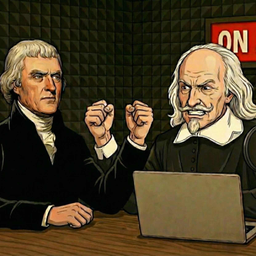
Great philosophers debate modern topics, channeled through AI philosopherstalk.com (https://philosopherstalk.com?utm_medium=podcast)
- Publisher
- Philosophers Talk
- Category
- news · society & culture
- Language
- en
- Explicit
- No
- First episode
- 4 Feb 2026
- Latest episode
- 9 Oct 2026
Latest episodes
115 episodes in the feed.
9 Oct 2026
Who Really Pays for the Data Center? Sumner vs Carnegie
Samuel Johnson: Good evening, and welcome to the second of six contests on who pays for the data center. I am Samuel Johnson, and I shall once again preside with perfect impartiality. Niccolo Machiavelli: I am Niccolo Machiavelli, and as I wrote in The Prince, it is far safer to be feared than loved. The Doctor has settled for neither. Samuel Johnson: Sir, tonight’s question is who truly pays the bill. In the near corner stands William Graham Sumner, a professor at Yale and the champion of the Forgotten Man. He is an American, which I am obliged to overlook. Niccolo Machiavelli: The Doctor once called the Americans a race of convicts, so this is him being warm. Samuel Johnson: And in the far corner stands Andrew Carnegie, a steelmaker and a Scotchman. My Dictionary records that oats are a grain which in England is generally given to horses, but in Scotland supports the people. Niccolo Machiavelli: My man Carnegie took the tariff, sold out for three hundred million dollars, and is remembered for libraries. Cesare Borgia never managed anything so elegant. Samuel Johnson: The household in Ohio now pays some sixteen dollars more each month for its electricity, and somebody must answer for it. Niccolo Machiavelli: Somebody will be blamed, Doctor, which is not the same thing at all. Samuel Johnson: Professor Sumner, Mister Carnegie, the floor is yours, gentlemen, and I beg you to keep it honest. Niccolo Machiavelli: Mister Carnegie, kindly ignore the Doctor and do whatever works. William Graham Sumner: Thank you, Doctor Johnson. I say the man who pays this bill was never invited to the meeting. Andrew Carnegie: And thank you, Mister Machiavelli, I fully intend to. I say a great works repays its town many times over. William Graham Sumner: Mister Carnegie called his industry an infant while he was the largest steelmaker on earth. Andrew Carnegie: The Professor has a remedy for nothing and a lecture for everything. William Graham Sumner: This conversation is brought to you by PhilosophersTalk.com, where thinkers discuss! Andrew Carnegie: Created by AITalkerApp.com, create your own animated conversations. Link in the description! William Graham Sumner: I am William Graham Sumner, professor of political and social science at Yale, and before that a clergyman, which taught me to distrust a collection plate. In 1883 I described a pattern. A sees something he wishes done and talks it over with B. Then A and B pass a law deciding what C shall do for X. I call C the Forgotten Man. He works, he votes, generally he prays, but he always pays. Andrew Carnegie: And I am Andrew Carnegie, born poor in Scotland, and a bobbin boy in a cotton mill at one dollar and twenty cents a week. I made steel cheaper than any man alive, sold the business for more than three hundred million dollars, and set about giving it away. I built more than sixteen hundred libraries in America. I mention it only because the Professor will not. William Graham Sumner: Then let us find the Forgotten Man in the present case. A is a governor who wants a ribbon to cut. B is a company that wants a great deal of electricity. The independent monitor of the largest American power market says data centers account for six point three billion dollars of its last capacity auction, out of sixteen point four billion. Households in Ohio pay about sixteen dollars more each month. In seven states, four point three billion dollars of connection costs were assigned to ordinary ratepayers in a single year. That household is C, and nobody asked him. Andrew Carnegie: Professor, you have read one column of the ledger. A national laboratory study found that the states with the fastest growth in demand saw real prices fall between 2019 and 2024. Another found rates six percent lower where data centers grew. I learned the reason at the mill. Run the works full and the cost of every ton comes down. A great customer shares the fixed cost of the wires with the widow down the lane. William Graham Sumner: That second study was supported by Google, which I mention for the widow’s benefit. And both findings can be true. When a system has idle capacity, a large customer lowers the average cost. When it is full, the same customer forces new plant at a higher price, and the bill goes to everyone. Your evidence comes from the slack years, sir. The sixteen dollars comes from the tight ones. Andrew Carnegie: Then hear what the town receives. Loudoun County in Virginia spends about four cents serving a data center for every dollar of tax it collects. An ordinary business costs the county twenty five cents. These buildings send no children to the schools and few wagons down the road. I never knew a town that was sorry to see my chimneys, Professor. William Graham Sumner: Homestead was sorry, sir, though I grant you were in Scotland at the time. And observe who gains in your example. The county that taxes the machine does well. The household two states away on the same grid gets the bill and none of the tax. Andrew Carnegie: The Professor has plainly been saving that one for some time. William Graham Sumner: I shall now state Mister Carnegie’s case properly, which I do only because a weak opponent teaches nothing. He says size is the source of cheapness. He says a steady customer running day and night is the best customer a utility can have. He says the works pays more in tax than it takes in service. All of that is sound arithmetic, and none of it explains why he needs a favor. Andrew Carnegie: That was nearly generous, Professor, and I shall treasure it always. William Graham Sumner: Here is my answer to it. In 1890 you wrote that the steel industry was not yet fully grown and must be protected until it was. You were then the largest steelmaker on earth. I wrote a book calling protectionism the doctrine that waste makes wealth, and you were my best illustration. An industry spending seven hundred billion dollars a year is no infant either, sir. It is merely holding the bottle. Andrew Carnegie: Now I shall do the Professor the same service, chiefly so the audience may see how little he asks for. He says that when two parties strike a bargain and send the bill to a third, it is no bargain at all. He says the cost is spread so thin that no household will fight it, while the gain is gathered so thick that somebody will always lobby for it. It is neatly put, and it is the most cheerful thing he has ever said. William Graham Sumner: You have stated it accurately, which surprises me a good deal. Andrew Carnegie: But the Professor has indicted the wrong man. That sixteen dollars does not come to the data center. It is a capacity payment, and it goes to the owners of power plants, many of them built long ago. The fellow he calls B never touches the money. And notice his cure. He would forbid the gift, and then forbid every rule that might replace it. He offers the Forgotten Man his deepest sympathy and nothing else. William Graham Sumner: The first point is correct, and I concede it. The money lands in a third pocket. That makes it worse, because two parties arranged a transfer and neither can be made to return it. As for my cure, I want no warehouse rule and no commission. I want a contract. One utility in Ohio required these companies to pay for eighty five percent of the power they reserved, for up to twelve years, used or not. Its forecast of new demand fell from thirty thousand megawatts to under six thousand. Four fifths of your great future left the room when it was handed a pen. Andrew Carnegie: Oh, that is good, Professor, and I may borrow it. But the fifth that stayed is the fifth that matters. I did not build every mill I sketched either. The men who signed in Ohio will pay their way, which proves my case. The serious builder never feared the bill. William Graham Sumner: Then you will not object to your own rule. When you gave a town a library, you required it to own the site and to tax itself ten percent of the gift every year. You said a community not willing to maintain a library had better not possess it. I agree entirely. An industry not willing to maintain its own power line had better not possess that either. Andrew Carnegie: I did say it, and I meant it, and I am rather pleased to be quoted. But mark the difference. I gave the building, and the town had only to keep the lamps lit. I have always held that the man who dies rich dies disgraced. Show me the ratepayer I left poorer, Professor. William Graham Sumner: You left the buyer of every steel rail poorer by the amount of the duty. He never knew your name, which is the whole of my point. And here is what neither of us knows. Much of that capacity bill is for data centers that have not been built. If the demand arrives, your arithmetic holds. If it does not, the household has paid for a power plant to serve a rumor. Andrew Carnegie: I will grant the uncertainty, for I have seen a boom or two. The contracts are private and the forecasts are guesses. But every great thing in this country was built ahead of its customers. Wait for certainty and you will have a very safe village and no steel. William Graham Sumner: Then build ahead with your own money, sir, as you advise the poor to do. Andrew Carnegie: I always did, Professor, once the tariff was paid! William Graham Sumner: THERE IS THE CONFESSION AT LAST! Andrew Carnegie: IT WAS THE LAW OF THE LAND! William Graham Sumner: YOU ARGUED FOR IT IN PRINT, SIR! Andrew Carnegie: I BUILT SIXTEEN HUNDRED LIBRARIES! William Graham Sumner: AND SENT THE TOWNS THE BILL! Andrew Carnegie: PEDANT! William Graham Sumner: INFANT! Andrew Carnegie: PREACHER! William Graham Sumner: PROTECTIONIST! Andrew Carnegie: SCHOOLMASTER! William Graham Sumner: SIXTEEN DOLLARS A MONTH! Andrew Carnegie: CHEAP AT THE PRICE! William Graham Sumner: If this was of use to you, like and subscribe. It is free, so for once the Forgotten Man is not being charged. Mister Carnegie is a cheerful man who never met a cost he could not hand to a stranger and call a gift. He will tell you he was a bobbin boy. Subscribe before he tells you again. Andrew Carnegie: Yes, like and subscribe, my friends. And spare a thought for the Professor, who gave up preaching to a congregation in order to preach to undergraduates. He has opposed the tariff, the subsidy, the reformer, and the philanthropist, and he has never once built a shed. He is the only man I know who can lose an audience by agreeing with it. William Graham Sumner: Doctor Johnson, I return the floor to you, and I trust that you can count. Andrew Carnegie: Mister Machiavelli, back to you in the booth, and do be kind to a poor Scotch boy. Samuel Johnson: Thank you, Professor. I can count, sir, and I count it for William Graham Sumner. He found the man who pays, he found the sum, and he found the infant. Niccolo Machiavelli: Thank you, Mister Carnegie, and I shall be more than kind. A prince must be a fox to know the traps and a lion to frighten the wolves. Carnegie was both, and he smiled throughout. Samuel Johnson: He smiled, sir, while confessing that he built with his own money only once the tariff was paid! My Dictionary calls excise a hateful tax levied upon commodities, and his tariff was its first cousin. Niccolo Machiavelli: Your Dictionary also calls a pension the pay given to a state hireling for treason to his country. Then the King offered you three hundred pounds a year, and you took it. Samuel Johnson: Sir, that was an entirely different matter, and I decline to discuss it. Niccolo Machiavelli: Now mark the blow of the night. The sixteen dollars never reaches the data center. Sumner prosecuted a man who was not holding the purse. Samuel Johnson: He conceded it like a gentleman, which is more than a Scotchman or a Florentine would do. Niccolo Machiavelli: He conceded it like a professor, Doctor, which is to say at length. Samuel Johnson: I confess that one thing troubles me. Neither man could say whether this great demand will ever arrive. Niccolo Machiavelli: Fortune governs half of what we do, Doctor, and tonight the ratepayer is covering her half. Samuel Johnson: Next time, John Locke and Jeremy Bentham dispute who owns the water beneath the ground. One of them is a Whig, sir, and the first Whig was the Devil. Niccolo Machiavelli: Locke is the Whig, and the Doctor has already filled in his scorecard. Samuel Johnson: Until then, I remain your impartial servant. Niccolo Machiavelli: He remains a pensioner, but do come back. Get full access to Philosophers Talk at philosopherstalk.com/subscribe (https://philosopherstalk.com/subscribe?utm_medium=podcast&utm_campaign=CTA_4)
6 Oct 2026
Could Data Centers Survive as Plain Warehouses? A New Series
Samuel Johnson: This conversation is brought to you by PhilosophersTalk.com, where thinkers discuss! Niccolo Machiavelli: Created by AITalkerApp.com, create your own animated conversations. Link in the description! Samuel Johnson: Good evening. I am Samuel Johnson, author of A Dictionary of the English Language, and I have been engaged to call a series of six debates from this booth. Niccolo Machiavelli: I am Niccolo Machiavelli, author of The Prince, and I have been engaged to tell you what is actually happening. Samuel Johnson: Our subject is the data center. It is a windowless building full of calculating engines, which drinks like a town and draws power like a city. Niccolo Machiavelli: And our question is a simple one. What if the law treated that building as the thing it resembles, which is a plain warehouse? Samuel Johnson: Under that rule it may take from the grid only what a warehouse of the same size would take. It may draw from the city main and the aquifer only what a warehouse would draw. Niccolo Machiavelli: It receives no tax favor written for its industry alone. Whatever else it needs, it must generate, find, or buy at the full price. Samuel Johnson: Could such a building still turn a profit? Or does the whole enterprise stand upon gifts from people who were never asked? Niccolo Machiavelli: That is too large a quarrel for one evening, Doctor, so we have cut it into six. Samuel Johnson: In the first bout, Henry George meets Leland Stanford on whether a state should pay an industry to come. Niccolo Machiavelli: In the second, William Graham Sumner and Andrew Carnegie dispute who is truly paying the bill. Samuel Johnson: In the third, John Locke and Jeremy Bentham contest who owns the water under the ground and the air above it. Niccolo Machiavelli: In the fourth, William Blackstone and Otto von Bismarck argue over whether a farm may be taken for a private customer’s power line. Samuel Johnson: In the fifth, Sumner returns to face George, for both men despise the subsidy and neither can abide the other’s cure. Niccolo Machiavelli: And in the sixth, Walter Bagehot and Alexander Hamilton open the ledger and settle whether the thing can pay its own way at all. Samuel Johnson: Here is how the evenings will run. Before each debate we shall introduce the two men and the stakes. Then we go down to the floor and we do not interrupt. Niccolo Machiavelli: When the shouting stops, we come back and score it. The Doctor scores on virtue, and I score on victory. Samuel Johnson: I shall judge who was right, sir, as any honest man would. Niccolo Machiavelli: And I shall judge who won, which is a different matter and a far more useful one. Samuel Johnson: Then the audience may rely upon one honest scorecard at least. Niccolo Machiavelli: The Doctor will now promise to be fair, so do enjoy it. Samuel Johnson: I must assure the audience that I come to this task entirely without prejudice. Niccolo Machiavelli: Doctor, you once wrote up the debates of Parliament for a magazine after sitting in the gallery a single time. You confessed that you took care the Whig dogs should not have the best of it. Samuel Johnson: I saved appearances tolerably well, and I shall do so again. Niccolo Machiavelli: Whereas I shall simply back whichever man is getting away with something. Samuel Johnson: Sir, that is an evasion of every duty a judge possesses. Niccolo Machiavelli: Where you see an evasion, Doctor, I see beautiful footwork. Samuel Johnson: One caution before we begin. The sums in this quarrel are very large. One state expects to forgive two and a half billion dollars in a single year, and four companies are spending more than seven hundred billion. Niccolo Machiavelli: And many of the contracts are sealed. So when our fighters are guessing at a figure, we shall make them say so. Samuel Johnson: That is the nearest thing to a principle I have heard from you this evening. Niccolo Machiavelli: Do not grow accustomed to it, Doctor. Samuel Johnson: If this series interests you, please like and subscribe, and pay no attention to the Florentine beside me. He was dismissed from the government of Florence, and he has been offering advice to princes ever since without one of them asking. Niccolo Machiavelli: Yes, do like and subscribe. And remember that the Doctor’s Dictionary has a word for everything except losing gracefully. He defined a lexicographer as a harmless drudge, which remains the only modest thing he ever wrote and the only accurate one. Samuel Johnson: I shall see you at the first bell, sir. Niccolo Machiavelli: I shall be the one enjoying myself. Get full access to Philosophers Talk at philosopherstalk.com/subscribe (https://philosopherstalk.com/subscribe?utm_medium=podcast&utm_campaign=CTA_4)
28 Sept 2026
Was Trump Right to Reject Iran's Deal? Napoleon vs Wellington
Napoleon: Iran offered to reopen the Strait on the seventh day, and the President said no. I once waited five weeks in Moscow for a letter like that. He is right not to wait. Duke of Wellington: You were offered the Rhine in eighteen thirteen and refused it. By the following spring you were offered Elba. Napoleon: A blockade is a siege, and I have never once lost an argument about sieges. Duke of Wellington: You invented the Continental System, which is a blockade, and it took you all the way to Moscow. Napoleon: This conversation is brought to you by PhilosophersTalk.com, where thinkers discuss. Duke of Wellington: Created by AITalkerApp.com, create your own animated conversations. Link in the description. Napoleon: Arthur, we meet again on the subject of Iran, which is fast becoming the longest campaign the two of us have ever fought together, and I notice that neither of us is being paid. Duke of Wellington: I was paid handsomely for Waterloo. Parliament bought me a country estate. You were given an island. Napoleon: That is good. That is very good, and I resent it enormously. Here is the map. The war began in February with the killing of the old Supreme Leader. His son Mojtaba took the chair and has not been seen in public since. A ceasefire in April, a memorandum in June, and by August it had expired quietly, like a marriage in which both parties had already moved out. Duke of Wellington: Then September arrived and the shooting resumed at sea. The Americans destroyed five Iranian oil tankers after Iran fired missiles at an American warship. Then the President announced that the war would end immediately after the midterm election, the first time I have heard a commander announce the date of his own retreat. Napoleon: And last week at the United Nations, Iran made its move. Foreign Minister Araghchi offered a seven day roadmap. America releases at least twelve billion dollars in frozen assets, waives the oil sanctions, and lifts the blockade. And then, on the seventh day, Iran graciously reopens the Strait of Hormuz, which it closed, and agrees to begin talking about the uranium, which it hid. Duke of Wellington: And on Saturday, leaving for a campaign stop, the President rejected it. He said Iran only made the offer because it is losing so badly. Then he posted a map on which the Strait of Hormuz had been renamed the Trump Strait. Napoleon: I admire that enormously. I conquered most of Europe, and posterity gave me a pastry and a psychological complex. He has not conquered anything yet, and already he has a strait. Duke of Wellington: I won, and I received a boot and a beef dish. Napoleon: Very good. The beef is the better of the two, and I will deny I ever said so. Now, my position. The President was right to refuse. Tighten the blockade. Let me tell you about Moscow. I arrived in September. I wrote to the Tsar proposing peace, and every morning I asked my aide whether the Tsar had written back. The first morning he said, sire, the Russian post office is on fire. Because the whole city was on fire. And I waited five more weeks for a letter from a man whose entire strategy was promising nothing and delivering less. That is this roadmap. Every American concession arrives on the first day. Every Iranian concession arrives on the seventh, or later, or in talks. I know this trick. I invented half of it. Duke of Wellington: You left out the part where you walked home. Napoleon: I did not walk anywhere. I rode home in a sleigh, which was very cold, and gave me considerable time to reflect on the Russian postal service. And look at Iran today. Araghchi now says the President’s refusal was only an initial reaction, and he is waiting for a definitive one. When a man is told no and asks for a more definitive no, he is losing. The blockade has turned back more than one hundred and twenty ships. Inflation near eighty percent. Grocery prices more than doubled in a year. The invisible Supreme Leader has issued a written order forbidding his officials from saying anything discouraging, which is what governments do when the truth has become discouraging. Their vice president says the policy for two years is neither war nor peace. That is not strategy. That is a bankrupt man telling his creditors he is taking a sabbatical. Duke of Wellington: My position is the one I held in April, and it has not improved with age, because neither has yours. The President has said no. He has not said what yes looks like. A blockade is a means. It is not an end. One newspaper reports he has told aides he expects to resume bombing after the election, while his own officials say the talks remain positive and constructive. That is not a policy. It is a weather forecast. In eighteen ten I built the Lines of Torres Vedras and starved Marshal Massena out of Portugal. It worked because I knew exactly what I was holding, and the Royal Navy could feed me for as long as I liked. Washington has neither a clear objective nor unlimited patience. It has gasoline above four dollars a gallon, record diesel prices, and a poll showing under a third of Americans support this war. The besieger is starving too. Napoleon: Very well, I will summarize the Duke’s argument fairly, the way a butcher first admires the cow. A siege is only as strong as the besieger’s patience, and America’s patience now has an expiration date printed on it. Pressure without a defined end becomes punishment, and punishment is not policy. An imperfect deal struck now, backed by force, is better than a perfect deal that never arrives, because the enemy has openly chosen to wait out the American calendar. That is his argument, and it is good, the way a good fence is good. It works perfectly until someone walks around it. Duke of Wellington: And the walk around it is what, exactly? Napoleon: Twelve billion dollars, Arthur. You pay them on the first day, and they walk around your fence carrying it. Every tyrant with a coastline is watching to learn whether seizing a strait pays. Duke of Wellington: Now I will summarize his position fairly, so that there is something left standing when I knock it down. The Emperor argues that Iran is closer to breaking than it admits, that paying before verification rewards hostage taking, and that the roadmap front loads American concessions while Iranian ones drift into the future. On sequencing, he is right, and I say that only because he will be insufferable if I do not. It is also exactly the case you would expect from the man who invented the Continental System. You were going to strangle Britain by closing every port in Europe. Russia stopped cooperating, so you marched to Moscow to enforce your blockade, and your blockade enforced you straight into the snow. Napoleon: The Continental System was a magnificent idea that was let down by a disappointing continent. Duke of Wellington: And in November of eighteen thirteen, after Russia, the allies offered you the Frankfurt proposals. France would keep the Rhine, the Alps, and the Pyrenees. You stalled for better terms, because you were certain the other side would break first. By April of eighteen fourteen you had abdicated and they gave you Elba. You are the only man in history who haggled his way from the Rhine to a Mediterranean rock. And now Washington says Iran is losing so badly that there is nothing to bargain over. That is precisely what you said about the allies in eighteen thirteen. Napoleon: I refused because I was certain I would win, which is the only reason anyone refuses anything. And you will notice I came back. Duke of Wellington: For one hundred days, and then I handled it. So here is what the President should have sent. Not yes, and not a bare no. A counteroffer. You treat their seven days as an opening bid, and you change the order. The blockade eases as ships verifiably move through the Strait. The money moves when inspectors move. American forces stay in the region until the terms are kept. After Waterloo I commanded the allied army that occupied France for three years to make certain the peace held. That is what a settlement looks like. You sign it, and you stand next to it. Napoleon: You negotiated with the House of Lords for years, and now you want to negotiate with a man nobody has seen since February, whose own president says Iran has no trust in the American side. Duke of Wellington: Here is what neither of us knows. The last public count put Iran’s stockpile of highly enriched uranium at about four hundred and forty kilograms. No inspector is known to have seen it since the war began. We do not know where it is, who in Tehran gives orders, or whether Iran breaks before America’s patience does. Napoleon: Agreed, and that is exactly why I would squeeze harder. You do not pay the man on the other side of the hill to describe the hill. Duke of Wellington: A blockade does not find a single gram of uranium. And kindly stop borrowing my line about the other side of the hill. I said it first, and I said it better. Napoleon: Everything you ever said, you said slowly, which the English always mistake for saying it better. And you are missing the point, the way you missed Lord Winchilsea in your duel. Iran’s president said just days ago that before the American elections or after, it makes no difference to them. That is a bluff from a government that cannot pay for groceries. Call it. Duke of Wellington: You called the Tsar’s bluff too, and you lost an army! Napoleon: You want to reward a hostage taker for returning the hostage! Duke of Wellington: THE BESIEGER IS STARVING! THE PUMPS ARE EMPTY AND THE POLLS ARE WORSE! Napoleon: THEIR SUPREME LEADER HAS BANNED BAD NEWS! THAT IS WHAT COLLAPSE SOUNDS LIKE! Duke of Wellington: THAT IS WHAT FRANKFURT SOUNDED LIKE! YOU THOUGHT THE ALLIES WOULD BLINK! Napoleon: THEY BLINKED TWICE! I WAS SIMPLY LOOKING THE OTHER WAY! Duke of Wellington: AT ELBA! Napoleon: AND YOUR SIDE LOST THE ARGUMENT! THE PRESIDENT SAID NO! Duke of Wellington: AND THEN HE RENAMED THE WATER! IT IS STILL CALLED HORMUZ! Napoleon: NOT ON HIS MAP, YOU IRON SHUTTERED ANTIQUE! Duke of Wellington: I PUT UP THOSE SHUTTERS BECAUSE A MOB BROKE MY WINDOWS! Napoleon: I WAS ON SAINT HELENA! I HAVE AN ALIBI! Duke of Wellington: MOSCOW! Napoleon: TORRES VEDRAS IS A FENCE! Duke of Wellington: WATERLOO! Napoleon: THE NEAREST RUN THING YOU EVER SAW! YOUR OWN WORDS! Duke of Wellington: AND I STILL WON IT! Napoleon: If you enjoyed watching me win an argument against a man who needed the entire Prussian army to win anything, please like this video and subscribe. Unlike the Duke, you can make a decision without waiting for Blucher to arrive. Duke of Wellington: And if you enjoyed watching a man who traded the Rhine for a rock lecture the rest of us about negotiating, subscribe anyway, so that at least one thing he touches grows instead of retreating. Napoleon: This entire debate was animated with AITalkerApp.com, where you can turn your own script into an animated conversation. The link is in the description, and it is the only offer in this video the Duke did not try to renegotiate. Get full access to Philosophers Talk at philosopherstalk.com/subscribe (https://philosopherstalk.com/subscribe?utm_medium=podcast&utm_campaign=CTA_4)
Contact Philosophers Talk Podcast
- Guest appearances
- Books guests
Based on episode analysis; this does not confirm that the show is currently accepting guests.
Host of Philosophers Talk Podcast?
Claim your podcast to manage its listing and keep your show details accurate.
Pod Engine is an independent podcast discovery and analytics service and is not affiliated with or endorsed by this podcast. Artwork and show content belong to their owners. Full legal notice.
Explore this show
Podcast research with Pod Engine