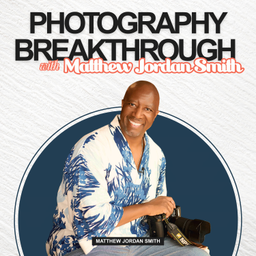
Photography Breakthrough System
Matthew Jordan Smith
5.0from 9 ratings
- 72
- Episodes
- 9
- Ratings
- Daily
- Cadence
- 2025
- First episode
About Photography Breakthrough System
Welcome to the Photography Breakthrough Podcast, the place where burnt out photographers come back to life. Where fear gets replaced with confidence and where your gift finally starts working for you, not against you.
- Publisher
- Matthew Jordan Smith
- Category
- arts
- Language
- en
- Explicit
- No
- First episode
- 28 Jul 2025
- Latest episode
- 11 Oct 2026
Latest episodes
72 episodes in the feed.
11 Oct 2026
Episode 63 - Don't Compete With AI. Become More Human
Don’t Compete With AI. Become More Human. Welcome back to the Photography Breakthrough Podcast. I hope you listened to last week’s episode. If you didn’t, I want you to go back and listen to Part One first, because today we’re going deeper into that conversation. And I want to begin with one question: What can you give people that AI cannot? Think about that for a second. What can you give people that artificial intelligence simply cannot? Because I believe one of the biggest mistakes creatives can make right now is trying to compete with AI at the things AI does extremely well. Speed. Volume. Variation. Automation. You are not going to win that battle. So instead, let’s think differently. What becomes more valuable precisely because technology is becoming more powerful? Human connection. Trust. Taste. Experience. Meaning. Your story. And this is a big one: Human presence. Those are enormous opportunities. So instead of asking: “How can I beat AI?” Ask yourself: How can AI make me better at the work only I can do? That is a completely different mindset. Yes, use technology where it helps you. Many of us are using AI every day. It can be an incredible assistant. But remember: It is an artificial assistant. Use it to brainstorm. Organize. Research. Build presentations. Develop concepts. Solve problems. Handle repetitive tasks. Learn faster. But then take some of the time that technology saves you and invest it back into becoming a more interesting human being. Spend more time with people. Listen more carefully. Study your craft. Create personal work. And when you create personal work, don’t ask whether anybody cares about it. Don’t ask whether they like it. Make it because you need to make it. It’s personal. Go somewhere unfamiliar. Have new experiences. Learn about the art you love. Learn about music. Learn about history. Study the people who came before you. Ask yourself: How did my craft begin? What was its original purpose? And what is its purpose now? And here’s another big one: Learn about people who are completely different from you. People from different cultures. Different beliefs. Different ideas. Different places. Because every experience you have gives you something new to bring back into your work. And there is one more thing I want you to do. Stop thinking of yourself simply as someone who makes something. A photographer. A painter. A designer. A writer. A filmmaker. A voiceover artist. Instead, start thinking about the value your work creates for another human being. That changes everything. If you are a portrait photographer, maybe your real work isn’t taking pictures. Maybe your work is helping somebody see themselves differently. If you are a wedding photographer, maybe your work isn’t simply documenting a wedding. Maybe you are preserving one of the few moments in a lifetime when several generations of a family will ever be together in the same place under joyful circumstances. If you are an artist, maybe you are giving physical form to something another person feels but cannot explain. If you are a designer, maybe you are helping someone communicate an idea clearly enough that another human being finally understands it. These are human outcomes. And the clearer you become about the transformation you provide, the harder it becomes to reduce your value to a button. We are now in the second week of October 2026. The final quarter of this year has begun. So I want to challenge you. For the next 90 days, stop spending your energy asking whether AI is going to take something away from you. Ask what you can build. Ask what you can learn. Ask who you can help. Ask what part of yourself you have been afraid to put into your work. And then get to work. Make the project you’ve been thinking about. Reach out to the person you’ve been afraid to contact. Learn the new technology instead of hiding from it. But at the same time, go deeper into the parts of your work technology cannot replace. Your relationships. Your reputation. Your experience. Your taste. Your story. Your ability to make another person feel something. Because the future of creativity is not simply human versus machine. The movies may have trained us to think that way. But I don’t believe that is the opportunity in front of us. The future will be shaped by people who know how to use powerful technology while remaining deeply human. And maybe that is the opportunity hiding inside all this uncertainty. When everybody can create more, meaning matters more. When everybody can generate something beautiful, point of view matters more. When everything becomes faster, trust matters more. And when technology becomes everywhere, being genuinely human may become one of the most valuable things you have. So don’t disappear. Don’t shrink. Don’t convince yourself that your best days are behind you. They’re not. Adapt. Learn. Experiment. But keep your humanity at the center of everything you create. Because maybe we have spent too many years believing the technology was the most important part. It never was. People don’t need more content. They need more perspective. They need more experience. They need the way you see. And somewhere out there, someone may be waiting for something that only you can create. I’m Matthew Jordan Smith, and this is the Photography Breakthrough Podcast. Keep learning. Keep evolving. Keep creating. And most importantly, keep believing that your creativity still has a place in the future. I look forward to seeing you right back here next week. Until then, always dream big. Bye for now.
4 Oct 2026
Episode 62 - AI Is Changing Everything. But Your Creativity Still Matters
AI Is Changing Everything. But Your Creativity Still Matters. Welcome to the Photography Breakthrough Podcast. As we begin October, I want to talk about something I know is sitting quietly in the minds of a lot of creatives: artists, designers, writers, photographers, filmmakers, voiceover artists, and creators everywhere. It’s AI. And more specifically, it’s the fear surrounding AI. Maybe you’ve wondered: What happens to photography when everyone can generate an image? What happens to design? What happens to writing? What happens to illustration? What happens to all the years you’ve spent learning your craft? And maybe the question underneath all of those questions is even more personal: Will there still be a place for me? I believe the answer is yes. But I also think we have to be honest. Things are changing, and they’re changing fast. Whenever technology changes an industry, fear usually arrives before clarity. I’ve lived through enormous changes in photography. Film to digital. Darkrooms to Photoshop. Print portfolios to websites. Websites to social media. DSLRs to mirrorless cameras. Every time something changed, somebody said photography was finished. But photography didn’t disappear. It evolved. And photographers had to evolve with it. Yes, AI is an enormous shift. Maybe one of the biggest we will ever experience. But I want you to remember something: Technology can generate an image. It cannot live your life. It didn’t experience your childhood. It didn’t experience your failures. Your victories. Your heartbreak. Your relationships. Your culture. Your curiosity. It didn’t spend years looking at the world and slowly developing a way of seeing that belongs only to you. And that matters now more than ever. You are unique. That’s the way the Creator made you. Look at your fingerprint for a second. Out of billions of people on this planet, nobody has a fingerprint exactly like yours. That’s how unique you are. The most important thing you bring to your creative work is not simply your ability to operate a camera, hold a brush, use your voice, or master any other creative tool. It is your point of view. Your taste. Your judgment. Your ability to walk into a room and understand another human being. Your ability to recognize a moment before anyone else sees it. Your ability to make somebody feel safe enough to reveal something real. Those aren’t camera skills. Those aren’t software skills. Those are human skills. And right now, human skills may become even more valuable in a world where creating something technically impressive becomes easier. Think about that. If everybody has access to incredible tools, the tool itself becomes less important. So what becomes more important? You do. What you have to say becomes more important. Your relationships become more important. Your point of view becomes more important. Yes, AI might make it possible to create a beautiful image in seconds. But beautiful images have never been enough. There are already billions of beautiful images in the world. The real question has always been: Why should I care about this one? Why should I remember it? Why should I remember you? That is where humanity enters the picture. And I want every creative listening to this to understand something as we begin October 2026: Do not spend the next three months being afraid of the future. Spend them preparing yourself for it. Learn. Experiment. Stay curious. But don’t abandon the things that make you human in an attempt to compete with a machine. Go deeper into them. Your story. Your relationships. Your curiosity. Your empathy. Your ability to connect. Your ability to see. Those things are not becoming less important. They are becoming more important. So if you’re sitting there wondering whether you should keep creating or find something else to do, I want to tell you: Keep creating. If you’ve been afraid that you missed your moment, you haven’t. If you’ve been wondering whether your voice still matters, it does. Maybe more than ever. But there is another side to this conversation. Because hope alone isn’t enough. We also have to prepare. Next week, in Part Two, we’re going to talk about how creatives can actually move forward in the age of AI. And the answer is not fighting technology. It’s learning how to move forward without losing the very thing that makes your work matter in the first place. Make sure you join me next week, because this conversation is extremely important if you want to do more than survive this transition. I want you to thrive through it. I’m Matthew Jordan Smith, and this is the Photography Breakthrough Podcast. I look forward to seeing you right back here next week. You don’t want to miss Part Two. Until then, always dream big. Bye for now.
27 Sept 2026
Episode 61 - How to Stop Fearing Rejection
How to Stop Fearing Rejection Speaker: Hello, and welcome to Photography Breakthrough Podcast. Speaker: Today, I wanna talk about a word that nobody likes, no. Speaker: No, thank you. Speaker: Not right now. Speaker: We decided to go in another direction. Speaker: We're looking for something different. Speaker: We'll keep your information on file. Speaker: Everyone knows what this feels like, especially those who work in creative fields. Speaker: You send an email. Speaker: You submit the portfolio. Speaker: You pitch the client. Speaker: You enter the competition. Speaker: You show work that matters deeply to you, and the answer is no. Speaker: Or sometimes even worse, there is no answer at all. Speaker: You hear crickets, silence, and that can hurt, especially when you care. Speaker: I get it. Speaker: Because rejection has a way of becoming personal very quickly. Speaker: We don't hear this particular opportunity, this particular opportunity didn't work out, we hear, "I'm not good enough." Speaker: We don't hear they chose someone else. Speaker: We hear, my work isn't good enough. Speaker: We don't hear, this isn't the right fit. Speaker: What we hear in our mind is, maybe I don't belong here. Speaker: And that is where rejection becomes dangerous. Speaker: Not because someone said no, but because of the story we begin telling ourselves afterwards. Speaker: Today, I want you to change that story. Speaker: Because rejection is not always evidence that you are failing. Speaker: Sometimes rejection is evidence that you are finally in the game. Speaker: Think about it. Speaker: You could not be rejected for an opportunity you never pursued. Speaker: You cannot hear no from the client you never contacted. Speaker: You cannot lose a competition you never entered. Speaker: You cannot have a gallery decline your work if you never show it to them. Speaker: And you cannot be turned down for something you were too afraid to ask for. Speaker: So if you are hearing no sometimes, good. Speaker: It means you are asking. Speaker: And maybe this is the more important part. Speaker: It means you're reaching beyond what's comfortable. Speaker: You're putting yourself into situations where something is actually at stake. Speaker: And that, my friends, is where growth happens. Speaker: Now, trust me, I'm not saying rejection feels good. Speaker: I know it doesn't. Speaker: I'm also not saying that every rejection should simply be ignored. Speaker: Because sometimes rejection contains very powerful information. Speaker: Maybe your work does need to be stronger. Speaker: Or improvements on your presentation. Speaker: Or maybe your pricing is wrong. Speaker: Whatever it is. Speaker: Maybe you simply need more time. Speaker: Those are all things we can learn from. Speaker: But there's a huge difference between learning from rejection and allowing rejection to define you. Speaker: One helps you grow and the other makes you stop. Speaker: And stopping is the real danger. Speaker: I've been working as a creative photographer for a long time, and I can tell you this. Speaker: There has never been a level where rejection completely disappeared. Speaker: Success doesn't remove rejection. Speaker: Experience doesn't remove rejection. Speaker: Awards don't remove rejection. Speaker: A stronger portfolio doesn't remove rejection. Speaker: You simply start asking bigger questions. Speaker: You pursue bigger opportunities. Speaker: You enter different rooms, and that means there are new opportunities to hear no. Speaker: So perhaps the goal isn't to create a life where nobody rejects you. Speaker: Maybe instead, the goal is to become somebody who is no longer destroyed by rejection. Speaker: Someone who can hear no and say, "Okay, what can I learn? What can I improve? And what's next?" Speaker: That last question is important. Speaker: What's next? Speaker: Not, what's wrong with me? Speaker: Not, why does this always happen to me? Speaker: Not, maybe I should quit. Speaker: What's next? Speaker: Because one no does not know what the next person will say. Speaker: One client does not speak for every client. Speaker: One gallery does not speak for every gallery. Speaker: One judge does not speak for every judge. Speaker: And one closed door does not mean there are no other doors. Speaker: Sometimes you gotta kick the door down. Speaker: Now listen closely because this part's important. Speaker: You don't need everybody to say yes. Speaker: Sometimes you have to go through 10, 20 nos to get to that yes. Speaker: But once you get to the yes, all the no's before, they don't matter. Speaker: So this week, I have a challenge for you. Speaker: I want you to earn one no. Speaker: Yes. Speaker: I actually want you to go out and earn a rejection. Speaker: Send that email that you are afraid to send. Speaker: Contact that client you think is beyond your level. Speaker: Ask for that meeting. Speaker: Show somebody your work. Speaker: Submit to an opportunity. Speaker: Make an offer, pitch an idea, do something where no is a genuine possibility. Speaker: Because if no is possible, yes is possible too. Speaker: I wanna thank you for your time today, and I hope this resonated with one person. Speaker: If it did, send me a message. Speaker: I'd love to hear from you. Speaker: Doing a podcast can feel lonely at times. Speaker: It's like you're-- sometimes you feel like you're talking to no one. Speaker: But if you hear this and it made a difference, drop me a line. Speaker: You can find me on Instagram under my name Matthew Jordan Smith. Speaker: Drop a line. Speaker: Say hello. Speaker: Let's start a conversation. Speaker: I'd love to hear from you. Speaker: All right, everyone, thank you for your time today. Speaker: Always dream big, and until next time, bye for now.
Reach and audience
Public platform figures. Ratings count people who left a rating, not total listeners.
- Apple Podcasts (US)
- 5.0 / 5
- 7 ratings
- Spotify
- 5.0 / 5
- 2 ratings
Contact Photography Breakthrough System
- Guest appearances
- Does not typically book guests
Based on episode analysis; this does not confirm that the show is currently accepting guests.
Host of Photography Breakthrough System?
Claim your podcast to manage its listing and keep your show details accurate.
Pod Engine is an independent podcast discovery and analytics service and is not affiliated with or endorsed by this podcast. Artwork and show content belong to their owners. Full legal notice.
Explore this show
Podcast research with Pod Engine