
Policy Beyond Mobility is a podcast series on the ever-evolving world of transportation, by the the Centre For Public Policy Research. Where we bring to you podcasts with insightful discussions and diverse perspectives that surround the policies and innovations in the public transport ecosystem. With experts to discuss, deconstruct and advocate for things that matter.
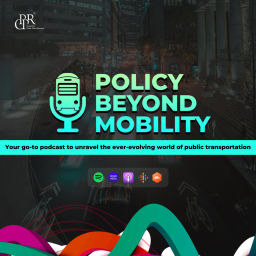
Policy Beyond Mobility
Claim This Podcastby CPPR Media & PR
5.0(2 reviews)
9 episodes
Updated Weekly
Accepts GuestsHas SponsorsLocation 🇮🇳
Podcast Overview
Policy Beyond Mobility is a podcast series on the ever-evolving world of transportation, by the the Centre For Public Policy Research. Where we bring to you podcasts with insightful discussions and diverse perspectives that surround the policies and innovations in the public transport ecosystem. With experts to discuss, deconstruct and advocate for things that matter.
Language
🇺🇲
Publishing Since
2/12/2024
3 verified contact emails on file for Policy Beyond Mobility
Pitch yourself as a guest, propose sponsorships, or reach out directly to the host.
Recent Episodes
December 11, 2025
EP 09 | Governance of the Shared Intermediate Public Transport Sector in Small and Medium Cities
<p>In this episode, we dive into the world of <strong>Shared Intermediate Public Transport (IPT)</strong>, the shared autos, taxis, and vikrams that are the de facto public transport in small and medium Indian cities. Despite their essential role in providing transportation services, the mainstream policy framework fails to adequately support the operational model of shared IPT.</p><p><br></p><p>We discuss the legal conflict created by colonial-era laws, the ingenious vernacular governance systems developed by operators, and the urgent reforms needed to formally recognize and integrate this vital sector, especially in the face of the Electric Vehicle transition.</p><p><br></p><p><strong>Key Discussion Points</strong></p><ul><li><p>Lack of acknowledgement that shared IPT constitutes the de facto public transport network in smaller Indian cities, in formal transport planning documents</p></li><li><p>Misclassification of shared IPT as contract carriage, stemming from the colonial-era Motor Vehicles Act</p></li><li><p>IPT operations and systems for route control, staging, and pricing</p></li><li><p>Future reforms including formal recognition and integration of existing governance structures into municipal planning</p></li><li><p>Promotion of Electric Vehicles (EVs) without clear operational guidelines and its governance risks</p></li><li><p>Revision of the Model Motor Vehicles Act<br></p></li></ul><p><strong>Speaker</strong></p><p><strong>Dr Gaurav Mittal</strong>, Researcher in Mobility Governance, Transport Studies Unit, University of Oxford</p><p><br></p><p><strong>Host</strong></p><p><strong>Chaithra Navada</strong>, Research Associate (Urban), CPPR</p><p>Tune in to delve into the evolving governance of the Shared IPT sector in Indian cities.</p>
August 23, 2024
EP 08 | Policy Beyond Mobility | The First And Last Mile Disconnect In Public Transport In Indian Cities
<p> </p> <p>In busy Indian cities, getting around can be challenging. We deal with problems like traffic congestion, pollution, and the constant struggle to find convenient transport options. The rapid growth of India’s urban population has triggered an increased demand for transport in the cities and surrounding areas, with commuters taking multiple long trips each day. This has also meant an augmented need for public transport. Public transportation systems account for 30 percent of trips in cities with populations between one and two million, 42 percent in areas with populations between two and five million, and 63 percent in cities with populations over five million.</p> <p>The innovation in the mobility space to close the first and last mile gap such as bike taxis, erickshaw, e-scooters should be encouraged as they offer better first and last mile connectivity. Further, a multimodal integration of all public transit modes in the city would enable service providers to build solutions to close the first and last mile gap. <br> KEY DISCUSSION POINTS</p> <ol> <li><p>Is India’s declining public transport ridership associated with poor first and last mile connectivity options? </p> </li> <li><p>Projected riderships in metro systems are often not achieved. Does this have a link to the non-availability of feeder services? </p> </li> <li><p><strong>Governance Perspective:</strong> </p> </li> </ol> <ul> <li><p>Who is responsible for ensuring first and last mile connectivity in Indian cities?</p> </li> <li><p>How do you think the permit system and capping on number of autorickshaw permits (in cities like Kochi) would affect the efficient implementation of first and last mile connectivity?</p> <p><br></p> <p><strong>4. Role of Micromobility:</strong> What role do micromobility options like bicycles and e-bikes play? Have they been able to cater to first and last mile connectivity? In some cities like Indore, these companies (eg. MyByk) are given VGF initially for operating. What other measures do the authorities have to take to ensure proper first and last mile connectivity?</p> </li> </ul>
August 2, 2024
EP 07 | Policy Beyond Mobility | The Hidden Pollution: A Case of Urban Vehicular Congestion
<p> </p> <p>Urban vehicular pollution has become a critical issue in the contemporary world, driven by rapid industrialization, urbanisation and the concentration of human activities in metropolitan areas. When discussing urban pollution, we tend to concentrate more on the air, sound and water pollution in urban areas. But it is equally important to delve into other attributes that influence and worsen the already prevalent pollution.</p> <p>We leave out one important aspect of pollution: urban congestion and its subsequent effects. The increase in vehicular ownership in India leads to congestion on urban roads, resulting in commuters spending more time on roads being stuck in traffic, leading to increased carbon emissions. </p> <p>The word congestion is often used in relation to vehicle traffic by specialists and the general public alike. The Concise Oxford English Dictionary (Oxford University Press, 2002) defines it as “abnormal accumulation, crowding, or obstruction, especially of traffic, etc.” It is commonly understood as a situation in which many vehicles are in motion and each of them progresses slowly and fitfully.</p> <p>Even though these definitions are subjective and fit into everyday usage, they are not completely accurate. Many attempts have been made to define what congestion is and to determine the origin point of traffic congestion. Multiple reports and research materials are available to get a better understanding of the same. </p> <p>This podcast discusses how traffic congestion contributes to urban pollution, what the possible reasons are and explores solutions for the same. The rationale for discussing urban congestion lies in its multifaceted impacts on economic efficiency, environmental sustainability and social well-being. Traffic congestion leads to significant economic costs due to lost productivity, increased fuel consumption, and delays in goods and services delivery. Additionally, it exacerbates aspects of conventional air and sound pollution. </p>
9 total episodes available
Deep-dive analytics for Policy Beyond Mobility
Frequently asked questions
Have a different question and can't find the answer you're looking for? Reach out to our support team by sending us an email and we'll get back to you as soon as we can.
- What is Policy Beyond Mobility?
- How often does this podcast release new episodes?
This podcast updates weekly.
- Where can I listen to this podcast?
This podcast is available on 7 platforms including Apple Podcasts, Spotify, and more. You can also use the RSS feed directly.
- Does this podcast accept guests?
Yes, this podcast regularly features guests.
Legal Disclaimer
Pod Engine is not affiliated with, endorsed by, or officially connected with any of the podcasts displayed on this platform. We operate independently as a podcast discovery and analytics service.
All podcast artwork, thumbnails, and content displayed on this page are the property of their respective owners and are protected by applicable copyright laws. This includes, but is not limited to, podcast cover art, episode artwork, show descriptions, episode titles, transcripts, audio snippets, and any other content originating from the podcast creators or their licensors.
We display this content under fair use principles and/or implied license for the purpose of podcast discovery, information, and commentary. We make no claim of ownership over any podcast content, artwork, or related materials shown on this platform. All trademarks, service marks, and trade names are the property of their respective owners.
While we strive to ensure all content usage is properly authorized, if you are a rights holder and believe your content is being used inappropriately or without proper authorization, please contact us immediately at hey@podengine.ai for prompt review and appropriate action, which may include content removal or proper attribution.
By accessing and using this platform, you acknowledge and agree to respect all applicable copyright laws and intellectual property rights of content owners. Any unauthorized reproduction, distribution, or commercial use of the content displayed on this platform is strictly prohibited.