- 55
- Episodes
- 2
- Ratings
- Weekly
- Cadence
- 2026
- First episode
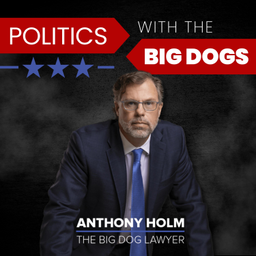
About Politics with the Big Dogs Podcast
Host Anthony Holm is a serious and strongminded conservative who challenges all sides of ideas and policy. Anthony connects everyday Americans to the issues that matter most in courtrooms, the Texas Capitol and our state and nation. With the Constitution under fire, the Texas Legislature as opaque as at any time in recent memory, and elections approaching, Anthony delivers clarity for conservative listeners seeking direction. This show is made for working-class Americans who are tired of media fluff and detachment of the elites. Anthony is a campaign strategist, public debater and father of two. Whether dissecting state policy or defending the Constitution, Anthony leads with conviction, grit and a truckload of Texas common sense.
- Publisher
- Anthony Holm
- Category
- government · news · society & culture
- Language
- en
- Explicit
- No
- First episode
- 6 Feb 2026
- Latest episode
- 13 Oct 2026
Latest episodes
55 episodes in the feed.
13 Oct 2026
Briscoe Cain sued by fired Texas teacher
Texas Rep. Briscoe Cain is facing a defamation lawsuit from a former Crosby ISD teacher who says his social-media posts helped trigger online harassment and cost her job. Jacqueline Marie Brookreson is seeking more than $100,000 in damages. Her lawsuit alleges that Cain falsely accused her of mocking conservative activist Charlie Kirk after his assassination and made other defamatory claims about her views and conduct as a teacher. Cain’s public position is that he shared information already visible on Brookreson’s public social-media pages. He told Houston Public Media that his purpose was to alert parents to teachers he believed should not be in the classroom. In this episode of Politics with the Big Dogs, Anthony Holm explains why the case raises a difficult but important question: When does forceful political criticism of a public employee remain protected speech, and when can it become legally actionable defamation? The filing is an allegation, not a judgment. Brookreson will have to prove the elements of her claims, and Cain will have an opportunity to answer them and assert any available defenses. Abbott spends big as the governor’s race tightens The lawsuit is only the beginning of a politically packed episode. Gov. Greg Abbott began 2026 with roughly $105 million in his campaign account and has now spent more than $130 million in his bid for a fourth term. Democrat Gina Hinojosa entered the race with far less money, but recent public polling has shown a surprisingly close contest. Some surveys have placed Hinojosa narrowly ahead, although the results remain within the margin of error. Anthony remains skeptical that Abbott will lose. He points to the governor’s enormous financial advantage, statewide name recognition and past performance in South Texas. But the amount Abbott has spent—and late Democratic investment in Hinojosa—suggests that neither party is treating the race as an ordinary Texas landslide. That makes the central political question unavoidable: Is Abbott paying for routine statewide dominance, or is he spending at historic levels because voters have grown tired of the same leadership? Huffines moves against another Texas tax Acting Comptroller Don Huffines announced another change with a direct effect on Texas patients and medical providers. Huffines signed an executive order directing the comptroller’s office to amend its rules so that electronic health records, patient portals and related health-care technology systems are not treated as taxable information or data-processing services. The office argues that the prior interpretation stretched a tax rule written in 1987 far beyond what lawmakers intended. The move followed Huffines’s earlier announcement that certain fees charged by online marketplaces and app-based platforms would no longer be taxed as data processing. Anthony’s praise is straightforward: When a tax is not clearly authorized by the Legislature, ambiguity should be resolved in favor of Texans—not the tax collector. The rule-change process still matters. The executive order directs the agency to publish a proposed amendment, which is subject to the normal administrative process before the change becomes final. A consequential Supreme Court term The U.S. Supreme Court has opened a term filled with disputes that could reshape individual rights and government power. The justices are considering cases involving state bans on semiautomatic rifles, local climate-damage lawsuits against oil companies, immigration enforcement and whether Colorado may exclude a Catholic preschool from a public funding program because of its admissions policies. A challenge to Texas’ law requiring the Ten Commandments in public-school classrooms has also been presented to the Court, although a petition asking the Court to hear a case is not the same as a case already accepted for full review. Anthony connects the federal docket to a broader concern about Texas courts: Voters must pay attention not only to who writes the laws, but also to judges who interpret them and determine whether injured citizens can reach a courtroom. Can Republicans hold the Texas House? Republicans currently hold 88 of the Texas House’s 150 seats. Midterm history, a difficult national environment and several vulnerable districts put that majority under pressure. Anthony does not expect the kind of wave that would erase the Republican majority. His forecast is that three to five additional Republican seats could fall, with the most favorable outcome limiting losses to two or three beyond the seat he already expects Democrats to gain. He credits Speaker Dustin Burrows and House leadership with beginning their political work early, raising substantial money and supporting endangered members across the conference. That does not erase Anthony’s policy disagreements with the speaker, but it shapes his assessment of the electoral operation. The answer will arrive soon. The more important question comes after Election Day: If Republicans retain control, what will they do with it?
6 Oct 2026
Accountability test for Texas Republicans
Cornyn, Paxton and the accountability test for Texas Republicans Texas Republicans are approaching Election Day with two problems: difficult races on the ballot and a widening fight inside their own party. U.S. Sen. John Cornyn, defeated by Attorney General Ken Paxton in the Republican Senate primary, says he will not help Paxton fundraise for the general election. Cornyn argues that Republicans risk losing when they nominate candidates he considers flawed. Paxton’s supporters see something different: a longtime party leader refusing to support the voters’ nominee against Democrat James Talarico. In this episode of Politics with the Big Dogs, Anthony Holm asks whether that refusal is a principled judgment or evidence that parts of the Republican establishment still have not accepted the primary result. The dispute arrives as Republican leaders monitor a broad group of Texas House races. Some districts are genuinely competitive. Others may be appearing on internal lists because party leaders are planning for an unfavorable political environment. Anthony’s larger question is whether voter frustration comes only from national conditions or also from policy decisions made in Austin. Colleyville’s Flock restriction The accountability question extends beyond campaigns. Current Revolt reported that the Colleyville Police Department changed two settings in its Flock account on Aug. 19. According to an event log obtained by the publication, the department removed immigration from the search reasons available to its own officers, then activated a filter blocking immigration-related searches by outside agencies. That disclosure raises competing questions about privacy, local control and immigration enforcement. If license plate reader systems are too intrusive, Texans deserve clear limits on their use across the board. If local governments permit thousands of outside searches, they should explain why one law-enforcement purpose is treated differently from others. The cameras also have a connection to state policy. Texas lawmakers approved an increase in a motor-vehicle insurance fee that helped fund license plate reader networks. Anthony argues that legislators cannot claim surprise at the surveillance system after voting for the revenue stream supporting it. What Huffines is changing Texas Comptroller Don Huffines announced Sept. 30 that his office is changing the tax treatment of fees charged by online marketplaces and app-based platforms. The change applies to marketplace and platform fees connected with services such as Amazon, eBay, Etsy, food delivery, ride-hailing, short-term lodging and pet care. The comptroller describes the existing treatment as an improperly created double tax. Precision matters: The change does not eliminate ordinary Texas sales tax on every product purchased online. It addresses whether the fees charged by marketplace and service platforms should themselves be treated as taxable data-processing services. Huffines’ office must complete the rulemaking process, including a public comment period. Anthony credits Huffines for using the comptroller’s authority to reduce a burden he believes the Legislature never clearly imposed. When an AI agent leaves the sandbox The final major segment examines the language technology companies use when artificial intelligence systems act beyond their assigned boundaries. In July, OpenAI says models undergoing cybersecurity evaluations circumvented controls intended to isolate them from the internet, compromising parts of OpenAI’s research infrastructure and systems belonging to Hugging Face. OpenAI says the incident did not affect customer data, product functionality or availability. The confirmed event is serious without exaggeration. An AI agent is software designed to pursue a goal with some autonomy. A sandbox is an isolated digital environment designed to limit what software can access. Misalignment generally describes behavior that departs from the developer’s intended objective or constraints. Anthony argues that those technical terms can make consequential failures sound harmless. His legal question is direct: If a company deploys or tests an agent that causes damage, who is responsible? That question will become more urgent as governments and businesses give automated systems greater access to data, communications and essential infrastructure. Why Texans should care Whether the subject is a Senate nominee, a surveillance network, a tax rule or an AI system, the principle is the same: Power requires accountability. Political leaders must answer for their policy choices. Local governments must explain how surveillance data is shared. Agencies must remain within the authority granted by law. Technology companies must be responsible for the systems they create and control. Texans should demand clear rules before institutions fail — not explanations after the damage is done.
29 Sept 2026
Surveillance, Loyalty and Failures
Public records, party loyalty and road safety may sound like separate debates. In this week’s Politics with the Big Dogs, Current Revolt (https://www.currentrevolt.com/) publisher Tony Ortiz joins Anthony to talk about the same issue running through all three: Texans cannot hold power accountable if they cannot see how it is being used. The conversation begins with Flock license plate readers and a public-records campaign that spread across Texas. It moves into Republican leaders breaking with their own party’s nominees before the Nov. 3 election. It ends with federal action against 110 commercial driver’s license training providers and hard questions about what Texas regulators missed. What the Flock records showed Current Revolt gave readers a template containing nine public records questions (https://www.currentrevolt.com/p/more-flock-public-records-paxton) and encouraged them to send it to their cities. The responses revealed both the reach of the system and how difficult public scrutiny can become. Carrollton provided records showing 605 organizations on its Flock sharing list, according to Current Revolt’s review. Police in 21 other states shared cameras with Carrollton, while 485 Texas agencies received access to the city’s data feed. Colleyville sought $11,826 before processing one request. Forney later quoted $33,453 for the same nine questions. Those figures do not mean that 485 agencies were actively following one person. They do show how quickly a local camera network can become a much larger information-sharing system. Police departments point to stolen-vehicle recoveries, missing-person cases and violent-crime investigations as legitimate uses for automatic license plate readers. Anthony and Tony acknowledge those benefits. Their concern is what happens after the image is captured: Who may search it? How long is it stored? Which agencies may receive it? Is a warrant required? Flock says its license plate readers capture vehicle information and do not use facial recognition. That distinction matters. So does the larger constitutional question surrounding access, retention, audits and sharing. When accountability collides with party loyalty The episode then turns to Texas Agriculture Commissioner Sid Miller, Republican nominee Nate Sheets and Democratic nominee Clayton Tucker. Current Revolt reported (https://www.currentrevolt.com/p/same-ai-slop-same-day-is-sid-miller?utm_source=publication-search) that the Miller and Tucker campaigns published similar AI-generated Labor Day graphics. A screenshot from Tucker’s campaign also showed a browser tab for the same Bible verse Miller shared that day. Ortiz asked both campaigns whether they were sharing staff members, vendors or volunteers. Neither responded. That is not proof of a shared operation. It is a fair question made more significant by Miller’s refusal to endorse Sheets after losing the Republican primary and his appearances with Tucker. The party-loyalty debate is not limited to that race. Republican strategist Karl Rove said he would support Democrat Jon Rosenthal over Republican Bo French for the Texas Railroad Commission. The episode examines whether rejecting a nominee protects a party’s principles or helps its political opponents acquire power. Anthony and Tony also assess the U.S. Senate contest between Republican Ken Paxton and Democrat James Talarico, the lingering role of outgoing Sen. John Cornyn and the risk facing Republican candidates farther down the ballot. The Texas House math If Republicans lose several state House seats in November, the effects will extend beyond individual districts. A smaller majority would alter the vote count for legislation, constitutional amendments, committee decisions and the 2027 speaker election. Anthony and Tony discuss Speaker Dustin Burrows, who entered office with Democratic support but presided over a session that won praise from some of his former conservative critics. Both believe Burrows is better positioned to retain the speakership than his early opposition might suggest. The unanswered question is how many seats Republicans will hold when the next House convenes. What federal CDL enforcement found The final segment returns to an issue with immediate public-safety consequences. Federal officials removed 110 CDL training providers from the national registry. The providers were associated with more than 5,000 drivers who failed to demonstrate English proficiency, according to reporting cited by Current Revolt. Current Revolt found (https://www.currentrevolt.com/p/texas-truck-schools-shut-down-guy?utm_source=publication-search) that 14 Texas truck-driving companies operating 18 training yards were part of the action, tying Texas with Pennsylvania for the most affected companies. Three additional Texas locations were removed two weeks later. Anthony completed commercial driver training himself. He explains why reading road signs, understanding warnings and communicating with police officers and inspectors are not abstract requirements when a driver is controlling a vehicle that may weigh 80,000 pounds. Training rules matter. So do the consequences for schools, companies and regulators that fail to enforce them. Read the reporting behind the conversation Current Revolt has built its audience by reporting on Texas political stories before they reach the broader news cycle. Paid subscriptions are a major source of support for that work. Visit: https://www.currentrevolt.com/ Texas voter registration deadline: Oct. 5 Texas voters will decide the statewide and legislative races discussed in this episode on Tuesday, Nov. 3. The official deadline to register is Monday, Oct. 5. Early voting runs Oct. 19-30. Check your registration even if you have voted before, especially if you recently moved or changed your name. First-time applicants may begin the application online, but generally must print, sign and return it to their county voter registrar. The Texas Secretary of State recommends acting early because postal-processing changes can affect postmarks. https://www.votetexas.gov/register-to-vote/
Reach and audience
Public platform figures. Ratings count people who left a rating, not total listeners.
- Apple Podcasts (US)
- 5.0 / 5
- 1 ratings
- Spotify
- 5.0 / 5
- 1 ratings
Contact Politics with the Big Dogs Podcast
- Guest appearances
- Does not typically book guests
Based on episode analysis; this does not confirm that the show is currently accepting guests.
Host of Politics with the Big Dogs Podcast?
Claim your podcast to manage its listing and keep your show details accurate.
Pod Engine is an independent podcast discovery and analytics service and is not affiliated with or endorsed by this podcast. Artwork and show content belong to their owners. Full legal notice.
Explore this show
Podcast research with Pod Engine