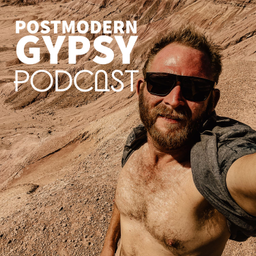
Postmodern Gypsy
Claim This Podcastby Jordan Poole
Podcast Overview
<p>Jordan Poole, a Millennial and an Artist from Appalachian Georgia, takes off to explore the backroads of America in this decade of the 2020’s. He finds an undercurrent of American counterculture’s survival along the path. Travel with him and Priscilla and find hope paved with the open road.</p>
Language
🇺🇲
Publishing Since
6/8/2023
1 verified phone number on file for Postmodern Gypsy
Pitch yourself as a guest, propose sponsorships, or reach out directly to the host.
Recent Episodes

June 16, 2026
The Scent of Revolution: George Washington’s Cologne and the Politics of American Perfume
<p><strong>In 1780, George Washington bought two cases of American-made cologne as a diplomatic gift for the Marquis de Lafayette. It was soft power disguised as fragrance. Here’s the full story.</strong></p><p></p><p><strong>Full Episode Description</strong></p><p><strong>In 1780, during an uncertain war for the survival of a new nation, George Washington paused his military campaign to purchase two full cases of perfume. He didn’t buy a prestigious French or British brand. He specifically sought out an American-made blend — and sent it to the Marquis de Lafayette, a French aristocrat from the highest echelons of a culture that essentially invented modern perfumery.</strong></p><p><strong>That fragrance was Number Six, formulated in 1772 by Dr. William Hunter at a small apothecary in Newport, Rhode Island that would eventually become Caswell Massey — still in business today, making it the longest continuously manufactured fragrance in America.</strong></p><p><strong>This episode traces the full story of Number Six: its 27-ingredient formula, the medical logic of colonial cologne, the diplomatic message embedded in Washington’s gifting choice, and the forensic chemistry required to recreate an 18th-century scent using 21st-century synthetic alternatives.</strong></p><p><strong>We also examine the uncomfortable tension in the story — Newport’s luxury economy was built on the triangular trade, meaning the symbols of American independence were assembled from the machinery of slavery and global commerce.</strong></p><p></p><p><strong>Topics Covered</strong></p><ul><li>Newport, Rhode Island as a cosmopolitan colonial hub and Dr. Hunter’s medical practice</li><li>Why cologne functioned as preventative medicine in the 18th century</li><li>The 27-ingredient formula of Number Six — bergamot, neroli, musk, clove, and amburgris</li><li>Washington’s non-importation philosophy and the politics of wearing American-made goods</li><li>The diplomatic flex of gifting American cologne to a French aristocrat</li><li>Lafayette’s 1826 return visit to Rhode Island — specifically to buy more Number Six</li><li>Molecular capture and synthetic substitution in historical fragrance recreation</li><li>The Newport wealth paradox: independence symbols built on the triangular trade</li></ul><p></p><p><strong>Tags / Keywords</strong></p><p>George Washington, Number Six cologne, Caswell Massey, American history, colonial history, fragrance history, perfume history, Mount Vernon, Lafayette, American Revolution, soft power, Newport Rhode Island, historic preservation, Postmodern Gypsy, Jordan Poole</p><p></p><p><strong>Category</strong></p><p>Primary: History | Secondary: Arts</p>

June 9, 2026
When the City Tries to Demolish Your Art: The Legal Battles Behind America’s Most Defiant Folk Art Sites
<p><strong>The Watts Towers survived a 10,000-pound crane test. The Heidelberg Project survived bulldozers. Salvation Mountain survived an environmental hit job. Here’s how folk art fights city hall.</strong></p><p></p><p><strong>Full Episode Description</strong></p><p><strong>In 1959, the city of Los Angeles wrapped a steel cable around Simon Rodia’s handmade towers and applied 10,000 pounds of lateral force — fully expecting the unauthorized scrap metal structure to snap and crumble. The towers didn’t move. The crane started to lift off the ground.</strong></p><p><strong>This episode examines the bureaucratic and legal battles that determine whether visionary self-taught art survives or gets bulldozed. We look at three landmark cases: the Watts Towers, the Heidelberg Project in Detroit, and Salvation Mountain in the California desert.</strong></p><p><strong>The Heidelberg Project faced city bulldozers multiple times in the name of blight ordinances before becoming one of Detroit’s most visited tourist destinations. Leonard Knight defeated an environmental shutdown at Salvation Mountain by disproving the county’s own soil sample data with independent laboratory tests.</strong></p><p><strong>Building codes exist for good reason. But applied without nuance, they can erase the most authentic expressions of American culture.</strong></p><p></p><p><strong>Topics Covered</strong></p><ul><li>Why monumental folk art exists in a state of perpetual legal illegality</li><li>The 1959 Watts Towers crane stress test — and the aerospace engineer who designed it</li><li>Tyree Guyton’s Heidelberg Project and the city of Detroit’s repeated bulldozing</li><li>Leonard Knight’s Salvation Mountain and the environmental shutdown he defeated</li><li>How demolition orders often catalyze the community recognition that saves a site</li><li>The irony of cities destroying what later becomes their most celebrated cultural landmark</li><li>Building codes as a language of structural load vs. art as a language of cultural truth</li></ul><p></p><p><strong>Tags / Keywords</strong></p><p>folk art, Watts Towers, Heidelberg Project, Salvation Mountain, outsider art, building codes, zoning laws, demolition orders, folk art preservation, urban art, Detroit art, Simon Rodia, Tyree Guyton, Leonard Knight, Postmodern Gypsy, Jordan Poole</p><p></p><p><strong>Category</strong></p><p>Primary: Arts | Secondary: Society & Culture</p>

June 2, 2026
The Untethered Workforce: What 18.5 Million Digital Nomads Are Doing to Cities, Labor Laws, and the American Dream
<p><strong>Over 18 million Americans now identify as digital nomads. Here’s what happens to cities, labor law, and civic life when high-paying work permanently detaches from geography.</strong></p><p></p><p><strong>Full Episode Description</strong></p><p><strong>For most of the 20th century, your zip code was your destiny. The city you lived in dictated the companies you could work for, the salary you could command, and the trajectory of your entire career. Then remote work, the gig economy, and a global pandemic dismantled that equation.</strong></p><p><strong>As of early 2025, an estimated 18.5 million Americans identify as digital nomads, a 153% increase since 2019. The global freelance and gig economy now generates an estimated $787 billion in annual economic value. More than 50 countries now offer digital nomad visas.</strong></p><p><strong>This episode traces the structural shift from centralized industrial labor to permanently untethered knowledge work — from the factory floor to Silicon Valley to the kitchen table to wherever you happen to have wifi.</strong></p><p><strong>We examine global employer of record platforms, the slow nomad movement, the maturation of van life demographics, and the fierce controversies the untethering is generating: gentrification in Lisbon and Bali, cross-border tax liabilities, and the growing precariousness beneath the gig economy’s freedom.</strong></p><p></p><p><strong>Topics Covered</strong></p><ul><li>How the Industrial Revolution centralized labor — and why that model is crumbling</li><li>The COVID-19 pandemic as involuntary mass remote work experiment</li><li>Global employer of record platforms and the elimination of the 50-mile hiring radius</li><li>The 50+ countries now offering digital nomad visas</li><li>The slow nomad movement and the maturation of van life demographics</li><li>Gentrification in popular nomad destinations and the local economic crisis it creates</li><li>Portable benefits and the precariousness beneath gig economy freedom</li></ul><p></p><p><strong>Tags / Keywords</strong></p><p>digital nomads, remote work, gig economy, future of work, nomadic lifestyle, van life, slow nomad, geographic arbitrage, employer of record, nomad visa, labor law, Postmodern Gypsy, Jordan Poole, work from anywhere, housing gentrification</p><p></p><p><strong>Category</strong></p><p>Primary: Business | Secondary: Society & Culture</p>
21 total episodes available
Deep-dive analytics for Postmodern Gypsy
Frequently asked questions
Have a different question and can't find the answer you're looking for? Reach out to our support team by sending us an email and we'll get back to you as soon as we can.
- What is Postmodern Gypsy?
<p>Jordan Poole, a Millennial and an Artist from Appalachian Georgia, takes off to explore the backroads of America in this decade of the 2020’s. He finds an undercurrent of American counterculture’s survival along the path. Travel with him and Priscilla and find hope paved with the open road.</p> - How often does this podcast release new episodes?
This podcast updates daily.
- Where can I listen to this podcast?
This podcast is available on 4 platforms including Apple Podcasts, Spotify, and more. You can also use the RSS feed directly.
- Does this podcast accept guests?
Information about guest appearances is not available.
Legal Disclaimer
Pod Engine is not affiliated with, endorsed by, or officially connected with any of the podcasts displayed on this platform. We operate independently as a podcast discovery and analytics service.
All podcast artwork, thumbnails, and content displayed on this page are the property of their respective owners and are protected by applicable copyright laws. This includes, but is not limited to, podcast cover art, episode artwork, show descriptions, episode titles, transcripts, audio snippets, and any other content originating from the podcast creators or their licensors.
We display this content under fair use principles and/or implied license for the purpose of podcast discovery, information, and commentary. We make no claim of ownership over any podcast content, artwork, or related materials shown on this platform. All trademarks, service marks, and trade names are the property of their respective owners.
While we strive to ensure all content usage is properly authorized, if you are a rights holder and believe your content is being used inappropriately or without proper authorization, please contact us immediately at hey@podengine.ai for prompt review and appropriate action, which may include content removal or proper attribution.
By accessing and using this platform, you acknowledge and agree to respect all applicable copyright laws and intellectual property rights of content owners. Any unauthorized reproduction, distribution, or commercial use of the content displayed on this platform is strictly prohibited.
