- 27
- Episodes
- 9
- Ratings
- Weekly
- Cadence
- 2026
- First episode
About POTENTIALITY
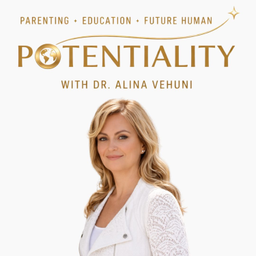
Welcome to Potentiality, a podcast exploring what becomes possible for humanity when we reimagine parenting and education. Through thought-provoking conversations, we make the unseen forces shaping human development visible. At its heart is a question: What becomes possible when we raise and educate young people who know who they are, trust themselves, and contribute meaningfully to the world? Empathic and sensitive youth are a central thread as a leading edge of what humanity is becoming. SUBSCRIBE to POTENTIALITY for an exploration of a more conscious path forward for the next generation.
- Publisher
- Dr. Alina Vehuni
- Category
- education
- Language
- en
- Explicit
- No
- First episode
- 30 May 2026
- Latest episode
- 16 Oct 2026
Latest episodes
27 episodes in the feed.
16 Oct 2026
Undoing the Silence of Young Girls
What becomes possible when a girl who has been taught to remain silent discovers that her voice can change not only her own life, but her community? In this episode of Potentiality, I welcome Crystal and Adrienne Warren from Global Catalyst, an organization mentoring girls across 30 countries to become confident leaders and advocates for themselves and others. Crystal's journey took her from volunteering as a teenager to working with girls affected by trafficking and exploitation in the Philippines. Adrienne left a career in financial management to pursue global health and development. Both found their way to work rooted in a shared conviction: young people deserve the opportunity to shape their own futures. At the heart of Global Catalyst's mission is Glow Club, a locally mentored program grounded in social-emotional learning (SEL). Girls develop self-awareness, emotional regulation, relationship skills, and the confidence to make decisions and use their voices. Leadership is not simply something they are told to demonstrate; it is something they are given the safety and space to practice. And the results extend far beyond the girls themselves. We hear about a girl in Vietnam who asked her grandfather to support her education as he had supported the boys in her family; girls in Rwanda who helped 60 peers return to school or vocational training; and a young leader in Côte d'Ivoire who mobilized her community to purchase equipment that created income opportunities for women. These stories invite us to consider a powerful progression: power within, power with, and power to — the inner confidence to act, the strength of collective effort, and the ability to create change beyond oneself. We also explore the challenge of adapting SEL across cultures without imposing outside assumptions, building authentic partnerships at scale, and measuring outcomes as deeply human as confidence and agency. For parents and educators, the conversation offers a particularly important reminder: children learn to trust their own judgment when adults listen, welcome respectful disagreement, and make room for meaningful choices. In this episode, you'll learn: Why Girls Need to Practice Leadership Before They Can Confidently Lead How SEL Builds Self-Awareness, Voice, and Agency Why One Caring, Consistent Adult Can Make a Profound Difference How Glow Club Turns Personal Growth Into Community Action What Girls in Vietnam, Rwanda, and Côte d'Ivoire Teach Us About Courage The Meaning of Power Within, Power With, and Power To Why Cultural Relevance and Local Mentorship Matter How to Measure Changes in Confidence and Self-Trust How Parents Can Encourage Independent Thinking and Respectful Disagreement Why Girls' Leadership Matters for the Future of Gender Equity Perhaps the deepest question is not whether girls have the potential to lead, but whether we are creating the conditions for that potential to emerge. When a girl discovers that her voice matters, she begins to imagine new possibilities. When she learns to act on what matters to her, those possibilities become real. And when girls are empowered to shape their own lives, the ripple effects reach families, communities, and generations to come. Guest Resources Website: https://www.global-catalyst.org Instagram: https://www.instagram.com/globalcatalysthq/LinkedIn: https://www.linkedin.com/company/global-catalyst-hq/Facebook: https://www.facebook.com/globalcatalyst.org What We Discuss: [Insert Timestamps]
10 Oct 2026
Who Is the Misread Learner?
What happens when a child enters a classroom carrying a wealth of knowledge, languages, experiences, and abilities, yet is seen primarily through the lens of what they cannot do? In this episode of Potentiality, I welcome Dr. Sebastian Puccio, an Argentinian-American educator, author, and speaker dedicated to more human and effective learning experiences for multilingual students. Sebastian immigrated to the United States from Argentina at age 11, bringing a rich educational foundation, family traditions, and everyday knowledge. Yet, while learning English, he encountered a school system that did not always recognize what he already knew. When a teacher corrected the method of division he had learned in Argentina, rather than exploring his understanding, Sebastian had to learn a new language and a new way of demonstrating knowledge he already possessed. That experience shaped his philosophy: What if, instead of beginning with what students lack, we began by discovering everything they bring? Drawing on his experiences as a multilingual learner, teacher, professor, and administrator, Sebastian introduces his Identity, Voice, and Agency Framework to help educators recognize the whole learner and support academic growth and self-determination. We explore long-term English learners, who may communicate comfortably in everyday English yet need support with academic language. We examine how silence can be mistaken for disengagement, how labels and low expectations shape a child's self-concept, and why relationships are an essential part of how learning happens. We also explore family partnerships, ancestral languages, cultural identity, and the profound loss that can accompany language disappearance. As AI becomes increasingly present in education, we consider why human connection, cultural knowledge, and the capacity to author one's own life matter more than ever. In this episode, you'll learn: • Why multilingual learners are often misread or unseen • The difference between conversational fluency and academic language proficiency • How deficit-based labels and low expectations shape student identity • Why cultural and linguistic knowledge must inform instruction • The three pillars of Identity, Voice, and Agency • Five daily commitments that bring asset-based teaching into practice • How language stories reveal strengths that test scores cannot capture • How to build student agency without compromising academic rigor • Why family partnerships and home-language preservation matter • What is lost when ancestral languages disappear The deepest invitation is to reconsider what it truly means to educate a human being. A student's proficiency level does not define their intelligence. Their silence does not reveal the depth of their thinking. Their family's circumstances do not determine the boundaries of their future. Every learner carries a story, a cultural inheritance, a developing voice, and possibilities that may remain undiscovered unless someone takes the time to see beyond the surface. When children are known, valued, challenged, and empowered, we help them recognize their worth, claim their voice, and become authors of their lives. Guest Resources: Website: https://sebastianpuccio.com/ (https://sebastianpuccio.com/) LinkedIn: Sebastian Puccio Ed.D. (https://www.linkedin.com/in/sebastian-puccio-ed-d-2897144/) What We Discuss: [02:18] The Childhood Experience That Shaped Sebastian's Approach [07:23] Long-Term English Learners: Why Is Fluency Misleading? [14:25] The Misread Student: Beyond Behavior and Language Gaps [20:52] How Labels and Low Expectations Shape Self-Concept [27:19] Identity, Voice & Agency: Empowering Multilingual Learners [35:47] Why Relationships, Trust & Human Connection Matter [39:29] Five Daily Commitments for Asset-Based Teaching [46:24] Beyond Test Scores: Students' Language Stories [54:44] Partnering with Families to Honor Language, Culture & Identity [01:04:51] Education in the Age of AI: Why Human Connection Matters
25 Sept 2026
From Violence to Peace
What if peace is not simply the absence of conflict, but a human capacity we can deliberately cultivate? In this episode of Potentiality, I welcome Mandar Apte, the director of Cities4Peace, whose work has taken him from corporate innovation at Shell to meditation, a filmmaking, and peacebuilding in communities divided by violence and generations of conflict. During his 17 years at Shell, Mandar managed the GameChanger social innovation program and developed a meditation-based leadership and innovation program that reached more than 2,000 employees. He has since worked with gang members, police officers, educators, and community leaders. But his journey into this work began with his own experience. After a frightening encounter as a young petroleum engineer in Nigeria, he returned home struggling with the psychological and physical effects of trauma. For the first time, he began asking a question his education had never prepared him to answer: What do we do when the system that breaks down is ourselves? That question led him to breathwork, meditation, and what he calls mental hygiene: learning to understand and work with our minds and emotions with the same care we bring to our physical health. We explore why these capacities belong not only in meditation centers or leadership programs, but in homes and schools. If children learn mathematics, science, and increasingly artificial intelligence, why are we not equally intentional about teaching them to regulate themselves, navigate conflict, build trust, and disagree without dehumanizing one another? We also explore From India With Love, inspired by Dr. Martin Luther King Jr.’s journey to India and his study of nonviolence. This work brought Mandar into spaces where people who might otherwise see one another as adversaries began sharing stories, practicing breathwork, and recognizing the humanity beneath their differences. At the heart of his work is an insight: peace cannot exist without trust. Trust begins when people feel safe enough to be seen, heard, and recognized as human beings. In this episode, we explore: • How Mandar’s experience with trauma changed his life • Why mental hygiene may be as essential as physical hygiene • How breathwork helps us work with stress and difficult emotions • Why inner regulation matters for parents, educators, and leaders • What Dr. King’s journey to India teaches us about nonviolence • What happens when gang members and police officers share a space • How storytelling and compassion help build trust across differences • Why educators can become powerful peacebuilders • How children can learn to disagree without losing connection • Why kindness, mutual respect, and healthy boundaries belong together Perhaps one of the deepest lessons of our conversation is that we cannot teach children capacities we have not begun cultivating within ourselves. As AI grows more capable and polarization shapes the world young people are inheriting, their future will depend not only on what they know, but on who they become: whether they can stay grounded, build relationships across differences, think beyond division, and recognize another person’s humanity without abandoning their own boundaries. Peace is not simply an aspiration for the world. It is an inner capacity, practiced one human being at a time. Guest resources https://www.mandarapte.net/ (https://www.mandarapte.net/) https://cities4peace.org/ (https://cities4peace.org/) https://cities4peace.org/america250/ (https://cities4peace.org/america250/)Use coupon code TAKE25 for a $25 discount. What we discuss: [03:06] From corporate engineer to peacebuilder [10:18] Breath, mind, and emotional regulation [21:44] Why mental hygiene should begin in childhood [26:34] Stress-free schools and regulated educators [34:06] Martin Luther King Jr., India, and nonviolence [46:10] Peace beyond the absence of conflict [54:38] From adversaries to humans: building trust [01:00:50] Human capacities that transform conflict [01:06:15] “Healed people heal people” [01:14:40] Teaching children the capacity for peace
Reach and audience
Public platform figures. Ratings count people who left a rating, not total listeners.
- Apple Podcasts (US)
- 5.0 / 5
- 4 ratings
- Spotify
- 5.0 / 5
- 5 ratings
Contact POTENTIALITY
- Guest appearances
- Books guests
Based on episode analysis; this does not confirm that the show is currently accepting guests.
Host of POTENTIALITY?
Claim your podcast to manage its listing and keep your show details accurate.
Pod Engine is an independent podcast discovery and analytics service and is not affiliated with or endorsed by this podcast. Artwork and show content belong to their owners. Full legal notice.
Explore this show
Podcast research with Pod Engine