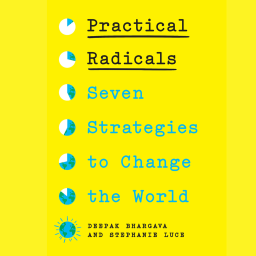
Podcast thumbnail for Practical Radicals

Practical Radicals

Claim This Podcast

by Deepak Bhargava and Stephanie Luce

5.0(39 reviews)
14 episodes
Updated Daily
Accepts GuestsHas SponsorsLocation 🇺🇸
6

Podcast Authority

Beta
PoorBased on show quality, social media presence, reviews, charts, and more
Pod Engine
Quality0
Social0
YouTube0
Engagement27

Podcast Overview

How do underdogs, facing far stronger opponents, sometimes win? In this biweekly podcast, based on their book "Practical Radicals: Seven Strategies to Change the World," Deepak Bhargava and Stephanie Luce talk with some of the leading progressive organizers and thinkers today and share insights crucial for the fight to build a better society. You can buy the book and find out more about the show at www.practicalradicals.org

Language

🇺🇲

Publishing Since

1/23/2024

Unlock The Full Podcast Authority Score Report

See how your podcast performs across key metrics

6

Podcast Authority

Beta
PoorBased on show quality, social media presence, reviews, charts, and more
Pod Engine
Quality0
Social0
YouTube0
Engagement27
3
Excellent Areas
1
Good Performance
7
Growth Opportunities
excellent
Show Notes Quality
4.0/5
Performing excellently!
good
Publishing Consistency
Every 13 days

Recommendations available

Unlock the full report to see detailed tips

poor
Episode Length
0 seconds

Recommendations available

Unlock the full report to see detailed tips

+8 More Metrics

Unlock comprehensive insights including:

  • • YouTube presence analysis
  • • Social media reach metrics
  • • RSS compliance scoring
  • • Podcast 2.0 features
  • • Technical standards
What's Included in Your Full Report

Detailed Analytics

  • Complete breakdown of all 11 authority metrics
  • Personalized recommendations for each metric
  • Industry benchmarks and comparisons
  • Technical RSS feed analysis and compliance scoring

Growth Strategies

  • Step-by-step action plans for improvement
  • Quick wins to boost your score immediately
  • Pro tips from successful podcasters
Get your free podcast insights report

See how your show performs across every key metric

Instant delivery
No spam
Attract Better Guests

High authority scores make your podcast more attractive to industry leaders and influencers who want to appear on credible shows.

Secure Sponsorships

Sponsors look for podcasts with proven authority and engagement. Your score demonstrates your podcast's value to potential partners.

Grow Your Audience

Understanding your strengths and weaknesses helps you make data-driven decisions to expand your listener base effectively.

2 verified contact emails on file for Practical Radicals

Pitch yourself as a guest, propose sponsorships, or reach out directly to the host.

Recent Episodes

Episode thumbnail for 13. Finale: What did we learn? Where do we go from here?

July 23, 2024

13. Finale: What did we learn? Where do we go from here?

<p>In this, our final episode of the Practical Radicals Podcast, we hear from over a dozen progressive leaders, including several former students, and reflect with them about what we’ve learned since the book <em>Practical Radicals</em> came out last November and what we make of the path ahead — as the U.S. and the world face a daunting and overlapping set of crises.</p> <p>We offer thoughts on the seven strategy models, looking at exciting developments in the field as well as areas that could improve. Base-building in community organizing faces major challenges. <strong>Sulma Arias</strong> has reoriented her organization, People’s Action, to spark a “revival of community organizing,” a field whose crisis became more acute and widely acknowledged during the COVID pandemic. The labor movement, by contrast, is experiencing its most exciting resurgence in decades.<strong> Stephen Lerner</strong> — whose organization, Bargaining for the Common Good, brings together unions and community groups to work on joint strategies — sees tremendous promise in labor’s upsurge, pointing especially to the prospect of organizing entire sectors and taking on “the giant corporations that are driving the whole economy.”  <strong>Thomas Walker</strong> of the Communications Workers of America explains why he thinks building on labor’s momentum calls for unions to spend more of their assets on base-building and to support new ways of organizing. </p> <p>Maurice Mitchell of the Working Families Party argues that movements need to get serious about governing power, which requires treating progressives elected to office as co-conspirators rather than targets. <strong>Lydia Avila</strong> describes her work with California Calls, which hopes to build a grassroots leadership development pipeline and combine the best principles of community organizing with electoral politics. </p> <p>A key strategy in the years ahead will be disruption, which <strong>Lisa Fithian</strong>, author of <em>Shut it Down</em>, argues is a “transformational process” that can give people a greater sense of agency over their own lives and the world. <strong>Lissy Romanow</strong>, who used to run the training institute called Momentum, points to hopeful examples where momentum as a strategy is being combined with more long-term base-building work. </p> <p>We then offer thoughts on the ways movements and organizations need to adapt to get sharper on strategy. Texas activist <strong>Asha Dane’el</strong> addresses the importance of developing a long-term vision and investing in leadership development that combines “rigor and compassion.” <strong>Alex Tom</strong> tells us how the Chinese Progressive Association hit upon a hugely successful new approach to fostering organizational alignment and preventing unnecessary internal conflict by writing a “culture operations document,” which is given to all new staff and explains the organization’s vision and leadership philosophy as well as key terminology. <strong>Doran Schrantz</strong> describes the commitment to leadership and other factors that have allowed ISAIAH, a church-based organization, and labor and community partners in Minnesota to transform the state. </p> <p>We conclude with some thoughts on our current historical conjuncture. Overdogs have never wanted a true democracy, and right now, they see an opening for autocracy. As <strong>Ian Bassin</strong> of Protect Democracy explains, by objective scholarly measures, “US democracy has been declining faster [in recent years] than almost any other country on the planet.” <strong>Alicia Garza</strong>, one of the founders of Black Lives Matter, argues that it’s crucial to form not only a “united front,” which brings together different elements of the left, but also a “popular front,” which unites the left with the center and even pro-democracy elements of the right. As the recent victories in France, India, and Brazil illustrate, there is nothing inevitable about the slide to authoritarianism — if we can achieve the unity and will to fight it.</p> <p><strong>Links: </strong></p> <p><a href="https://substack.com/redirect/56fb500b-1d7b-4a84-8785-5900fd7acad7?j=eyJ1IjoiZzc0cGQifQ.fwDMViKv6bYKFjtxO8zsV3s80E0hUkHJC8Whq4fOYGg" target="_blank">Leadership for Democracy and Social Justice</a></p> <p>Alicia Garza, <a href="https://substack.com/redirect/638db247-2406-47ba-a29e-5ba1e5142c94?j=eyJ1IjoiZzc0cGQifQ.fwDMViKv6bYKFjtxO8zsV3s80E0hUkHJC8Whq4fOYGg" target="_blank">The Purpose of Power: How We Come Together When We Fall Apart</a></p> <p>Lisa Fithian, <a href="https://substack.com/redirect/9e28d98b-cbc0-4600-bfdb-d3231f0f584d?j=eyJ1IjoiZzc0cGQifQ.fwDMViKv6bYKFjtxO8zsV3s80E0hUkHJC8Whq4fOYGg" target="_blank">Shut It Down: Stories from a Fierce, Loving Resistance</a></p> <p>Transcript for Ep. 13 (coming soon)</p>

Episode thumbnail for 12. Learning from Opponents with Munira Lokhandwala of LittleSis.org

July 2, 2024

12. Learning from Opponents with Munira Lokhandwala of LittleSis.org

<p>Most famous guides to strategy are written for overdogs. (Think of Machiavelli’s <em>The Prince</em> or Sun Tzu’s <em>Art of War.</em>)<em> </em>And overdogs today invest in strategic education at a scale that dwarfs anything on the left. Their commitment is captured in the slogan of the right-wing Leadership Institute, which has trained over 200,000 people: “You owe it to your philosophy to learn how to win.” </p> <p><br></p> <p>In researching<em> Practical Radicals</em>, Stephanie and Deepak found that overdogs rely mainly on three strategies to gain and keep power: 1) weakening underdogs’ sources of power; 2) employing what’s known in the military as psychological operations, or PSYOPS; and 3) dividing their opponents to conquer them. </p> <p><br></p> <p>The good news is that underdogs can use these same strategies against more powerful opponents. In this episode, Deepak and Stephanie discuss some great examples of how to counter corporate power, use PSYOPS against white supremacists, and drive wedges in elite coalitions. They also explore other lessons progressives can take from the overdogs’ playbook: crafting long-term plans, recruiting based on belonging rather than belief, and using data-driven evaluation paired with the lean startup model for organizing. </p> <p><br></p> <p>Our guest has made a career out of researching overdogs in innovative ways. <strong>Munira Lokhandwala</strong> is Director of Tech and Training at<a href="http://littlesis.org"> LittleSis.org</a>, the “nonprofit public interest research organization focused on corporate and government accountability.”  As the answer to Big Brother, LittleSis conducts research on the power elite, offers trainings for social change movements, and provides resources like<a href="https://littlesis.org/news/littlesiss-oligrapher-for-beginners/"> Oligrapher</a>, a tool that allows organizers to map power networks and pinpoint where to drive wedges. The secretive and overlapping networks of the powerful can seem “daunting” says Lokhandwala, “but actually, every one of those connections is a relationship that has to be maintained for them to maintain their power.” She encourages progressives to “think about[the overdogs’] large networks as an opportunity to come at their power, their reputation, their profits from many different angles. Then we can imagine building long-term, intersectional issue campaigns” that “turn the very source of their power against them.”</p> <p><br></p> <p><a href="https://docs.google.com/document/d/18OVQf5O2GPhAM9RChA_0siVnHU14PajDO3xTFTMPOoQ/edit?usp=sharing">Episode 12 transcript</a></p> <p>Links: </p> <p><a href="https://littlesis.org/news/littlesiss-oligrapher-for-beginners/">LittleSis’s Oligrapher for Beginners</a></p> <p><a href="https://mapthepower.net/trainingseries2024/#:~:text=This%20training%20will%20explore%20howto%20inform%20campaign%20strategy%20and">LittleSis 2024 Research Tools for Organizers Training Series</a></p> <p>Choose Democracy’s scenario planning tool<a href="https://whatiftrumpwins.org/"> https://whatiftrumpwins.org/</a></p> <p><br></p>

Episode thumbnail for 11. Abolitionism & the Seven Strategies with Manisha Sinha

June 18, 2024

11. Abolitionism & the Seven Strategies with Manisha Sinha

<p>In the struggle to abolish slavery — the social movement that arguably set the template for all that followed — organizers used all seven strategies we identify in <em>Practical Radicals</em>. According to our guest, historian <strong>Manisha Sinha</strong>, the abolitionists were “radical in their goals . . . but pragmatic in implementation” — the quintessential practical radicals. Stephanie and Deepak begin this episode by talking about the concepts of movement cycles and movement ecosystems and how conflict within movements can be generative. Then Stephanie and Professor Sinha explore some themes from Sinha’s award-winning 2016 book<a href="https://yalebooks.yale.edu/book/9780300227116/the-slaves-cause/"> <em>The Slave’s Cause: A History of Abolition</em></a>. As Sinha explains, the conventional wisdom about the abolitionists is wrong in many ways: contrary to depictions of the abolitionists as mostly white, bourgeois, defenders of capitalism, Sinha highlights the crucial role of Black abolitionists (including enslaved people who resisted from the earliest days of the slave trade), and the pervasive and “overlapping radicalisms” of the abolitionists, many of whom were utopian socialists and attended international conferences, not just against slavery but also for peace and women’s rights. Where previous historians have focused on the abolition movement that peaked in the 19th century, Sinha draws attention to an earlier wave of multiracial abolitionism in the late 18th century. And where others have viewed the movement as riven by differences and infighting, Sinha sees the abolitionists’ diversity as a source of strength, applauding their sensitivity to movement cycles and their political acumen in shifting strategies (e.g., at a key juncture, away from boycotts and toward party politics). She contends that the abolitionists served as “a prototype for racial social movements” in America and that radicals have been as “American as apple pie.” Sinha also suggests that the key lesson the abolitionists offer movements today is to “realize who the real enemy is . . . when you have at stake the future of American democracy.” Sinha’s new book, published in March of 2024, is entitled<a href="https://wwnorton.com/books/9781631498442"> <em>The Rise and Fall of the Second American Republic, Reconstruction 1860-1920</em></a><em>, </em>and it promises to be no less audacious and groundbreaking than her previous work, framing Reconstruction as a continuation of aspirations born in abolitionism and an attempt to fundamentally reground American democracy. </p>

14 total episodes available with 14 transcripts

Deep-dive analytics for Practical Radicals

Frequently asked questions

Have a different question and can't find the answer you're looking for? Reach out to our support team by sending us an email and we'll get back to you as soon as we can.

What is Practical Radicals?

How do underdogs, facing far stronger opponents, sometimes win? In this biweekly podcast, based on their book "Practical Radicals: Seven Strategies to Change the World," Deepak Bhargava and Stephanie Luce talk with some of the leading progressive organizers and thinkers today and share insights crucial for the fight to build a better society.

You can buy the book and find out more about the show at www.practicalradicals.org

How often does this podcast release new episodes?

This podcast updates daily.

Where can I listen to this podcast?

This podcast is available on 8 platforms including Apple Podcasts, Spotify, and more. You can also use the RSS feed directly.

Does this podcast accept guests?

Yes, this podcast regularly features guests.

Legal Disclaimer

Pod Engine is not affiliated with, endorsed by, or officially connected with any of the podcasts displayed on this platform. We operate independently as a podcast discovery and analytics service.

All podcast artwork, thumbnails, and content displayed on this page are the property of their respective owners and are protected by applicable copyright laws. This includes, but is not limited to, podcast cover art, episode artwork, show descriptions, episode titles, transcripts, audio snippets, and any other content originating from the podcast creators or their licensors.

We display this content under fair use principles and/or implied license for the purpose of podcast discovery, information, and commentary. We make no claim of ownership over any podcast content, artwork, or related materials shown on this platform. All trademarks, service marks, and trade names are the property of their respective owners.

While we strive to ensure all content usage is properly authorized, if you are a rights holder and believe your content is being used inappropriately or without proper authorization, please contact us immediately at hey@podengine.ai for prompt review and appropriate action, which may include content removal or proper attribution.

By accessing and using this platform, you acknowledge and agree to respect all applicable copyright laws and intellectual property rights of content owners. Any unauthorized reproduction, distribution, or commercial use of the content displayed on this platform is strictly prohibited.