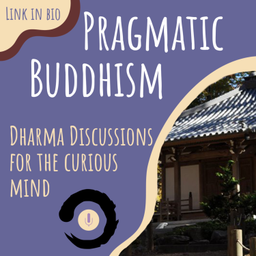
Welcome to Pragmatic Buddhism, a podcast offering down-to-earth Dharma talks, mindful reflections, and unscripted conversations for curious minds. We explore the intersection of ancient insight and modern life, weaving together Buddhist teachings, psychology, neuroscience, and lived experience.
Whether you're new to meditation or a longtime practitioner, this podcast invites you into a path of authentic awareness, compassionate acceptance, and wise action without dogma, jargon, or perfectionism.
What if you could explore Buddhism without having to believe that Buddhism is the one true path?
In this episode, Glenn leads a discussion with the Columbus sangha that explores one of the most important and most easily overlooked aspects of a pragmatic approach to Buddhism: don't cling to Buddhism itself.
Glenn and the sangha talk about what happens when Buddhists become attached to their own philosophy, how engaged Buddhism challenges the idea that accepting reality means simply accepting the world as it is, and why the practical question isn't always “Is this teaching true?” but rather, “Does this reduce suffering or increase it?”
Along the way, Glenn and the sangha consider Christianity, Islam, religious certainty, proselytizing, and our own tendency to believe that our way is better than everyone else's.
For anyone curious about Buddhism but uncomfortable with dogma, religious exclusivity, or the idea that you have to accept a particular set of beliefs, this conversation offers another possibility: Buddhism as a way of living that can be tested in your own life—not a claim that you've found the only way.
Because perhaps the point isn't to find the right philosophy.
Perhaps it's to find a way that helps us live with greater awareness, compassion, and less suffering.
28 Aug 2026
Aspiration, Appreciation, Conviction: Batchelor on Resolve, and Why Trust Isn't Faith
What do you do with a teaching that asks you to trust something you can't prove? James from the St. Louis sangha reads Stephen Batchelor's "Resolve" chapter and his answer is to keep the trust pointed at yourself and at the decision you already made, rather than at a claim about the universe. He works through Batchelor's three words for resolve — aspiration, appreciation, conviction — through the idea that our conditioning behaves like an addiction, and through Buddha nature, which he handles carefully because this is an agnostic practice and he'll only speak to what he knows. He's honest that he'd still call it spiritual. The St. Louis sangha discusses these ideas and introduces equanimity, self-compassion, tai chi, and more from their experiences.
14 Aug 2026
Can AI Teach Us Buddhism? Why Practice Still Matters
AI can give us almost endless information about Buddhism, but can information actually transform us? In this thought-provoking Dharma talk, Tim Curtis explores what gets lost when we confuse knowing about the Dharma with experiencing it. Using AI, meditation, and the famous Good Will Hunting distinction between knowledge and lived experience, Tim asks if we can truly understand the Dharma without actually practicing it. This compelling conversation is for anyone interested in Buddhism as something to live, not simply something to learn.
Reach and audience
Public platform figures. Ratings count people who left a rating, not total listeners.
Spotify
5.0 / 5
2 ratings
Contact Pragmatic Buddhism
Guest appearances
Does not typically book guests
Based on episode analysis; this does not confirm that the show is currently accepting guests.
Host of Pragmatic Buddhism?
Claim your podcast to manage its listing and keep your show details accurate.
Pod Engine is an independent podcast discovery and analytics service and is not affiliated with or endorsed by this podcast. Artwork and show content belong to their owners. Full legal notice.
Explore this show Podcast research with Pod Engine