- 26
- Episodes
- 3
- Ratings
- Bi-weekly
- Cadence
- 2025
- First episode
About Price Power
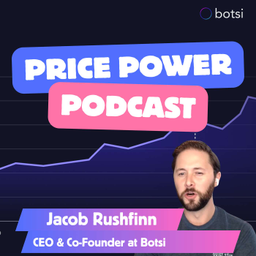
The Price Power Podcast is for all things growth, retention, and monetization for subscription mobile apps. We talk with amazing leaders in the industry to help share their knowledge with you. Hosted by Jacob Rushfinn, CEO of Botsi.
- Publisher
- Jacob Rushfinn
- Category
- business · technology
- Language
- en
- Explicit
- No
- First episode
- 7 Oct 2025
- Latest episode
- 15 Oct 2026
Latest episodes
26 episodes in the feed.
15 Oct 2026
26: The truth about ChatGPT ads w/ Gabe Kwakyi
We’re talking with Gabe Kwakyi today, who was actually our first guest! He is a mobile app OG, was previously the CEO of Lingvano, the #1 sign language app, and is now doing consulting, advising and fractional head of growth for apps. As well as building some stuff on his own. This is a pretty cool episode because Gabe has been testing ChatGPT ads, and we get to learn from his real experience about how they work, what works today, and what the future could look like. Gabe has run ChatGPT Ads tests across his own portfolio of apps and several client apps since the self-serve platform launched in May 2026. He walks through the setup, shares the context hints that flopped and the ones that drove conversions, and explains why an app icon beat every other creative he tried. He also makes the case that ChatGPT Ads will become a serious channel once OpenAI has enough conversion data; until then, most tests will fail. What you’ll learn: • How ChatGPT Ads are structured: campaigns, ad groups, ads, and the handful of targeting options available today • What context hints are and why they’re the main lever you control • Why ChatGPT Ads deliver decent CPMs, CPCs and CTRs but very few trials or purchases • How Gabe’s test across eight apps turned out, and why most apps saw zero purchases • Why users on ChatGPT’s free and Go plans may be harder to convert into subscribers • Why OpenAI’s missing conversion data, not its targeting tech, is the real blocker • How conversation “turns” affect whether a user is ready to see an ad • Which context hint patterns worked: conversation context, user goals, rejected ideas, and the “layup insertion” • Why keyword-style context hints only sometimes work • Why a plain app icon outperformed screenshots and Meta creative • What URL parameters ChatGPT passes and what the “oppref” parameter is • How to tailor your onboarding to ChatGPT traffic intent • How to tell whether ChatGPT Ads are lifting your organic ChatGPT referrals • When it’s worth testing now and when to wait • Gabe’s feature wish list for the ChatGPT Ads team Key Takeaways: Context hints are your creative. ChatGPT Ads give you almost no creative surface, so the context hint does the work that ad creative does on Meta. Gabe spends his testing budget there first and treats headline and copy as secondary. Clicks are cheap; buyers are rare. Across Gabe’s eight-app test, CTR averaged 1.68% and install rate 3.36%, but purchase conversion averaged 0.14%. Most apps saw zero purchases. Industry reports match: one review of 35 case studies found 22 with zero conversions. The blocker is data, not targeting. Meta became a great performance channel because every advertiser sent conversion events back. ChatGPT Ads launched in May 2026 and hasn’t collected enough postbacks to know which users buy. That will change as more advertisers integrate their MMPs. Target the moment, not the topic. “Users who want date ideas” brings volume. “User keeps rejecting every date idea and wants better ones” brings people who still have the problem and are open to a new solution. Gabe’s best results came from these frustrated, self-qualifying moments. Use your app icon. The ad image is a small square next to the answer. Screenshots and text-heavy banners are unreadable there. An icon looks like a product recommendation, which is what users expect. Testing is cheap, so treat it as learning. The minimum budget is $25 a day and setup takes minutes with an MMP tracking link. Gabe recommends testing every couple of months so you’re ready when performance turns, and skipping it if you need a new channel to work this quarter. Check your organic referrals. One advertiser spent $600 with no attributed conversions but saw organic ChatGPT referrals rise. If you test, watch untracked traffic and “how did you hear about us” answers. Links & Resources • Gabe Kwakyi on LinkedIn: https://www.linkedin.com/in/gabrielkwakyi/ • Rhythmic apps: https://rhythmicapps.com/ Timestamps 00:00 Why Gabe started testing ChatGPT Ads 01:45 How the ChatGPT Ads platform works 03:15 What context hints are 07:30 Great clicks, low conversions: results from eight apps 10:00 Free and Go users, and the missing conversion data 13:00 Is ChatGPT closer to search or social? 15:30 Conversation turns and the right moment for an ad 17:30 Rejected ideas and the “layup insertion” 20:45 Why campaigns are so volatile 22:00 More context hint categories to test 26:00 Personalizing onboarding by traffic intent 28:30 URL parameters and tracking 30:00 Why the app icon beats every other creative 35:15 Is it worth testing right now? 38:30 The organic referral halo 41:00 Gabe’s feature wish list 46:15 Have fun with it: the return of real marketing
1 Oct 2026
25: 13 Onboarding Principles for High-Converting Subscription Apps
Jacob Rushfinn, CEO of Botsi, has spent a decade in consumer apps figuring out how to convert users. He compiled 13 principles for your onboarding flow that will make a difference. These are all from experimentation and research from top apps like Opal, Finch, Headway, Tiimo, Tolan, Zing, and more. What you'll learn: • Why the first screen is a drop-off point most teams never measure • How Opal, Rise Science, and Headway hook users before they tap anything • Why story-style intro screens beat any UI pattern you invent • Why simple string personalization beats complex personalization almost every time • How to make quiz questions feel like a conversation instead of a form • Why letting people build something (a pet, a name, a journal entry) raises commitment • How to show users the math on the value they'll get • How to build trust across the whole flow: answer the biggest fear, lead with emotion, back it with numbers • When to prime permission prompts and when to just fire the native one • Why there is no excuse left to skip video, with examples from Lingokids, BoldVoice, and Ladder • How to turn loading screens into selling screens • How to make the free trial impossible to miss, and what to do when users close the paywall anyway Key Takeaways: - Your first screen is a drop-off point. It can lose 10 to 30 percent of new users before they tap anything. A plain welcome, get started, log in screen works for big brands; everyone else needs a hook that's interesting and easy, like Opal's glowing rock or Finch's "Hatch a new pet" button. - Ask for the account when intent is highest. Tiimo moved account creation from right before the paywall to right after the welcome screen and lifted both account creation and trial starts. It also stops you from asking for an email and a payment back to back. Test it, or skip account creation until after the paywall. - Say the user's goal back to them. Ask the goal, ask why it matters, then repeat their words on the next screen, in the plan recap, and in the paywall headline. Zing, Tiimo, and Impulse all do this, and it rarely fails to lift conversion. - Let people build something. People value what they put work into. Finch has you design a bird, which is fun, low-effort, and raises no privacy concerns. Add presets and shuffle buttons so nobody stalls on a blank text field. - Show them the math. Turn inputs into a concrete number: Opal's five years of your life, Rise's sleep debt, Headway's 38 book summaries a month. When users hit the paywall, they should already know what they're getting. - Build trust before you ask for money. Most apps cram trust into the paywall. Better apps spread it across the flow: answer the user's biggest fear (privacy, for Flo), lead with emotion, back it with a number, and repeat your strongest social proof. - Make the trial impossible to miss. People don't read paywalls. They see a price and leave, even when the trial is visible. Trial reminders, choose-your-trial screens, and multi-page paywalls force users to notice it. When they close the paywall, follow up with a second offer. - Onboarding doesn't end at the paywall. Don't drop a new subscriber onto an empty home screen. Imprint sends you straight into your first lesson; Balance auto-starts a sleep meditation for people who picked sleep. This is what separates good trial starts from good trial conversion. Links & Resources - Price Power Podcast: https://pricepowerpodcast.com - Botsi onboarding flow library: https://botsi.com/resources/flows - Retention.blog: https://retention.blog - Jacob on LinkedIn: https://www.linkedin.com/in/jacob-rushfinn/ Timestamps 00:00 Why onboarding decides whether your app is worth paying for 00:45 1. Hook them on the first screen 03:00 2. Borrow UI patterns people already know 04:00 3. Ask for account creation when intent is highest 05:30 4. Ask the user's goal, then say it back to them 07:05 5. Make onboarding questions feel like a conversation 08:15 6. Let people build something 09:30 7. Show them the math 10:30 8. Build trust before you ask for money 12:48 9. Earn the permission opt-in 14:15 10. Use video, because it's cheap now 16:05 11. Turn loading screens into selling screens 18:00 12. Make the trial impossible to miss 20:20 13. Onboarding doesn't end at the paywall 22:13 Recap of all 13 24:15 What to test first and which metrics to watch
17 Sept 2026
24: Failed Payments are Free Money w/ Philip Pages
Philip Pages, founder of Redux Payments, explains why moving off Apple's in-app purchases quietly strips away a retention machine most founders never knew they had, how failed payments actually work, and when payment orchestration is worth the extra complexity. Philip has looked inside hundreds of app payment accounts, and most of them are leaving real money on the table. He walks through the difference between a customer who wants to churn and a card that simply had no funds that morning; why recovered subscribers stick around for another three to six billing cycles; and the single setting that quietly blows up Stripe accounts. Jacob and Philip also get tactical on the app-to-web paywall pattern that converts, the retry schedule that recovers cards without triggering the card networks, and a meditation app that got back six figures by changing nothing but the timing of its retries. What you'll learn • Why Apple's in-app purchase system silently recovers failed payments, and exactly what you give up when you leave it • Why most failed payments have nothing to do with a customer wanting to cancel • How recovered subscribers behave once you win them back (they stay another three to six billing cycles) • Why the "30% down to 5%" margin pitch for web billing is misleading • How to tell whether your app is even ready to test web billing • Why older, Facebook-native audiences convert better on web-to-app flows than younger ones • How to set up web payments without blowing up your Stripe or Paddle account • What chargebacks, early fraud warnings, and approval rates actually do to your account health • How merchant-of-record providers take ownership of your transactions, and what that costs you later • What payment orchestration is, and the revenue point where it starts paying for itself • How one meditation app recovered over $150K by fixing retry timing by locale • How long you should really retry a failed card, and why spamming it backfires • The compliant two-button app-to-web paywall pattern that didn't exist a year ago Key takeaways • Apple runs a retention machine you never see. Behind the scenes, Apple retries cards near paydays, fixes bank issues, and serves in-app prompts for up to 60 days. It feels like magic, but it is a system. Move to web and that system is now your job. • Most failed payments are not people trying to leave. Insufficient funds at one moment in time and random bank rejections make up the bulk of failures. Treating every failure as a lost cause writes off customers who already paid you for months. • The margin math is messier than the pitch. Providers love to say you'll save 25 to 27 percent. Philip says heavily discount that. Even so, saving 15 percent and reinvesting it in growth can compound fast, so the channel is still worth testing. • Don't touch web billing before product-market fit. Under a million in ARR with no PMF, the only job is finding PMF. Optimizing payments early is a distraction. Post-PMF, commit real budget or don't bother. • Cancel your subscriptions. The number one way apps wreck their Stripe account is leaving failed subscriptions open. They stack, they collect chargebacks, and one subscription that should have had a single chargeback ends up with seven. • Retry timing beats retry volume. One app had 64 percent of failures come from insufficient funds. Retrying by local payday instead of at random recovered over $150K. Brute-forcing the card just gets you flagged by the networks. • Orchestration is where big brands quietly win. Netflix, Spotify, and other large subscription companies route payments across multiple processors to lift approval rates. Most smaller apps have never even considered it. • The app-to-web playbook is new, and it works. Two CTA buttons, a rebuilt mini-onboarding before the paywall, and Apple Pay on by default. Philip's word for the pattern Jacob describes: gold. It did not exist a year ago. Links & resources • Philip Pages on LinkedIn: https://www.linkedin.com/in/philip-pages-a881b5139/ • Redux Payments: https://www.reduxpayments.com/ 0:00 Intro 02:00 Intro and Philip's first company (peaked near $3.5M ARR, then shrank) 04:11 Apple's hidden failed-payment machine, and what you lose moving to web 07:00 What a failed payment actually is, and why most aren't churn 11:05 The real margin math behind leaving the App Store 12:16 Why web billing is hitting critical mass now 17:20 Matching the right user to the right payment method 21:33 Getting started: providers, merchant of record, subscription management 25:47 How to not blow up your Stripe account 28:43 Chargeback alerts and fighting chargebacks 30:40 Merchant of record: owning the transaction, and getting out 34:27 Payment orchestration and cascading across processors 39:06 When web billing is a mistake (pre product-market fit) 44:47 App-to-web compliance and the two-button paywall playbook 52:32 A failed-payment recovery teardown (the six-figure meditation app) 59:02 How long to retry a failed card 01:03:00 The scariest account story, and what Redux Payments does
Reach and audience
Public platform figures. Ratings count people who left a rating, not total listeners.
- Apple Podcasts (US)
- 5.0 / 5
- 1 ratings
- Spotify
- 5.0 / 5
- 2 ratings
Contact Price Power
- Guest appearances
- Books guests
Based on episode analysis; this does not confirm that the show is currently accepting guests.
Host of Price Power?
Claim your podcast to manage its listing and keep your show details accurate.
Pod Engine is an independent podcast discovery and analytics service and is not affiliated with or endorsed by this podcast. Artwork and show content belong to their owners. Full legal notice.
Explore this show
Podcast research with Pod Engine