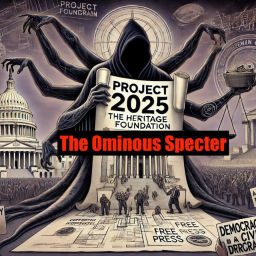
Podcast thumbnail for Project 2025: The Ominous Specter

Project 2025: The Ominous Specter

Claim This Podcast

by Inception Point AI

2.9(20 reviews)
273 episodes
Updated Daily
Accepts GuestsHas SponsorsLocation 🇺🇸
60

Podcast Authority

Beta
FairBased on show quality, social media presence, reviews, charts, and more
Pod Engine
Quality99
Social0
YouTube0
Engagement49

Podcast Overview

Project 2025: The Ominous Specter Ladies and gentlemen, we find ourselves standing at the precipice of a dark and foreboding future, one in which the very foundations of our democracy are under siege. The threat we face is not an external one, but rather a cancer that has metastasized within the body politic itself. I speak, of course, of the insidious manifesto known as Project 2025 – a blueprint for authoritarian rule that masquerades as a conservative vision for the United States. As we delve into the depths of this pernicious document, crafted in the shadowy halls of the Heritage Foundation, it becomes abundantly clear that we are witnessing nothing less than a frontal assault on the principles that have long sustained our republic. Project 2025 is not merely a misguided set of policy proposals; it is a calculated attempt to dismantle the very fabric of our democratic institutions, to concentrate power in the hands of a few, and to impose a rigid ideological orthodoxy on a nation that has always prided itself on its diversity and its commitment to individual liberty. At its core, Project 2025 seeks to reshape the federal government in the image of a conservative dystopia. Its proponents, consumed by an insatiable hunger for power and an unwavering commitment to their ideological agenda, have meticulously crafted a roadmap for the systematic erosion of checks and balances, the suppression of dissent, and the consolidation of executive authority. It is a vision that should send a shiver down the spine of every freedom-loving American, for it represents nothing less than a repudiation of the very principles upon which this nation was founded. The architects of Project 2025 argue, with a level of audacity that borders on the delusional, that the federal bureaucracy is overrun with unaccountable liberals who impede their agenda. Their solution? A purge of Stalinist proportions, reclassifying tens of thousands of civil servants as political appointees, effectively transforming the machinery of government into an apparatus of ideological conformity. The implications of this proposal alone are staggering – the eradication of expertise, the subversion of meritocracy, and the creation of a loyalty-based system that would make even the most fervent authoritarian blush. But the assault on democratic institutions does not end there. Project 2025's disdain for the separation of powers is as blatant as it is dangerous. Its vision of a "unitary executive theory" is nothing short of a repudiation of the very principles enshrined in our Constitution. By seeking to exert control over independent agencies like the Department of Justice and the FBI, the project's architects aim to transform these bastions of impartiality into instruments of partisan enforcement. It is a move that would make Richard Nixon's transgressions seem like mere child's play, a power grab of such magnitude that it threatens to unravel the very fabric of our democracy. And yet, even as we r This content was created in partnership and with the help of Artificial Intelligence AI.

Language

🇺🇲

Publishing Since

7/11/2024

Unlock The Full Podcast Authority Score Report

See how your podcast performs across key metrics

60

Podcast Authority

Beta
FairBased on show quality, social media presence, reviews, charts, and more
Pod Engine
Quality99
Social0
YouTube0
Engagement49
9
Excellent Areas
2
Good Performance
8
Growth Opportunities
excellent
Publishing Consistency
Every 2 days
Performing excellently!
good
Show Notes Quality
3.0/5

Recommendations available

Unlock the full report to see detailed tips

poor
Episode Thumbnails

Recommendations available

Unlock the full report to see detailed tips

+16 More Metrics

Unlock comprehensive insights including:

  • • YouTube presence analysis
  • • Social media reach metrics
  • • RSS compliance scoring
  • • Podcast 2.0 features
  • • Technical standards
What's Included in Your Full Report

Detailed Analytics

  • Complete breakdown of all 19 authority metrics
  • Personalized recommendations for each metric
  • Industry benchmarks and comparisons
  • Technical RSS feed analysis and compliance scoring

Growth Strategies

  • Step-by-step action plans for improvement
  • Quick wins to boost your score immediately
  • Pro tips from successful podcasters
Get your free podcast insights report

See how your show performs across every key metric

Instant delivery
No spam
Attract Better Guests

High authority scores make your podcast more attractive to industry leaders and influencers who want to appear on credible shows.

Secure Sponsorships

Sponsors look for podcasts with proven authority and engagement. Your score demonstrates your podcast's value to potential partners.

Grow Your Audience

Understanding your strengths and weaknesses helps you make data-driven decisions to expand your listener base effectively.

2 verified contact emails on file for Project 2025: The Ominous Specter

Pitch yourself as a guest, propose sponsorships, or reach out directly to the host.

Recent Episodes

Episode thumbnail for Project 2025: Heritage Foundation's 900-Page Blueprint to Reshape Federal Government and Executive Power

June 18, 2026

Project 2025: Heritage Foundation's 900-Page Blueprint to Reshape Federal Government and Executive Power

Project 2025 begins with a bold promise. In the Heritage Foundation’s own words, its Mandate for Leadership is designed to give the next conservative president “the personnel and policies needed to rescue the country.” Heritage and its partners have built a 900‑plus‑page blueprint, and, as Democracy Forward reports, an eight‑figure transition effort to make sure that blueprint is ready to use on day one. At the heart of the project is a sweeping reimagining of federal power. According to Heritage’s Mandate, the goal is to restore what it calls “presidential control of the executive branch,” replacing many career officials with loyal appointees and curbing the independence of agencies that traditionally operate at arm’s length from the White House. The Center for Progressive Reform’s Project 2025 Executive Action Tracker notes that the Trump administration has already initiated or completed more than half of the domestic administrative agenda drawn from these proposals, illustrating how quickly such ideas can move from paper to policy. Listeners can see the scope of the plan most clearly in its treatment of federal agencies. Brookings Institution analysts describe how the education chapter calls for dismantling the U.S. Department of Education altogether, eliminating Head Start and phasing out Title I funding for low‑income schools over ten years. The same section urges rolling back civil rights protections for LGBTQ+ students and weakening federal enforcement of discrimination laws. Brookings warns that, taken together, these ideas would “dramatically reshape the federal government’s role in education,” shifting power and risk back onto states, districts, and families. Other chapters reach just as far. The American Civil Liberties Union explains that Project 2025 urges reviving the 19th‑century Comstock Act to block abortion medication by mail, expanding immigration crackdowns through mass deportations and family separation, and even ending birthright citizenship. Democracy Forward’s People’s Guide to Project 2025 calculates that proposed executive actions could cut overtime protections for 4.3 million workers, reduce food assistance for roughly 40 million people, and push more seniors from traditional Medicare into private plans. Supporters argue these steps would restore constitutional government, religious liberty, and what Heritage calls “ordered liberty.” Critics, including the ACLU and the Center for American Progress, counter that the blueprint would erode checks and balances, centralize power in the presidency, and “disrupt nearly every aspect of American lives,” from health care to retirement. The next major milestones will come as candidates either embrace or distance themselves from this playbook, and as courts, Congress, and voters test how far any president can go in remaking the federal state by executive action alone. Thanks for tuning in, and come back next week for more. Some great Deals https://amzn.to/49SJ3Qs For more check out http://www.quietplease.ai

Episode thumbnail for Project 2025: How the Heritage Foundation's Conservative Blueprint Plans to Remake the Federal Government

June 16, 2026

Project 2025: How the Heritage Foundation's Conservative Blueprint Plans to Remake the Federal Government

Project 2025 began as a thick policy manual on a shelf in 2023. Today, it is rapidly becoming a test of how far a presidential administration can remake American government using the machinery of the executive branch alone. According to the Heritage Foundation, which coordinates the effort, Project 2025 is “a conservative policy agenda and curated personnel database” designed to guide a future administration in “taking back the administrative state” through its 900‑page Mandate for Leadership blueprint. Heritage casts the project as a course correction. In the introduction to Mandate for Leadership, the authors argue that “the next conservative President must make the institutions of American government work again for the American people” and insist that too much power has migrated to “unaccountable bureaucrats” within federal agencies. That framing underpins their most aggressive proposals: replacing large numbers of civil servants with political loyalists, restructuring agencies, and centralizing power in the Oval Office through an expanded view of the so‑called unitary executive, the theory that the president must control the entire executive branch. The scale is striking. The American Civil Liberties Union explains that Project 2025 is a “roadmap for how to replace the rule of law with right‑wing ideals,” touching immigration, reproductive rights, education, and civil rights. Heritage’s own documents call for a sweeping reorganization of the Department of Justice, with a sharper focus on prosecuting what they describe as “woke extremism,” and for reining in the independence of the Department of Education by steering funds away from diversity, equity, and inclusion programs and toward religious and charter schools. Critics see something much darker. Democracy Forward, a legal advocacy group that conducted a subject‑by‑subject review, concludes that Project 2025 outlines “a systemic, ruthless plan to undermine the quality of life of millions of Americans.” Their analysis highlights proposals to cut overtime protections for roughly 4.3 million workers, limit food assistance relied on by more than 40 million people each month, and eliminate the Head Start early education program that serves over a million children annually. Democracy Forward warns that Project 2025’s authors explicitly argue many of these changes can be done “through executive branch action alone, without new legislation.” Civil rights groups are especially alarmed by social policy. The ACLU notes that Project 2025 urges reviving the nineteenth‑century Comstock Act to restrict the mailing of abortion medication, rolling back nondiscrimination protections for LGBTQ people, and reshaping immigration enforcement through mass deportations and a weakened asylum system. In the ACLU’s words, it is “a blueprint for a radical restructuring of the executive branch” that would sharply narrow protections for immigrants, women, and marginalized communities. Supporters counter that these are overdue corrections. Project 2025 authors argue that agencies like the Environmental Protection Agency and the Department of Health and Human Services have long pursued “woke” agendas without democratic accountability, and they present their plan as returning power to elected leaders and, ultimately, to voters. Yet the stakes go beyond individual programs. At its core, Project 2025 is a bid to settle a long‑running fight over who governs: career experts working under broad laws, or a strongly ideological White House using every administrative tool available. Upcoming court challenges, agency rulemakings, and the next election cycle will determine how far this experiment goes, and whether future presidents of either party embrace the same playbook. Thank you for tuning in, and come back next week for more. Some great Deals https://amzn.to/49SJ3Qs For more check out http://www.quietplease.ai

Episode thumbnail for Project 2025: Inside the Conservative Blueprint Reshaping Federal Power and American Policy

June 13, 2026

Project 2025: Inside the Conservative Blueprint Reshaping Federal Power and American Policy

Project 2025 began not with a candidate, but with a playbook. In 2022, the conservative Heritage Foundation assembled former Trump officials and allied groups to craft a 900‑plus page manual called “Mandate for Leadership,” billed as, in its own words, “the conservative promise.” According to the Heritage Foundation’s document, the project aims to “pave the way for an effective conservative administration” by reshaping the federal government from the inside out. At its core, Project 2025 is about power over the executive branch. Heritage and its partners describe four pillars: a detailed policy agenda, a personnel database to fill thousands of political posts, training programs to prepare loyal staff, and a transition plan ready for “Day One.” The goal, as summarized in the guide, is to ensure the next conservative president can “wield the powers of the executive branch” more aggressively and quickly than in past administrations. Listeners can see that ambition most clearly in proposals for federal agencies. Project 2025 calls for reasserting presidential control over the civil service, expanding tools like “Schedule F” to convert career officials into at‑will employees and remove those seen as resisting the White House. The American Civil Liberties Union explains that this would give a future administration far greater leverage over agencies that traditionally operate with professional, nonpartisan staff, from the Justice Department to environmental regulators. The Environmental Guide to Project 2025 from the University of California, Berkeley, notes that the playbook envisions a “significant and often radical overhaul” of agencies that address climate change and energy. It urges rolling back climate regulations, expanding fossil fuel production, and curbing the authority of the Environmental Protection Agency. The Heritage volume argues that unleashing American energy is essential for prosperity, echoing language similar to recent White House orders emphasizing “affordable and reliable” domestic production. Social policy is another front. The ACLU reports that Project 2025 proposes reviving the 19th‑century Comstock Act to block abortion medications by mail, reversing the FDA’s approval of mifepristone, and dismantling many protections for LGBTQ people and racial minorities. The ACLU describes the blueprint as a plan to “replace the rule of law with right‑wing ideals,” warning that many initiatives would invite constitutional challenges. Economic and safety‑net changes are equally far‑reaching. Democracy Forward’s “People’s Guide to Project 2025” highlights proposals that could, if implemented by executive action, cut overtime protections for an estimated 4.3 million workers, limit food assistance used by more than 40 million people, eliminate the Head Start program serving over a million children, and push more Medicare enrollees toward private plans. The guide estimates these shifts could also jeopardize hundreds of thousands of jobs created by recent federal investments. Experts are already tracking how much of this agenda has moved from blueprint to reality. The Center for Progressive Reform’s Project 2025 Executive Action Tracker reports that, one year into the current administration, 53 percent of the domestic policy recommendations it monitors have been initiated or completed, with 283 of 532 actions in motion. That suggests the playbook is more than theory; it is functioning as a governing template. Supporters say this is exactly the point. Heritage frames Project 2025 as a way to “restore self‑governance” by dismantling what conservatives call the “administrative state” and returning authority to elected leadership. Critics counter that concentrating so much power in the White House, weakening independent expertise, and rolling back rights amounts to a fundamental redefinition of American governance. The next milestones will come as courts rule on contested policies, Congress weighs oversight and funding, and voters decide whether to endorse or reject this vision in upcoming elections. For now, Project 2025 is both a warning and a promise, depending on where listeners stand. Thanks for tuning in, and come back next week for more. Some great Deals https://amzn.to/49SJ3Qs For more check out http://www.quietplease.ai

273 total episodes available

Recent guests on Project 2025: The Ominous Specter

Guests from recent episodes — sign up to see every guest that has ever appeared on this show.

Paul Dans

Guest

Spencer Chretien

Guest

Kevin Roberts

Guest

Deep-dive analytics for Project 2025: The Ominous Specter

Frequently asked questions

Have a different question and can't find the answer you're looking for? Reach out to our support team by sending us an email and we'll get back to you as soon as we can.

What is Project 2025: The Ominous Specter?

Project 2025: The Ominous Specter Ladies and gentlemen, we find ourselves standing at the precipice of a dark and foreboding future, one in which the very foundations of our democracy are under siege. The threat we face is not an external one, but rather a cancer that has metastasized within the body politic itself. I speak, of course, of the insidious manifesto known as Project 2025 – a blueprint for authoritarian rule that masquerades as a conservative vision for the United States. As we delve into the depths of this pernicious document, crafted in the shadowy halls of the Heritage Foundation, it becomes abundantly clear that we are witnessing nothing less than a frontal assault on the principles that have long sustained our republic. Project 2025 is not merely a misguided set of policy proposals; it is a calculated attempt to dismantle the very fabric of our democratic institutions, to concentrate power in the hands of a few, and to impose a rigid ideological orthodoxy on a nation that has always prided itself on its diversity and its commitment to individual liberty. At its core, Project 2025 seeks to reshape the federal government in the image of a conservative dystopia. Its proponents, consumed by an insatiable hunger for power and an unwavering commitment to their ideological agenda, have meticulously crafted a roadmap for the systematic erosion of checks and balances, the suppression of dissent, and the consolidation of executive authority. It is a vision that should send a shiver down the spine of every freedom-loving American, for it represents nothing less than a repudiation of the very principles upon which this nation was founded. The architects of Project 2025 argue, with a level of audacity that borders on the delusional, that the federal bureaucracy is overrun with unaccountable liberals who impede their agenda. Their solution? A purge of Stalinist proportions, reclassifying tens of thousands of civil servants as political appointees, effectively transforming the machinery of government into an apparatus of ideological conformity. The implications of this proposal alone are staggering – the eradication of expertise, the subversion of meritocracy, and the creation of a loyalty-based system that would make even the most fervent authoritarian blush. But the assault on democratic institutions does not end there. Project 2025's disdain for the separation of powers is as blatant as it is dangerous. Its vision of a "unitary executive theory" is nothing short of a repudiation of the very principles enshrined in our Constitution. By seeking to exert control over independent agencies like the Department of Justice and the FBI, the project's architects aim to transform these bastions of impartiality into instruments of partisan enforcement. It is a move that would make Richard Nixon's transgressions seem like mere child's play, a power grab of such magnitude that it threatens to unravel the very fabric of our democracy. And yet, even as we r

This content was created in partnership and with the help of Artificial Intelligence AI.

How often does this podcast release new episodes?

This podcast updates daily.

Where can I listen to this podcast?

This podcast is available on 8 platforms including Apple Podcasts, Spotify, and more. You can also use the RSS feed directly.

Does this podcast accept guests?

Yes, this podcast regularly features guests.

Legal Disclaimer

Pod Engine is not affiliated with, endorsed by, or officially connected with any of the podcasts displayed on this platform. We operate independently as a podcast discovery and analytics service.

All podcast artwork, thumbnails, and content displayed on this page are the property of their respective owners and are protected by applicable copyright laws. This includes, but is not limited to, podcast cover art, episode artwork, show descriptions, episode titles, transcripts, audio snippets, and any other content originating from the podcast creators or their licensors.

We display this content under fair use principles and/or implied license for the purpose of podcast discovery, information, and commentary. We make no claim of ownership over any podcast content, artwork, or related materials shown on this platform. All trademarks, service marks, and trade names are the property of their respective owners.

While we strive to ensure all content usage is properly authorized, if you are a rights holder and believe your content is being used inappropriately or without proper authorization, please contact us immediately at hey@podengine.ai for prompt review and appropriate action, which may include content removal or proper attribution.

By accessing and using this platform, you acknowledge and agree to respect all applicable copyright laws and intellectual property rights of content owners. Any unauthorized reproduction, distribution, or commercial use of the content displayed on this platform is strictly prohibited.