- 82
- Episodes
- Daily
- Cadence
- 2026
- First episode
About Protein Pulse Podcast
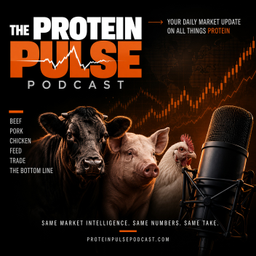
The Protein Pulse Podcast delivers concise, commercially focused protein market intelligence for buyers, sellers, traders, procurement leaders, processors, and executives across the beef, pork, chicken, feed, and global protein markets. Each episode translates USDA data, market pricing, slaughter trends, trade flows, imports, feed costs, policy developments, and supply-chain signals into clear, practical market context. The focus is simple: cut through the noise, explain what the numbers mean, and give protein professionals the market context they need before making their next decision. Your Daily Market Update on All Things Protein.
- Publisher
- Shawn Sparks
- Category
- arts · business · news
- Language
- en
- Explicit
- No
- First episode
- 4 Sept 2026
- Latest episode
- 26 Oct 2026
Latest episodes
82 episodes in the feed.
26 Oct 2026
THE PROTEIN PULSE — DRIVE TIME Monday Market Open | October 26th, 2026
Protein Pulse Drive Time — Monday Market Open | October 26th, 2026 HOST: Protein Pulse Drive Time. Monday Market Open, October 26th. From The Sparks Group. SHAWN: September cattle placements fell twelve percent, the lowest September number since 1996. That tightens the 2027 pipeline, but it doesn't make every beef cut worth chasing today. Avian influenza is hitting egg and turkey operations. Screwworm is raising new border questions. Neither headline tells you what's available on a truck this week, and neither gives packers automatic pricing power. Watch the actual restrictions, the product, and the delivery date. Price what your plant needs, not what the rumor says. Separate the noise from the inventory. HOST: The Choice grade cutout closed at three sixty-five seventy-nine, down three sixty-eight. The Select grade gained two twenty-eight to three fifty-two sixty-nine. Fresh nineties at three eighty-seven F-O-B. Imported nineties near three oh eight F-C-A. Pork cutout at seventy-four oh nine, down one fourteen. Bellies down two forty-one. Chicken breast at one thirteen. Thighs at one seventy-five. West Texas Crude at one oh three twenty-seven. Corn at four fifty-six. Soybean meal at three forty-six ten. SHAWN: USDA announced a five billion dollar processing-finance initiative with ninety percent loan guarantees up to one hundred seventy-five million. Lula won reelection in Brazil. Four new screwworm cases confirmed in Texas and New Mexico. Columbus is scheduled to reopen today. Brazil reported a second Newcastle outbreak. The commercial consequences will depend on what actually changes in financing, delivered offers and physical shipments. Stay disciplined. HOST: Protein Pulse Drive Time. Shawn Sparks, The Sparks Group. SHAWN: Stay disciplined.
26 Oct 2026
THE PROTEIN PULSE — Monday Market Open | October 26th, 2026
Monday Market Open | October 26th, 2026 Full Executive Briefing — Spoken Script HOST: Welcome to The Protein Pulse Podcast, your daily market update on all things protein. This is Monday Market Open for October 26th, 2026, from The Sparks Group. SHAWN: September cattle placements fell twelve percent, the lowest September number since 1996. That tightens the 2027 pipeline, but it doesn't make every beef cut worth chasing today. Avian influenza is hitting egg and turkey operations. Screwworm is raising new border questions. Neither headline tells you what's available on a truck this week, and neither gives packers automatic pricing power. Watch the actual restrictions, the product, and the delivery date. Price what your plant needs, not what the rumor says. Separate the noise from the inventory. Stay disciplined. HOST: USDA announces a five billion dollar processing-finance initiative. Its new SPUR program offers ninety percent guarantees on eligible commercial loans of up to one hundred seventy-five million dollars for meat, poultry and seafood processors. Implementation remains pending congressionally approved funds. Neither loans nor additional slaughter capacity have been established. Brazil's election triggers a currency shock. Lula won reelection October 25th with fifty-one point seven nine percent of valid votes. The real's reported overnight futures selloff could change Brazilian exporters' dollar-price flexibility, but no corresponding decline in delivered protein quotations has been confirmed. Cattle placements hit their lowest September level since 1996. Placements fell twelve point one percent. October 1st feedlot inventory declined just zero point four percent. Friday's futures settlement preceded the USDA release, so it does not measure the market's reaction. Four new livestock screwworm cases confirmed in Texas and New Mexico. The October 26th Texas Agriculture Department release reports two Hudspeth County cattle, plus a cow and ram in Doña Ana County. Movement controls and today's scheduled Columbus cattle-crossing reopening require separate operational checks. Steiner's October 25th chicken assessment highlights uneven demand. The analysis describes higher 2026 production and competing expectations for 2027. Separate HPAI detections continue to affect egg and turkey operations, not an established national broiler shortage. SHAWN: September feedlot placements totaled one point seven seven seven million head, down twelve point one percent, the lowest September tally since records began in 1996. October 1st cattle on feed totaled eleven point three seven two million, down just zero point four percent. September marketings fell six point six percent, while three point seven one million cattle had been on feed at least one hundred fifty days. Longer feeding sustains current inventories while placements affect future supply. Weekly cattle slaughter totaled five hundred forty-six thousand head, down seven thousand from the prior week. Year-to-date slaughter trailed 2025 by seven point two percent. Friday's Choice cutout fell three sixty-eight to three sixty-five seventy-nine while Select gained two twenty-eight to three fifty-two sixty-nine. The Choice rib primal stood at six seventy-two fifty-seven. Prices diverged by cut. Imported lean trimmings passed for entry reached nineteen thousand four hundred thirty-two metric tons for the latest reported week, up six point four percent week over week and sixty-seven point seven percent year over year. Year-to-date entries reached eight hundred two thousand seven hundred fifty-eight metric tons, up twenty point seven percent. Friday's domestic fresh nineties averaged three eighty-seven F-O-B plant, while Platts assessed imported nineties near three oh eight F-C-A East Coast port on October 22nd. Specifications and delivery bases prevent a direct landed-cost comparison. USDA's new negotiated cash-cattle aggregation for Colorado, Kansas, Texas, Oklahoma and New Mexico is scheduled to begin Monday afternoon. It aggregates existing reporting, not new transactions. HOST: September frozen pork inventories reached four hundred twenty-seven point eight million pounds, nine percent above a year earlier. Hams totaled about one hundred sixty point six million pounds, up twenty-eight percent, and loins forty point six million, up twenty-five percent. Trimmings fell thirteen percent. Stocks are not immediate wholesale offers. Friday's pork cutout fell one fourteen to seventy-four oh nine. Ribs lost nine oh one. Bellies two forty-one. Picnics gained three nineteen. Weekly hog slaughter totaled two point six one five million head, up sixty-two thousand. Ham buyers must distinguish frozen stocks from current offers. Pork muscle-cut net export sales totaled thirty-seven thousand four hundred seventy-five metric tons for the week ended October 15th, about fourteen percent above the recent four-week average. China booked seven thousand two hundred seventy-six metric tons, while South Korean purchases exceeded sixteen thousand metric tons over two weeks. Mexico's weekly sales were below twelve thousand metric tons, about thirty-two percent under its four-week average, and outstanding commitments were approximately eighteen percent lower year over year. Commitments are not completed shipments. SHAWN: Steiner's October 25th analysis cites a 2026 broiler-production forecast near forty-nine point two billion pounds, about three point six percent above 2025. Its forecast vintage differs from USDA's newer October estimate of forty-nine point seven two billion pounds. The report describes domestic availability growing faster than production, with exports absorbing a smaller proportional share and quick-service demand uneven. More than half enters further processing. For 2027, USDA expects continued production growth while an alternative industry forecast points toward possible contraction. Neither outcome is confirmed. For the October 19th to 23rd week, boneless skinless breasts averaged one thirteen, down three ninety-three cents. Thighs one seventy-five, up one forty-eight cents. Wings one ten, up one oh two cents. Tenderloins one twelve, up sixty-nine cents. And leg quarters about fifty-three, down sixty-one cents. Cut prices diverged. A reported Illinois detection involved nine hundred thirty-four thousand six hundred laying hens. Other reported detections involved about twenty thousand meat turkeys in South Dakota, sixty thousand six hundred in North Dakota and forty-one thousand four hundred in Wisconsin, plus another Wisconsin commercial flock without a confirmed size. These detections do not establish a national broiler shortage. Brazil's electoral authority confirmed President Lula's October 25th reelection, fifty-one point seven nine percent to forty-eight point two one percent. Overnight reporting described a roughly ten percent decline in real futures, with dollar-equivalent indications around five fifty-one reais versus Friday spot near four ninety-nine. These are different instruments and sessions. A weaker real can give Brazilian beef, pork and chicken exporters room to negotiate dollar offers, but actual prices depend on destination access, product eligibility, freight, contracts and delivery date. Buyers need executable offers. Brazil's Agriculture Ministry reported a second Newcastle disease outbreak October 25th in Coronel Freitas, Santa Catarina, inside an existing restricted area. Poultry exporters and importers should check destination-specific restrictions already in force. Additional shipment losses or price effects are not confirmed. Low Mississippi River levels prompted restrictions that reduce some barge tows by about five barges, approximately thirteen percent of earlier capacity. That is reduced capacity, not a confirmed freight-rate increase. Friday December West Texas Crude settled at one oh three twenty-seven a barrel, up three eighty. December Ultra-Low Sulfur Diesel at four seventy-nine a gallon, up about five cents. No new Strait of Hormuz closure is confirmed. Monday soybeans fell more than one percent to a two-month low amid record U.S. harvest supplies and lower crude oil. Friday corn settled at four fifty-six a bushel and soybean meal at three forty-six ten a short ton. Local delivered basis still matters. HOST: USDA announced at least five billion dollars in financing capacity for eligible U.S. meat, poultry and seafood processing businesses. The new Rural Development SPUR program would guarantee ninety percent of participating lenders' loans, up to one hundred seventy-five million dollars per borrower, for qualified expansion, equipment and other projects. Its program page states that implementation is pending congressionally approved funds. No loans, plant openings or added head-per-day capacity have been established. It is distinct from the earlier five hundred million dollar Farm Service Agency support program, whose deadline was September 30th. Processor investments depend on livestock supply, staffing, inspection and viable throughput. A Texas Department of Agriculture release dated October 26th reports four new livestock screwworm cases confirmed by federal laboratories. Two cattle in Hudspeth County, Texas, and a cow and ram in Doña Ana County, New Mexico. The release groups them under October 24th confirmation. Individual case records distinguish October 23rd Texas cases from October 24th New Mexico cases. Livestock operators must check applicable movement requirements, not assume a statewide restriction. Separately, an October 23rd Texas animal-health order released portions of Crockett and Pecos Counties from Zone 12.A while retaining restrictions in the remaining Zone 12.B. The earlier Pecos County elk detection remains a separate wildlife finding. APHIS...
23 Oct 2026
THE PROTEIN PULSE — DRIVE TIME Special Report - Cattle on Feed | October 23rd, 2026
THE PROTEIN PULSE — DRIVE TIME Special Report | October 23rd, 2026 Cattle on Feed HOST: Protein Pulse Drive Time. Special report, October 23rd. Cattle on Feed. From The Sparks Group. SHAWN: The headline says cattle on feed are basically unchanged from last year. I wouldn't confuse that with a stable cattle pipeline. September placements dropped twelve percent, the lowest September number in thirty years of reporting. And here's what catches my attention. The trade was already expecting fewer placements. USDA came in another three point seven percentage points below those expectations. Placements declined across every weight class, and some of the biggest cattle-feeding states took substantial hits. Meanwhile, marketings are running lower. That's helping keep cattle in feedlots today, but it doesn't replace the cattle that aren't coming in. The inventory is holding. The replacement pipeline isn't. HOST: October 1st cattle on feed eleven point three seven two million, down zero point four percent. September placements one point seven seven seven million, down twelve percent. Marketings one point five two four million, down seven percent. Kansas, Nebraska and Texas accounted for about eighty-two percent of the national placement decline. SHAWN: Eleven point three seven million cattle on feed tells us where we are. One point seven eight million placements tells us more about where we are going. Stay disciplined. HOST: Protein Pulse Drive Time. Shawn Sparks, The Sparks Group. SHAWN: Stay disciplined.
Contact Protein Pulse Podcast
- Guest appearances
- Does not typically book guests
Based on episode analysis; this does not confirm that the show is currently accepting guests.
Host of Protein Pulse Podcast?
Claim your podcast to manage its listing and keep your show details accurate.
Pod Engine is an independent podcast discovery and analytics service and is not affiliated with or endorsed by this podcast. Artwork and show content belong to their owners. Full legal notice.
Explore this show
Podcast research with Pod Engine