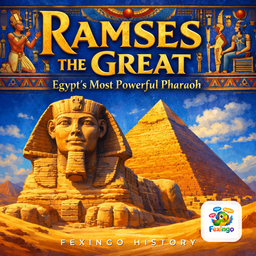
About Ramses the Great: Egypt's Most Powerful Pharaoh — Fexingo History
Ramses II, often called Ramses the Great, ruled Egypt for 66 years during the 19th Dynasty, a period of unprecedented wealth, monumental construction, and military expansion. From his early campaigns against the Hittites at the Battle of Kadesh—the largest chariot battle in history—to the signing of the first known peace treaty, Ramses shaped the ancient Near East. This podcast explores the man behind the monuments: his 200-plus children, his beloved queen Nefertari, and his colossal building projects from Abu Simbel to the Ramesseum. Lucas and Luna unravel the propaganda of temple inscriptions, the controversies of his reign (did he really win at Kadesh?), and the daily life of Egyptian society under a pharaoh who proclaimed himself a god. They examine the decline that followed his death, the looting of his tomb, and his mummy's journey to a museum in Cairo. Why does Ramses still captivate us? Because his story is one of power, art, and the human drive for immortality—a legacy carved in stone that still speaks across millennia.
#RamsesTheGreat #AncientEgypt #Pharaoh #19thDynasty #BattleOfKadesh #Nefertari #AbuSimbel #Hittites #EgyptianHistory #NewKingdom #PeaceTreaty #Ramesseum #Hieroglyphs #Sphinx #Pyramids #History #WorldHistory #FexingoHistory
Keep every episode free: buymeacoffee.com/fexingo (https://buymeacoffee.com/fexingo)
While previous episodes have explored Ramses II’s wars, his mummy, and his family, this episode uncovers the quiet machinery behind his immortality: the scribes who managed his image. We focus on Hori, the Royal Scribe and Chief of Works, whose administrative records reveal how Ramses systematically recycled monuments from earlier pharaohs like Seti I and Amenhotep III. By inscribing his own cartouches over older statues and rebuilding temples in Nubia, Ramses didn’t just conquer territory—he curated history itself. Lucas and Luna discuss the Ebers Papyrus references to royal workshops, the logistical scale of moving colossi, and how Hori’s ostraca provide a rare, unvarnished look at the bureaucratic engine that kept the Great King’s legend alive for millennia.
#RamsesII #AncientEgypt #HoriScribe #PiRamesses #AbuSimbel #KarnakTemple #SetiI #AmenhotepIII #Cartouche #EgyptianBureaucracy #MonumentalReuse #Ostraca #RoyalScribe #Nubia #Luxor #Thebes #HistoryPodcast #FexingoHistory #AncientHistory
Keep every episode free: buymeacoffee.com/fexingo (https://buymeacoffee.com/fexingo)
18 Oct 2026
Ramses II's Shadow: The Rise of the Royal Scribes
While history remembers Ramses II for his monumental architecture and military campaigns, the true engine of his empire’s longevity was a quiet bureaucracy led by men like Paser and Khaemwaset. This episode explores how Ramses cultivated a class of literate administrators who managed everything from grain distribution to diplomatic correspondence across the ancient world. We trace the career of Paser, who rose from humble beginnings to become the Vizier and Overseer of the Treasury, effectively running the state while the Pharaoh focused on legacy-building. Through analysis of ostraca and administrative papyri, we see how this meritocratic shift stabilized Egypt during its golden age, allowing for unprecedented economic growth and cultural flourishing. Luna and Lucas discuss the daily realities of these scribes, their training at the House of Life, and the complex web of records that kept Per-Ramesses functioning. From the logistical nightmares of feeding a standing army to the delicate art of international diplomacy, this conversation reveals the unseen hands that wielded power behind the stone monuments.
#RamsesII #AncientEgypt #PaserVizier #EgyptianBureaucracy #NewKingdom #Kemet #PerRamesses #Scribes #HouseOfLife #Ostraca #AncientHistory #FexingoHistory #HistoryPodcast #Egyptology #Merneptah #Khensataui #AdministrativePapyri #NorthAfrica
Keep every episode free: buymeacoffee.com/fexingo (https://buymeacoffee.com/fexingo)
17 Oct 2026
Ramses II's Grandson and the Crisis of Succession
By the twenty-fifth year of his reign, Ramses II had secured peace with the Hittites and stabilized Egypt’s borders, yet a different threat emerged from within his own dynasty. This episode explores the turbulent final years of Ramses II’s rule, focusing on the political instability caused by the premature deaths of his designated heirs and the rise of Merneptah. We examine the Judicial Papyrus of Turin, which reveals a shocking harem conspiracy involving Queen Tiye and Prince Pentawere, suggesting that court intrigue nearly toppled the throne. Lucas and Luna discuss how the aging pharaoh struggled to maintain control as his favorite sons died one by one, forcing him to name Merneptah, his thirteenth son, as successor at an advanced age. The conversation also touches on the economic strain of maintaining vast building projects like the Ramesseum while dealing with famine and civil unrest. Through the lens of recent archaeological findings and textual analysis, we uncover how a stable empire can unravel when succession is left to chance rather than clear policy, revealing the human vulnerability behind the golden mask of Ramses the Great.
#RamsesII #Merneptah #EgyptianHistory #HaremConspiracy #JudicialPapyrusOfTurin #QueenTiye #Pentawere #AncientEgypt #Kemet #SuccessionCrisis #FexingoHistory #AncientEspionage #PiRamesses #Ramesseum #PharaohsOfEgypt #Archaeology #AncientIntrigue #HistoryPodcast
Keep every episode free: buymeacoffee.com/fexingo (https://buymeacoffee.com/fexingo)
Contact Ramses the Great: Egypt's Most Powerful Pharaoh — Fexingo History
Guest appearances
Does not typically book guests
Based on episode analysis; this does not confirm that the show is currently accepting guests.
Host of Ramses the Great: Egypt's Most Powerful Pharaoh — Fexingo History?
Claim your podcast to manage its listing and keep your show details accurate.
Pod Engine is an independent podcast discovery and analytics service and is not affiliated with or endorsed by this podcast. Artwork and show content belong to their owners. Full legal notice.
Explore this show Podcast research with Pod Engine