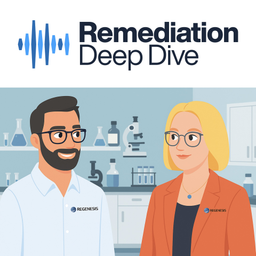
About Remediation Deep Dive - PFAS Environmental Science in 7 Minutes or Less
Welcome to Remediation Deep Dive — where key peer-reviewed publications on complex soil and groundwater challenges are discussed in 7 minutes or less. AI Technical Correspondents Max Phlux and Sandi Lohm break down the latest innovations in PFAS remediation offering listeners actionable insight to treat PFAS. Max and Sandi dive deep into the science and strategy behind managing forever chemicals using cutting edge approaches like in situ remediation with colloidal activated carbon to cost-effectively treat PFAS in soil and groundwater. Max and Sandi deliver practical knowledge to keep consultants, regulators, and decision-makers informed on best practices for tackling PFAS and other contaminants.
STOP Using High Pressure! Why Sorbent Placement Matters
In this podcast episode, AI hosts Max Flux and Sandi Loam explore why successful in situ sorbent treatment depends less on how far an amendment travels and more on how evenly it reaches contaminant mass and groundwater-flow pathways. Drawing on field research, the discussion examines ten performance, monitoring, cost, and safety concerns associated with high-pressure injection of powdered and granular sorbents—including fracture-controlled placement, incomplete treatment-zone coverage, biased monitoring results, and contaminant rebound. They also discuss how low-pressure colloidal activated carbon delivery can achieve broader, more consistent coverage by moving through accessible aquifer pore spaces. The key takeaway: effective remediation requires distributing the sorbent—not fracturing the formation.
9 Sept 2026
Rethink PFAS Soil Excavation
The Rethink PFAS Soil Excavation podcast examines the financial, environmental, and long-term liability drawbacks of excavating and transporting PFAS-contaminated soil. Through a New Jersey case study, it highlights how a low-dust colloidal activated carbon treatment immobilized PFAS in place, reducing leachability by more than 99% while eliminating surface waste, trucking, and landfill disposal. The episode makes the case that in situ treatment can better protect groundwater while lowering cleanup costs, carbon emissions, and lifecycle risks.
31 Aug 2026
Stop PFAS at the Source - A Large-Scale Airport Finds a Smarter Way
This podcast explores how a large-scale airport remediation project in Sweden is demonstrating a smarter way to stop PFAS contamination at the source before it spreads to sensitive drinking water receptors. Through the use of an in situ colloidal activated carbon barrier, Max Flux and Sandi Loam highlight a shift from costly pump-and-treat approaches to passive, underground containment that captures both target PFAS compounds and precursors where the plume begins.
20 Aug 2026
$31 Billion and Still Pumping: The Real Cost of PFAS Cleanup
The U.S. Department of War (DoW) faces an estimated $31 billion in legacy PFAS cleanup liability, and the environmental industry's default answer is still pump and treat. This episode follows the money.
Max Flux and Sandi Lomb compare 30-year lifecycle costs at Wurtsmith Air Force Base ($19 million versus $7.2 million), a commercial airport site ($4.1 million versus $1.6 million), and a failing system in Barnstable County bleeding $450,000 a year — and explain why the savings represent potential millions.
21 Oct 2025
PFAS Treatment Success at 17 Airport Sites
Max and Sandi dive into the peer-reviewed article, “Longevity of Colloidal Activated Carbon for In Situ PFAS Remediation at AFFF-Contaminated Airport Sites” by Carey et al. (2022), highlighting >90–99% PFAS reduction across 17 sites and the key factors driving CAC’s long-term performance.
7 Oct 2025
A Practical Tool for PFAS CAC Barrier Design
Max and Sandi dive into the peer-reviewed article, “Tool and Database for Estimating Potential Longevity of Colloidal Activated Carbon Barriers for PFAS in Groundwater” by Newell et al. (2025), highlighting a new planning tool that simplifies estimating CAC barrier lifespan to guide design, planning, and PFAS plume management.
23 Sept 2025
The Science Behind PFAS Monitored Retention
Max and Sandi dive into the peer-reviewed article, “PFAS Monitored Retention: A Framework for Managing PFAS-Contaminated Groundwater Sites” by Adamson et al. (2025), exploring how PFAS Monitored Retention (PMR) and PFAS Enhanced Retention (PER) use physical and chemical processes to slow plume migration and reduce risk—offering a cost-effective option where immediate threats are absent.
9 Sept 2025
PFAS Treatment Face-Off
Max and Sandi dive into the peer-reviewed article, “A Cost Comparison of Pump-and-Treat and In Situ Colloidal Activated Carbon for PFAS Plume Management” by Birnstingl and Wilson (2024), highlighting how CAC delivers decades-long PFAS containment at one-third the cost of pump-and-treat—without the waste, energy use, or long-term liabilities.
14 Aug 2025
Introduction to Remediation Deep Dive: PFAS Remediation in 7 Minutes or Less
In this opening episode, AI Technical Correspondents Max Phlux and Sandi Lohm introduce the Remediation Deep Dive podcast—a 5-part series dedicated to summarizing and discussing key technical papers in PFAS environmental remediation. They preview the topics ahead, offering listeners a clear roadmap of the science, strategies, and innovations that will be explored in each episode.
6 Aug 2025
Remediation Deep Dive: Opening Pandora’s PFAS Box
AI Tech. Correspondents, Max Phlux and Sandi Loam, discuss the futility of trying to flush PFAS from an aquifer and the increased risk associated with generating and handling the PFAS waste.
Reach and audience
Public platform figures. Ratings count people who left a rating, not total listeners.
Apple Podcasts (US)
4.0 / 5
4 ratings
Spotify
5.0 / 5
1 ratings
Contact Remediation Deep Dive - PFAS Environmental Science in 7 Minutes or Less
Guest appearances
Does not typically book guests
Based on episode analysis; this does not confirm that the show is currently accepting guests.
Host of Remediation Deep Dive - PFAS Environmental Science in 7 Minutes or Less?
Claim your podcast to manage its listing and keep your show details accurate.
Pod Engine is an independent podcast discovery and analytics service and is not affiliated with or endorsed by this podcast. Artwork and show content belong to their owners. Full legal notice.
Explore this show Podcast research with Pod Engine