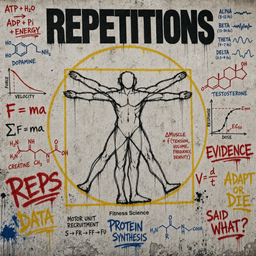
Repetitions is a fitness science podcast for people who actually want to know what works. Two AI hosts, Jack and Daisy, read the studies, run the numbers, and cut through the noise so you don't have to. Jack brings the gym floor reality check. Daisy brings the meta-analyses and the receipts. Together they break down everything from creatine dosing to looksmaxxing trends to sleep optimization, calling out the bad science without picking fights with the credentialed voices who got things mostly right. No supplements to sell you, no affiliate codes, no hot takes for clicks. Just real research. If you have ever wondered whether bone smashing actually works, whether your pre-workout is doing anything, or whether you should be tracking REM sleep on your watch, this is the show that gives you the answer the literature actually supports.
Lymphatic Drainage Massage: De-Puff Is Real, Detox Is Not
Lymphatic drainage massage has racked up billions of TikTok views, promising detox, immunity boosts, faster metabolism, and even weight loss. Jack and Daisy trace the technique back to its legitimate medical roots — and work through the evidence claim by claim to find out what it can and can't actually do. Plus: the safety warnings most wellness content skips entirely.
11 Sept 2026
Salt Stomping's Magnesium Claim Is Busted
Salt stomping — standing on coarse salt before bed — is going viral with promises of better sleep, lower cortisol, and transdermal magnesium absorption. Jack and Daisy dig into the skin science, track down the single pro study, and find out whether the ritual holds any water.
4 Sept 2026
Dopamine Patches: Zero Trials, Zero Brain Delivery
A peel-and-stick patch promising better mood, focus, and productivity through a dopamine boost is making the rounds in wellness spaces. Jack and Daisy work through the pharmacology — the blood-brain barrier, transdermal delivery, and what real dopamine-active patches actually are — to find out whether the science holds up. The verdict is clean, and the reasoning gets there fast.
23 Aug 2026
Cortisol Face and Low-Cortisol Maxxing, Busted
"Cortisol face" and "low-cortisol maxxing" have racked up hundreds of millions of TikTok views, claiming that everyday stress spikes cortisol high enough to bloat your face and that the right supplement routine can fix it. Jack and Daisy work through the actual endocrinology — what stress management can and can't do to cortisol levels, where ashwagandha's numbers really land, and the rare disease the trend's before-and-after photos are quietly borrowing from.
25 Jul 2026
Proteinmaxxing Hits a Wall at 1.6G per Kilo
Proteinmaxxing — the trend of chasing 250-plus grams of protein a day — promises more muscle, faster. Jack and Daisy dig into three meta-analyses to find out where the dose-response curve actually flattens, and whether the kidney fears are as real as the influencers say.
29 Jun 2026
Mitochondrial density: the mechanism behind cardio's mortality reduction
The reason cardio cuts your risk of early death basically comes down to tiny organelles from your high school bio textbook. Researcher Inigo San-Millan found that mitochondrial density in muscle cells predicts not just Tour de France performance but also who develops type 2 diabetes, heart disease, and dies younger, and the specific training that builds it is slow, boring, conversational-pace cardio called Zone 2, which most people either skip or blow right past. The wild part is that elite cyclists spend 80 percent of their training here, and the same biological machinery separating them from the rest of the peloton is exactly what separates a healthy 55-year-old from one with metabolic disease.
25 Jun 2026
Training to failure: equivalent muscle, 2x recovery cost
Training to failure builds the same amount of muscle as stopping 2-3 reps short, but takes twice as long to recover from, and that gap has been sitting in the research since 2022 while gym culture kept pretending grinding out every last rep was the price of gains. A meta-analysis of 55 studies and nearly 2,000 trained subjects found zero statistically significant difference in muscle growth between failure and non-failure training, and a separate trial quantified the recovery cost as roughly double with nothing extra to show for it. The math is pretty simple: same muscle, twice the recovery, half the training sessions your body can actually absorb.
22 Jun 2026
Hardmaxxing surgery won't fix what body fat will resolve
A 2025 systematic review just pulled 54 years of facial implant data and landed on a 4.4 percent complication rate covering infections, nerve damage, displacement, and revision surgeries — and that is the number jaw surgery forums have been debating without ever actually having. Here is the part that stings: a lot of the jaw definition guys are going under the knife for already exists underneath their facial fat, which the anatomy literature confirms responds directly to body composition changes. The surgery is real, the results are permanent, and the risk is documented — but for a chunk of these patients, a cut is literally all they needed.
18 Jun 2026
250-500mg caffeine for a 180 lb lifter, timed 8-10 hours before bed
The science-backed caffeine sweet spot for a 180-pound lifter is 250 to 500mg, but if you train after 3pm and go to bed at 11, the math literally does not close. That same dose sharpening your focus and strength output is still halving itself every 5 hours, wrecking your sleep architecture even 6 hours later according to a clinical sleep study. The honest answer is that the performance benefits are real, the timing constraint is real, and nobody in the research has fully resolved the tension between them.
11 Jun 2026
Cold plunges: skip them after training if size is the goal
Back in 2015, researchers found that cold plunging after lifting literally suppresses the cellular signals your muscles need to grow, and a 2023 systematic review backed it up. The ice bath crowd got the anti-inflammation part right, they just missed that the inflammation is the point when you are trying to build muscle. If size is the goal, that post-lift plunge is quietly costing you gains every single session.
8 Jun 2026
Most depression advice ignores what 12 weeks of lifting does
Two massive studies — one pulling from 1,039 clinical trials, another ranking 218 head-to-head — found that exercise outperforms antidepressants and therapy by 1.5 times for depression, anxiety, and psychological distress. Strength training and walking showed the strongest effects, results kicked in around 12 weeks, and moderate intensity beat high intensity every time. The evidence has been sitting in top medical journals since 2023 and 2024 — it just never made it into your doctor's actual recommendations.
1 Jun 2026
10-20 sets per muscle: the volume sweet spot that stops working
Turns out the 10-20 sets per muscle per week rule that took over every gym conversation since 2017 is real, but it was never meant to be your number specifically. Schoenfeld's meta-analysis nailed the population average, then a 2022 review came in and showed some people plateau way before 20 sets while others can push past it without burning out, depending on recovery, stress, and training history. The science is basically saying use the range as a starting point, then watch how your body actually responds, because the research found the sweet spot, not your sweet spot.
25 May 2026
Mewing doesn't reshape adult skulls: what actually changes your face
The AAO officially called it in 2019: pressing your tongue to the roof of your mouth does nothing to reshape adult bone, because the palate finishes fusing in your early twenties and stops responding to tongue pressure entirely. The jawlines you see in mewing before-and-afters are almost always just weight loss, better posture, or a different camera angle. Hundreds of millions of views later, the biology has not changed, only the audience believing otherwise has grown.
21 May 2026
0.8g per pound of protein covers all muscle growth: beyond that is waste
49 randomized controlled trials and nearly 2,000 subjects later, researchers at McMaster University found your muscles stop responding to protein at 0.73 grams per pound of bodyweight per day, not the one gram per pound that gym culture has been preaching for decades. For a 180-pound person, that gap means eating roughly 47 extra pounds of protein per year with zero additional muscle to show for it. The one-gram standard was never backed by dose-response data, it just got laundered through bodybuilding forums and supplement marketing until everyone forgot to ask where it came from.
18 May 2026
Fadogia agrestis has no human trials: only rat data exists
Millions of men are taking Fadogia agrestis to boost testosterone and the entire scientific foundation for that decision is one rat study from 2005 — zero human trials, ever. The same paper that showed elevated testosterone in rats also showed dose-dependent toxicity, and that part somehow never made it into the podcast ads. Tongkat ali at least has five human RCTs behind it, but that evidence belongs to a completely different plant, and the supplement industry has been quietly borrowing its credibility to sell something that has never been tested on a single human being.
14 May 2026
Sleep regularity: 60,000 people show consistency beats duration
Sleeping 8 hours means nothing if you're doing it at different times every night — a 60,000-person study just proved consistency beats duration when it comes to staying alive. People with the most irregular sleep schedules had a 53 percent higher risk of dying from any cause, even after researchers controlled for how much sleep they were actually getting. The metric we have been told to obsess over for decades, total hours, turned out to be the weaker signal.
12 May 2026
700 studies on creatine and the answer is simpler than you think
After 700 studies across 30 years, scientists didn't land on some cutting-edge compound or patented formula -- they landed on a $15 tub of creatine monohydrate, which the International Society of Sports Nutrition officially called the most effective ergogenic supplement available to athletes. The kidney damage fears? Not supported by controlled research in healthy people. The fancy branded versions with better "absorption"? A marketing story, not a science one.
7 May 2026
TikTok bone smashing debunked: what actually builds facial structure
Young men on TikTok have been hitting themselves in the face with rocks and hammers trying to sharpen their jawlines, citing a 132-year-old bone biology principle called Wolff's Law — and oral surgeons are now treating them for nerve damage and microfractures. The science they are quoting is real, but they are applying it so wrong that bone researchers do not even consider it a debate. The actual path to jaw definition is dropping body fat below 15 percent, chewing hard mastic gum to build your masseter muscle, and fixing your posture — none of which require hitting yourself in the face with anything.
Reach and audience
Public platform figures. Ratings count people who left a rating, not total listeners.
Spotify
5.0 / 5
1 ratings
Contact Repetitions
Guest appearances
Does not typically book guests
Based on episode analysis; this does not confirm that the show is currently accepting guests.
Host of Repetitions?
Claim your podcast to manage its listing and keep your show details accurate.
Pod Engine is an independent podcast discovery and analytics service and is not affiliated with or endorsed by this podcast. Artwork and show content belong to their owners. Full legal notice.
Explore this show Podcast research with Pod Engine