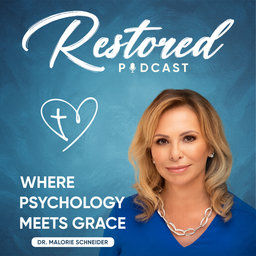
Restored: Where Psychology Meets Grace
Dr. Malorie Schneider
5.0from 5 ratings
- 46
- Episodes
- 5
- Ratings
- Weekly
- Cadence
- 2025
- First episode
About Restored: Where Psychology Meets Grace
Restored is a podcast where the science of the mind meets the heart of grace. Each episode explores how psychological insights and timeless spiritual wisdom work together to heal wounds, renew hope, and help you thrive. Whether you're navigating life's challenges, seeking deeper purpose, or simply wanting to grow, Restored offers practical tools, compassionate conversations, and faith-infused guidance to help you live whole and free.
- Publisher
- Dr. Malorie Schneider
- Category
- health & fitness · religion & spirituality
- Language
- en
- Explicit
- No
- First episode
- 8 Sept 2025
- Latest episode
- 27 Oct 2026
Latest episodes
46 episodes in the feed.
27 Oct 2026
More Than Mom: Loving Your Family Without Losing Yourself
Want to go deeper? Subscribe for access to the Restored Reflection Journal Library, where you'll find guided prompts to help you explore the themes of each episode and apply them to your own life. Get access to the Reflection Journal Library: https://subscribepage.io/restored-reflection-guide Who Are You When Motherhood Begins to Change? Motherhood has a way of becoming woven into nearly every part of our identity. For years, we're needed in countless ways—guiding, nurturing, organizing, protecting, and showing up. But what happens when our children grow older and begin building lives of their own? Even when we celebrate their independence, the transition can bring unexpected questions about identity, purpose, marriage, and what comes next. In this episode of Restored: Where Psychology Meets Grace, Dr. Malorie explores the psychology of motherhood, identity, and the changing relationship between mothers and their adult children. This isn't a conversation about loving your family less. It's about recognizing that you can love your family deeply without allowing motherhood to become the entirety of who you are. In This Episode We explore: Motherhood and identity: How the roles we occupy shape our sense of self, and what happens when one role begins to define us too narrowly. Role engulfment: Why becoming so identified with motherhood can make life transitions feel especially unsettling. The psychology of self-schemas: How deeply held beliefs about who we are influence our choices, relationships, and sense of purpose. Parenting adult children: The shift from being needed in familiar ways to developing a different, often deeply rewarding relationship with our grown children. Marriage and personal identity: Why nurturing your relationship with your spouse, your interests, and your individual goals matters alongside your role as a mother. Rediscovering yourself: How to make room for the parts of your identity that may have received less attention during the busiest years of parenting. Where Psychology Meets Grace In Luke 10, we encounter Mary and Martha, two sisters whose different responses to Jesus offer an opportunity to reflect on responsibility, presence, and the roles that can consume our attention. Through this familiar biblical story, we consider what it means to care deeply for others without becoming so absorbed in what we do that we lose sight of who we are and what matters most. A Thought to Carry With You Motherhood is a meaningful part of your identity. But it was never meant to be the only part. As children grow, motherhood doesn't disappear. It evolves. And that evolution can create room for something beautiful: a new relationship with your adult children, renewed investment in your marriage, and opportunities to rediscover interests, relationships, and possibilities that belong to you. This episode offers a gentle invitation to embrace those possibilities without guilt. Continue the Reflection What parts of yourself have received less attention while you've been caring for your family? What might you want to rediscover or cultivate in this next season? The accompanying Reflection Journal provides space to explore these questions more deeply. Subscribe for access: https://subscribepage.io/restored-reflection-guide Listen and Share Listen here: https://pod.link/1864576270 or wherever you get your podcasts. If this episode resonates with you, consider sharing it with another mother who may be navigating a changing season of life. Following, rating, and reviewing Restored also helps others discover these conversations about psychological well-being, relationships, faith, and personal growth. Disclaimer Restored: Where Psychology Meets Grace is intended for educational and informational purposes only. The content shared in this podcast is not a substitute for psychotherapy, mental health treatment, medical care, diagnosis, or individualized professional advice. Listening to this podcast does not establish a therapist-client relationship. Psychological concepts and strategies discussed are general in nature and may not be appropriate for every individual or circumstance. If you are experiencing mental health concerns or significant emotional distress, please seek support from a qualified mental health or healthcare professional who can provide guidance specific to your situation.
19 Oct 2026
When Everything Feels Important: Saying No Without the Mom Guilt
Go deeper with Restored. Subscribe for free access to the Restored Reflection Journal Library, featuring episode-specific prompts to help you reflect on what you're learning and apply it to your own life. Access the Reflection Journal Library: https://subscribepage.io/restored-reflection-guide When Saying No Feels Like Letting Someone Down Have you ever said yes to something you didn't have the time, energy, or desire to do—simply because saying no made you feel guilty? For many mothers, the challenge isn't recognizing that they're overwhelmed. It's believing they're allowed to make choices that might disappoint someone else. Another school activity. Another volunteer opportunity. Another request that seems perfectly reasonable on its own. And when everything feels important, how do you decide what deserves your yes? In this episode of Restored: Where Psychology Meets Grace, Dr. Malorie continues The Weight of Modern Motherhood series with a conversation about mom guilt, healthy boundaries, people-pleasing, and the psychological pressure to be everything to everyone. Drawing on clinical psychology, neuroscience, personal experience, and faith, she explores why setting limits can feel so uncomfortable—and how mothers can make thoughtful decisions without allowing guilt to determine their choices. In This Episode Why mom guilt can be so powerful Explore how our beliefs about being a good mother shape the way we interpret our decisions. Learn why feeling guilty doesn't necessarily mean we've done something wrong—and why discomfort and genuine guilt aren't always the same thing. The psychology of saying yes Discover how agreeing to requests can provide immediate relief from the discomfort of disappointing others. Over time, this pattern can reinforce people-pleasing and make it increasingly difficult to establish healthy boundaries. When every opportunity feels important Children benefit from meaningful experiences, but not every activity or opportunity is necessary. Explore the psychological cost of treating every worthwhile possibility as an obligation, and why choosing one good thing sometimes means declining another. How our childhood experiences influence our parenting Dr. Malorie shares a personal reflection about watching her own mother struggle to say no to requests from others—and how that experience influenced the kind of childhood she wanted to create for her own children. She also explores an unexpected realization: in trying to give our children something different from what we experienced, we can sometimes create a different kind of pressure for ourselves. The difference between disappointment and harm Learn why allowing children and other people to experience ordinary disappointment can be part of healthy relationships. Setting a thoughtful boundary doesn't automatically mean we're being unkind, neglectful, or selfish. What faith teaches us about limits In Mark 1, Jesus withdraws to pray even as people continue looking for Him. His example offers a meaningful perspective on the difference between responding to every demand and remaining grounded in one's purpose. Key Takeaways Guilt is not always evidence of wrongdoing. Sometimes it's the emotional discomfort of making a healthy but unfamiliar choice. Every yes has a cost. Time, attention, and energy devoted to one commitment are no longer available for something else. Relieving guilt isn't the same as making a good decision. Saying yes may feel better in the moment while contributing to longer-term exhaustion. Disappointment is not the same as harm. We can love our children deeply without meeting every preference or providing every opportunity. Boundaries protect what matters. Saying no can be an intentional way of honoring our values, relationships, and capacity. A Question to Carry With You Am I saying yes because this genuinely reflects what matters to me—or because I feel uncomfortable saying no? The goal isn't to become a mother who never feels guilty. It's to become more confident in making thoughtful choices, even when those choices come with uncomfortable feelings. Coming Next: The Mother Beyond the Role In Episode 21, More Than Mom: Loving Your Family Without Losing Yourself, we conclude The Weight of Modern Motherhood series by exploring what happens when motherhood becomes so central to our identity that other parts of ourselves—and sometimes our marriages—receive less attention. We'll talk about maintaining our individual identities, nurturing important relationships, and discovering the joy of growing into new relationships with our children as they become adults. Because loving our families deeply should never require us to disappear from our own lives. Listen, Follow, and Share If this episode resonates with you, consider sharing it with another mother who may need permission to make thoughtful choices without carrying unnecessary guilt. Follow Restored: Where Psychology Meets Grace for more conversations at the intersection of psychology, neuroscience, and faith. Listen here: https://pod.link/1864576270 or wherever you get your podcasts. Access the free Reflection Journal Library: https://subscribepage.io/restored-reflection-guide Disclaimer Restored: Where Psychology Meets Grace is intended for educational and informational purposes only. It is not a substitute for psychotherapy, mental health treatment, medical care, diagnosis, or professional advice. Listening to this podcast does not establish a therapist–client relationship. Listeners are encouraged to seek appropriate professional support for their individual circumstances.
13 Oct 2026
The Invisible Load Why Moms Feel Like They're Always Behind
Go deeper with Restored. Subscribe for access to the free Reflection Journal Library, where you'll find episode-specific prompts to help you reflect, process, and apply what you're learning. Access the Reflection Journal Library: https://subscribepage.io/restored-reflection-guide The Invisible Work That Never Seems to End Have you ever reached the end of a busy day, feeling completely exhausted, yet wondering why you didn't accomplish more? For many mothers, the most exhausting part of family life isn't necessarily the physical work. It's the constant mental responsibility of remembering, anticipating, planning, coordinating, and making sure nothing falls through the cracks. It's the invisible load of motherhood—the cognitive and emotional labor that often goes unnoticed, even when everything is running smoothly. In this episode of Restored: Where Psychology Meets Grace, Dr. Malorie explores why so many mothers feel perpetually behind, even when they're doing an extraordinary amount. Through psychology, neuroscience, personal experience, and faith, we examine how the invisible mental load develops, why it contributes to stress and exhaustion, and what can help families begin sharing responsibility more effectively. In This Episode The psychology of the invisible load Understand the difference between completing household tasks and carrying the ongoing mental responsibility for making sure those tasks happen. Explore why being the person who remembers, anticipates, and coordinates can be more exhausting than the visible work itself. What the brain is carrying Learn how working memory, unfinished responsibilities, and constant task-switching place demands on attention and cognitive resources. Discover why the feeling that something still needs to be done can persist even when you're trying to rest. Why being busy can still feel like falling behind Explore the frustrating nature of repetitive family responsibilities—work that must be done again tomorrow, regardless of how much you accomplished today—and how that affects our sense of progress. The difference between helping and sharing ownership Why doesn't asking someone to help always reduce the mental load? We examine the difference between delegating individual tasks and genuinely sharing responsibility for planning, remembering, and following through. A personal approach to sharing family responsibility Dr. Malorie shares how weekly family meetings helped her and her children coordinate schedules, identify needs, recognize accomplishments, and distribute age-appropriate responsibilities. What began as a practical family routine also became a collection of meaningful memories preserved in notebooks of meeting minutes. A biblical perspective on carrying too much In Exodus 18, Moses' father-in-law, Jethro, recognizes that Moses is carrying responsibilities that are too much for one person. His advice offers a powerful reminder: responsibility can be meaningful without requiring us to carry everything alone. What You'll Take Away Why mental and emotional labor can leave mothers exhausted even when the work is largely invisible. How cognitive overload, open mental loops, and task-switching contribute to the feeling of always being behind. Why sharing tasks isn't the same as sharing responsibility. How family communication and age-appropriate ownership can reduce the burden on one person. Why acknowledging our limits is not a failure of love or commitment. A Question to Carry With You What responsibilities am I holding in my mind that could become shared responsibilities instead? You don't have to become better at carrying everything. Sometimes the healthier solution is to stop carrying it alone. Coming Next In Episode 20, When Everything Feels Important: Saying No Without the Mom Guilt, we'll explore why setting limits can feel so uncomfortable, even when we know those limits are necessary. We'll look at the psychology of guilt, the pressure to say yes, and how to make choices that reflect what matters most without feeling responsible for everyone's disappointment. Listen, Follow, and Share If this episode resonates with you, consider sharing it with another mother who may be carrying more than anyone realizes. Follow Restored: Where Psychology Meets Grace so you don't miss the next conversation in The Weight of Modern Motherhood series. Listen here: https://pod.link/1864576270 Access the free Reflection Journal Library: https://subscribepage.io/restored-reflection-guide Disclaimer Restored: Where Psychology Meets Grace is intended for educational and informational purposes only. It is not a substitute for psychotherapy, mental health treatment, medical care, diagnosis, or professional advice. Listening to this podcast does not establish a therapist–client relationship. Listeners are encouraged to seek appropriate professional support for their individual circumstances.
Reach and audience
Public platform figures. Ratings count people who left a rating, not total listeners.
- Apple Podcasts (US)
- 5.0 / 5
- 5 ratings
Contact Restored: Where Psychology Meets Grace
- Guest appearances
- Does not typically book guests
Based on episode analysis; this does not confirm that the show is currently accepting guests.
Host of Restored: Where Psychology Meets Grace?
Claim your podcast to manage its listing and keep your show details accurate.
Pod Engine is an independent podcast discovery and analytics service and is not affiliated with or endorsed by this podcast. Artwork and show content belong to their owners. Full legal notice.
Explore this show
Podcast research with Pod Engine