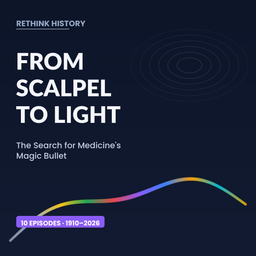
In 1910 Paul Ehrlich promised medicine a "magic bullet": a drug that would strike only the disease and leave the patient untouched. On 5 October 2026, the Nobel Prize in Physiology or Medicine went to Karl Deisseroth, Peter Hegemann and Georg Nagel for optogenetics. Their method uses a protein borrowed from green algae, together with pulses of light, to switch chosen cells on or off within a thousandth of a second.
This ten-part series follows the century between those two moments through five tools for controlling the body: the knife, the electric current, the molecule, the virus, and finally light. Each tool aimed more precisely than the one before it. Each also promised more than it delivered, from the Nobel-winning lobotomy to thalidomide to the first death in a gene-therapy trial.
Before light learned to command the body, it learned to read it. Episode 5 tells the story of the pulse oximeter on your fingertip, partly through the compiler's own work: as a Stanford anesthesia trainee, he gathered calibration data for Nellcor's first commercial oximeter.
Episodes 1–4: the magic bullet, surgery, electricity, pharmacology
Episode 5: reading the body with light
Episodes 6–9: gene delivery, the discovery of optogenetics, what it revealed about the brain, and the first attempts to use it in patients
Episode 10: closed loops and AI, and the question of whether a magic bullet ever existed. Smallpox, polio and Guinea worm were all beaten without one.
History, not medical advice. Clinical-trial status is current as of October 2026.
Researched and compiled by Nick Mackenzie. Narrated by AI from a sourced research dossier.
The series ends with its own thesis tested. The real gains in precision may have come less from better bullets than from better loops: sense, decide, act, sense again. Adaptive brain stimulation, automated insulin delivery, closed-loop anesthesia, and artificial intelligence that designs better molecular switches all follow that pattern.
The strongest skeptical case gets a full hearing too: most of the gain in life expectancy came from vaccines, sanitation and public health, precision therapies can cost millions per patient, and the metaphor itself may mislead. The compiler closes on the diseases he saw vanquished in his lifetime. Smallpox, polio and Guinea worm all fell without a magic bullet.
In this episode:
• Adaptive deep brain stimulation and the artificial pancreas
• Machine-learning-designed opsins and AlphaFold
• Smallpox, polio and Guinea worm: victories without bullets
• Who decides which circuits to adjust, and who pays
Watch on YouTube: https://youtu.be/PESc2t6oalQ
7 Oct 2026
Ep 9: Light Enters the Clinic
On the day optogenetics won the Nobel Prize, not one optogenetic therapy was approved anywhere. This episode audits where the technology actually stands: the 2021 report of a blind man who partly regained sight with an algal protein and light-amplifying goggles, and Nanoscope's MOGENRY for retinitis pigmentosa, whose FDA application was accepted in September 2026. It also covers the optical cochlear implant, which no human has yet received, and light-pacing of the heart in animals.
It also looks at the routes around genetic modification, from light-switchable drugs to chemogenetics, and at the barriers: light that cannot pass through tissue, immune responses to foreign proteins, permanence, and ethics. All clinical status is as of early October 2026.
In this episode:
• RetroSense, GenSight and the first human trials
• MOGENRY (MCO-010) and the RESTORE trial
• Optical cochlear implants
• Photopharmacology and chemogenetics
Watch on YouTube: https://youtu.be/1KLXeXB-KRY
6 Oct 2026
Ep 8: What the Light Revealed
Optogenetics became the most powerful tool ever built for mapping the brain's wiring. In mice it showed how deep brain stimulation may actually work, traced the circuits of reward and anhedonia, separated the brain's "go" and "stop" pathways, and reactivated single memories stored in a sparse set of cells.
This episode also keeps the discipline the field requires: these are animal findings, two major 2012 studies pointed in opposite directions, and the headline "erase trauma with light" is science fiction. What optogenetics delivered is a set of maps.
In this episode:
• Parkinson's circuits and deep brain stimulation (2009)
• Direct and indirect pathways (2010)
• Dopamine, reward and depression-like behavior
• Fear, extinction and the amygdala
• Engrams: reactivating memories in mice
Watch on YouTube: https://youtu.be/B9QFNLetCJQ
6 Oct 2026
Ep 7: The Light Switch
A single-celled green alga swims toward light using a protein that opens like a gate when light hits it. Georg Nagel, Peter Hegemann and colleagues described channelrhodopsin in 2002 and 2003; in 2005 Karl Deisseroth's lab at Stanford, with Edward Boyden and Feng Zhang, put it into neurons and switched them on with blue light. On 5 October 2026 Deisseroth, Hegemann and Nagel won the Nobel Prize.
This episode tells the whole discovery fairly, including Francis Crick's wish, Dieter Oesterhelt's bacteriorhodopsin, Gero Miesenböck's first light-controlled neurons, and why a Nobel can name only three people.
In this episode:
• Crick's wish for a switch for one cell type
• Bacteriorhodopsin, halorhodopsin and the algal eyespot
• Channelrhodopsin (2002–2003) and the 2005 neuron paper
• Inhibition with amber light and fiber optics in moving mice
• Prizes, credit and the 2026 Nobel
Watch on YouTube: https://youtu.be/BucCl1E2YAg
6 Oct 2026
Ep 6: The Virus as Courier
A virus is a package of genetic instructions wrapped in protein. Medicine learned to empty it and fill it with a healthy gene. This episode follows gene delivery from the first gene therapy in 1990 through the death of Jesse Gelsinger in 1999, the leukemias of the French trial, and the comeback of the adeno-associated virus: Luxturna for inherited blindness, Zolgensma, CAR-T and the first CRISPR approval.
It also covers the costs and the setbacks, from million-dollar price tags to the 2025 trial deaths, and the limit that sets up the rest of the series: a delivered gene has no off switch.
In this episode:
• Asilomar and recombinant DNA
• Ashanthi DeSilva and the first gene therapy
• Jesse Gelsinger and the oversight reckoning
• Luxturna, Zolgensma, Casgevy
• Cell-type "zip codes" and engineered capsids
Watch on YouTube: https://youtu.be/v3aDaKW-HPE
6 Oct 2026
Ep 5: Reading the Body with Light
Before light could command a cell, it learned to read the body. In 1972 Takuo Aoyagi saw that the pulsing part of light through a finger is arterial blood. A decade later Nellcor, founded by Stanford anesthesiologist William New and partners, turned it into the clip and the tone that became a standard of anesthesia care.
The compiler was there: as a Stanford anesthesia trainee he worked at Nellcor, gathering calibration data from consenting volunteers on a virtual trip to the altitude of a Himalayan pass, and published it in the Journal of Clinical Monitoring in 1985. The episode then tests the instrument honestly: a giant Danish trial that found no change in outcomes, and the finding that oximeters read high in patients with darker skin. Alongside it comes a clinician's argument that the deeper fault was rigid, protocol-based care.
In this episode:
• Millikan, Wood and the ear oximeter
• Aoyagi's insight and Nellcor's N-100
• How oximeters are calibrated on people
• The 1986 monitoring standards and anesthesia safety
• Skin pigmentation, Jubran and Tobin (1990), Sjoding (2020)
Watch on YouTube: https://youtu.be/tziuYg9Vr4A
6 Oct 2026
Ep 4: The Molecule
Drugs brought a new kind of precision: a molecule that fits one receptor like a key in a lock. Insulin in 1922, the sulfa drugs, penicillin, and chlorpromazine, first explored by a French naval surgeon looking for a better anesthetic cocktail, then the beta-blockers and the drugs for the mind.
But a pill has no address. It floods every organ, takes minutes to hours to act, and lingers. This episode follows the gains and the warnings: thalidomide and the 1962 drug-safety law, and the long argument over the "chemical imbalance" story of depression, told evenhandedly.
In this episode:
• Langley, Ehrlich and the receptor
• Insulin, sulfonamides and penicillin
• Laborit, chlorpromazine and the first psychiatric drugs
• James Black's beta-blockers and rational drug design
• Thalidomide and Frances Kelsey
Watch on YouTube: https://youtu.be/TVhaw_T-TJI
6 Oct 2026
Ep 3: The Spark
Electricity is the body's own language, and medicine learned to speak it: from Galvani's frog legs to the first implanted pacemaker in Stockholm in 1958, the implantable defibrillator, the cochlear implant and deep brain stimulation for Parkinson's disease. Current is fast, but it is indiscriminate: it touches every cell and fiber near the electrode.
The episode ends at the first closed loop in the brain: in February 2025 the FDA approved an adaptive deep brain stimulator that listens to the brain before it responds.
In this episode:
• Galvani, Volta, Duchenne and Penfield
• Delgado's bull: spectacle and warning
• Arne Larsson, Elmqvist and Senning, Greatbatch
• Deep brain stimulation from Benabid (1987) to adaptive systems (2025)
Watch on YouTube: https://youtu.be/pmeB75v5cAo
6 Oct 2026
Ep 2: The Knife
Medicine's first instrument of control was the knife. Once anesthesia and antisepsis made surgery survivable, surgeons learned what organs do by taking them out. Theodor Kocher removed the thyroid and saw what its absence did, and won the 1909 Nobel. Charles Huggins starved prostate cancer of its hormones, and won in 1966.
The same logic produced a warning: the prefrontal lobotomy, which also won a Nobel, in 1949. This episode tells that story soberly, alongside the radical mastectomy trial that showed bigger surgery was not better, and the knife's hard limit: it can remove, but it cannot reach a signal inside a cell.
In this episode:
• Ether in 1846 and Lister's antisepsis
• Kocher, Reverdin and the thyroid
• Hormone-ablation surgery for cancer
• Moniz, Freeman and the lobotomy
Watch on YouTube: https://youtu.be/grhi4UkrZ_M
6 Oct 2026
Ep 1: The Magic Bullet
Every physician shares one dream: a treatment that strikes the disease and spares the patient. Paul Ehrlich gave it a name, the magic bullet, and in 1910 delivered the first one: Salvarsan, compound 606, an arsenic drug designed to hunt the organism that causes syphilis. It worked, and it was toxic, hard to give, and fiercely contested.
This episode traces Ehrlich's idea from the dye works of nineteenth-century Germany to the 2026 Nobel Prize for optogenetics, and sets up the series' question: how did medicine move from crude tools to precise ones, and has precision ever been enough? The compiler, a retired anesthesiologist, opens with what forty years of practice taught him, beginning with the smallpox and polio vaccines of his own childhood.
In this episode:
• Selective dyes, side-chain theory and the receptor idea
• Compound 606, Salvarsan and Neosalvarsan
• The five instruments: knife, current, molecule, gene, light
• Precision in space and precision in time
Watch on YouTube: https://youtu.be/cG5IzgP8U6o
Contact ReThink History: From Scalpel to Light
Guest appearances
Does not typically book guests
Based on episode analysis; this does not confirm that the show is currently accepting guests.
Host of ReThink History: From Scalpel to Light?
Claim your podcast to manage its listing and keep your show details accurate.
Pod Engine is an independent podcast discovery and analytics service and is not affiliated with or endorsed by this podcast. Artwork and show content belong to their owners. Full legal notice.
Explore this show Podcast research with Pod Engine