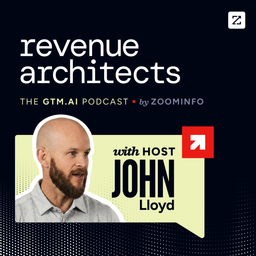
Most AI in GTM is failing, not because the models are wrong, but because the layer underneath them isn't ready.
Revenue Architects is the bi-weekly podcast for GTM operators responsible for the infrastructure AI actually runs on. The data, the signals, the systems that decide whether AI in GTM works or fails.
Hosted by John Lloyd, Principal Business Consultant at ZoomInfo, every episode starts with original data, lands a real take from operators in the trenches, and ends with a workflow you can actually build.
No hot takes or vendor pitches. Just the data, the opinion, and the play.
If you're a GTM or RevOps leader responsible for making AI work in your motion, this show is built for you.
New episodes every two weeks.
#12: The one thing AI can't copy in GTM, with Kamil Rextin
When anyone can vibe code an app over a weekend, features stop being much of a moat. Products in the same category start to converge, and when everyone runs the same models on the same inputs, the marketing behind them starts to sound the same too.
In this episode of Revenue Architects, John Lloyd is joined by Kamil Rextin, who has run B2B demand gen agency '42 Agency' since 2017, on what AI can’t copy in GTM. Kamil thinks that once the product stops setting you apart from the rest, the fight moves to brand: the story you tell and the fans who feel strongly about you.
A competitor can catch up with your product in a few weeks, but nobody can code their way to a community of fans. He also expects marketing to split in two, with product marketing moving under product and a brand function owning content and events.
Then marketing itself. Kamil’s team went so deep on AI that one day he realized all of their output looked the same. Now AI handles the data analysis and media mix modeling, while people keep the creative ideas and the strategic thinking. Out of home and events are back on the plan too, because when everyone is scaling through AI, he does what doesn’t scale. John and Kamil also get into why a shared library of AI skills and context should sit with RevOps under the CRO, and why his first hire for a new marketing team would be a product marketer.
15 Oct 2026
#11: How to turn cold outbound into an always-on GTM conversation, with Keith Jensen
Reply rates have been falling for years, and many teams have responded by using AI to send more, faster. Cold email gives you fewer early signals too, since a link or a tracking pixel makes a message more likely to land in spam.
In this episode of Revenue Architects, John Lloyd is joined by Keith Jensen, President at Cadre AI and a former CMO, on turning cold outbound into an always-on conversation with your total addressable market. His view is that email should be judged like any paid channel, on what it drives, since nobody expects everyone who sees a Meta or TikTok ad to reply. The asks get more creative too, like an invitation to contribute to a white paper or join a coffee at an event, and the signal often comes later, when someone from the TAM turns up on your website. For clients, Keith's team builds a pre-CRM that holds the whole TAM. Website visitors are resolved against it and scored, and once they're ready, AI pushes them into the CRM and on to the right seller.
Then the marketing side. The same TAM becomes an ad audience, matched to devices for connected TV and social, so a small segment sees a company that looks much bigger. Messaging comes from 55 playbooks, built after rolling 515 industries up into industry groups. And once leads come from signals, Keith argues an MQL has to be a score, measured against the conversion rates of form fills. John and Keith also get into who should own all of this when there's no well-built RevOps team, and where AI slop comes from: people keeping the old five-minute review for work AI now does in zero minutes, when it needs 25 or 30.
1 Oct 2026
#10: How to get the human and AI split right, with Greg Symons
Asymbl has already run the experiment that many GTM leaders are still making predictions about. Roughly 120 employees work alongside 200 digital workers, and every one of those agents reports to a named manager, the same way a new hire would.
In this episode of Revenue Architects, John Lloyd is joined by Greg Symons, Founder, President and COO at Asymbl, to walk through a sales play that runs across both. It starts with Teddy, their AI SDR.
Inbound leads get sorted from spam, graded and scored, and once they clear a threshold, they land in Teddy's queue, where he researches the account against their ICP and persona before the first touch. He has his own email account, Salesforce user record, and Slack presence, so when he books a meeting on Jordan's calendar, the human BDR he reports to can see every exchange that came before it. Each week Jordan reviews Teddy's dashboards and runs an export of his emails through a separate AI tool to check the messaging.
Then the extremes. With people alone, Greg expects similar output at a significantly higher cost of acquisition. With agents alone, the output wouldn't hold up, because Asymbl's buyers make big financial decisions that depend on trust. John and Greg also get into why Asymbl rebuilt Stanley, an internal agent built in Claude, on plain compute and cut his run time from as long as two days to five minutes, how third-party data from ZoomInfo widened what Teddy could do, and why the first step is naming the outcome before choosing the tool.
17 Sept 2026
#9: How to structure a GTM team that can actually run AI, with Mallory Lee
Job titles have moved faster than the jobs underneath them. RevOps, GTM engineer, growth engineer, ops partner. Some of it is real change in the work. Some of it is relabelling. And underneath the titles sits a question many teams haven't answered: AI is running somewhere in the workflow already, so who actually owns it, who gets to ship it, and who is accountable when it gets something wrong?
In this episode of Revenue Architects, John Lloyd is joined by Mallory Lee, VP of Revenue Operations at Zipline, on how to structure a GTM team that can actually run AI. Her answer isn't one owner, it's points of entry. Someone dedicated to CS and sales operations. Marketing ops as her night job alongside demand gen. A systems administrator on her team who gets everything connected from a plumbing standpoint and takes each new MCP through IT and internal security. The stakeholders sit outside all of it, getting pitched tools all day and pushing requests in. Her job in the middle is deciding which tool gets used for what, because there are now unlimited options and people early in their careers are frightened of picking wrong.
Then the hiring. She isn't screening for a long list of tools someone has used for five years that haven't existed for five years. She wants people who learn systems fast. She's also cancelled a planned analyst hire, because she now does that analysis herself and RevOps teams are getting smaller because of it. John and Mallory also get into why the silo is almost always the customer success group, why standardising a few things beats everyone using AI their own way, and why workflows fail on the edge case nobody built for rather than the tooling.
3 Sept 2026
#8: The non-negotiables in an AI-ready tech stack, with Brendan Powers
When an agent gets something wrong, the model is the first thing anyone blames. Bumping it up a tier is the cheapest available fix, which is why it happens so often and why it so rarely works. The fault is almost always upstream, in the prompting or in the data sitting underneath it. An agent that needs an account's industry can't do much with the half of your accounts where that field is empty.
In this episode of Revenue Architects, John Lloyd is joined by Brendan Powers, Principal Go-to-Market Operations and Engineering Manager at ZoomInfo, on what a stack has to look like before an agent can run on it without a human checking the output. His answer starts underneath the agent: enrichment data, CRM data, and product usage in the warehouse, because the play for a customer who barely logs in isn't the play for one about to blow through their credits. Then the working rule. Make as much of the agent deterministic as you can, and hand it data instead of asking it to decide. When it breaks, you want to know which layer failed, and a heavy prompt doing five jobs will never tell you.
Then Salesforce. Rep time in the CRM is trending down and to the right, and Brendan is building custom apps in his terminal without being an engineer, but it's still the source of truth and still the trigger for almost every agent they run. Klarna is the cautionary tale for anyone in a hurry. John and Brendan also get into why shadow AI is usually an enablement gap rather than a discipline problem, why the account notes rotting in someone's Evernote are suddenly worth something, and why the job is wide guardrails, not gatekeeping.
20 Aug 2026
#7: Build or buy? The GTM decision that's hard to decipher, with Mollie Bodensteiner
Building is cheap now. The trouble is that cheap to build has quietly turned into cheap to own, and those are two different things. Plenty of teams can list the agents they've shipped. Far fewer can say who fixes one at two in the morning when a model drifts or a Salesforce admin repurposes a field and the output turns to gibberish.
In this episode of Revenue Architects, John Lloyd is joined by Mollie Bodensteiner, VP of Revenue Operations at ZoomInfo, to take on the build versus buy call. Her reframe: most teams aren't building, they're assembling. Wiring together models, data sources, and triggers, then claiming engineering-grade confidence over someone else's model with some logic glued on top. The test she uses is simple. Who notices when it breaks, and how fast? If you can't answer that, you composed it.
Then the calls themselves. ZoomInfo could build a dialer, but shouldn't, once you price in the regulation and the cost of maintaining it in house. Post-sales went the other way: proprietary enough to build, but with a product manager, a roadmap, and a release schedule behind it, not a go-to-market engineer vibing it up. John and Mollie also get into why the signal is the easy part, why surface area is the penthouse and entity resolution is the parking garage, and why ownership is a name with a backup, not a department.
6 Aug 2026
#6: How to use an MCP to act on live GTM data (and the play that shows how)
MCP comes up in every other GTM conversation. Plenty of people can define it. Far fewer have connected one. When 50 senior GTM leaders were asked which AI use cases are working and which are overhyped, agents querying GTM data via MCP split them more than anything else in the survey: 52% were undecided, and only 16% said it was genuinely working.
In this episode of Revenue Architects, Florin Tatulea and John Lloyd define what MCP actually is and where it breaks. Think of it as a USB-C port for AI: one standard interface instead of a brittle custom integration for every platform. An API runs on fixed endpoints set in advance. MCP lets the agent decide what to call and grounds it in live data rather than whatever was last written to the CRM. Which is where the trust problem sits, because the protocol is only as good as the layer underneath it.
Then the play. Churn risk prevention, built as five prompts: pull the book of business filtered to accounts inside their renewal window, layer in pain points from recent call recordings, add competitive intent and review-site activity, weight it into a tiered risk score, then draft outreach to whatever lands in critical. Churn rarely announces itself in one system, so the query has to reach across four.
Florin and John also cover what makes it possible: resolved identity, so a fused risk score isn't reading one account as four separate records, a grounding test for whether an agent can trace its output back to a real source, and the part nobody assigns, someone owning recalibration.
23 Jul 2026
#5: Why your best signals go cold before anyone acts (and what to implement)
Every buying signal has a half-life. A pricing-page visit, a job change, an intent spike: they all decay, and most GTM teams act on them long after they've gone cold. When 50 senior GTM leaders were asked what needs fixing in their setup, 56% pointed at the same gap: their AI tools don't have access to real-time signals.
In this episode of The Context Layer Tapes, Florin Tatulea and John Lloyd get into why speed, not just data, is where teams fall down. Act on a website visit within 20 minutes and you can lift conversion 2 to 3x. Wait days on a social signal, or months on a job change, and you've lost the buyer's trust before you've said a word. Two clocks are always ticking, the signal decaying and the buying window closing, and the deal is lost when they fall out of sync.
Then the plays. The setup: a connected account plan that meshes first-party and third-party signals across the whole book of business. The trigger: an in-market score built across intent, website and social engagement, firing on the spike rather than any single signal, which took one team's call connect rate from 3% to 12% in a week.
To close, Florin and John cover what makes it possible: identity resolution and first-and-third-party unification, and the part nobody budgets for, owning the process so the signal reaches the rep in time.
9 Jul 2026
#4: Why your best investment isn't more AI (and what to do instead)
Most teams are still wondering which AI tool they should buy next. But when 50 senior GTM leaders were given a blank cheque and asked what they’d build in their data stack, the answer wasn’t more agents, better prompts, or a flashier model. It was the foundation underneath.
In this episode of The Context Layer Tapes, Florin Tatulea and John Lloyd dig into why 62% of senior GTM leaders said their next investment would be a unified data layer connecting all of their GTM tools. Continuous enrichment, intent feeds, and real-time signal engines followed close behind, while AI agents plugged in via MCP sat at the bottom of the list.
Florin and John break down why this is not really a budget problem, why a unified data layer is hard to buy as a single project, and why the biggest blocker is often ownership rather than technology. They also unpack the gap between where information lives and where decisions actually happen.
The play: run a lost-deal trace. Take one real deal that slipped, walk it backwards, find the signal or context that existed somewhere in the stack but never reached the right person or workflow, and build that connection first. Don’t try to build the whole data layer in one go. Find the first brick, prove its value, and start there.
25 Jun 2026
#3: Why AI can't serve your GTM stack (and how to fix it)
Most teams plugged an AI agent into their CRM and expected it to just work. The data was there. The model was smart enough. It still came up short.
In this episode of The Context Layer Tapes, Florin Tatulea and John Lloyd go a layer deeper than data. Drawing on research from 50 senior GTM leaders at US enterprises, they dig into why nearly three-quarters say the real blocker is how data moves between their tools and their CRM, not the data sitting inside any one of them.
Florin and John break down why this is an infrastructure problem and not a data problem, why the CRM was never built to be a live hub for autonomous agents, and the multi-agent handoff (watcher, researcher, actor, executor) that turns a single intent signal into tailored outreach without a human copying between tools.
You can have good data in every tool and still fail. The teams that win build the intelligence once and deploy it everywhere. Stop wiring AI into one tool at a time. Build the layer that connects them.
11 Jun 2026
#2: What GTM leaders want from AI (and how to build it)
When you ask GTM leaders about AI, you expect a wish list of capabilities back. Smarter models, better content, sharper agents. But that's not what we saw on our survey.
In this episode of The Context Layer Tapes, Florin Tatulea and John Lloyd pick up where episode one left off, digging into what GTM leaders actually want AI to do and why they still can't. Nearly 40% described the same ambition in their own words, and it wasn't more AI. It was AI that connects the data they already have and acts on it instantly.
Florin and John break down why leaders aren't asking for capability but writing the build spec, why the signals (and the people who own them) keep bouncing off each other instead of connecting, and the automated signal-to-action play that turns scattered intent into a tailored offer in the right rep's hands the same day.
Same ambition, same AI. The only thing standing between "we wish we could do this" and "we do this every day" is the layer underneath. Stop wishing AI could connect what you have. Build the layer that connects it.
28 May 2026
#1: Why AI in GTM isn't working (and what's underneath it)
Every GTM team that's invested in AI in the last 18 months expected leverage. What they got was a sophisticated form of double-checking.
In this first episode of The Context Layer Tapes, Florin Tatulea and John Lloyd unpack fresh research from 50 senior GTM leaders at US enterprise companies. The top three things blocking them from getting value out of AI aren't three problems. They're one problem, showing up three times. And no, it's not the algorithms.
Florin and John break down why the AI conversation has been pointed at the wrong layer for years, why "nearly right" AI is the silent killer of time savings, and the play GTM teams need to run if they want AI to actually deliver.
AI thrives on context. Give it foundational context and watch it do wonders.
Reach and audience
Public platform figures. Ratings count people who left a rating, not total listeners.
Spotify
5.0 / 5
2 ratings
Contact Revenue Architects: The GTM.AI Podcast
Guest appearances
Books guests
Based on episode analysis; this does not confirm that the show is currently accepting guests.
Host of Revenue Architects: The GTM.AI Podcast?
Claim your podcast to manage its listing and keep your show details accurate.
Pod Engine is an independent podcast discovery and analytics service and is not affiliated with or endorsed by this podcast. Artwork and show content belong to their owners. Full legal notice.
Explore this show Podcast research with Pod Engine