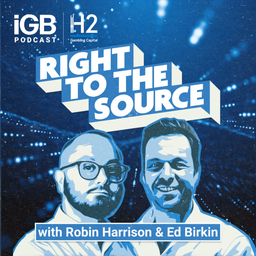
Episode 43: NFL prediction markets and the M&A value debate
Right to the Source returns after Nigel Eccles’ candid interview. Robin Harrison and Ed Birkin touch on FanDuel again in the latest episode, then explore a few key themes in the gambling industry. On top of that, there is something our listeners have been missing: prediction markets are back.
NFL prediction markets: headwind or hype?
Ed shares H2’s unreleased prediction market data set. The NFL sportsbook handle is roughly flat for the year, up 0.4% in reporting states and down 1% once Florida is included. That is the net result of around 4% organic growth and a 4-5% headwind from prediction markets.
Prediction markets are also taking a bigger slice of the pie. Their share of the combined handle in regulated states has jumped from around 5% six months ago to roughly 15%. Aggressive spending around the World Cup and through August drove much of that rise.
Which state feels the biggest headwind? The hint: it has a warmer climate. Tune in to find out.
Robin and Ed also explore the legal uncertainty around prediction markets. Ed relays views from a recent US trip, where many expect the fight between states and the CFTC to reach the Supreme Court around 2027-28. Events are already moving. As Matt Rybaltowski reported, the NFL has since filed an amicus brief urging the Supreme Court to review Flaherty v. KalshiEx, LLC.
Lottomatica and Cirsa: does M&A really add value?
The episode wraps up with a lively exchange on acquisitions in the industry. Robin and Ed compare a few recent deals, including the earlier Banijay and Tipico merger, with Flutter as the central case study.
Ed argues nobody has proven that Flutter’s acquisitions created value beyond FanDuel. Where does Lottomatica’s acquisition of Cirsa fit in? Tune in to hear the pair’s verdict.
6 Aug 2026
Episode 42: Nigel Eccles on the FanDuel lawsuit ruling
Right to the Source is pleased to welcome Nigel Eccles, co-founder of FanDuel and now CEO of Sentient Studios, to join Robin Harrison and Ed Birkin this week.
Nigel walks through the recent court ruling in his long-running case against FanDuel's former board, discusses his new AI dealer venture and shares some sharp views on prediction markets and crypto gambling along the way.
Inside the FanDuel lawsuit
Nigel co-founded FanDuel in 2009 as a daily fantasy sports business. After PASPA was repealed in 2018, FanDuel merged its US assets with Flutter's. This created a new combined entity in which founders, early investors and employees held 40%.
The board, controlled by preferred shareholders, valued that stake at just $559 million, arguing PASPA's repeal had no impact on its worth. However, comparable companies like DraftKings saw valuations rocket in the same period.
Nigel and over 100 former employees and investors subsequently sued, arguing the board breached its fiduciary duty and engaged in fraud and secret commissions to strip value from common shareholders, before a later sale valued the same stake at $4.2 billion.
As iGB reported at an earlier stage of the case, the defendants have pushed back hard. They claimed Eccles himself mismanaged the company before the sale. Nigel walks through how the case has evolved since, from the early jurisdictional battles to the recent ruling in favour of the claimants. He also gives his honest expectation for how long it could still take to reach trial.
Is AI dealer the future of live casino?
As Martin Bjoerck recently reported, Nigel has now gone all in on the AI live dealer product. He has shut down his crypto casino BetHog to focus entirely on Sentient Studios and its AI-powered product.
He believes the category has real staying power. The group also agrees there is something missing from traditional live dealer tables and RNG products, which is a niche in the market for AI dealer to capitalise on. Listen in to hear what Nigel thinks will actually drive its growth.
Along with a candid discussion on where crypto goes next in gambling, the conversation also throws up some interesting perspectives on prediction markets, a topic that clearly intrigues Ed.
30 Jul 2026
Episode 41: How serious is the revenue leakage from fake games?
Robin Harrison and Ed Birkin are pleased to welcome Jack Crabtree, Head of Sales at GameCheck, to the latest episode. Jack joins the pair to explain the GameCheck business and discuss the impact fake games have on the industry.
How GameCheck works and who it serves
Jack explains how GameCheck detects fake or manipulated slot games running on unlicensed or grey market sites, sometimes with altered RTPs.
For operators offering genuine games, GameCheck offers the SEAL, an independent certification badge that signals authenticity. According to Jack, the seal sees particularly strong uptake in less regulated markets like Turkey.
As Robin previously reported, Brazil has become the biggest hotspot GameCheck monitors, with over 6,800 fake games detected in the market alone. Jack unpacks why Brazil's rapid growth has made it such fertile ground for rogue operators.
The business works with both operators and suppliers, but it has recently shifted from a pure revenue protection model for suppliers to something more sustainable. Tune in to find out what that looks like.
Revenue leakage for suppliers
GameCheck and H2 Gambling Capital data puts the number of detected fake games globally at 8,500, though Jack suggests the real figure is likely higher.
The issue is most prevalent in grey or unregulated markets, and one particularly striking finding came from research with BetBlocker: most sites not listed on its blocklist turned out to be operating fakes.
So how much revenue is actually leaking out of the industry because of this? Jack has a figure in mind, but you will need to listen in to hear it.
Jack also references comments from Evolution's CEO, who has flagged game cloning as one of the single biggest sources of revenue leakage for the company, effectively reducing its RTP to zero on every cloned instance since it earns nothing from the activity.
With studios already under pressure from tightening margins and an oversaturated content pipeline, is this the next issue they cannot afford to ignore?
Before wrapping up, listen out for the unfiltered chat that almost did not make the final cut. A hint: one of the hosts prefers Thundercats to He-Man.
Podcast Authority Score: 33 / 100
A composite of feed quality, social presence, YouTube performance and engagement. Read the methodology.
Quality
66
Social presence
0
YouTube
0
Engagement
0
Contact Right to the Source
Guest appearances
Does not typically book guests
Based on episode analysis; this does not confirm that the show is currently accepting guests.
Questions about Right to the Source
Who hosts Right to the Source?
Ed Birkin and Robin Harrison host the show. Published by iGamingBusiness.
How often do new episodes come out?
The show publishes monthly, based on its RSS feed.
Does Right to the Source take guests?
The show does not typically feature guests, based on episode analyses.
Host of Right to the Source?
Claim your podcast to manage its listing and keep your show details accurate.
Pod Engine is an independent podcast discovery and analytics service and is not affiliated with or endorsed by this podcast. Artwork and show content belong to their owners. Full legal notice.
Explore this show Podcast research with Pod Engine