- 23
- Episodes
- 1
- Ratings
- Weekly
- Cadence
- 2026
- First episode
About Safe Doesn't Scale
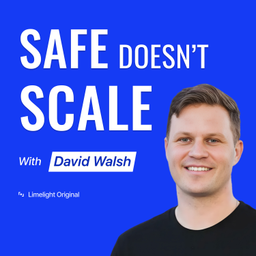
"What's the ROI?" Those three words kill more creative marketing ideas than bad execution ever will. Not here. Safe Doesn't Scale is a weekly podcast for marketing and growth leaders. We’ll be interviewing Heads of Marketing, Unicorn Founders, and Revenue Leaders at B2B companies to prove that the riskiest marketing campaigns drive the biggest returns. While brands are burning $500K on LinkedIn ads that are generating zero demos, there’s someone out there who closed a $2M deal they sourced from a meme. Host David Walsh, Founder of Limelight, breaks down real examples from brands spending less and converting more by leaning into creator-led growth, unconventional distribution, and campaigns that make traditional marketers panic. You’ll learn: How growth leaders sell “unsafe” ideas to the C-suite How to attribute sales pipeline to content, creators, and social signals Why the campaigns that feel uncomfortable often drive the most revenue No e-book downloads. No buzzwords. This show is for marketers with a chip on their shoulder who are tired of playing it safe. We celebrate the campaigns that make legal sweat and sales teams crush quota. Because marketers who don't take risks won't exist in 2027.
- Publisher
- David Walsh
- Category
- business · business · business
- Language
- en
- Explicit
- No
- First episode
- 9 Feb 2026
- Latest episode
- 27 Aug 2026
Latest episodes
23 episodes in the feed.
27 Aug 2026
AI Became Public Enemy Number One in B2B Social (with Meryoli Arias, ex-Apollo and Chili Piper) | Ep. 22
AI Made Content Cheap. It Made Trust Expensive. ㅤ Every B2B company now has the ability to publish more than it ever has, and buyers are reading less of it than they ever have. LinkedIn shipped a button that lets people flag posts as AI slop, which tells you where the feed ended up. The companies still getting attention are doing something that can't be generated. ㅤ David Walsh (https://www.linkedin.com/in/david-walsh-limelight/), founder of Limelight (https://www.limelighthq.com/), talks with Meryoli Arias (https://www.linkedin.com/in/meryoliarias/), who built social and community programs at Chili Piper and Apollo before going independent. They cover what to publish when everyone can publish, how to run employee advocacy without mandating it, and how to prove social is working when attribution won't cooperate. ㅤ Meryoli has run the version of this that worked at scale: an employee advocacy program at Chili Piper five years before it was common, a nomination campaign that pulled in millions of impressions in a month, and a stretch at Chili Piper where more than 70% of closed deals said they first heard about the company through social. ㅤ Guest Bio Meryoli Arias (https://www.linkedin.com/in/meryoliarias/) is a B2B social media and community marketing consultant who now works with earlier-stage companies setting up their first real social strategy. She spent six years inside B2B marketing teams, including Chili Piper, where she ran social and helped build the employee advocacy program the company became known for, and Apollo, where she led social through the period right before the company hit unicorn status. Her work centers on what she calls community marketing: activating customers, partners, and employees rather than broadcasting from a company page. She still spends most of her day on LinkedIn, and she is one of the few marketers who will say out loud that she likes it there. ㅤ What We Cover Why social went from nice to have to table stakes: Products, websites, and copy can be replicated quickly now. Brand and the people behind it can't. Meryoli traces how social moved from afterthought to competitive advantage to baseline requirement. What she saw working at Apollo: She joined when the company started investing in brand, right before unicorn status. The product already had organic advocates, so the team started conversations with those people instead of talking over them. AI as public enemy number one: The mistake she sees most is leadership believing social strategy can be replaced by AI. Production can be automated. The judgment about what to publish can't. The LinkedIn AI slop button: People stopped reading posts because they assumed AI wrote them. LinkedIn responded to that behavior with a reporting mechanism, and Meryoli says the feed has shifted noticeably in the three weeks since. Why inauthentic content gets discounted: She draws a line between AI content and paid endorsements. Once you know something was paid for, you pull back. The same reflex now applies to anything that reads as machine-written. Employee advocacy without the mandate: Handing employees copy to paste, or requiring reposts, produces nothing. She starts by showing individuals what a personal brand does for their own career, then works with the people who opt in. Building criteria instead of a content calendar: Her term for the internal standard someone applies to a draft. AI can produce the first version. Criteria is what tells you how to make it better, and it only comes from experience. Who a founder should actually hire first: A founder asked her whether his first marketing hire should be a social specialist. Her answer was no. Start with a generalist who understands a bit of everything, and start the social foundation early regardless. Community marketing versus building a community: Two different jobs. Building a community means owning the space and keeping it alive. Community marketing means joining conversations that already happen in your category, on Reddit or inside groups your buyers are in. Choosing channels beyond LinkedIn: The first question is where your ICP spends time. Engineers lean toward Reddit and YouTube. Designers go somewhere more visual. She has seen results on TikTok, Instagram, Reddit, and the recent revival of X. Measuring social when attribution breaks: Nobody sees a post and buys. Her preferred signal is the sales team reporting that prospects say they heard about the company on social, plus the answer to the onboarding question about where they first heard of you. Campaigns worth stealing: The Chili Piper top 32 marketers nomination campaign, where nominees rallied their own followers to vote, and the employee takeover format, where an employee wrote a post for the company page and, on launches, the engineer who built the product explained why. ㅤ Resources Mentioned Apollo (https://www.apollo.io/): Where Meryoli ran social during the run up to unicorn status, including an engineering newsletter written by the engineers themselves. Chili Piper (https://www.chilipiper.com/): The employee advocacy program, the employee takeover format, and the top 32 marketers campaign all came out of her time there. Exit Five (https://www.exitfive.com/): The B2B marketing community Meryoli recommends, whose event David hears is sold out and whose newsletter he already reads. Dave Gerhardt (https://davegerhardt.com/): Founder of Exit Five, and the writer of one of the only newsletters David subscribes to. Gong (https://www.gong.io/): David describes teams running agents across sales call transcripts to count how often prospects mention a social post, an employee, or a creator. Reddit (https://www.reddit.com/): Named as a place where category conversations already happen, and a strong channel for engineering audiences. ChatGPT (https://chatgpt.com/): Meryoli's example of a first draft that experience lets you improve, rather than a finished post. Notion (https://www.notion.com/): Home of David's to-do list, where joining Exit Five has been stuck in progress. ㅤ Safe Doesn't Scale is hosted by David Walsh (https://www.linkedin.com/in/david-walsh-limelight/), founder of Limelight (https://www.limelighthq.com/). New episodes drop weekly.
6 Aug 2026
The Best Influencers Aren't Influencers (with Max Nimmo from CreatorWorks) | Ep. 21
The Best Influencers Aren't Influencers. B2B teams will happily pour money into paid social for a year before asking it to prove itself. Give a creator program three months and one post, and the same team wants pipeline by Friday. That double standard is quietly killing a channel before most companies have run it properly once. ㅤ David Walsh (https://www.linkedin.com/in/david-walsh-limelight/), founder of Limelight (https://www.limelighthq.com/), sat down with Max Nimmo, who started CreatorWorks a year ago and now runs creator programs for B2B SaaS and AI companies. They get into what a creator budget actually has to be, why organic content on its own stopped producing results, and how to turn creator posts into thought leader ads without blowing up your rates. You'll leave with a number to benchmark against and a clear view of where creator content sits in a go-to-market motion. ㅤ Max came into B2B from gaming, where he ran campaigns with YouTubers and Twitch streamers for brands like Activision Blizzard, then moved to the performance side building marketing mix models for influencer spend. He brings both halves to this conversation: the creative relationship work and the measurement discipline that most influencer programs skip. ㅤ Guest Bio Max Nimmo (https://www.linkedin.com/in/max-nimmo) is the founder of CreatorWorks (https://www.creator-works.com/), a creator-led growth agency for B2B SaaS and AI companies, which he started in London a year before this recording. He spent his early career in gaming influencer marketing, working with YouTubers and Twitch streamers on campaigns for brands including Activision Blizzard and Call of Duty, before moving to the performance marketing side and building marketing mix models that measured influencer spend against paid media. At CreatorWorks he runs a small team supported by an automated middle layer, managing pods of five to 10 clients across LinkedIn creator programs, thought leader ads, and intent tracking. Before he founded the company, he hadn't logged into LinkedIn in about five years. He describes the version of himself that stumbled into the industry as someone playing video games 16 hours a day at university with no idea what to do next. ㅤ What We Cover What creator-led growth means: Max separates the sponsored post everyone recognizes from the wider motion he sells. Organic creator content sits at the foundation, then thought leader ads, engagement tracking, and signal capture turn it into a loop rather than a one-off campaign. Why organic alone stopped working: Partnerships that rely purely on organic reach aren't producing the results brands expect anymore. Max is direct that impressions and CPM are the wrong scorecard, and that consistent results now require going beyond organic. From Call of Duty to LinkedIn: Gaming adopted influencer marketing early and understood creator distribution before anyone else. Max traces the line from managing campaigns with Twitch streamers to building marketing mix models to landing in B2B, where product creation is commoditized and distribution is what's left. The 10/80/10 agency model: The first 10% of any campaign is human strategy. The middle 80% runs on agents, workflows, Airtable, and Claude Code. The final 10% is a human check before anything reaches a client or goes live, which is how a very small team supports a pod of five to 10 clients. The real budget floor: Max reverse engineers from the number of creators, pieces of content, and data points needed to see results in three months. That lands at 10 to 15K per month as an absolute minimum for LinkedIn, before ad spend or usage rights. The measurement double standard: Nobody expects one Meta ad or one event to generate a flood of leads, but a single creator post gets held to exactly that. David adds that sales cycles often run six to nine months, longer than most companies have even been running influencer. The B2C playbook mostly transfers: Roughly 80% of what Max ran for D2C brands is what he now runs in B2B. The differences sit at the back end: tying content to a CRM, routing intent to SDRs. He calls the wider "you can't apply consumer playbooks here" argument rubbish. The best influencers aren't influencers: Founders, analysts, investors, and people doing the work day to day carry the most influence, and none of them think of themselves as creators. That changes the working relationship, because they need real input on hooks and formats rather than a brief and a wave goodbye. Reading the algorithm in real time: Max uses Favikon to find top-performing posts and creators, then collects CSVs from creators because LinkedIn's own reporting doesn't give enough. He describes a creator with over 100,000 followers whose lead magnet posts suddenly couldn't clear 200 impressions. Big creators versus small creators: David's experience is that brands reach for the largest names by default and get worse outcomes. Max pushes back on the binary: different creator sizes serve different jobs and should be measured on different things, but budget forces a choice. Usage rights get negotiated on day one: Thought leader ads run about 3X the click-through rate of regular brand creatives, so repurposing rights are agreed up front with an execution clause. Wait until a post performs and the creator's rate goes up immediately. Authenticity is overrated as a first principle: Max says it's very important but not the most important thing, and questions how well any of us actually detect it. The fix is positioning: not "I use this and love it" but "I found this recently and here's why it matters to you." Creators as a signal engine: A Clay strategy needs quality data to scrape from the outset. Tracking your competitor's posts or your founder's five posts a week produces a trickle. A creator program produces thousands of data points to feed a CRM, outbound sequences, or ads. The AI visibility hot take: Companies run five tools to measure AI visibility because nobody has an accurate answer yet. What's known is that third-party sources like LinkedIn, Reddit, and YouTube get cited most, and everyone else is guessing with confidence. ㅤ Resources Mentioned Favikon (https://www.favikon.com/): the tool Max returns to for finding top-performing LinkedIn posts and creators. Clay (https://www.clay.com/): named as the destination for intent signals, which is why the quality of the data you scrape matters at the outset. Airtable (https://www.airtable.com/): part of the CreatorWorks stack for building internal dashboards and campaign workflows. Claude Code (https://www.anthropic.com/claude-code): used alongside Airtable to automate the middle 80% of campaign execution. Y Combinator (https://www.ycombinator.com/): its request for AI-enabled service businesses is the thesis CreatorWorks was built on. 20VC (https://www.20vc.com/): David references Harry Stebbings' observation about how many founders were once gamers. ㅤ Safe Doesn't Scale is hosted by David Walsh (https://www.linkedin.com/in/david-walsh-limelight/), founder of Limelight (https://www.limelighthq.com/). New episodes drop weekly.
16 Jul 2026
The $50,000 Floor Nobody Tells You About Before You Try Influencer (with Stephen Titus from Faved) | Ep. 20
Most B2B teams have already run their influencer test. Four or five creators sitting dead center in the category, twenty or thirty thousand dollars, a handful of posts, and a quiet decision that the channel doesn't work. The test was never big enough to prove anything either way. ㅤ David Walsh (https://www.linkedin.com/in/david-walsh-limelight/), founder of Limelight (https://www.limelighthq.com/), sits down with the co-founder of a competing marketplace to argue about where creator budgets actually break. You'll walk away with a spending floor, a reason to buy creators outside your category, and a straight answer on what AEO changes about influencer content. ㅤ Stephen brings four years of running flat-fee creator partnerships at scale, a bootstrapped P&L that forces him to care what brands actually renew on, and a blunt estimate of how little of B2B advertising currently reaches creators at all. ㅤ Guest Bio Stephen Titus (https://www.linkedin.com/in/stephen-titus/) is co-founder and CEO of Faved (https://faved.com/), a marketplace connecting brands with creators for flat-fee sponsorships. He runs it with a team of eight, more than 30,000 creators, and hundreds of brands, and has deliberately kept the company bootstrapped after raising venture capital for earlier ventures. He and his co-founder are engineers who first met the world of influencer marketing by accident: they built a productivity smartwatch straight out of university, ran a Kickstarter, and discovered that niche communities could drive volume that paid media couldn't. Multiple failed startups followed before Faved. He now works with consumer brands in supplements and cosmetics alongside a growing roster of AI and software companies. ㅤ What We Cover Two founders, two watch companies: Both David and Stephen started watch brands and backed into influencer marketing the same way. Why flat fee, not commission: Stephen's case for making creator deals more transactional and merit-based. The sin of raising VC too early: Investors became the customer, and the actual customer got ignored. Bootstrapped as a forcing function: Revenue as the funding model ties the platform's goals to the brand's goals. The real competitor is an agency: Not platforms. Mostly no-name agencies and headcount. Alignment before spend: Awareness, clicks, qualified interest, or sales. Pick one before the budget moves. The $50,000 floor: Below that, on one platform, across 20 to 30 creators, you learn nothing. What the first 50K actually buys: One or two creators worth doubling down on with the next 50K. Go non-obvious on category: A CRM should be buying performance coaching and freelancer creators, not just sales creators. AEO, SEO, GEO: Stephen's view that it's all the same job with a new front door. Trust beats topical match in LLM answers: Why a running creator mentioning HubSpot can outrank a sales creator. Consistency over spikes: Monthly baseline spend, or your competitors take the share of attention. B2B is under 1%: Stephen's estimate of creator spend as a share of B2B advertising budget. ㅤ Resources Mentioned Faved (https://faved.com/): Stephen's flat-fee creator sponsorship marketplace. Limelight (https://www.limelighthq.com/): David's B2B influencer marketplace, discussed as the friendly competitor. Luma AI (https://lumalabs.ai/): Named as one of the AI brands running creator partnerships. Notion (https://www.notion.com/): Cited as a brand reaching prosumer audiences through creators. Skillshare (https://www.skillshare.com/): Example of an advertiser running a known playbook that just needs tooling to scale. Brilliant (https://brilliant.org/): Named alongside Skillshare as a scaled creator advertiser. HubSpot (https://www.hubspot.com/): Used in the example of trust outranking topical match in ChatGPT answers. Kickstarter (https://www.kickstarter.com/): Where Stephen's first company discovered the power of niche communities. ㅤ Safe Doesn't Scale is hosted by David Walsh (https://www.linkedin.com/in/david-walsh-limelight/), founder of Limelight (https://www.limelighthq.com/). New episodes drop weekly.
Reach and audience
Public platform figures. Ratings count people who left a rating, not total listeners.
- Apple Podcasts (US)
- 5.0 / 5
- 1 ratings
Contact Safe Doesn't Scale
- Guest appearances
- Books guests
Based on episode analysis; this does not confirm that the show is currently accepting guests.
Host of Safe Doesn't Scale?
Claim your podcast to manage its listing and keep your show details accurate.
Pod Engine is an independent podcast discovery and analytics service and is not affiliated with or endorsed by this podcast. Artwork and show content belong to their owners. Full legal notice.
Explore this show
Podcast research with Pod Engine