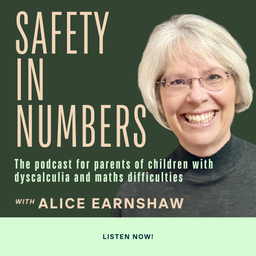
Safety in Numbers: For Parents of Children with Maths Difficulties
Alice Earnshaw
- 13
- Episodes
- Daily
- Cadence
- 2026
- First episode
About Safety in Numbers: For Parents of Children with Maths Difficulties
Does your child struggle with maths? Are you starting to wonder if something more is going on? Whether you have answers yet or not, this podcast is for you. Safety in Numbers is a podcast for parents of children with maths difficulties, hosted by Dr Alice Earnshaw, a maths education consultant and Specific Learning Difficulties assessor based in the Northwest of England. Each episode takes a concern that parents commonly bring (such as why maths facts won't stick, why homework becomes a battle, why nothing seems to make it click) and works through it properly: what's happening, why it's happening, what it means for your child, and what you can do about it today. The practical suggestions are realistic. They don't require specialist knowledge or hours you don't have. The podcast aims to cover the full range of questions parents face: what maths difficulties and dyscalculia actually are (and aren't), why the school system often misses them, what support you can reasonably expect, and how to help your child at home with least resistance. Episodes stand alone, so you can start wherever feels most relevant to you right now. The episodes draw on current research and assessment guidance, translated into language that makes sense.
- Publisher
- Alice Earnshaw
- Category
- education · kids & family
- Language
- en
- Explicit
- No
- First episode
- 10 Apr 2026
- Latest episode
- 13 Sept 2026
Latest episodes
13 episodes in the feed.
13 Sept 2026
What does dyscalculia mean for my child's future?
"What does this mean for my child's future?" is one of the first questions parents ask once dyscalculia is properly on their radar. In this episode, Iwork through the five questions parents ask most often about secondary school, GCSEs and adult life, and looks honestly at what can be known now, and what genuinely can't. I cover: Why "what does this mean for the future?" is such a common response to a dyscalculia diagnosis, and why nobody can answer it with certainty The difference between a difficulty being lifelong and being fixed — and what actually changes for a child over time Choosing a secondary school: what to look for beyond the maths department, and what to know about access arrangements at the 11+ What a GCSE grade does and doesn't determine, including alternative routes like Functional Skills Maths Practical support available in adulthood, including the Disabled Students' Allowance and Access to Work Why helping your child find the words to advocate for themselves matters more than any single piece of information in this episode Free companion guide: This episode's free PDF guide brings together the questions worth asking when choosing a secondary school, along with the self-advocacy phrases from the episode. Download it at aedds.co.uk/podcast (http://aedds.co.uk/podcast). References mentioned in this episode: Department for Education. 16 to 19 funding: maths and English condition of funding (https://www.gov.uk/government/publications/16-to-19-funding-maths-and-english-condition-of-funding/2026-to-2027-academic-year-16-to-19-funding-maths-and-english-condition-of-funding) Disabled Students' Allowance (DSA) (https://www.gov.uk/disabled-students-allowance-dsa) Access to Work (https://www.gov.uk/access-to-work): get support if you have a disability or health condition Next time: That's a wrap on Season 1 of Safety in Numbers. Follow and subscribe so you don't miss the start of the next season, and if you'd like updates and resources in the meantime, there's a sign-up link for Alice's weekly email at aedds.co.uk/contact-email (http://aedds.co.uk/contact-email) About the podcast: Safety in Numbers is hosted by Dr Alice Earnshaw, a maths education consultant and Specific Learning Difficulties assessor. Each episode addresses a question parents commonly face when their child struggles with maths whether or not they have a formal diagnosis. Find more episodes and resources at aedds.co.uk/podcast (http://aedds.co.uk/podcast). Website: aedds.co.uk (http://aedds.co.uk) Facebook group: www.facebook.com/profile.php?id=61551091072526 (http://www.facebook.com/profile.php?id=61551091072526)
6 Sept 2026
How to talk about maths at home
Maths conversations at home can turn into battlegrounds without either parent or child quite knowing how it happened. In this episode, I look at what's really going on underneath those difficult conversations and why the goal isn't getting one conversation right, but understanding what every conversation is building over time. I cover: Why maths conversations break down so predictably, and the roles parents and children fall into without ever discussing them Why some parents' own maths history (good or bad) shapes how these conversations go How maths anxiety affects a child's ability to talk about maths, not just do it Four practical shifts parents can make to change the tone of these conversations, without needing a script Why telling your child you're trying something new matters as much as the change itself Free companion guide: This episode's free PDF guide walks you through the four shifts from the episode, with prompts to try at home this week. Download it at aedds.co.uk/podcast (http://aedds.co.uk/podcast). References mentioned in this episode: Ashcraft, M. H., & Krause, J. A. (2007). Working memory, math performance, and math anxiety. Psychonomic Bulletin & Review, 14(2), 243–248. Doz, E., Cuder, A., Pellizzoni, S., Granello, F., & Passolunghi, M. C. (2024). The interplay between ego-resiliency, math anxiety and working memory in math achievement. Psychological Research, 88(8), 2401–2415. https://doi.org/10.1007/s00426-024-01995-0 (https://doi.org/10.1007/s00426-024-01995-0) Next time: In our final episode of Season 1, we look at what a diagnosis of dyscalculia actually means for your child's future and why that question often causes more worry than it needs to. About the podcast: Safety in Numbers is hosted by Dr Alice Earnshaw, a maths education consultant and Specific Learning Difficulties assessor. Each episode addresses a question parents commonly face when their child struggles with maths whether or not they have a formal diagnosis. Find more episodes and resources at aedds.co.uk/podcast (http://aedds.co.uk/podcast). Website: aedds.co.uk (http://aedds.co.uk) Facebook group: www.facebook.com/profile.php?id=61551091072526 (http://www.facebook.com/profile.php?id=61551091072526)
30 Aug 2026
What maths support should schools provide?
If you've ever left a parents' evening reassured, only to watch your child struggle just as much at home the following week, this episode is for you. I look at why "my child is getting support" and "my child's support is actually working" aren't the same thing, and what tends to get in the way of the second one, without any of it being anyone's fault. I also cover the different, less obvious shapes a maths difficulty can take at school: the helpful child, the funny one, the child who's called lazy or easily distracted, and why a parent is often the one person who can see what's really going on underneath. We cover: Two real examples of "support" that looked the same from the outside but weren't doing the same job Why more practice and more explanation don't always reach the actual difficulty What the research says about how much dyscalculia-specific training teachers actually receive The different ways a maths difficulty can hide behind a child's behaviour, without anyone realising that's what's happening A better question to ask school than "is my child getting enough support?" What good support actually looks like day to day, so you know what to listen for What to do if those conversations with school aren't getting you anywhere If you've been unsure what to expect from school, or how to ask for what your child actually needs, this episode should leave you with a clearer, more specific way in. Links: SENDIASS: www.sendiass.org (http://www.sendiass.org) IPSEA: www.ipsea.org.uk (http://www.ipsea.org.uk) Free companion guide A short, practical guide with the questions from this episode written out, so you've got something to take into a conversation with school. Download it free at aedds.co.uk/podcast (http://aedds.co.uk/podcast). References: Loughborough University. (2026). Teachers receive limited dyscalculia training. https://www.lboro.ac.uk/news-events/news/2026/february/teachers-receive-limited-dyscalculia-training/ (https://www.lboro.ac.uk/news-events/news/2026/february/teachers-receive-limited-dyscalculia-training/) Monahan, F., O'Connor Bones, U., Taggart, L., McDowell, C., & Mulhall, P. (2025). Supporting children with dyslexia in primary school settings through effective professional development of teachers and classroom assistants: An international scoping review. Journal of Research in Special Educational Needs, 25(4), 1067–1088. Roulstone, A., Morsanyi, K., LÊ, M.-L., Tomasetto, C., Erasmus, P., Tsabedze, W., & Bahnmueller, J. (2026). What do educators know about dyscalculia in the UK, Italy, Vietnam and South Africa? Neurodiversity, 4, 1–17. Next episode: We move closer to home, and look at how to talk about maths with your child without it becoming a source of tension. Safety in Numbers is a podcast for parents of children with dyscalculia and maths difficulties. Website: www.aedds.co.uk/podcast (http://www.aedds.co.uk/podcast) Facebook group: www.facebook.com/profile.php?id=61551091072526 (http://www.facebook.com/profile.php?id=61551091072526)
23 Aug 2026
Why maths seems to fall apart under pressure
Your child can do the method at home. They can explain it, work through it calmly, get the right answer. Then in class, or in a test, or the moment they're put on the spot, it disappears. In this episode, Alice explains what's actually happening in those moments, why it isn't carelessness or a lack of effort and what you can do about it. This episode covers: Why a method, a fact, or knowing which operation to use can all fall apart under pressure, even when a child clearly understands them What "demand" really means, and why classroom pressure is often much quieter than an exam or a time limit The central executive: the part of working memory that manages several things at once, and what happens when it reaches its limit Two real cases: a boy whose method came apart the moment anything was added to it, and a girl who lost a carried digit mid-calculation despite knowing the method perfectly well Why this is fragility, not failure, and why it can look like your child is going backwards when the conditions have changed, not their understanding Four practical strategies for parents: slowing down at home, separating understanding from performance, reducing what your child has to keep in their head at once, and responding to where things actually break down Free companion guide Download the free companion guide for this episode, with practical ways to put these four ideas into action at home. https://learn.aedds.co.uk/cgsu (https://learn.aedds.co.uk/cgsu) References Baddeley, A. (2000). The episodic buffer: a new component of working memory? Trends in Cognitive Sciences, 4(11), 417–423. Caviola, S., Carey, E., Mammarella, I. C., & Szűcs, D. (2017). Stress, time pressure, strategy selection and math anxiety in mathematics: A review of the literature. Frontiers in Psychology, 8, 1488. Doz, E., Cuder, A., Pellizzoni, S., Granello, F., & Passolunghi, M. C. (2024). The interplay between ego-resiliency, math anxiety and working memory in math achievement. Psychological Research, 88(8), 2401–2415. Next episode: What support should schools be providing? How to tell whether your child is getting what they need, and what to expect as standard. Safety in Numbers is a podcast for parents of children with dyscalculia and maths difficulties. Website: www.aedds.co.uk (http://www.aedds.co.uk) Facebook group: www.facebook.com/profile.php?id=61551091072526 (http://www.facebook.com/profile.php?id=61551091072526)
16 Aug 2026
Should my child still use their fingers for maths?
If your child still uses their fingers to work out maths, you may have wondered whether they should have grown out of it by now. In this episode, Alice explains why the important question is not simply whether a child uses their fingers, but how they are using them. There is a big difference between counting fingers one by one and using fingers to recognise and combine amounts. Seeing one whole hand as five, for example, is the beginning of understanding numbers as being made up of parts rather than as a sequence of individual ones. Alice explores: why fingers can be an important part of developing number sense the difference between one-by-one counting and recognising amounts instantly what finger gnosis is and why it may matter for maths development why telling a child to stop using their fingers can sometimes make calculation harder what parents should look for before deciding whether finger use is a concern how to help children move from tallying towards seeing numbers as parts how this supports later calculation strategies, including bridging through ten when continued one-by-one finger counting may be worth discussing with school The episode also looks at the shame some children develop around using their fingers, and why children should not feel they need to hide a strategy that is helping them think. Free companion guide Download the free companion guide for this episode, with practical ideas for helping your child use their fingers to build a stronger understanding of number: https://learn.aedds.co.uk/cgsu (https://learn.aedds.co.uk/cgsu) References: Dehaene, S. (1997). The Number Sense: How the Mind Creates Mathematics. Oxford University Press. Butterworth, B. (1999). The Mathematical Brain. Macmillan. Lorenzi, E., Kobylkov, D., & Vallortigara, G. (2025). Is there an innate sense of number in the brain? Cerebral Cortex, 35(2). In the next episode, Alice looks at why calculation methods can seem to fall apart under pressure and what parents can do to support their child in those moments. Safety in Numbers is a podcast for parents of children with dyscalculia and maths difficulties. Website: www.aedds.co.uk (http://www.aedds.co.uk) Facebook group: www.facebook.com/profile.php?id=61551091072526 (http://www.facebook.com/profile.php?id=61551091072526)
9 Aug 2026
What to do when you're worried about your child's maths
That niggling feeling - the one that doesn't quite go away, even when you can't put your finger on exactly what's wrong - is the starting point for this episode. I look at why, in the early stages, it's difficult to tell a normal learning wobble apart from something more persistent, and what actually separates the two over time. I talk through the patterns worth watching for, why "everything's fine" from school isn't the final word, and why shifting from judgement to observation changes everything about how useful your worry can be. We cover: Why a temporary gap in learning and a deeper difficulty can look almost identical at first, and what tells them apart over time Three patterns worth paying attention to: persistence, inconsistency and effort without expected progress Why a child working hard and still not making progress doesn't have a motivation problem Why "the teacher hasn't noticed anything" doesn't mean your concerns aren't valid The difference between asking "is my child bad at maths?" and asking "what am I actually seeing?" and why it is important to distinguish between those two questions Why a child's belief about themselves as a learner matters just as much as being able to do the maths itself Why asking questions at school isn't being a "pushy parent" References: Dweck, C. S. (2006). Mindset: The New Psychology of Success. Random House. Boaler, J. (2016). Mathematical Mindsets: Unleashing Students' Potential through Creative Math, Inspiring Messages and Innovative Teaching. Jossey-Bass. Next episode: Why does my child still use their fingers in maths? — why the advice to stop might be getting it exactly backwards. Free companion guide Download the free companion guide for this episode, with practical ideas for developing your child’s understanding of number by building on their use of fingers at home: https://learn.aedds.co.uk/cgsu (https://learn.aedds.co.uk/cgsu) Safety in Numbers is for parents of children who are struggling with maths – with or without a formal diagnosis. Each episode looks at a specific aspect of maths difficulty: what's going on, why it happens, what it means and what you can actually do. No jargon. No quick fixes. Just honest, research-informed information for parents who want to understand. Website: www.aedds.co.uk/podcast (http://www.aedds.co.uk/podcast) Facebook group: www.facebook.com/profile.php?id=61551091072526 (http://www.facebook.com/profile.php?id=61551091072526)
2 Aug 2026
Why place value is confusing for some children
A child may be able to tell you that the 7 in 762 is in the hundreds column and represents 700, yet still struggle to write a number they hear, compare larger numbers or use place value accurately in a calculation. In this episode, Alice explains why knowing the names of the columns is not always the same as understanding what the digits are worth. Place value relies on more than remembering labels such as ones, tens, hundreds and thousands. It requires a secure sense of numerical magnitude: an intuitive understanding of how much bigger or smaller one quantity is than another. For children with dyscalculia or specific learning difficulties in maths, that felt sense of quantity may be less secure. Alice explores why this can lead children to: write numbers incorrectly from spoken language rely on partially remembered rules become increasingly confused as numbers grow larger struggle when decimals are introduced follow carrying or borrowing procedures without understanding why they work remember a calculation method one day and lose it the next The episode also explains why physical resources can be so valuable. Base ten blocks, squared paper, place value counters and simple playdough activities can help children see, feel and manipulate the relationships between ones, tens, hundreds, thousands, tenths and hundredths. Using practical equipment is not a step backwards. It gives children a route into understanding that abstract digits alone may not provide. Free companion guide Download the free companion guide for this episode, with practical ideas and language to support place-value understanding at home: https://learn.aedds.co.uk/cgsu (https://learn.aedds.co.uk/cgsu) Base ten blocks See an example of base ten blocks and how they represent place value: https://youtu.be/p6bvKB4jUf8 (https://youtu.be/p6bvKB4jUf8) Place value counters See an example of place value counters and how they represent place value: https://youtu.be/y77eDV2ptQQ?si=4dVD97WrZLBnra5i (https://youtu.be/y77eDV2ptQQ?si=4dVD97WrZLBnra5i) Place value chart See an example of a place value chart and how it helps to represent place value: https://www.youtube.com/watch?v=Bp6h0YJ2xdc (https://www.youtube.com/watch?v=Bp6h0YJ2xdc) In the next episode, Alice looks at what parents can do when they are worried about their child’s maths. Safety in Numbers is a podcast for parents of children with dyscalculia and maths difficulties. Website: www.aedds.co.uk (http://www.aedds.co.uk) Facebook group: www.facebook.com/profile.php?id=61551091072526 (http://www.facebook.com/profile.php?id=61551091072526)
26 Jul 2026
Why maths homework becomes a battle
Why maths homework becomes a battle Maths homework can become a source of dread, frustration and distress for children with dyscalculia or specific learning difficulties in maths, and for their parents. In this episode, Alice explains why homework can feel so overwhelming after a full day at school. A child may already have used much of the working memory, mental effort and emotional regulation that maths requires, leaving very little available when the homework appears. You will also hear why “I can’t do it” may be a sign of overload or anxiety rather than defiance, and why children who appear to cope at school may become distressed or shut down at home. Alice shares four practical ways to reduce the pressure: experiment with the timing of homework lower the emotional temperature before beginning sit alongside your child rather than taking the role of teacher give yourself and your child permission to stop when their resources have run out Stopping is not the same as giving up. When a child is overwhelmed, continuing may create more distress rather than more learning. Free companion guide Download the free guide accompanying this episode, with the four practical suggestions to return to when maths homework becomes difficult: https://learn.aedds.co.uk/cgsu (https://learn.aedds.co.uk/cgsu) In the next episode, Alice explores place value: why it can be such a persistent source of confusion for children with dyscalculia and specific learning difficulties in maths. Safety in Numbers is a podcast for parents of children with dyscalculia and maths difficulties. Website : www.aedds.co.uk/podcast (http://www.aedds.co.uk/podcast) Facebook page: www.facebook.com/profile.php?id=61551091072526 (http://www.facebook.com/profile.php?id=61551091072526)
19 Jul 2026
What dyscalculia actually means
If you've searched for dyscalculia online, you've likely come away more confused than when you started. There are different sources, different definitions and some of them even seem to contradict each other. This episode explains why that is, and gives you the definition most assessors in England work from. I set out what dyscalculia is, how it sits within the broader picture of specific learning difficulties (SpLD) in maths and why the distinction between the two is important for seeking the right support. I also explain what numerical magnitude processing is, why it's the foundation dyscalculia difficulties sit on and what that looks like in practice. We cover: Why definitions of dyscalculia vary so much, and the different frameworks (DSM-5, WHO, SASC) behind that variation The specific differences between a ‘Specific Learning Difficulty (SpLD) in Maths’ and ‘Dyscalculia’, and why SASC describes both as "equally debilitating" What numerical magnitude processing actually means and why our sense of quantity has much older evolutionary roots than school maths The specific areas dyscalculia can show up in such as naming and ordering numbers, estimation, place value and counting Why maths-specific language and vocabulary add another layer of difficulty on top of the numbers themselves A practical framework for observing what's actually going on for your child, whatever label does or doesn't apply yet There's a practical takeaway at the end, and a companion guide to help you put it into practice with your own child. Companion guide: https://learn.aedds.co.uk/cgsu (https://learn.aedds.co.uk/cgsu) Reference: Lorenzi, E., Kobylkov, D., & Vallortigara, G. (2025). Is there an innate sense of number in the brain? Cerebral Cortex, 35(2). Next episode: Why homework becomes a battle – why this is often one of the most exhausting parts of having a child who struggles with maths, and what might help.
12 Jul 2026
Is my child just "bad at maths"?
"I was never any good at maths." "He just doesn't have a maths brain." "I'm just bad at it." This episode takes that phrase apart to consider where it comes from, what it actually covers up and why it does more damage than we tend to notice. I look at why "bad at maths" isn't a description of a child, but a verdict that closes down the search for what's actually going on. And I talk about what happens once a child believes it: how the goal shifts from understanding maths to simply surviving it, and the strategies children develop to manage that. We cover: Why nobody is born bad at maths, and what's really happening when difficulties start to emerge The idea of a fixed mindset versus a growth mindset, and why "bad at maths" is a fixed mindset applied to an entire subject What's usually hiding underneath the label – maths anxiety, working memory pressure, or a missed concept further back The coping strategies children develop once they've accepted the label, from hiding finger-counting to reading a teacher's tone instead of the maths itself Why the language you use, especially when you're tired or worried, matters more than most parents realise Practical changes to the way you talk about maths at home, including one small word worth adding to your vocabulary There's a practical takeaway at the end, and a companion guide to help you put it into practice with your own child. Access the companion guide here: https://learn.aedds.co.uk/cgsu (https://learn.aedds.co.uk/cgsu) Next episode: What dyscalculia actually means.
5 Jul 2026
Why won't maths facts stick?
If your child understood something perfectly last night and can't remember it this morning, this episode explains exactly what's happening, and why more repetition isn't the fix. In this episode I look at why times tables and number facts often refuse to stick for children with a specific learning difficulty in maths, including dyscalculia. It comes down to working memory, and how information does (or doesn't) make its way into long-term memory. We cover: Why some children have to rebuild a fact from scratch every time, rather than simply recalling it What working memory actually is, and why it fills up faster for some children than others Why understanding in the evening can disappear by morning, and what that has to do with consolidation Why drilling times tables often doesn't work for these children, and what to do instead What genuine fluency means (it isn't speed) There's a practical takeaway at the end, and a companion guide to help you put it into practice with your own child. Access the free companion guide here: https://learn.aedds.co.uk/cgsu (https://learn.aedds.co.uk/cgsu) Next episode: Is my child just 'bad at maths'? This is a phrase I want to take apart carefully, because I think it does more quiet damage than people realise.
28 Jun 2026
Why maths is so difficult for some children
If you've ever sat next to your child during maths homework and wondered Why is this so hard for them? then this episode is a good place to start. In this first episode, I want to step back from labels and diagnoses and start with the question most parents are already asking: why is maths so hard in the first place? The answer is more complex than you might expect, and understanding it changes how you see what's happening for your child. We cover: Why maths places such heavy demands on the brain and what that actually means The role of number magnitude, working memory, and consolidation How other learning differences (dyslexia, ADHD, dyspraxia) can make maths harder even when maths isn't the primary difficulty Why anxiety builds and how it gets in the way What your child's behaviour around maths might be telling you There's a practical takeaway at the end, and a companion guide to help you hold on to what we've covered and think it through in relation to your own child. Companion guide: available here. (https://learn.aedds.co.uk/cgsu) Links mentioned: The Dyscalculia Network's Jenga Effect: available here (https://dyscalculianetwork.com/what-is-the-jenga-effect/). Next episode: Why maths facts don't seem to stick, and why repetition so often isn't the answer parents expect.
10 Apr 2026
Trailer
A short introduction to me and what you can expect from Safety in Numbers. I look forward to releasing my episodes soon.
Contact Safety in Numbers: For Parents of Children with Maths Difficulties
- Guest appearances
- Does not typically book guests
Based on episode analysis; this does not confirm that the show is currently accepting guests.
Host of Safety in Numbers: For Parents of Children with Maths Difficulties?
Claim your podcast to manage its listing and keep your show details accurate.
Pod Engine is an independent podcast discovery and analytics service and is not affiliated with or endorsed by this podcast. Artwork and show content belong to their owners. Full legal notice.
Explore this show
Podcast research with Pod Engine