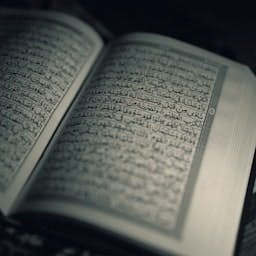
The Quran (/kʊˈrɑːn/, kor-AHN;[i] Arabic: القرآن, romanized: al-Qurʼān, lit. 'the recitation', Arabic pronunciation: [alqur'ʔaːn][ii]), also romanized Qur'an or Koran,[iii] is the central religious text of Islam, believed by Muslims to be a revelation from God (Allah).[11] It is widely regarded as the finest work in classical Arabic literature.[12][13][iv][v] It is organized in 114 chapters (surah (سور; singular: سورة, sūrah), which consist of verses (āyāt (آيات; singular: آية, āyah)).
Assistance [1] (https://en.wikipedia.org/wiki/An-Nasr#cite_note-1) (Arabic (https://en.wikipedia.org/wiki/Arabic_language): النصر, an-naṣr aka "Help",[2] (https://en.wikipedia.org/wiki/An-Nasr#cite_note-2) "[Divine] Support" [3] (https://en.wikipedia.org/wiki/An-Nasr#cite_note-3)) is the 110th chapter (sūrah (https://en.wikipedia.org/wiki/S%C5%ABrah)) of the Qur'an (https://en.wikipedia.org/wiki/Qur%27an) with 3 verses (āyāt (https://en.wikipedia.org/wiki/%C4%80y%C4%81t)).
4 Sept 2020
Surah Al-Kahf
Al-Kahf[1] (https://en.wikipedia.org/wiki/Al-Kahf#cite_note-Quran_4_U-1) (Arabic (https://en.wikipedia.org/wiki/Arabic_language): الكهف, "The Cave") is the 18th chapter (https://en.wikipedia.org/wiki/List_of_chapters_in_the_Quran) (sūrah (https://en.wikipedia.org/wiki/S%C5%ABrah)) of the Quran (https://en.wikipedia.org/wiki/Quran) with 110 verses (āyāt (https://en.wikipedia.org/wiki/%C4%80y%C4%81t)). Regarding the timing and contextual background of the revelation (asbāb al-nuzūl (https://en.wikipedia.org/wiki/Asb%C4%81b_al-nuz%C5%ABl)), it is an earlier "Meccan surah (https://en.wikipedia.org/wiki/Meccan_surah)", which means it was revealed in Mecca, instead of Medina.
4 Sept 2020
Surah Ya-Sin
Yā Sīn [1] (https://en.wikipedia.org/wiki/Ya-Sin#cite_note-GST-1) (also Yaseen; Arabic (https://en.wikipedia.org/wiki/Arabic_language): يس) is the 36th sūrah (https://en.wikipedia.org/wiki/S%C5%ABrah) of the Quran (https://en.wikipedia.org/wiki/Quran). It has 83 verses (āyāt (https://en.wikipedia.org/wiki/%C4%80y%C4%81t)). Regarding the timing and contextual background of the supposed revelation (asbāb al-nuzūl (https://en.wikipedia.org/wiki/Asb%C4%81b_al-nuz%C5%ABl)), it is an earlier "Meccan surah (https://en.wikipedia.org/wiki/Meccan_surah)", which means it is believed to have been revealed in Mecca, instead of later in Medina. Some scholars maintain that verse 12 is from the Medinan (https://en.wikipedia.org/wiki/Medinan_surah) period.[2] (https://en.wikipedia.org/wiki/Ya-Sin#cite_note-2)
2 Sept 2020
Surah Al-Masad
Twisted Strands (Arabic (https://en.wikipedia.org/wiki/Arabic_language): المسد, al-masad, aka "The Palm Fiber") is the 111th chapter (sūrah (https://en.wikipedia.org/wiki/S%C5%ABrah)) of the Quran (https://en.wikipedia.org/wiki/Quran) with 5 verses (āyāt (https://en.wikipedia.org/wiki/%C4%80y%C4%81t)). In the 1730s the chapter title was known as Abu Laheb by translator George Sale (https://en.wikipedia.org/wiki/George_Sale).
2 Sept 2020
Surah Al-Ikhlas
The Declaration of God's Unity [1] (https://en.wikipedia.org/wiki/Al-Ikhlas#cite_note-1) aka Sincerity (Arabic (https://en.wikipedia.org/wiki/Arabic): الْإِخْلَاص, al-ikhlāṣ ) [2] (https://en.wikipedia.org/wiki/Al-Ikhlas#cite_note-Quran_4_U-2) aka Monotheism (Arabic (https://en.wikipedia.org/wiki/Arabic_language): التوحيد, al-tawḥīd),[3] (https://en.wikipedia.org/wiki/Al-Ikhlas#cite_note-3) is the 112th chapter (https://en.wikipedia.org/wiki/List_of_chapters_in_the_Quran) (sūrah (https://en.wikipedia.org/wiki/S%C5%ABrah)) of the Quran (https://en.wikipedia.org/wiki/Quran).
2 Sept 2020
Surah Al-Falaq
The Daybreak [1] (https://en.wikipedia.org/wiki/Al-Falaq#cite_note-1) (Arabic (https://en.wikipedia.org/wiki/Arabic_language): اَلْفَلَق, al-falaq) is the 113th chapter (sūrah (https://en.wikipedia.org/wiki/S%C5%ABrah)) of the Qur'an (https://en.wikipedia.org/wiki/Qur%27an). It is a brief five verse invocation, asking God (https://en.wikipedia.org/wiki/God_in_Islam) for protection from the evil:
2 Sept 2020
Surah An-Nas
Mankind (Arabic (https://en.wikipedia.org/wiki/Arabic_language): الناس, romanized (https://en.wikipedia.org/wiki/Romanization_of_Arabic): al-nās) is the 114th and last chapter (sūrah (https://en.wikipedia.org/wiki/S%C5%ABrah)) of the Qur'an (https://en.wikipedia.org/wiki/Qur%27an). It is a short six-verse (https://en.wikipedia.org/wiki/Ayah) invocation (https://en.wikipedia.org/wiki/Invocation).
2 Sept 2020
Surah Al-fatihah
Al-Fātiḥah (Arabic (https://en.wikipedia.org/wiki/Arabic_language): الْفَاتِحَة, The Opening or The Opener. George Sale (https://en.wikipedia.org/wiki/George_Sale) translates simply as The Preface, or Introduction) is the first chapter (sūrah (https://en.wikipedia.org/wiki/S%C5%ABrah)) of the Quran (https://en.wikipedia.org/wiki/Quran). Its seven verses (āyāt (https://en.wikipedia.org/wiki/%C4%80y%C4%81t)) are a prayer (https://en.wikipedia.org/wiki/Prayer_in_Islam) for the guidance, lordship, and mercy of God (https://en.wikipedia.org/wiki/God_in_Islam).
Reach and audience
Public platform figures. Ratings count people who left a rating, not total listeners.
Apple Podcasts (US)
5.0 / 5
2 ratings
Contact Saleh Quran
Guest appearances
Books guests
Based on episode analysis; this does not confirm that the show is currently accepting guests.
Pod Engine is an independent podcast discovery and analytics service and is not affiliated with or endorsed by this podcast. Artwork and show content belong to their owners. Full legal notice.
Explore this show Podcast research with Pod Engine