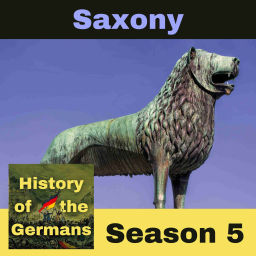
I promised you a History of the Germans but I am afraid there is no such thing. All I can give you is the histories of the German people. The previous 94 episodes you have heard one of the histories of the Germans, the one about the mighty emperors and their political, military and spiritual struggle with the papacy. It is a great story, and it was fun to tell it.
This podcast is part of the broader History of the Germans podcast that aims to track the history of the German people from the Early Middle Ages to Reunification in 1991. If you enjoy this show, check out any of the other seasons or follow the main show.
So far I have the following seasons:
The Ottonians (919 AD-1024 AD)
Salian Emperors and Investiture Controversy (1024 AD-1125 AD)
Fredrick Barbarossa and Early Hohenstaufen (1125-1190)
Frederick II Stupor Mundi (1190-1268)
Saxony and Eastward Expansion
The Hanseatic League
The Teutonic Knights
The Holy Roman Empire (1250 AD -1356 AD)
The Reformation before the Reformation (1356AD -1439 AD)
The Empire in the 15th Century
The Fall and Rise of the Habsburgs (1439AD -1519 AD)
But today we kick off another of the histories, the history of the North of Germany, the part that looked east, rather than south. It is a story of a frontier culture where an estimated 7% of the population of the western part of the empire pack up their belongings and move east, sometimes under the cover of expansionary princes or knightly orders, sometimes invited by local potentates looking to grow their economies. It is a story about the creation and expansion of trade networks, the foundation of cities, some that will remain modest in size, others that turn into important European capitals. It is the story of a periphery that will in time become the centre.
This is a narrative history in weekly 25-30 minute episodes that had initially been published in the History of the Germans Podcast. This is a re-release, so if you want to listen ahead, just go to https://historyofthegermans.com/eastward-expansion/
The Empire in the 15th Century - Season Opener - History of the Germans
Host [Host Name] explores the 15th century's profound impact on Germany's geography and identity, revealing overlooked historical significance.
27 Jul 2024
Ep. 14 (108) – From Saxony to Saxonies - The Fragmentation of the duchy of Henry the Lion
Host Bret Devereaux explores the fragmentation of the duchy of Saxony, revealing how princely opposition and broader European trends led to its division and the rise of new powers.
20 Jul 2024
Ep. 13 (107) - The House of Wettin
Host "History of the Germans" explores the enduring power of the House of Wettin, revealing the true source of their centuries-long rule beyond military might.
13 Jul 2024
Ep. 12 (106) – How to make a Mark in Brandenburg - The rise of Albrecht the Bear
Host [Host Name] interviews historian [Guest Name] about Albrecht the Bear's founding of the March of Brandenburg and its lasting impact on German history.
6 Jul 2024
Ep. 11 (105) – The Foundation of Lübeck
Host "History of the Germans" explores theories behind Lübeck's rapid medieval growth and its rise as a major Hanseatic League city.
29 Jun 2024
Ep. 10 (104) - The Making of Holstein
Host "History of the Germans" explores how Saxon policy shifts toward the east during Lothar of Supplinburg's reign lead to the development of Holstein and the founding of Hamburg and Lubeck.
22 Jun 2024
Ep. 9 (103) – All the Duke’s Men - Lothar III as duke of Saxony kicks of the colonisation of the East
Host Bret Devereaux explores how Lothar III, as duke of Saxony, consolidates power and initiates eastward expansion, establishing key dynasties.
15 Jun 2024
Ep. 8(102) – The Great Divide - The Investiture Controversy and its impact on the East
Host [Host Name] explores the Investiture Controversy's profound impact on Saxony and Eastward Expansion, revealing its significance in medieval German history.
8 Jun 2024
Ep. 7 (101) – Gottschalk and Adalbert - The emergence of the duchy of Mecklenburg
Host Johannes Watt shares an interview with historian Adalbert discussing Gottschalk's rise and alliance, revealing the emergence of the duchy of Mecklenburg.
1 Jun 2024
Ep. 6 (100) – The Saxon War – The Conflict between the Saxons and the Emperors breaks out in the open
Host "History of the Germans" explores the escalating conflict between the Saxons and the Emperors during the 10th and 11th centuries, revealing Saxony's growing independence from the empire.
25 May 2024
Ep. 5 (99) – Follow the Money - The reason the Saxon nobles raided the east but did not conquer
This week we stumble into the next imperial succession where the Saxons are again standing on the side lines. On paper the new guy, Konrad II was a man after their own heart, fearsome warrior untroubled by bookish learning, but he was also a sponsor of the church. His son, Henry III was even more so, and there are many reasons why the Saxon magnates did not like the ecclesiastical princes. And it is not just about them greedily gobbling up lands and privileges, but they are also hitting them where it hurts most – the economy, stupid…
The music for the show is Flute Sonata in E-flat major, H.545 by Carl Phillip Emmanuel Bach (or some claim it as BWV 1031 Johann Sebastian Bach) performed and arranged by Michel Rondeau (https://www.windrep.org/Michel_Rondeau) under Common Creative Licence 3.0 (https://imslp.org/wiki/Flute_Sonata_in_E-flat_major%2C_H.545_%28Bach%2C_Carl_Philipp_Emanuel%29).
As always:
Homepage with maps, photos, transcripts and blog: www.historyofthegermans.com (https://historyofthegermans.com/)
Facebook: @HOTGPod (https://www.facebook.com/HOTGPod/)
Twitter: @germanshistory (https://twitter.com/germanshistory?lang=en)
Instagram: history_of_the_germans (https://www.instagram.com/history_of_the_germans/?hl=en-gb)
Reddit: u/historyofthegermans
Patreon: https://www.patreon.com/Historyofthegermans (https://www.patreon.com/Historyofthegermans)
To make it easier for you to share the podcast, I have created separate playlists for some of the seasons that are set up as individual podcasts. they have the exact same episodes as in the History of the Germans, but they may be a helpful device for those who want to concentrate on only one season.
So far I have:
The Ottonians: (https://podfollow.com/1737878874)
The Hanseatic League (https://podfollow.com/the-hanseatic-league)
The Teutonic Knights (https://podfollow.com/1719261540)
The Holy Roman Empire 1250-1356 (https://podfollow.com/1733632792)
18 May 2024
Ep. 4 (98) - The Rift - The Saxon Nobles and the Emperors fall out over what to do with the East
This week we are talking about the rift that is opening up between the Saxons and the Empire. For 80 years Saxony had been the centre of imperial power and the Ottonians had been supportive of the Saxon nobles’ policy vis-à-vis the Wends and Poland. All that Is about to change. The new emperor Henry II, though a direct descendant of Henry the Fowler, was no Saxon. For three generations his family had been dukes of Bavaria and all that exposure to the despised southerners had rubbed off. The Saxons were too divided to field their own candidate, but that does not mean they wanted Henry II.
The music for the show is Flute Sonata in E-flat major, H.545 by Carl Phillip Emmanuel Bach (or some claim it as BWV 1031 Johann Sebastian Bach) performed and arranged by Michel Rondeau (https://www.windrep.org/Michel_Rondeau) under Common Creative Licence 3.0 (https://imslp.org/wiki/Flute_Sonata_in_E-flat_major%2C_H.545_%28Bach%2C_Carl_Philipp_Emanuel%29).
As always:
Homepage with maps, photos, transcripts and blog: www.historyofthegermans.com (https://historyofthegermans.com/)
Facebook: @HOTGPod (https://www.facebook.com/HOTGPod/)
Twitter: @germanshistory (https://twitter.com/germanshistory?lang=en)
Instagram: history_of_the_germans (https://www.instagram.com/history_of_the_germans/?hl=en-gb)
Reddit: u/historyofthegermans
Patreon: https://www.patreon.com/Historyofthegermans (https://www.patreon.com/Historyofthegermans)
To make it easier for you to share the podcast, I have created separate playlists for some of the seasons that are set up as individual podcasts. they have the exact same episodes as in the History of the Germans, but they may be a helpful device for those who want to concentrate on only one season.
So far I have:
The Ottonians: (https://podfollow.com/1737878874)
The Hanseatic League (https://podfollow.com/the-hanseatic-league)
The Teutonic Knights (https://podfollow.com/1719261540)
The Holy Roman Empire 1250-1356 (https://podfollow.com/1733632792)
11 May 2024
Ep. 3 (97) – Rebellion! - The Slavic Wends push the Saxons back across the Elbe River
Now that we know the lay of the land it is time for action, and quite some action it will be. The Wends, the pagan Slavic peoples living east of the Elbe who found themselves ever more squeezed by their now Christian neighbours wake up one morning to find their oppressors fatally weakened. Events 2000 km south of Brandenburg create the once in a century opportunity to throw off the yoke of the Saxons. The newly built churches go up in flames and their tormentors flee back across the Elbe. Any plans for retaliation are thwarted by a succession crisis. This loss of control will have a major impact not on German history, but will reset the relationship with Poland and Bohemia as well. In the year 1000, emperor Otto III will manifest this new relationship when he visits one of Poland’s most remarkable monarch, Boleslav the Brave in Gniesno. Let’s find out…
The music for the show is Flute Sonata in E-flat major, H.545 by Carl Phillip Emmanuel Bach (or some claim it as BWV 1031 Johann Sebastian Bach) performed and arranged by Michel Rondeau (https://www.windrep.org/Michel_Rondeau) under Common Creative Licence 3.0 (https://imslp.org/wiki/Flute_Sonata_in_E-flat_major%2C_H.545_%28Bach%2C_Carl_Philipp_Emanuel%29).
As always:
Homepage with maps, photos, transcripts and blog: www.historyofthegermans.com (https://historyofthegermans.com/)
Facebook: @HOTGPod (https://www.facebook.com/HOTGPod/)
Twitter: @germanshistory (https://twitter.com/germanshistory?lang=en)
Instagram: history_of_the_germans (https://www.instagram.com/history_of_the_germans/?hl=en-gb)
Reddit: u/historyofthegermans
Patreon: https://www.patreon.com/Historyofthegermans (https://www.patreon.com/Historyofthegermans)
To make it easier for you to share the podcast, I have created separate playlists for some of the seasons that are set up as individual podcasts. they have the exact same episodes as in the History of the Germans, but they may be a helpful device for those who want to concentrate on only one season.
So far I have:
The Ottonians: (https://podfollow.com/1737878874)
The Hanseatic League (https://podfollow.com/the-hanseatic-league)
The Teutonic Knights (https://podfollow.com/1719261540)
The Holy Roman Empire 1250-1356 (https://podfollow.com/1733632792)
4 May 2024
Ep. 2 (96) - Meet the Neighbours - Poland, Bohemia and Denmark
This week we are still getting our bearings. Last week we saw the emergence of the Stem duchy of Saxony and the Eastern marches. This week we take a look at the most important neighbours to the East and North, the Bohemians, the Poles and the Danes.
It is right around this time, the middle of the 10th century that these coalesce into political entities. As always none of this happens smoothly, so expect all sorts of battles and betrayals, including a legion of thieves…
The music for the show is Flute Sonata in E-flat major, H.545 by Carl Phillip Emmanuel Bach (or some claim it as BWV 1031 Johann Sebastian Bach) performed and arranged by Michel Rondeau (https://www.windrep.org/Michel_Rondeau) under Common Creative Licence 3.0 (https://imslp.org/wiki/Flute_Sonata_in_E-flat_major%2C_H.545_%28Bach%2C_Carl_Philipp_Emanuel%29).
As always:
Homepage with maps, photos, transcripts and blog: www.historyofthegermans.com (https://historyofthegermans.com/)
Facebook: @HOTGPod (https://www.facebook.com/HOTGPod/)
Twitter: @germanshistory (https://twitter.com/germanshistory?lang=en)
Instagram: history_of_the_germans (https://www.instagram.com/history_of_the_germans/?hl=en-gb)
Reddit: u/historyofthegermans
Patreon: https://www.patreon.com/Historyofthegermans (https://www.patreon.com/Historyofthegermans)
To make it easier for you to share the podcast, I have created separate playlists for some of the seasons that are set up as individual podcasts. they have the exact same episodes as in the History of the Germans, but they may be a helpful device for those who want to concentrate on only one season.
So far I have:
The Ottonians: (https://podfollow.com/1737878874)
The Hanseatic League (https://podfollow.com/the-hanseatic-league)
The Teutonic Knights (https://podfollow.com/1719261540)
The Holy Roman Empire 1250-1356 (https://podfollow.com/1733632792)
27 Apr 2024
Ep. 1 (95) - Callous Kings and Murderous Margraves - The first wave of expansion east in the 10th century
I have to start with an admission. I promised you a History of the Germans but I am afraid there is no such thing. All I can give you is the histories of the German people. The last 94 episodes you have heard one of the histories of the Germans, the one about the mighty emperors and their political, military and spiritual struggle with the papacy. It is a great story, and it was fun to tell it.
But today we kick off another of the histories, the history of the North of Germany, the part that looked east, rather than south. It is a story of a frontier culture where an estimated 7% of the population of the western part of the empire pack up their belongings and move east, sometimes under the cover of expansionary princes or knightly orders, sometimes invited by local potentates looking to grow their economies. It is a story about the creation and expansion of trade networks, the foundation of cities, some that will remain modest in size, others that turn into important European capitals. It is the story of a periphery that will in time become the centre.
And because it is an almost independent history, we start at the beginning, in the year 772, the year when Charlemagne takes his troops into Saxony hell bent on turning these pagan tribesmen into good Christians and subjects of his emerging empire. If things work out as I hope, we should end this episode with the life of Hermann Billung and Margrave Gero, the first of a wave of chancers and warlords that seek their fortune in the east.
And to all of you who may be new to the History of the Germans Podcast, do not panic. You do not have to catch up on all the previous episodes; you can just start right here, and the narrative should make sense in itself – at least I hope it will. However, some say that the previous three seasons weren’t completely shoddy and may be worth listening to.
Reach and audience
Public platform figures. Ratings count people who left a rating, not total listeners.
Apple Podcasts (US)
5.0 / 5
1 ratings
Podcast Authority Score: 23 / 100
A composite of feed quality, social presence, YouTube performance and engagement. Read the methodology.
Quality
46
Social presence
0
YouTube
0
Engagement
0
Contact Saxony and Eastward Expansion
Guest appearances
Books guests
Based on episode analysis; this does not confirm that the show is currently accepting guests.
Host of Saxony and Eastward Expansion?
Claim your podcast to manage its listing and keep your show details accurate.
Pod Engine is an independent podcast discovery and analytics service and is not affiliated with or endorsed by this podcast. Artwork and show content belong to their owners. Full legal notice.
Explore this show Podcast research with Pod Engine