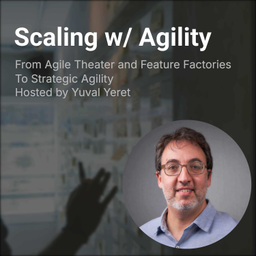
Yuval Yeret hosts Scaling AI: From Activity to Impact, conversations for technology, product, and business leaders asking a hard question: how do we turn all this AI activity theater into real business impact? Yuval and his guests explore what needs to change in how organizations choose, fund, learn, and work with AI — including how native AI capabilities can help scale AI itself. Building on its roots in scaling with agility, the podcast applies adaptive, product-oriented thinking to the biggest operating-model challenge facing organizations today.
When nobody can predict the next five months, let alone five years, what does it mean for a leader to be agile? Brad Farris coaches owners and CEOs of professional services firms through what he calls a polycrisis: AI reshaping the work, shifting expectations between owners and the people who deliver it, and geopolitical shocks on top.
We talk about what agility looks like in practice for a managing partner, not a product team: admit you don't know how this will go, stay anchored on the mission and the people you serve, agree on outcomes before debating how, and take the smallest step that moves you toward them. Then we turn to the harder question for anyone who built their reputation in product and engineering: how do you bring these ideas to the rest of the organization without arriving as the person who is there to fix them?
Key takeaways:
Start by admitting "I don't know how this is going to go." Without that, planning is pretending.
Get agreement on the mission and outcomes before anyone jumps to the how.
In the fog, take the smallest step toward the outcome, check what you learned, and repeat. More people running experiments means more information.
Don't show up as the fixer. Sit on the same side of the table and let people create the solution through small experiments.
Move from expectations to agreements: both sides can negotiate, and that is the first step toward trust.
Agile principles fit well beyond product and engineering, but distill them to first principles and leave the mandates behind.
Chapters:
00:00 Fog, uncertainty, and the need for agility
01:09 Brad's path from consulting to executive coaching
02:22 The polycrisis facing professional services firms
05:30 What agility means in practice for a CEO
06:27 Admitting "I don't know" and renewing the mission
08:16 Outcomes as the North Star
10:13 Developing your company like a product
13:39 Small experiments when you can't see ahead
16:07 Bringing agility beyond product and engineering
20:03 Getting on the same side of the table
22:41 Consulting vs. coaching: who owns the problem
24:29 Agile coaches and leader accountability
29:54 Co-creation and accountability
34:31 What leaders do between sessions
36:05 Agreements vs. expectations
37:49 Principles without the mandates
40:02 Where to find Brad
About Brad:
Brad Farris is an executive coach at Anchor Advisors in Chicago. For 25 years he has worked with leaders of growing businesses, mostly professional services and creative firms in the $2M to $50M range.
Join Brad's weekly email, The Conversation: https://anchoradvisors.com/join-the-conversation/ (https://anchoradvisors.com/join-the-conversation/)
Brad on LinkedIn: https://www.linkedin.com/in/bradfarris/ (https://www.linkedin.com/in/bradfarris/)
Brad on why there are no generalized solutions: https://anchoradvisors.com/there-are-no-generalized-solutions/ (https://anchoradvisors.com/there-are-no-generalized-solutions/)
Further reading from Yuval on developing your company like a product: https://yuvalyeret.com/category/develop-the-company-as-a-product/ (https://yuvalyeret.com/category/develop-the-company-as-a-product/)
Scaling AI: From Activity to Impact — yuvalyeret.com
Insights (and help/advice) on scaling AI from activity to impact — yuvalyeret.com/insights
Yuval's Linkedin – https://www.linkedin.com/in/yuvalyeret/ (https://www.linkedin.com/in/yuvalyeret/)
22 Sept 2026
AI Is Rewriting Professional Services: When Faster Implementation Moves the Bottleneck
AI can significantly compress enterprise software implementation timelines. That does not eliminate the constraint. It moves it.
Julie Hodge, AI Strategy & Operations Leader at Zuora, joins me to discuss how AI is changing professional services, customer onboarding, and the relationship between product and services. We use Zuora's Milo implementation agent and digital quote-to-cash twin as a concrete example, then follow the implications downstream: customer testing and change capacity can become the next bottleneck, customer-facing experts can become builders, and faster teams still need shared direction and lightweight governance.
Key takeaways:
• Start with the implementation bottlenecks customers already feel.
• Digital twins create an early working model from existing business inputs.
• When everyone can build, the product–services boundary starts to blur.
• Faster engineering can move the bottleneck into customer testing, training, or change readiness.
• Tiny teams still need shared context, priorities, and traceability.
• Human effort alone is a poor test for whether an AI-generated change needs governance.
Chapters:
00:00 Why AI matters in professional services
01:49 Where enterprise implementation time goes
03:27 Start with customer-visible bottlenecks
04:32 Milo, digital twins, and the first working tenant
07:02 Mapping the customer onboarding value stream
08:38 Product, engineering, and services working together
11:38 When everyone can build
13:25 Engineering stops being the only constraint
16:38 Prioritizing the services AI backlog
17:06 When delivery outpaces customer capacity
18:00 Following the moving constraint
20:14 Using AI to build AI solutions
22:19 Ownership across product and services
23:34 Speed without abandoning governance
24:08 What project management survives AI acceleration
27:02 Tiny teams and coordination costs
29:17 Start with one or two visible wins
About Julie:
Julie Hodge is an AI Strategy & Operations Leader at Zuora. Her work focuses on how AI operates inside the enterprise and how professional-services teams turn AI capabilities into faster, more dependable customer outcomes.
Julie on LinkedIn: https://www.linkedin.com/in/jdhodge (https://www.linkedin.com/in/jdhodge)
Learn about Zuora Milo: https://www.zuora.com/products/milo/ (https://www.zuora.com/products/milo/)
Scaling AI: From Activity to Impact — yuvalyeret.com
Insights (and help/advice) on scaling AI from activity to impact — yuvalyeret.com/insights
Yuval's Linkedin – https://www.linkedin.com/in/yuvalyeret/ (https://www.linkedin.com/in/yuvalyeret/)
14 Sept 2026
Tiny Teams, Same Dependencies: Can AI Flatten Your Organization?
Consulting firms are telling engineering leaders that coding agents mean you can flatten the org, cut coordination layers, and move to autonomous tiny teams. But in the enterprise trenches, most teams aren't decoupled feature teams—they are system teams with heavy cross-team dependencies. 10x-ing code generation without fixing organizational coupling doesn't eliminate scaling overhead; it just floods downstream queues with unintegrated PRs and dependency waits.
In this solo episode, Yuval Yeret breaks down what scaling frameworks (SAFe, LeSS) actually do in the age of AI, why procedural coordination collapses while structural complexity remains, and how to use coding agents at your system bottlenecks to continuously descale without breaking delivery.
Notable Quotes:
"If your organization requires 4 portfolios, 8 value chains, and 16 pods to align before a single customer epic can ship, 10x-ing code generation just produces more unintegrated PRs and longer dependency queues. That isn't throughput—it's activity theater."
"Scaling frameworks exist for one reason: to manage the coordination overhead forced on you by your current dependencies. As long as those dependencies exist, you need to manage them somewhere."
"Don't just create smaller teams, call them tiny, and assume they will 10x without fixing the architecture and the system around them."
Links & Resources:
- Read the companion article: https://yuvalyeret.com/blog/most-of-your-scaling-apparatus-is-now-optional (https://yuvalyeret.com/blog/most-of-your-scaling-apparatus-is-now-optional)
- Organizing teams around outcomes: https://yuvalyeret.com/blog/when-and-why-do-we-need-a-product-operating-model (https://yuvalyeret.com/blog/when-and-why-do-we-need-a-product-operating-model)
- Kevin Fox's Blue Light (Theory of Constraints): https://theoryofconstraints.blogspot.com/2007/06/toc-stories-2-blue-light-creating.html (https://theoryofconstraints.blogspot.com/2007/06/toc-stories-2-blue-light-creating.html)
Scaling AI: From Activity to Impact — For leaders trying to turn AI activity into real business impact.
Insights (and help/advice) on scaling AI from activity to impact — yuvalyeret.com/insights (http://yuvalyeret.com/insights)
Yuval's Linkedin – https://www.linkedin.com/in/yuvalyeret/ (https://www.linkedin.com/in/yuvalyeret/)
Who has been a guest on Scaling w/ Agility Podcast
Names identified in recent episode analyses. Showing up to five guests.
Jesper Boeg
Michael Gerharz
Jonathan Stark
Podcast Authority Score: 11 / 100
A composite of feed quality, social presence, YouTube performance and engagement. Read the methodology.
Quality
22
Social presence
0
YouTube
0
Engagement
0
Contact Scaling w/ Agility Podcast
Guest appearances
Books guests
Based on episode analysis; this does not confirm that the show is currently accepting guests.
Questions about Scaling w/ Agility Podcast
Who hosts Scaling w/ Agility Podcast?
Yuval Yeret host the show. Published by Yuval Yeret.
How often do new episodes come out?
The show publishes weekly, based on its RSS feed.
Does Scaling w/ Agility Podcast take guests?
Yes. Guests have been identified in episode analyses.
Host of Scaling w/ Agility Podcast?
Claim your podcast to manage its listing and keep your show details accurate.
Pod Engine is an independent podcast discovery and analytics service and is not affiliated with or endorsed by this podcast. Artwork and show content belong to their owners. Full legal notice.
Explore this show Podcast research with Pod Engine