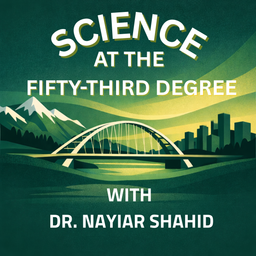
Great science doesn't happen in a vacuum — it happens at universities, in labs, and in the minds of researchers who've dedicated their lives to solving problems that matter. At the fifty-third degree of latitude, the University of Alberta is home to some of the world's most compelling scientific work. And most people have never heard of it.
Science at the Fifty-Third Degree changes that.
Hosted by Dr. Nayiar Shahid, each episode takes a deep dive into a single piece of research — exploring not just the science itself, but the human story behind it. The questions being asked. The methods being used. And what the answers might one day mean for the rest of us.
From the molecular machinery of a healing heart to the cutting edge of fields you didn't know existed, this is science made accessible, personal, and genuinely surprising — one discovery at a time.
New episodes available on the University of Alberta's Aviary platform and wherever you listen to podcasts. Questions or feedback? Reach us at basicsci@ualberta.ca.
This podcast was recorded and produced at the University of Alberta. The University of Alberta, its buildings, labs and research stations are primarily located on the territory of Néhiyaw (Cree), Niitsitapi (Blackfoot), Métis, Nakoda (Stoney), Dene, Haudenosaunee (Iroquois) and Anishinaabe (Ojibway/Saulteaux), lands that are now known as part of Treaties 6, 7 and 8 and homeland of the Métis. The University of Alberta respects the sovereignty, lands, histories, languages, knowledge systems and cultures of all First Nations, Métis, and Inuit.
Have you ever woken up just moments before your alarm clock goes off, or felt completely undone by jet lag? In this episode of Science at the Fifty-Third Degree, host Dr. Nayiar Shahid sits down with Dr. Deniz Top from the Department of Cell Biology at the University of Alberta to explore the molecular clocks that keep our bodies on schedule.
Using fruit flies (Drosophila) as a pared-down genetic model, Dr. Top’s lab investigates how genetic mutations and environmental disruptions—like Edmonton's short winter days or blue light exposure—can desynchronize our internal timing and impact mental health. The discussion dives into viewing neural biochemistry as a binary operating system, using firefly genes to watch cellular clocks tick in real time, and why uncoupling clock programs across brain regions may explain complex behavioral disorders.
This episode covers:
● How circadian rhythms link to mental health, Seasonal Affective Disorder, and directional jet lag.
● The binary code analogy: viewing biochemical interactions as 1s and 0s driving the brain's operating system.
● Why fruit flies are the ultimate model for circadian neuroscience
● Using firefly luciferase reporters to track tissue-specific clock oscillations in real time.
● Dr. Top's uncoupling hypothesis for behavioral disorders and practical chronobiology tips for daily living.
28 Sept 2026
S2E1: More Than A Prescription
What springs to mind when you think of a local pharmacy—a pill bottle, a quick prescription pickup, or a simple errand? In Alberta, pharmacists are doing far more. They can independently prescribe, order laboratory tests, administer vaccinations, and manage chronic conditions as an integral part of your primary care team.
In this season premiere of Science at the Fifty-Third Degree, host Dr. Nayiar Shahid sits down with Dr. Yazid Al-Hamarneh from the EpiCore Center at the University of Alberta. With Alberta boasting the fullest scope of pharmacy practice in the world, Dr. Al-Hamarneh shares groundbreaking research on what happens when community pharmacies become accessible primary care health hubs.
This episode covers:
● Why Alberta leads the world in scope of practice, allowing pharmacists to independently prescribe and order lab tests.
● How local pharmacies fill primary care gaps in a system where 50% of Canadians lack timely access to a family physician.
● The "three-legged stool" of research proof: superior clinical outcomes, high patient satisfaction, and billions in health economic savings.
● The critical role of community pharmacists in catching and managing "silent killers" like high blood pressure, diabetes, and high cholesterol.
● How nonjudgmental conversations and strong patient rapport help address health hesitancy with evidence-based care.
30 Jun 2026
S1E9: The Sound of Science
Right now, billions of your brain cells are talking in unison, communicating in rhythms so complex that visually you would never understand them. But what if you could hear them instead? In this episode of Science at the Fifty-Third Degree, host Dr. Nayiar Shahid explores the cutting edge of data sonification with Mitch Prostebby, a graduate student in Dr. Clayton Dickson's lab at the University of Alberta. Mitch recently took home the top prize at the university's Sounds of Research competition with his track, "Thunderstorms and Symphonies of the Brain," which maps the neural activity of a rat during sleep.
Merging his background as an aspiring jazz musician with electrophysiology, Mitch shows how our ears can instantly pick up on subtle data patterns—like neural ripples—that are easily obscured on a static visual graph. The conversation covers the potential for creating a "brainwave dictionary," using music theory to map neural pathways, and the revolutionary future of medical therapies that actually "sing back to the brain" to correct cognitive dysfunction.
This episode covers:
● How short staccato electrical pops from a sleeping rat's hippocampus are converted into musical notes across the octave spectrum.
● Why combining auditory and visual data helps researchers spot subtle patterns—like neural ripples—that are easily obscured on static graphs.
● The concept of the "Neural Orchestra," where distinct cell circuit motifs cooperate flexibly to produce overlapping frequency ranges.
● Moving away from simplistic, single-frequency neurostimulation toward a dynamic frequency dialogue that mimics natural brain communication.
● Future goals of using EEG headsets to map how the human brain musically responds to art, poetry, and favorite foods.
23 Jun 2026
S1E8: If He Could Turn Back Time
Imagine taking a page from a book, wiping it completely blank, and writing an entirely different story on it. In the world of cell biology, this is called cellular reprogramming. In this episode of Science at the Fifty-Third Degree, host Dr. Nayiar Shahid steps into a cellular time machine with Dr. Sandeep Gupta from the Department of Cell Biology at the University of Alberta to look at how scientists are turning back the clock on human cells. Using Induced Pluripotent Stem Cell (iPSC) technology, Dr. Gupta’s lab takes simple skin or blood cells from patients and coaxes them to forget their adult identity, returning them to an embryonic blank slate. From there, they can grow patient-specific brain and spinal cord neurons in a dish. This groundbreaking approach allows researchers to study the fundamental biology of Autism Spectrum Disorder (ASD) and explore sensory dysfunction directly at its source.
This episode covers:
● The high-tech wizardry behind cellular reprogramming and rewiring transcriptomic structures.
● How the discovery of the Yamanaka factors (OSKM: OCT4, SOX2, KLF4, c-MYC) eliminated the need for human embryos in stem cell research.
● Mapping the massive diversity of autism by looking at mutations across nearly 1,000 risk genes.
● Dr. Gupta's exciting, brand-new data revealing the critical role of the spinal cord as a sensory gating mechanism in autism.
● How "brain in a dish" models have moved from science fiction to standardized drug-discovery platforms for precision medicine.
16 Jun 2026
S1E7: Here For A Good Time AND A Long Time
Imagine walking into a research lab in 1980: no laptops, no automated kits, manual sequencing gels read entirely by eye, and a physical slide box for every single medical student. In this episode of Science at the Fifty-Third Degree, host Dr. Nayiar Shahid sits down with Julie Haskins from the Department of Cell Biology at the University of Alberta. With an incredible 45-year milestone career, Julie has served as a constant, brilliant anchor while the biological world exploded with technological revolutions around her.
From her start as a histology technician in the original Department of Anatomy to navigating modern digital workflows and next-generation sequencing, Julie shares her perspective on what has changed, what has stayed the same, and what it truly takes to stay engaged in the lab marathon for over four decades.
This episode covers:
● What the "vibe" and operational setup of a university lab looked like in 1980.
● The profound shift from hands-on reagent mixing to automated core facility testing.
● Why senior technicians hold irreplaceable institutional knowledge and continuity for new graduate students.
● How staying fresh means evolving—revealing how Julie stayed excited by working across six completely different labs.
● Essential life lessons for day one in the lab, starting with a golden rule: "Keep good notes"
9 Jun 2026
S1E6: All By Fly Self
During the pandemic lockdowns, many of us experienced a persistent mental fog, making it harder to focus or remember. While it was easy to dismiss this as mere stress, it turns out our brains were actively rewiring themselves to survive the quiet. In this episode of Science at the Fifty-Third Degree, host Dr. Nayiar Shahid sits down with Dr. Anna Phan from the Department of Biological Sciences at the University of Alberta to explore what happens to the brain during isolation—not just emotionally, but biologically.
Using fruit flies (Drosophila) as a genetic powerhouse model, Dr. Phan’s lab discovered that isolated brains show a shocking 30% reduction in synaptic proteins across the entire brain, fundamentally altering how neurons communicate. The discussion explores how isolation impairs learning and memory, how recovery times differ by gender, and why digital meetings can never truly replace physical, in-person social connection.
This episode covers:
● How social isolation dynamically impacts neural activity and molecular signaling brain-wide.
● The discovery that isolated fruit flies retain only about 70% of vital synaptic proteins compared to their socially experienced peers.
● Why reversing the cognitive impairments of isolation is significantly more difficult in males than in females.
● The critical roles that dopamine and serotonin neurons play in regulating and potentially reversing isolation-induced behaviors.
● The sensory puzzle of why seeing and hearing someone through a screen or a divider pales in comparison to real-world, physical interaction.
2 Jun 2026
S1E5: He Can Go His Own Way
Science is all about getting a closer look, but instead of diving into a molecule or an organ, this episode zooms in on the person behind the science. In this episode of Science at the Fifty-Third Degree, host Dr. Nayiar Shahid goes behind the lab bench to explore the journey from student to success with Dr. Martin Munz. Spanning two continents and numerous postings, Dr. Munz shares how he has built a vibrant scientific community around his research on neural circuits.
From early work with tadpoles to whole-brain studies in mice, Dr. Munz discusses how key mentorships, early career funding, and a willingness to take high-impact risks have shaped his career. Now establishing his own lab at the University of Alberta with local support from the Stollery Children's Hospital Foundation through the Women's and Children's Health Research Institute (WCHRI), he is pushing the boundaries of neuroscience.
This episode covers:
● The story behind his 2014 Science paper investigating how neuronal activity impacts circuit development in Xenopus laevis tadpoles.
● His decision to move to Switzerland for a postdoc in Dr. Boton-Roska’s lab, expanding from retina research into embryonic neocortex development.
● The critical role of early career funding, specifically the Simons Foundation Bridge to Independence Fellowship.
● Transitioning from an experimental postdoc to a professor building a team and working with lab manager Araya at the University of Alberta.
● Navigating a high-risk, high-reward phase of launching ambitious research projects aimed at high-impact publications.
26 May 2026
S1E4: Library is a Highway
Forget the image of dusty shelves and quiet rooms. In this episode of Science at the Fifty-Third Degree, host Dr. Nayiar Shahid explores how the modern library has transformed into "mission control" for the information age. Joined by Janice Kung, a professional librarian at the University of Alberta, the discussion dives into the chaotic world of Artificial Intelligence (AI) and the crucial role librarians play as the "superheroes" of information literacy.
As AI tools generate "hallucinations" and fake research papers, the challenge for scientists is no longer just finding data, but verifying if it is real. This episode introduces the CARE framework—a vital tool for evaluating AI-generated content—and discusses the ethics of AI in academic publishing.
This episode covers:
● The evolution of libraries from analog sanctuaries to digital hubs.
● How AI is changing the way researchers search for and filter data.
● The danger of AI hallucinations and "noise" in scientific literature.
● A breakdown of the CARE framework: Check the source, Analyze the info, Review for bias, and Evaluate accuracy.
● Why AI cannot be a co-author and the importance of human accountability in research.
19 May 2026
S1E3: Come Fruit Fly With Me
Most people see the fruit fly as a kitchen nuisance or an agricultural menace, but to cancer researchers, Drosophila is a giant in the field. In this episode of Science at the Fifty-Third Degree, host Dr. Nayiar Shahid talks with Dr. Sarah Hughes, a Medical Genetics professor at the University of Alberta.
Dr. Hughes explains why this tiny insect is a foundational tool for human oncology, sharing roughly 75% of human cancer genes. The conversation dives deep into the SNR1 gene (known as SMARCB1 in humans), a critical regulator of chromatin remodeling. When this regulation fails, neural stem cells become "confused," leading to aggressive pediatric brain tumors like Atypical Rhabdoid Tumors (ATRT).
This episode covers:
● Why fruit flies are powerful models for human organ systems.
● The role of SNR1/SMARCB1 in stopping proliferation and guiding cell differentiation.
● How "stem-cell-like" cells in the wrong place lead to tumor overgrowth.
● The future of RNA-based therapies to regulate protein production.
● The importance of lab culture and mentorship in driving scientific discovery.
12 May 2026
S1E2: The Power of N-of-1
What happens when the patient sitting across from you is the only person in the world with their specific condition? In traditional medicine, that's a problem. For Harry Wilton-Clark, it's the whole point.
In this episode of Science at the Fifty-Third Degree, host Dr. Nayiar Shahid talks with Harry Wilton-Clark, a researcher at the University of Alberta's Women and Children's Health Research Institute, about a quiet revolution happening at the edges of medicine — the rise of N-of-1 therapies. These are treatments designed not for thousands of patients, but for one.
Harry's work focuses on Duchenne muscular dystrophy, a rare and fatal disease that strikes children. Using a technique called exon skipping therapy, his lab designs what he calls "genetic band-aids" — molecules that bind to a specific mutation in a patient's DNA and hide it from the body, allowing it to function more normally. The therapy isn't built for a population. It's built for a child.
This episode covers:
What Duchenne muscular dystrophy is and why it's so difficult to treat
How exon skipping therapy works — and what a "genetic band-aid" actually does
Why traditional clinical trials fail rare disease patients — and what N-of-1 trials offer instead
How patient families and advocacy organizations are driving research breakthroughs
What it felt like when a mouse that wouldn't run — finally ran
Why a single patient's treatment could become a master key for thousands of othersHarry recently represented Canada at the Falling Walls Lab in Berlin — one of 100 researchers selected from around the world to present work breaking the boundaries of science's biggest problems. The wall he chose to break: the one standing between a child and a cure.
6 May 2026
S1E1: How She Mends A Broken Heart
Your heart beats more than 100,000 times a day without you ever asking it to. But what happens when something interrupts that rhythm — and more importantly, what happens after?
In this pilot episode of Science at the Fifty-Third Degree, host Dr. Nayiar Shahid sits down with Dr. Zam Kassiri, a professor at the University of Alberta, to explore the fascinating and surprisingly delicate science of cardiac repair. After a heart attack, the heart doesn't just sit still — it begins a complex process of remodeling itself, reshaping its own structure to survive. But that same repair process, if it goes too far or lasts too long, can quietly become the source of long-term damage.
Dr. Kassiri's research focuses on the molecular signals — including a family of proteins called ADAMs, and particularly ADAM17 — that guide whether the heart heals properly or continues to decline. Using cutting-edge tools like single-cell sequencing, her lab is mapping the conversations happening between individual cells in an injured heart, one cell at a time.
This episode covers:
What's actually happening inside the body during a heart attack
The process of cardiac remodeling and why timing is everything
How the same molecules that protect the heart early on can become harmful later
What single-cell sequencing is revealing about heart disease at the microscopic level
What it feels like to do science that could one day change — or extend — someone's life
6 May 2026
Science at the Fifty-Third Degree: Trailer
Have you ever seen a news headline about a medical breakthrough and wondered about the rest of the story? In this trailer for Science at the Fifty-Third Degree, host Dr. Nayiar Shahid introduces a podcast designed to bring science "from the bench right to your backdoor."
After a decade-long journey spanning pharmaceutical quality control, drug discovery in London, diabetes research in Malaysia, and a PhD in pharmacology at the University of Alberta, Dr. Shahid is moving from the lab bench to the bridge. This series shifts the focus from dry data to the human stories, precision, and invisible systems that make scientific success possible.
Contact Science at the Fifty-Third Degree
Guest appearances
Books guests
Based on episode analysis; this does not confirm that the show is currently accepting guests.
Host of Science at the Fifty-Third Degree?
Claim your podcast to manage its listing and keep your show details accurate.
Pod Engine is an independent podcast discovery and analytics service and is not affiliated with or endorsed by this podcast. Artwork and show content belong to their owners. Full legal notice.
Explore this show Podcast research with Pod Engine