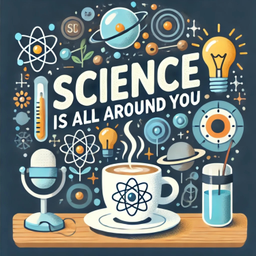
Unlock the mysteries of science in a fun, accessible way! Join us as we break down everyday phenomena and explore strange, fascinating facts from the world of science. No jargon, just curious conversations that everyone can enjoy. Made with Gemini help.
S1E18: The Science Beyond Water and Ice. And why Why Shower Curtains cling to You?
Hosts Alex Reneau and Zach Albertson explain how their Feature Enhancement technology simplifies machine learning by achieving state-of-the-art results without complex models.
8 Dec 2024
S1E17: The Formative Years: Albert Einstein's First Years
Albert Einstein's early life experiences are revealed, shaping the mind of one of history's greatest physicists.
2 Dec 2024
S1E16: The Science of Persuasion
Psychologist Robert Cialdini and marketing expert Adam Grant discuss the psychological principles behind persuasion, offering actionable strategies to increase success in influencing others.
20 Nov 2024
S1E15: Teaching Physics, Turning Smartphones into Mini Physics-Laboratories
Physics educator Dr. Sibel Ozdemir demonstrates how smartphones can be transformed into portable mini-laboratories for hands-on experiments in mechanics, optics, sound, and electromagnetism.
7 Nov 2024
E1S14 : Climate Change: Navigating a Sea of Misinformation ... and a Quiz
This episode delves into the intersection of scientific diplomacy, climate change, and misinformation. It highlights ultracrepidarianism—people giving opinions outside their expertise—and its link to the Dunning-Kruger effect, where individuals with low competence overestimate their abilities. These phenomena contribute to climate change misinformation, complicating consensus and solutions.
The discussion also covers fast thinking, which relies on heuristics and can lead to inaccurate judgments about complex issues like climate change. For example, experiencing a harsh winter might lead someone to mistakenly dismiss global warming.
To combat misinformation, the episode emphasizes improving science literacy and critical thinking skills, advocating for engaging communication of climate science through personal stories and real-world impacts. It concludes by stressing the need for evidence-based policies and creating spaces for respectful dialogue to bridge differing perspectives on climate change.
29 Oct 2024
S1E13 : History and physics of Lasers
Summary
This episode provides a comprehensive overview of the history, physics, and technological development of lasers, from their theoretical foundations laid by Einstein to the most recent advancements in attosecond pulse generation and inertial confinement fusion. The podcast covers key figures and milestones in laser research, including the invention of the first laser by Maiman, the development of various types of lasers, and the applications of lasers in fields such as spectroscopy, communications, and medicine. It also explores the potential of lasers for advancing areas such as attosecond science and nuclear fusion.
21 Oct 2024
S1E11 : The universe is written in the language of mathematics.
In this episode, we delve into the use of quantitative methods in social science and education research. Starting with Galileo's emphasis on mathematics, we explore the strengths and limits of quantitative research, techniques for data collection and analysis, and common statistical tests for comparing groups and testing hypotheses. We also touch on key sampling methods used in research.
21 Oct 2024
S1E12 : The birth of Quantum Physics
In this episode, we explore the birth of quantum physics. We trace its historical development, from the discovery of the photoelectric effect to the foundational contributions of Max Planck and Albert Einstein. The episode highlights the shift from classical physics' idea of continuous energy to quantum theory's concept of quantized energy.
10 Oct 2024
S1E10 : Opinion dynamics in human groups
The episode explores mathematical models of opinion dynamics, focusing on how individual opinions and social influences interact. One study examines the impact of periodic propaganda in the Continuous Opinions with Threshold (COT) model, revealing that strategic timing can be more effective than constant propaganda. Another study adds a “death/birth” process to the COT model, showing how the influx of new opinions can alter the system’s behavior, even when consensus would naturally be reached without external influence. The episode highlights the complex dynamics of opinion formation and the significant role of external factors.
https://journals.aps.org/pre/abstract/10.1103/PhysRevE.76.066105
https://www.worldscientific.com/doi/abs/10.1142/9789814287456_0019?srsltid=AfmBOop5FcvosoxRC1XlJmqDKavYRb81IO6iFn18YqMQ4P8Qi5ypUqHs
https://hal.univ-reunion.fr/hal-02059365/document
7 Oct 2024
S1E9 : The Power of Heart Coherence Breathing in Schools
In this episode, we delve into the transformative potential of heart coherence breathing exercises in school classrooms. Our discussion is based on a compelling research study conducted in La Réunion, where both teachers and students engaged in an eight-week heart coherence breathing programme. The findings are remarkable: teachers experienced significantly reduced stress levels and reported a more positive classroom climate. Additionally, the study hints at a boost in students’ sense of belonging and their relationships with teachers, though further research is needed to solidify these results. Join us as we explore the argument for integrating heart coherence breathing exercises in schools to create a more inclusive and positive learning environment. Tune in to discover how these simple exercises could revolutionize education!
4 Oct 2024
S1E8 : An easy experiment to show apparent weightlessness in free fall
This podcast describes a simple experiment that can be performed in a classroom to demonstrate the concept of apparent weightlessness in free fall. The author proposes using a transparent plastic container with toys and a feather to recreate the conditions of a weightless environment. The experiment aims to show students that apparent weightlessness isn't limited to outer space, as objects in free fall within the container will appear to float, mimicking the experience of astronauts in orbit. The experiment also highlights Newton's second law of motion, showcasing how objects in free fall accelerate at the same rate regardless of mass.
2 Oct 2024
S1E7 : Post-quantum cryptography
This episode discuss the increasing threat posed to current encryption methods by the development of quantum computers. The first source, from France-Science in USA, explains the White House’s efforts to combat this threat by transitioning to post-quantum cryptography (PQC) for sensitive communications. The source highlights the importance of PQC for national security and mentions the three new standards developed by the US National Institute of Standards and Technology (NIST). The second source, from NIST itself, focuses on the release of these three PQC standards, which are designed to resist attacks from quantum computers. The source also discusses the importance of these standards for protecting sensitive information and encourages the adoption of PQC by organisations.
1 Oct 2024
S1E6 : Simpson's paradox
In this episode, we dive into the intriguing world of Simpson's paradox, a statistical phenomenon that reveals how trends in an overall population can reverse when broken into subgroups. We explore how this paradox, more common than previously thought, can lead to misleading conclusions, affecting everything from research findings to public policy. Using real-world examples, we’ll discuss the dangers of relying solely on group-level data and why it's crucial to dig deeper into subgroups. We’ll also highlight the solutions proposed by researchers, including a new software tool, "Simpsons," designed to help detect and manage this paradox. Tune in to discover how understanding Simpson's paradox can improve data interpretation and decision-making across fields like psychology, medicine, and beyond.
More info: https://blog.univ-reunion.fr/alessioguarino/2019/06/05/le-paradoxe-de-simpson-statistique-analyse-des-donnees/
30 Sept 2024
S1E5 : What Scientists Can Learn From Alien Hunters ?
The episode explores the history of the search for extraterrestrial life and examines the division between scientists and non-scientists in this field. It discusses how the "boundary work" performed by scientists to separate legitimate research from fringe perspectives can inadvertently alienate those outside the scientific mainstream, leading to mistrust and the perpetuation of conspiracy theories. The podcast also considers how the inclusion of UFO research, despite its problematic history, could benefit both science and the public understanding of the world.
To know more, click here ! (https://blog.univ-reunion.fr/alessioguarino/2020/02/13/what-scientists-can-learn-from-alien-hunters-2/)
27 Sept 2024
S1E4 : The physics of dancing peanuts in beer
This episode is about the phenomenon of "dancing peanuts" in beer, where peanuts move up and down in a glass due to the formation and detachment of bubbles on their surfaces.
https://blog.univ-reunion.fr/alessioguarino/2023/06/15/the-physics-of-dancing-peanuts-in-beer/
27 Sept 2024
S1E3 : Understanding Projectile Motion: Beyond the Parabolic Approximation
This episode explores the often-overlooked fact that the true trajectory of a projectile on Earth is an ellipse, not a parabola, due to the Earth's spheroidal shape and the direction of gravitational acceleration.
https://blog.univ-reunion.fr/alessioguarino/2024/09/27/physics-heresy-projectiles-dont-actually-make-parabolas/
6 Sept 2024
S1E2 : How to fairly share a watermelon ?
In this episode, we explore a fascinating and practical application of mathematics—using integral calculus to solve the everyday problem of fairly sharing a watermelon. Based on a recent research article, this discussion highlights how mathematical concepts can be applied to real-world scenarios, making the subject more engaging and accessible. The episode delves into the geometric principles behind dividing a watermelon into equal-volume slices, using the "2/3 rule" as a key method. By making the connections between theory and practice, this podcast aims to demonstrate the relevance of mathematics in daily life and inspire a new appreciation for its usefulness. Join us as we uncover how mathematics can transform a simple summer treat into a fun and educational experience.
Video (https://youtu.be/62_B9WyEcq4?si=43dExYA6QAdKW0n0)
Original Paper: Article (https://arxiv.org/pdf/2009.02325)
2 Sept 2024
S1E1 : Collective Intelligence: When Groups Perform Better Than Teammates
In this podcast episode, we explore the fascinating concept of collective intelligence, drawn from recent research on how groups can outperform individual members in solving complex problems. The study presents a mathematical model that explains how collective intelligence arises from the integration of individual members' knowledge, conceptualized as 'mental maps.' It reveals a non-linear relationship between group intelligence and the average intelligence of its members, depending on task difficulty. Additionally, we delve into how past studies may have yielded conflicting results due to variations in task complexity. The episode sheds light on the intersection between theoretical models and real-world applications, offering insights into the evolving field of collective intelligence research.
To know more, click here (https://blog.univ-reunion.fr/alessioguarino/2020/07/02/when-groups-perform-better-than-teammates/)
Original paper: https://jasss.soc.surrey.ac.uk/23/3/4.html (https://jasss.soc.surrey.ac.uk/23/3/4.html)
Contact Science is all around you !
Guest appearances
Does not typically book guests
Based on episode analysis; this does not confirm that the show is currently accepting guests.
Host of Science is all around you !?
Claim your podcast to manage its listing and keep your show details accurate.
Pod Engine is an independent podcast discovery and analytics service and is not affiliated with or endorsed by this podcast. Artwork and show content belong to their owners. Full legal notice.
Explore this show Podcast research with Pod Engine