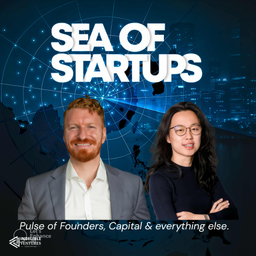
SEA of Startups
Hosted by Kevin Brockland and Kim Yeoh and Kevin and Kim · Decoding the Pulse of Founders, Capital & Conviction in Southeast Asia.
5.0from 1 ratings
- 93
- Episodes
- 1
- Ratings
- Daily
- Cadence
- 2022
- First episode
- 4K
- YouTube views
About SEA of Startups
Real, raw, relatable takes on Southeast Asian startups. One investor, the week's news, no script. seaofstartups.substack.com (https://seaofstartups.substack.com?utm_medium=podcast)
- Publisher
- Decoding the Pulse of Founders, Capital & Conviction in Southeast Asia.
- Category
- business · technology
- Language
- en
- Explicit
- No
- First episode
- 22 Aug 2022
- Latest episode
- 7 Oct 2026
Latest episodes
93 episodes in the feed.
7 Oct 2026
Seed is booming. Not here.
Let me describe a company to you. Real revenue. Customers who pay every month, on time. A product that works and a team that ships. By every standard that mattered three years ago, this is a fundable company. Three years ago it raises a Series A without breaking a sweat. Today it cannot get a second meeting. Nothing about the company changed. The bar moved underneath it while the founder was busy building. That is happening everywhere, in San Francisco, London and Bangalore. But if you are building in Southeast Asia, here is the part almost nobody says out loud. The bar did not move once here. It moved twice. And the second move is one no venture podcast in San Francisco will ever explain to you, because none of them has had to raise a round across six countries at once. So this week I want to walk all the way through it. Why your next round is harder than your last one had any right to be. What it costs in months and in cash. And what I would do on Monday morning if I were sitting where you are. One. The seed mirage The headline going around is that seed funding in Southeast Asia is up this year. On paper, true. DealStreetAsia’s half-year numbers have seed dollars up 128% year on year to $328 million. Read only the top line and you would think the taps are open and the hard years are behind us. Now look at who got the money. In the first half of 2026, 63 companies in the entire region received their first institutional cheque. Sixty-three. Across six countries, 680 million people and six months. That is not a wave of new founders getting funded. That is a number you could seat on one decent coworking floor in Singapore. Here is the part that should make you suspicious. While the seed total went up, the number of deals across the region fell to its lowest level since at least 2018, and the typical seed cheque got bigger. Hold those two facts together. Bigger cheques, fewer of them than in nearly a decade. That is not money spreading out to more people. That is money piling up on fewer of them. Who gets the fat cheques? Overwhelmingly AI and deep tech. A normal software seed in this region is still one to three million dollars. The AI rounds run at roughly double that and climbing, and they are the ones dragging the average up and making the chart look healthy. The chart is not lying exactly. It is letting you believe something that is not true. When you hear “seed is back,” the honest follow-up is “back for whom.” The honest answer is: for a small number of companies that probably do not look like yours. One more number, same story at a bigger scale. The region raised $7.25 billion in the first half, the strongest half since 2022. Almost all of it was one data centre raise, DayOne’s $4.5 billion Series C. Take that single deal out and the region raised about $2.75 billion, down on the half before and below the same period a year earlier. One deal, one building full of servers, is doing the work of making an entire half-year look like a recovery. I made the same point about exits a week ago. The discipline never changes: how many deals? So here is where we stand. The money that exists is real. It is also concentrated, going to a narrow slice of companies, and the breadth a healthy early stage is supposed to have is not there. The costume says boom. The body underneath says something much tighter. Two. The bar moved, and the Americans admit it Now the thing that actually decides your future: the bar for your next round. Listen to the American shows, 20VC, SaaStr, the ones every founder here has on in the background, and the same confession comes up every few weeks. A partner gets comfortable in the chair and says the quiet part out loud. The bar to raise a Series A today would have been a Series B three years ago. They say it the way you mention the weather, and then they move on. Here are the numbers behind the anecdote. The revenue a company needs to clear a US Series A has roughly tripled. A few years ago, about $1 million of annual recurring revenue got you a serious conversation. In early 2026 the figure doing the rounds is closer to $3.5 million. Not double. More than triple. Graduation fell off a cliff too. Carta, which sees a huge slice of American cap tables, tracks the share of seed-stage companies that go on to raise a Series A within two years. For companies that raised seed in early 2018, that was about 31%. For the early-2022 cohort it was about 15%. One in three became one in six. And it takes longer. The median walk from seed to Series A is now past two years, against roughly a year and a half in the late 2010s. Put those together and you understand what people mean when they say a stage of the market got deleted. Seed became the new Series A. Series A became the new Series B. The old Series A, the round you raised on promise and early traction, quietly stopped existing. The companies standing on it got no warning. They raised their seed, hit the milestones that used to be enough, went out for the A, and found the floor had moved while they were heads down. Pre-seed founders are discovering the same thing one step earlier: the seed bar is far higher now unless you are spinning out of a frontier lab. That is the American story. It is brutal on its own, and it is the story your foreign investors carry in their heads whether they say so or not, because the serious players read the market globally. Hold onto it. Now the Southeast Asian version, which is worse. Three. One company, one raise Numbers in the abstract do not land, so let me walk you through a raise. Invent a company. Call the founder Mei. She is in Kuala Lumpur, where I am based, and she has built B2B software for mid-sized logistics operators. It is good. Two years in, she is at about $1.5 million of annual recurring revenue, almost all of it in Malaysia. Her customers renew. Her churn is low. Her team is lean. By the standard of 2021, Mei is a textbook Series A. She did everything the playbook told her to do. So she goes out to raise. Meeting by meeting, here is what happens. The local funds take the meeting, because they know her, they are polite, and they like the business. But the ones who would have led her A two years ago are either not raising a new fund right now or have quietly moved upmarket, chasing bigger, later, safer deals. They tell her she is a little early. Early, at $1.5 million of revenue and two years of history. That word is the sound of the bar moving. Then the regional funds out of Singapore. The first serious question is not about her revenue. It is about her map. How many markets are you in? When she says one, Malaysia with a little spillover, she watches the temperature in the room drop. What they are really asking is whether she is a Malaysian company or a Southeast Asian one. A Malaysian company at $1.5 million is not a regional Series A. It is a nice local business they no longer know how to underwrite, or no longer want to. Then, if she is lucky, a foreign fund. Now she is being measured, silently, against the American number. $3.5 million, growing fast, in a market the investor understands. She is at $1.5 million in a market they would need a fourteen-hour flight to visit. She does not lose that meeting because her company is bad. She loses it because she is graded on a curve drawn in another part of the world. Mei, who did everything right, walks away from a month of meetings with no term sheet, a lot of “keep us posted,” and a dawning understanding that the round she was told to raise does not exist for her at her size. That is not a failure of the company. That is three versions of the bar stacked on top of each other, all moving, and she walked into all three at once. Four. The border tax The second move of the bar, the one San Francisco never has to explain, is what I call the border tax. A software company in San Francisco proves one market. The United States is one language for business, one currency, mostly one set of rules, one enormous wallet. A founder there can reach $3.5 million of revenue without leaving home. They could reach $100 million without leaving home. A company here gets asked to prove three markets. That is the real test gating a regional Series A: not just revenue, but evidence you can cross borders. The whole thesis of a Southeast Asian company is that it is regional, and an investor writing a Series A cheque is buying the regional story, not the single-country one. So the question is never only how much revenue. It is how much revenue, in how many markets, and can you do it again in the next one. Here is what nobody puts on a slide: what market number two actually costs. • A local entity, which means lawyers and a registration process measured in months, not weeks. • Local payment rails, because money moves differently in Indonesia, the Philippines and Thailand, and your billing has to speak all of them, e-invoicing mandates included. • Localisation that goes well past translating the buttons: tax rules, invoice formats and compliance quirks that differ in every single country. • A first hire on the ground who actually knows the market, because selling into Jakarta from Kuala Lumpur over video calls does not work, and everyone who has tried it knows it. Add it up and entering one new market properly is a 12 to 18 month project that swallows a serious chunk of your round and a serious chunk of your attention. The Series A test asks you to have done it two or three times before anyone writes the cheque. Look at what that does to Mei. The American founder gets to $3.5 million by going deep in one market. Mei is asked to go wide across three, each one more than a year and a large pile of cash, on a seed round that was never sized for it. That is the border tax. It is invisible in the headline numbers, and it is the single biggest reason a good regional company stalls between seed and Series A. Not product. Not revenue quality. Geography, and the cost of crossing it. Five. The missing middle, and the bridge trap The third wall catches you even after you clear the first two. Say Mei does it. She grinds into a second and a third market, lifts her revenue, builds the regional story. Who writes the cheque that takes her from there to real scale? Right now, in this region, almost nobody local. Chua Kee Lock runs Vertex, one of the most established investors in this part of the world, and he is not a man who reaches for drama. In late September he told DealStreetAsia that “not only has the early-stage VC market dropped significantly, but that whole middle layer of this stage is essentially hollow.” He called it a breakdown. Regional firms, he said, now look as far as Japan, Hong Kong and mainland China for growth co-investors. The late-stage money chases a handful of megadeals. The seed money is small and getting more selective. The growth capital in between, the money meant to catch a company between its first cheque and its scale, has thinned to almost nothing locally. The same reporting has the median Series A in the region shrinking to $8 million from $11.6 million in late 2025. Watch what the smartest early investors are doing in response, because it tells you they see it too. Peak XV, the firm that used to be Sequoia’s arm out here, raised the ceiling on its Surge seed programme from $3 million to $5 million per company at the end of September. Rajan Anandan said it plainly: the bar for a Series A has gone up significantly. Read that honestly. They are putting more money in at seed precisely because they know how long and how lonely the walk to the next round has become. Extra supplies for a longer trek, because the resupply station in the middle may not be there. Now the trap that catches founders in exactly this spot. The bridge round. When the Series A does not come and runway is short, the tempting move is a bridge. A little more from existing investors, same terms or close, to buy another year. Sometimes a bridge is a genuine bridge to a real milestone and a real round. Very often in this market it is a plank extended over the same gap, and at the end of the plank is the same Series A that was not there before, except now with more investors, more dilution, more pressure and less time. A bridge makes sense only if you know exactly what milestone sits on the other side and you have evidence someone will fund it. If you are raising one because you ran out of road and hope the market turns, you are not buying time. You are borrowing it at a terrible rate. If you are an angel or an emerging manager reading this, the flip side is the opportunity. The mispricing in this region is not at seed, where everyone is crowding into the same AI deals. It is in the abandoned middle: companies that did everything right, with real revenue across real markets, and nowhere local to land. If you have the capital and the patience to be the one who catches them, that is where the returns are hiding. Everyone is standing at the shiny end of the room. The value is in the part they walked past. Six. The AI objection If you have been reading closely you have the obvious objection ready. Kevin, you keep saying the money is going to AI. I am building in AI, or I could be. Is that not the way through? Honest answer: partly, and less than you think. Yes, the AI rounds are where the big cheques are, here and everywhere. If you are genuinely building something hard, you can raise a bigger seed than a normal software company, and some of that capital reaches this region. That is real. I am not telling you to ignore where the money is. Two things to be clear-eyed about. First, most of the enormous AI cheques are not coming here at all. They go to a small number of labs and model companies, overwhelmingly in the US and China, founded by people with very specific pedigrees. When you read that global AI funding is at a record, you are mostly reading about a dozen companies you could name, and none of them is in Jakarta. The odds your AI seed looks like theirs are genuinely low. Second, and this is the part founders here miss, a thin layer around somebody else’s model is not a defensible company, and the investors who matter know it now. Eighteen months ago you could raise on “AI for X” and a demo. That window has closed. There is value in a wrapper, but the wrapper itself has to carry a value proposition that is more than a user interface on someone else’s model. If anything, the bar for an AI company is higher than for normal software, because everyone can see how fast a feature gets copied when the model does the heavy lifting. So, the exception stated honestly. AI is a real lane if you have genuine depth, a real wedge, and something that gets better with use in a way a competitor cannot instantly clone. For most founders here it is not an escape hatch from the three walls. It is the same three walls with more competition and a more skeptical room. Build in it because you have an edge, not because that is where you heard the money was. Seven. Two founders I think in people more than in charts, and I suspect you do too. The first founder reads the American playbook literally. They hear $3.5 million, they hear three times a year, and they decide the answer is to burn hard and chase the metric. They raise a seed and spend it fast on sales and marketing to force the curve up. They stay in one market because that is where the quick revenue is, and they bet that if the number gets high enough the Series A will come. Sometimes it works. Usually, here, it does not. They hit the border question with an empty tank, one market deep and out of money, having optimised for a number priced somewhere else. They built for a room they were never going to be in. The second founder accepts the terrain they are standing on. They raise a seed and treat it like it has to last, because it does. They pick their two or three markets deliberately and early, and start the slow, expensive work of crossing borders while they still have cash and calm to do it properly. The revenue curve looks less exciting on a slide, because the money went into entity setup and local hires instead of a growth spike. But two years in, they hold the one thing that actually gets a regional Series A written: proof the model travels. Not the flashiest company in the batch. The one still standing when the flashy ones ran out of road. This is not an argument for less ambition. The disciplined, multi-market, capital-aware founder is the one who survives the three walls. The burn-to-a-foreign-metric founder becomes the cautionary story at a conference. The terrain rewards patience and punishes imitation. Build for the terrain you are on. Eight. What I would do on Monday Enough diagnosis. If you are building here right now, this is what I would actually do. 1. Raise your seed for 30 months of runway, not 18. It sounds conservative. It means raising more or spending slower, and both hurt. Do it anyway. The walk to a Series A stretched past two years in the best-funded market on the planet. Assume it is longer here, and give yourself room to arrive without a desperate bridge. Runway is not caution. In this market, runway is strategy. 2. Pick your two or three markets on day one, and make crossing into the second an explicit milestone of the seed round, not a someday ambition. Budget the entity, the payment rails and the local hire from the start. One market deep is a lifestyle business here, and there is no shame in that, but it is not a venture Series A story. Three markets working is. 3. Do not run your company against a San Francisco revenue number. A foreign investor will quote $3.5 million at you like it is the law of gravity. Know the number exists so you are not surprised in the room, but do not let it set how you spend. Customers in Kuala Lumpur, Manila and Bangkok do not pay like customers in San Francisco, and pricing your burn as if they do is the fastest way to set your runway on fire chasing a target that was never yours. 4. Be honest about the bridge. Before you raise one, write down the single milestone it gets you to, and the name of the investor who has told you they will fund that milestone once you hit it. If you cannot write both down, you are not raising a bridge. You are delaying a hard decision with other people’s money and your own equity. 5. Pick the AI lane only if you have a real edge in it. Not because that is where the headlines are. The headlines are about a dozen companies that are not you. The bow Everyone is calling this a Series A crunch, as if it were weather. It rolls in, ruins a season, passes, and all you have to do is wait it out. In San Francisco, maybe. Maybe it is cyclical there, and the floor they deleted gets rebuilt when the mood turns. Here it is not weather. Here it is the building. We never built the stage of the market that is supposed to catch a company between its first cheque and its scale. Seed has always been thin. The next layer has always been thinner. The thick layers sit at the very end, around a handful of megadeals. So when the hot money comes back, and it will, because it always comes back for whatever is shiny that year, it will not rebuild a middle that was never really there. It will chase the next shiny thing and leave the same gap behind. Which means the founders who make it through the next two years will not be the ones who raised the biggest seed or chased the loudest metric. They will be the ones who understood the terrain, planned for a longer and lonelier walk, spent their money like it had to last, and could stand in front of an investor and prove they had crossed a border while everyone around them was still quoting a San Francisco number at a Southeast Asian cap table. Seed is booming. Not here. Pretending otherwise is how good companies quietly run out of money in month 19. If you are sitting on a seed round right now, or about to raise one, I want to know two things, and I read every reply. How long is your runway, really, not the optimistic version? And have you started on market number two? Tell me where you are. I want to know who is still standing. This piece accompanies this week’s episode of SEA of Startups. Real. Raw. Relatable. Listen on Spotify, Apple Podcasts, or YouTube, and subscribe to the newsletter at seaofstartups.substack.com. This is a public episode. If you would like to discuss this with other subscribers or get access to bonus episodes, visit seaofstartups.substack.com (https://seaofstartups.substack.com?utm_medium=podcast&utm_campaign=CTA_1)
30 Sept 2026
Twelve doors out: Southeast Asia's exits are back, and the buyers are flying in
There are two ways out of a company in Southeast Asia. One of them is loud. On 20 October, GCash will ring the bell at the Philippine Stock Exchange in the biggest listing that country has ever done. Cornerstone investors with names like BlackRock and T. Rowe Price. A valuation that starts with a number most Filipino founders will never see in their lifetime. The other is quiet. A few weeks earlier, on 8 September, private equity firm Navis Capital closed the sale of a chain of premium Malaysian supermarkets, Village Grocer, Ben’s Independent Grocer and a few others, to a Thai retailer. No bell. No cameras. Just a wire transfer and, reportedly, around five times the money they put in more than a decade ago. For years the complaint about this region was that there were no exits. Great companies, nowhere to sell them. That complaint just stopped being true. The door is cracking open. But before anyone pops the champagne, walk through it with me and look at who is standing on the other side. Because it is almost never a Southeast Asian. One. Six and a half times the money, four more companies Here is the number that made me put this on the docket. In the first half of this year, venture-backed companies in Southeast Asia returned $5.65 billion in exits, per DealStreetAsia. Trade sales, listings, the lot. In the first half of last year, that figure was $856 million. Call it a six and a half times jump in twelve months. Hear only that and you would think the drought is over, and the region has finally figured out how to give investors their money back. Here is the part that gets buried. That $5.65 billion came from twelve exits. Twelve. The year before, it was eight. The value went up more than six times. The number of companies actually getting out went up by four. Sit with that, because it is the whole story of this market right now. The money is real. The breadth is a mirage. Twelve companies is not a wave of liquidity. Twelve companies is a handful of very large outcomes, and everybody else is still sitting in the waiting room. We saw the same trick with funding. The region raised $7.25 billion in the first half, the strongest since 2022. Sounds fantastic, until you notice that deal volume fell to its lowest level since at least 2018, and a single data centre deal carried the headline. Strip that one out and regional funding actually fell. The median Series A cheque shrank. The average founder is not living in the record. The average founder is living in the drought. When you see “exits are back” or “funding hits a record,” your first question is always the same. How many deals? Two. The loud door, and who already has a key The public market. The listing. The dream. And in the Philippines, that dream is about to come true in a very big way. GCash, the wallet on almost every Filipino phone, is going public through its parent, Mynt. The offer could raise around 80 billion pesos, roughly $1.4 billion, and closer to $1.6 billion with the overallotment. At the top of the range, Mynt is worth 669 billion pesos, about $11.5 billion. It is the largest listing in the history of the Philippine Stock Exchange, and it beats the old record, Monde Nissin, comfortably. More than 20 cornerstone investors are in, BlackRock and T. Rowe Price among them. The offer period opens on 6 October. Trading starts on the 20th. I want to be genuinely positive here, because this matters and I am on record as bullish on the Philippines. For a decade, the knock on Manila was that it could not host a listing like this. Any serious technology company would have to go to Singapore or New York to find money deep enough. GCash is proving that wrong on home soil. That is a real milestone, and Filipino founders should take a moment with it. Then I put the investor hat back on and read the cap table out loud, because Real. Raw. Relatable. means I do not just clap at big numbers. GCash is not a scrappy startup three friends built in a Makati garage. Mynt is a joint venture between Globe Telecom and the Ayala group, one of the most powerful families in the country, and Ant Group, the fintech affiliate of China’s Alibaba. The anchor buyers flying in are the giant American asset managers. So the biggest technology listing in Philippine history is, honestly described, a telco and a Chinese fintech giant selling a slice of their joint venture to Wall Street. That is not a criticism of the deal. It is a great deal, and GCash is a great company. It is a question about the pattern. If the only way to a landmark listing is to already be owned by a conglomerate and a foreign tech giant before you start, what exactly does that prove for the founder with no conglomerate behind them? Across the region in the first half, there were 47 listings raising about $3 billion. Healthy on paper. But reliable public liquidity for a venture-backed technology company still exists on a very short list of exchanges. Malaysia will point out that Bursa has been busy, and SkyeChip showed a local chip designer can list at home. Fair. It is still the exception. For most of the region, the loud door is not actually on offer. The public door is open. Just notice how narrow it is, and who already has a key. Three. The quiet door is a grocery aisle Most exits here do not happen with a bell and the start of public trading. They happen with a strategic buyer writing a cheque and quietly absorbing your company. Trade sales are the workhorse. And the clearest picture of this entire market I have seen is a story about groceries. Back to Navis. More than a decade ago, they started putting together a group of premium Malaysian supermarkets under a company called The Food Purveyor: Village Grocer, Ben’s Independent Grocer, BSC Fine Foods and a couple of others. This month they closed the sale for about RM1.66 billion. Good outcome, clean exit, the kind of return that keeps a fund alive. The buyer? CP Axtra, the Thai company that runs Lotus’s. And this is where one deal stops being one deal and starts being a pattern, because this is not the first time CP has gone shopping in Malaysia. Rewind to 2020. CP Group bought Tesco’s entire business in Thailand and Malaysia for $10.6 billion, one of the biggest deals in Asia that year. The Malaysian piece alone was valued at around $3 billion. Seventy-four Tesco stores were rebranded as Lotus’s. Follow the timeline. In 2020, CP buys the value end of the market, the big hypermarkets. In 2026, CP buys the premium end, the shops where the affluent city crowd does its weekly run. Put them together and one Thai conglomerate now has more than 120 outlets across Malaysia, covering everyone from the most price-sensitive shopper to the most comfortable. Top to bottom. The whole aisle. And it is not only CP. The other big premium chain in Malaysia is Jaya Grocer. Grab bought a majority of it at the end of 2021, in a deal reported at RM1.5 to 1.8 billion, roughly $400 million. Grab is a Singapore company. Some Malaysians will argue that point with me, and I am going to keep calling it Singaporean anyway. So let me say the thing plainly. Malaysia’s two leading premium supermarket chains are now both foreign-owned. One Thai, one Singaporean. Malaysian operators and Malaysian investors built these businesses into category leaders, and when it was time to sell, the buyer flew in from Bangkok or Singapore. Each time. That is the exit market in one shopping trip. You build it here. You sell it there. Four. The pattern holds in tech Widen out from groceries and the data backs it up. In the first half, technology M&A in the region fell to 41 deals, down 37% on the year before, according to DealStreetAsia. So even while exit value went up, the number of tech deals went down. Fewer transactions, bigger cheques. The same concentration we started with. And who did the deals that did happen? Foreign buyers completed 30 of the 41. Nearly three in four. Domestic acquirers managed eleven. Japanese corporates, Chinese groups, regional conglomerates like CP: they are the ones clearing the market while local buyers sit on their hands. One more piece, the least glamorous and the most telling. A growing share of what gets counted as an exit here is not really an exit at all. It is one private equity fund selling to another. By some estimates, secondaries are now around 30% of exit value in the region. Funds are getting older. Their LPs want some money back. There is no strategic buyer and no open listing window. So the asset goes to the fund down the street, and everyone calls it liquidity. That is a perfectly respectable strategy. Secondaries are a well-worn path in more mature markets. But put the whole board together. Exit value is up, yes. But the deals are few, they skew large, they are increasingly bought by companies headquartered outside the region, and a big chunk of what is left is just capital rotating between funds. Five. The constraint was never capital The old complaint was that Southeast Asia had no exits. That was never quite right. The truer version, the one I want you to take away, is this: the constraint here was never capital. There has always been money. The constraint is liquidity, the ability to actually turn a company into cash. And the person most able to give you that liquidity today does not live here. Six. What I would actually do with this I do not like diagnosing and walking away. So if you are a founder or an early investor in this region, here is what I would do. 1. Build for a specific strategic buyer, and be honest with yourself about who they are. If you are building a consumer brand in Malaysia or Indonesia, your most likely exit is a regional conglomerate or a foreign strategic, not a listing. Know that on day one. Know their names. Build the thing they will eventually need to own, because buying you is faster than building you. 2. Stop worshipping the listing. The GCash IPO is a beautiful, rare event. It is not your path. For almost every company here, the realistic door is a trade sale, and there is no shame in that. A five times return in a quiet sale to a Thai retailer spends exactly the same as a bell on an exchange. 3. Sit with the uncomfortable question. If you care about this region beyond your own cheque, the grocery story should bother you. When the value end and the premium end of an entire national category both end up owned from outside the country, where is the domestic champion ever supposed to come from? The bow Foreign capital validating our companies is a good thing. Foreign capital owning every company that gets good is a different thing. I do not have a clean answer for that. But we should stop pretending it is not happening. The headline this quarter is that exits are back. They are, and the value is real. Just remember, every time you see that number, to ask two things. How many companies? And where did the buyer fly in from? Twelve doors, mostly foreign on the other side. That is the market we are actually in. So tell me where I am wrong. If you think foreign buyers are the best thing that ever happened to this region, I genuinely want to hear it, because the pushback is usually where the next episode starts. And if you know a founder quietly assuming an IPO is their ending, send them this. They probably need to hear about the quiet door. This piece accompanies this week’s episode of SEA of Startups. Real. Raw. Relatable. Listen on Spotify, Apple Podcasts, or YouTube, and subscribe to the newsletter at seaofstartups.substack.com. This is a public episode. If you would like to discuss this with other subscribers or get access to bonus episodes, visit seaofstartups.substack.com (https://seaofstartups.substack.com?utm_medium=podcast&utm_campaign=CTA_1)
23 Sept 2026
Count who gets paid: the least glamorous AI money in Southeast Asia
Somebody is going to stand on a stage in Singapore this month and tell you two things. Southeast Asia now has more than 60 profitable tech startups. And the region is in the middle of a $4 billion AI boom. Both numbers are true. Both are also lies. Not made up. Lies the way your uncle lies at dinner, where every word checks out and the whole thing is still nonsense. So I am going to tell you up front where this lands. The most profitable AI business in Southeast Asia is not building the model. It is not even the thing people are calling the AI boom. It is teaching people how to actually use it. That is a services business. It gets paid on day one, or net 30. And it is the one lane where being a follower is not a weakness. It is the strategy. I am writing this from KL with the haze back, the Twin Towers invisible from three streets away and a throat that sounds like I gargled a satay grill. We cannot see through the sky this week. We can still see through the press releases. One. The 40 people who never logged back in This did not start with a report. It started with watching the same movie play out across my portfolio and my network. A company I am close to spent good money last year buying every AI tool you can name. Seats for the whole team. I did the same thing myself. I had so many subscriptions I lost count, and I justified every one as my R&D budget. Fast forward to today and ask how it is going. Past the slides, the honest answer is this. A handful of people went fully red-pilled and got the lift. The rest logged in once, maybe twice, felt a bit confused or a bit silly, and quietly went back to doing the job the way they already knew how. Nothing was wrong with the tools. The tools are incredible. What was missing was the boring part. Nobody sat down with 40 people and taught them, in plain language, for their actual job, how to make the thing useful before nine o’clock on a Monday. Once you see it, you see it everywhere. Startups, SMEs, corporates. The gap is not the model. The gap is the person in the chair who was never taught, and was too embarrassed to say so. Multiply that person across 680 million people and you do not have a technology problem. You have the biggest teaching job this region has ever faced. And where there is a job that big that nobody has done yet, there is money. Two. Take a wrench to the headline numbers First, the 60-plus profitable startups. It comes from a single list, quoted everywhere, and nobody says who is on it or how profitable is defined. I sanity-checked it against my own portfolio and I would apparently be a meaningful chunk of the region’s total. I am a good solo GP. I am not that good. Here is what I will concede. Directionally, it is right. I sit across from early-stage founders every week, and genuinely profitable venture-backed companies are less rare than they used to be. The capital drought forced it. Treat the number as a direction, not a fact. The second one is worse. Native AI startups in the region raised about $4.1 billion so far this year, roughly double all of last year. Pop the champagne. Now pull the thread. Kling AI, the video generation unit of Beijing’s Kuaishou, raised a $2.8 billion Series D. That one round is about 68 percent of the entire “boom.” Strip it out and you are looking at a fraction of the headline. The number of rounds actually fell, from 41 last year to 23 this year. That is not a boom. That is one cheque and a thinner deal count. Of what is left, almost all of it lands in Singapore. With the usual caveat I will keep repeating until it stops being true: half the region is incorporated in a Singapore holdco, so the geography in these tables is partly an accounting artefact. So put both numbers down. Neither tells a founder in Manila or Bangkok where to make money in AI this year. Here is the rule I want you to carry for the rest of this piece: Do not count logos on a slide. Do not count dollars in one giant round. Count who sells a thing and collects cash. Three. AI projects do not fail. They stall on people. We have all seen the MIT-style reports on enterprise AI projects that never deliver a return. I do not think most of them fail, exactly. They stall. And not because the model is not smart enough, or the tool is badly designed. They stall because nobody knows how to use it, nobody trusts it, and the pilot dies quietly in a slide deck. If you have ever rolled out a CRM at a growing company, you know this movie. The software was never the hard part. Changing the daily habit was. Research on the roughly $400 billion corporate learning market lands on the same point: workforce readiness, not technology, is what blocks most enterprise AI. One survey has three in four companies saying they cannot keep up with their own demand for new skills. They have the tools. They have the budget. They do not have the drivers. That flips the story. If the model is not the moat and the model is not the blocker, the bottleneck in the entire AI economy is human. It is a teaching problem. A change management problem. A get-accounts-payable-to-trust-the-tool problem. That is not a San Francisco problem. That is an on-the-ground, local, human problem. And being close to the ground is one of the few things we are genuinely good at. Four. Sell shovels, not a prayer The AI training and enablement slice of corporate learning is somewhere in the six to seven billion dollar range today, heading toward something like 18 by the end of the decade. Estimates vary and I am not going to pretend to precision. Every serious forecast points the same way: up and to the right, fast. Here is why I care. Teaching people is a services business, and services get paid differently. No eight-year burn. No praying you hit an inflection before the money runs out. A company signs a purchase order, you deliver, you invoice, you get paid. Assuming a good payer. We have all met the other kind. This is the picks and shovels trade of the AI era. You can run at the hills and maybe strike gold. Or you can sell shovels to everybody running, and get paid whether they find gold or not. You do not need a frontier lab or a $200 million round. You need expertise, a curriculum, a customer and a purchase order. That is a business. Not a bet. Five. Three kinds of buyer, all moving at once Demand for this is not spread evenly around the world. It is concentrated here. Surveys have roughly 96 percent of Southeast Asian employers prioritising upskilling, against around 85 percent globally. Young workforce, fast adoption, hundreds of millions of people who came online mobile-first and now have AI in their pocket from day one. The instinct that let this region skip the desktop and skip the credit card is now pointed at AI. And this is not a prediction. Two of these moves landed this month while most people were not looking. Individuals. On 16 September, Singapore rolled out more than 200 AI courses under SkillsFuture, and citizens who take one get six months of a premium AI tool for free, so they can actually practise. A government putting shovels directly in people’s hands. Educators. ASEAN education officials endorsed AI Ready ASEAN, backed by Google.org and the ADB, moving from awareness into applied learning with a target of more than 1.7 million students and teachers by the end of 2028. That is not a webinar. That is a regional workforce being built on purpose. Governments. Here at home, Malaysia’s national AI skilling push with Microsoft, Microsoft Elevate, has already reached 80,000 learners from its pilot. The part I like is who it includes: educators, small business owners, civil servants, even retired servicemen and women. That is a whole-of-country bet that the bottleneck is people and the fix is teaching. A word to my friends in the Philippines, because this one is yours to win. The youngest population, the strongest English, and a workforce that already trains and supports the rest of the world for a living. You have done the BPO. You have done the data annotation. If any country here is built to become the place that teaches the region to use AI, it is you. Do not let anyone tell you that is a small ambition. Demand is not the question. Demand is the one thing we are not short of. The only question is who supplies it, and whether that supplier is one of us. Six. What it looks like as a company Take Gnowbe out of Singapore. AI-powered microlearning for enterprise. The client list is not hopeful startups. It is General Mills, Shangri-La, MetLife. Blue chips paying real money. The clever bit: they are SkillsFuture-accredited, so corporate clients can get up to 90 percent of the training cost co-funded by the government. Malaysia has its own version in HRD Corp. Employers pay into the levy whether they like it or not, and a lot of them genuinely struggle to spend it. There is cash sitting there. Smart operators build straight on top of it. What I respect is that this is a capital-light business. Nobody raised nine figures and set it on fire. It is a book of blue-chip customers, government co-funding pulling demand through the door, quietly compounding. That is what a healthy company looks like when the hype leaves the room. And it is not one company. A business in our portfolio has started running AI training in India and has landed some very large contracts. Someone in my network doing the same in the Middle East tells me they have more demand than they can possibly supply. Corporate bootcamps are running week-long intensives for executive teams. None of it shows up in that $4 billion number, because nobody is counting it. Which is exactly why there is still room. Seven. The plumber is now worth more than the engine builder There is a job title that barely existed three years ago and is now the hottest role in AI: the forward-deployed engineer. The idea is simple. Instead of selling a company a model and wishing them luck, you send an engineer to sit inside the customer and make the thing work in their actual mess. It is the Palantir playbook, now going mainstream, and at the top labs the people who make it work have become the people who close the deal. Why? Because the project dies on the unglamorous stuff. The AI cannot talk to the customer’s ancient database. It cannot get through their login system. It hits a data rule that says this information cannot leave the country. None of that is intelligence. All of it is plumbing. And the person who does the plumbing is now worth more than the person who built the engine. A one-week course for a bank’s back office and an engineer embedded for six months in a factory are the same business: get the thing to work for real people in a real building in this region. Teaching at one end, deployment at the other, and every dollar in between is a dollar for making AI useful, not inventing it. That entire line, from the classroom to the server room, is ours to own, because it is won on the ground, in local context and local language. Eight. Now take a wrench to the word “trained” I opened by taking apart “profitable.” Fair is fair, so let me do the same to “trained.” 1.7 million learners. 80,000 reached. 200 courses. Big, impressive numbers. And a lot of what sits underneath them is a two-hour awareness webinar and a certificate of attendance. Sitting through a webinar does not make you a skilled worker any more than watching a cooking video makes you a chef. When you hear a giant training number, ask the boring question. Trained to do what, exactly? And can they still do it the following Monday? Second, a lot of these programmes are funded by the American giants: Google.org, Microsoft, AWS. That is genuinely generous. It is also not charity. Free curriculum is a demand funnel. Teach a million people to build on your cloud and a chunk of them pay you cloud bills for the rest of their careers. The training is real, and it is also a customer acquisition cost. Hold both. Which is actually the whole opportunity. The free, generic, awareness-level stuff is covered. The giants have it. What they do not have, and probably do not care about, is the deep end. Sector-specific, applied training, taught in Bahasa, Tagalog, Thai or Vietnamese, for the way business actually gets done here. Teaching a bank’s compliance team, a hospital’s admin staff or a factory floor to use AI in their actual workflow, with their actual rules. Do not just hand out the shovels somebody else made. Own the part that teaches people to dig. Nine. If you wanted to build this on Monday Let me stop being the analyst and be the investor who would write the cheque. Here is how I would tell you to do it. 1. Pick a lane you already know. Do not sell generic AI literacy, it is crowded and much of it is free. Sell AI for insurance underwriters, for property agents, for hospital admins. Narrow is where you can promise a real outcome and deliver it. 2. Sell the outcome, not the attendance. The moment you can say “we cut this team’s reporting time in half, and here is the measurement,” you are not a trainer anymore. You are a consultant, and consultants charge ten times more. 3. Stand on the government’s money. Get accredited under SkillsFuture, HRD Corp or the local equivalent, so the state picks up a big chunk of the bill. You are not competing with free. You are riding the subsidy that makes your deal an easy yes. 4. Win one logo, then never let it go. Land one respected enterprise in your lane, do the work so well they put their name to it, and use that name to walk into the next ten. In services, one great reference customer beats any funding round. 5. Stay capital-light on purpose. Customer cash funds the growth. That is the whole point of the model. Do not turn into a burn machine to impress somebody on a stage. It will probably not get you on the cover of anything. It will get you paid every month for solving a problem the entire region has at the same time. The bow The conference circuit is going to sell you 60 profitable startups and a $4 billion AI boom. One is a list with the definition deleted. The other is mostly one company. Neither is where the money is. Remember the 40 people who never learned to use the tools the boss bought them. That is not one company’s problem. That is the whole region, at once. Enterprise AI does not fail on the model. It fails on the people. So every worker, every boss and every government is trying to fix the same human problem at the same time, and they are all holding a cheque. We are probably not going to build the smartest model. We are not going to out-Anthropic Anthropic. I have made peace with that, and so should you. If one of the crazy ones out there can actually do it, I would love to find and back them. But we are going to teach 680 million people how to use it. We are going to send an invoice for that teaching, and we are going to get paid. Followers who teach can beat innovators who burn. So here is my question for you. Look at your own team. How many of the people you bought AI seats for are actually using them? And if the answer embarrasses you, who is going to fix it: you, a free webinar, or a local founder who just found their business? This piece accompanies this week’s episode of SEA of Startups. Real. Raw. Relatable. Listen on Spotify, Apple Podcasts, or YouTube, and subscribe to the newsletter at seaofstartups.substack.com. This is a public episode. If you would like to discuss this with other subscribers or get access to bonus episodes, visit seaofstartups.substack.com (https://seaofstartups.substack.com?utm_medium=podcast&utm_campaign=CTA_1)
Who has been a guest on SEA of Startups
Names identified in recent episode analyses. Showing up to five guests.
- Kimberly
- Ryan Ng
- Pavel Veselovsky
- Chi Chi Wong
- Axel Winter
Reach and audience
Public platform figures. Ratings count people who left a rating, not total listeners.
- YouTube views
- 3,778
- Score snapshot 15 Sept 2025
- Apple Podcasts (US)
- 5.0 / 5
- 1 ratings
Podcast Authority Score: 55 / 100
A composite of feed quality, social presence, YouTube performance and engagement. Read the methodology.
- Quality
- 83
- Social presence
- 0
- YouTube
- 68
- Engagement
- 0
Contact SEA of Startups
- Guest appearances
- Books guests
Based on episode analysis; this does not confirm that the show is currently accepting guests.
Questions about SEA of Startups
Who hosts SEA of Startups?
Kevin Brockland and Kim Yeoh and Kevin and Kim host the show. Published by Decoding the Pulse of Founders, Capital & Conviction in Southeast Asia..
How often do new episodes come out?
The show publishes daily, based on its RSS feed.
Does SEA of Startups take guests?
Yes. Guests have been identified in episode analyses.
Host of SEA of Startups?
Claim your podcast to manage its listing and keep your show details accurate.
Pod Engine is an independent podcast discovery and analytics service and is not affiliated with or endorsed by this podcast. Artwork and show content belong to their owners. Full legal notice.
Explore this show
Podcast research with Pod Engine