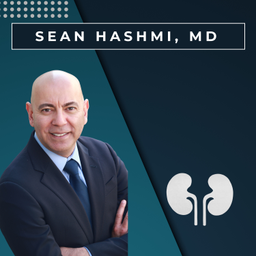
Understand your kidney numbers and metabolic health. I'm Dr. Sean Hashmi, a board-certified kidney and obesity medicine specialist. I explain the research behind your lab results, food choices and daily habits in plain English.
I'm the founder of SELF Principle, a nonprofit built around Sleep, Exercise, Love and Food.
Free weekly newsletter: https://selfprinciple.org/newsletter/
Website: https://www.seanhashmimd.com/
For education only, not personal medical advice.
Dialysis Timing: What Actually Decides When You Start
Three people can have the exact same kidney number, and completely different futures. One needs dialysis this year. One never will. Nephrologist Dr. Sean Hashmi breaks down the biggest myth in kidney care: that a single eGFR number decides when you need dialysis.
There is no eGFR threshold that automatically triggers dialysis, according to a 2024 review in JAMA. What actually decides timing is a combination of symptoms, fluid status, blood acid level, and potassium, not a single lab value. Dr. Hashmi walks through the landmark IDEAL trial, a randomized study of 828 people that found starting dialysis early bought no survival benefit at all, and explains why preparing early and starting early are two completely different things. He closes with the one medication class proven to slow kidney decline, and a simple two-column tracking method to bring to every appointment.
References:
Flythe JE, Watnick S. Dialysis for chronic kidney failure: a review. JAMA. 2024;332(18):1559-1573.
Cooper BA, Branley P, Bulfone L, et al. A randomized, controlled trial of early versus late initiation of dialysis. N Engl J Med. 2010;363(7):609-619.
Heerspink HJL, Stefánsson BV, Correa-Rotter R, et al. Dapagliflozin in patients with chronic kidney disease. N Engl J Med. 2020;383(15):1436-1446.
The EMPA-KIDNEY Collaborative Group. Empagliflozin in patients with chronic kidney disease. N Engl J Med. 2023;388(2):117-127.
Want the evidence without the hype? Sign up for the free weekly newsletter at selfprinciple.org/newsletter.
The information in this content is for educational purposes only and does not constitute medical advice. Always seek the advice of your physician or other qualified health provider with any questions you may have regarding a medical condition. Never disregard professional medical advice or delay seeking it because of something you have seen in this content. The views expressed here are my own and do not represent the views of my employer or any affiliated institution. Never start, stop, or change the dose of any prescription medication without consulting your physician.
Practice kindness and gratitude.
26 Jul 2026
This Sign Means Your Kidneys Are Already Damaged
Your kidneys can lose more than half their function and never once make you feel sick. Nephrologist Dr. Sean Hashmi walks through the real warning signs of kidney disease, including the ones almost everyone misses because they blame them on something else.
Fewer than one in 20 people with early kidney disease are aware they have it, because kidneys are built with so much spare filtering capacity that blood tests can look normal while damage quietly continues underneath.
Dr. Hashmi covers the eight warning signs to watch for as a cluster, from swelling and foamy urine to washed-out fatigue and itchy skin, the visible signs on your ankles, eyes, and nails and why they show up late, and the sign people miss completely: rising blood pressure. He also explains why diabetes and high blood pressure cause about half of all kidney disease with zero symptoms, and the two simple tests, a blood test for creatinine and a urine albumin-to-creatinine ratio, that catch kidney damage years before any symptom appears.
References:
Gong J, Vaduganathan M, Wadhera RK. Chronic kidney disease prevalence and awareness among US adults. JAMA Cardiol. 2026;11(1):77-81.
Romagnani P, Agarwal R, Chan JCN, et al. Chronic kidney disease. Nat Rev Dis Primers. 2025;11(1):8.
Kalantar-Zadeh K, Jafar TH, Nitsch D, Neuen BL, Perkovic V. Chronic kidney disease. Lancet. 2021;398(10299):786-802.
KDIGO CKD Work Group. KDIGO 2024 Clinical Practice Guideline for the Evaluation and Management of Chronic Kidney Disease. Kidney Int. 2024;105(4S):S117-S314.
Want the evidence-based breakdowns in writing? Sign up for the free weekly newsletter at selfprinciple.org/newsletter.
The information in this content is for educational purposes only and does not constitute medical advice. Always seek the advice of your physician or other qualified health provider with any questions you may have regarding a medical condition. Never disregard professional medical advice or delay seeking it because of something you have seen in this content. The views expressed here are my own and do not represent the views of my employer or any affiliated institution.
Practice kindness and gratitude.
Dr.Sean
20 Jul 2026
Do Proton Pump Inhibitors Cause Kidney Disease?
Do heartburn pills like omeprazole really damage your kidneys? Nephrologist Dr. Sean Hashmi breaks down what the actual research found, how big the risk really is, and who carries it versus who barely does.
Large observational studies do show a higher rate of chronic kidney disease in people who take proton pump inhibitors daily for years, roughly 26 to 50 percent higher depending on the study. But that number is smaller than it sounds once it's anchored in real numbers, and every one of these studies is observational, meaning it cannot prove the pill itself is the cause rather than the reasons someone was prescribed it in the first place. Dr. Hashmi explains the research trap called confounding by indication, the one kidney injury from these drugs that is not a myth, and why dose and time, not the single pill, are what actually drive the risk. He also covers the safe, planned way to taper off a proton pump inhibitor without acid rebound, and who genuinely needs to stay on one.
References:
Lazarus B, et al. Proton pump inhibitor use and the risk of chronic kidney disease. JAMA Intern Med. 2016;176(2):238-246.
Ang SP, et al. Association between proton pump inhibitor use and risk of incident chronic kidney disease. Biomedicines. 2024;12(7):1414.
Rajan P, et al. The association between proton pump inhibitor use and the risk of adverse kidney outcomes. Therap Adv Gastroenterol. 2022;15:17562848221074183.
Praga M, González E. Acute interstitial nephritis. Kidney Int. 2010;77(11):956-961.
Want the evidence-based breakdowns in writing? Sign up for the free weekly newsletter at selfprinciple.org/newsletter.
The information in this content is for educational purposes only and does not constitute medical advice. Always seek the advice of your physician or other qualified health provider with any questions you may have regarding a medical condition. Never disregard professional medical advice or delay seeking it because of something you have seen in this content. The views expressed here are my own and do not represent the views of my employer or any affiliated institution. Never start, stop, or change the dose of any prescription medication without consulting your physician.
Practice kindness and gratitude.
Dr.Sean
Reach and audience
Public platform figures. Ratings count people who left a rating, not total listeners.
Apple Podcasts (US)
5.0 / 5
3 ratings
Contact Sean Hashmi, MD
Guest appearances
Does not typically book guests
Based on episode analysis; this does not confirm that the show is currently accepting guests.
Host of Sean Hashmi, MD?
Claim your podcast to manage its listing and keep your show details accurate.
Pod Engine is an independent podcast discovery and analytics service and is not affiliated with or endorsed by this podcast. Artwork and show content belong to their owners. Full legal notice.
Explore this show Podcast research with Pod Engine