- 16
- Episodes
- Daily
- Cadence
- 2026
- First episode
About Seen at the Right Level
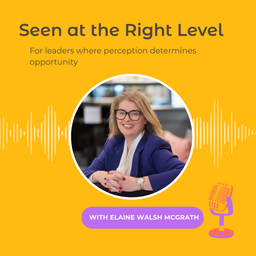
Short, sharp episodes for senior leaders whose capability isn’t always understood at the level they operate. You’re already operating at a high level. But the way you’re perceived, understood or considered doesn’t always reflect the judgement, experience and value you bring. Seen at the Right Level explores what happens when that gap starts to affect the opportunities that come next. Why are you still being seen through an old role? Why do people value you, but struggle to explain what to bring you in for? Why can someone with less experience be considered before you? And what changes when the right people finally understand the level you’re operating at? Elaine Walsh-McGrath looks at the real situations behind those questions - and at how positioning, reputation, visibility and senior-level communication shape roles, referrals, board conversations, commercial opportunities and influence. For CEOs, MDs, NEDs, C-suite executives and senior leaders who are already operating at a high level, but aren’t always being recognised or considered that way. No tactics. No noise. Just clear thinking on how to be understood at the level you operate - and the level you want next.
- Publisher
- Elaine Walsh-McGrath
- Category
- business · business · business
- Language
- en
- Explicit
- No
- First episode
- 4 Jun 2026
- Latest episode
- 7 Oct 2026
Latest episodes
16 episodes in the feed.
7 Oct 2026
Episode 15 - The Work Is Finished. The Value Isn’t.
A lot of senior leaders are doing valuable work, then moving straight onto the next thing. The client is won. The event is over. The project is delivered. The meeting is finished. But the wider commercial value often hasn’t been used at all. This episode is about the habit of treating each activity as if it has only one purpose, when the same piece of work could also strengthen your reputation, support a relationship or help the next opportunity arrive with less explanation. I share an example from a food business that had delivered a major corporate order brilliantly. They had proved they could operate at scale, but nobody had captured the moment. The work was done, the client was happy, and the evidence had disappeared. That is the bit I want you to notice. When something important lands, delivery and the wider commercial value need to be considered together. In this episode, I talk about: Why being busy can make you miss the value already sitting inside your work How stop-start visibility forces you to keep reintroducing yourself Why important client wins should do more than generate one announcement How evidence of good work can help the next buyer understand what you’re capable of Why this is a commercial habit, not simply a content problem A useful question to ask after any important piece of work is: What else could this support? It might strengthen how you’re understood, give someone evidence of your capability, restart an important relationship or make the next opportunity easier to recognise. If this is something you’re working through in your own leadership profile, you can find out more about my advisory work here: Advisory Work - Find Out More (https://www.elainewalshmcgrath.com/executive-advisory) And if you want to stay connected, you’ll find me on LinkedIn here: Connect with me on LinkedIn (https://www.linkedin.com/in/elainewalshmcgrath/)
30 Sept 2026
Episode 14 - Do the Right People Know When to Bring You In?
This week, we’re talking about what happens after a good conversation. Because someone can know you’re experienced, understand broadly what you’re doing now and still not know when they should bring you into a situation. I see this a lot with senior leaders. The credibility is already there. The experience is already there. What is often missing is the translation. If your experience is still being described as a merger, a restructure, a difficult growth period or a leadership transition, you know exactly what that involved because you lived it. The person sitting across the table didn’t. So if you want your network to think of you when something relevant comes up, you need to make it easier for them to understand where that experience fits. In this episode, I talk about: Why a good conversation doesn’t automatically become an opportunity Why credibility is rarely the issue at senior level How broad language such as “I’m looking for board work” or “I’m open to consultancy” can make it harder for someone to place you Why the right people need to recognise the business situation in which your experience becomes relevant The question to ask yourself before your next coffee, introduction or board conversation The practical question from this episode is: What would need to be happening inside a business for someone to think of me? If this is something you’re working through in your own leadership profile, you can find out more about my advisory work here: Executive Advisory Work (https://www.elainewalshmcgrath.com/executive-advisory) And if you want to stay connected, you’ll find me on LinkedIn here: LinkedIn (https://www.linkedin.com/in/elainewalshmcgrath/) Here are a couple of episodes you should also listen to: Episode 13 - Your Next Opportunity May Be Sitting in Your Old Network Reconnecting gets you back into the conversation. This episode looks at why the network you already have may be closer to your next opportunity than you think. Listen to Episode 13 (https://www.elainewalshmcgrath.com/podcasts/seen-at-the-right-level/episodes/2149242163) Episode 8 - Your Success Stories May Be Positioning You for the Wrong Role The examples you share shape what other people associate you with and the opportunities they’re likely to consider you for. Listen to Episode 8 (https://www.elainewalshmcgrath.com/podcasts/seen-at-the-right-level/episodes/2149232943)
23 Sept 2026
Episode 13 - Your Next Opportunity May Be Sitting in Your Old Network
When senior leaders start looking for board roles, advisory work, consultancy opportunities or a different kind of senior position, they often assume they need to build an entirely new network. But your existing network doesn’t need to contain your next client. It may contain the person who knows your next client. In this episode, I talk about the mistake I made when I wrote off my old network because those contacts weren’t my target market, and what happened when I started reconnecting with former colleagues and clients. One of those conversations led to an introduction, which led to work with Airfield, then Social Entrepreneurs Ireland, and later another significant client engagement. None of that came from meeting someone new. It came through someone who already knew me, trusted my work and now understood what I was doing. I also talk about why we can be too quick to dismiss former colleagues and clients because they’re in the wrong sector or aren’t potential buyers themselves, and why staying present in the minds of the people who already know you can matter when an opportunity appears. One thing I’m assuming in this episode: before you start having these conversations, you’ve done the work to get clear on how you want to be positioned now. If that part isn’t sorted yet, go back to Episode 3 (https://www.elainewalshmcgrath.com/podcasts/seen-at-the-right-level/episodes/2149220069), where I talk about why old positioning keeps pulling old opportunities towards you, and start there. Otherwise, you can have a great coffee with someone who genuinely wants to help you and still leave them unclear about what they should think of you for. If that part isn’t sorted yet, go back to my earlier episode on positioning and start there. Or, if you want help getting clear on how your experience should be positioned for what you want next, get in touch with me. Connect with me on LinkedIn: https://www.linkedin.com/in/elainewalshmcgrath/ (https://www.linkedin.com/in/elainewalshmcgrath/)
16 Sept 2026
Episode 12 - The Market Intelligence You’re Not Capturing
Valuable market information is already moving through your business every day. But very little of it may be captured. In this episode, Elaine explores how the questions prospects ask, the objections that keep appearing and the feedback clients give can sharpen positioning, sales conversations and external communication. In many businesses, that information is answered in the moment and then lost. So when the Managing Director writes a LinkedIn post, marketing updates the website, or sales needs a better way to explain the offer, everyone falls back on the same flat language. High-quality service. Trusted partner. Tailored solutions. Experienced team. Meanwhile, clients and prospects are already giving the business far more useful language. In this episode: • Why valuable client and prospect insight often disappears inside busy teams • How repeated questions, objections and feedback reveal what the market is thinking • Why sales, marketing and delivery need to share what they are hearing • How client moments can become useful evidence when handled appropriately • The simple habit leaders can introduce to capture better market intelligence This episode is for leaders of established service-based businesses who know valuable information is entering the company every day, but suspect it is not being used properly. Because this is not only content inspiration or testimonial gathering. It is market intelligence. The questions, concerns and language clients use can help the business understand what people value, where they hesitate and what they have not yet understood. The positioning gold you need may already be sitting inside the company. But until someone creates a habit of recognising it and bringing it back in, the business will keep inventing weaker language than the words its clients and prospects are already giving it. Further thinking: Elaine shares ongoing perspectives on executive visibility, positioning and commercial perception on LinkedIn. https://www.linkedin.com/in/elainewalshmcgrath/ (https://www.linkedin.com/in/elainewalshmcgrath/)
9 Sept 2026
Episode 11 - Your Team Is Already a Growth Asset
Some of the experience, trust and relationships that could help a business grow may already be sitting inside the team. But the market may never see them. In this episode, Elaine explores why established service-based businesses often rely too heavily on the Managing Director, sales team and company page to carry the company’s reputation. Meanwhile, some of the strongest commercial insight is sitting with the people closest to the work. They understand where clients get stuck, hear the questions that come up repeatedly and often explain the value of the work in language that is much closer to the real buying decision. The problem is not always that the team is unwilling to be visible. Often, nobody has shown them what useful external communication should look like. In this episode: • Why the market may only see a thin version of the business • How vague pressure to “do more on LinkedIn” creates uncertainty • Why the most useful material is already happening in the work • The role leaders play in setting clear boundaries and direction • How team visibility can support growth without turning employees into influencers This episode is for leaders of established service-based businesses who know there is strong expertise across the company, but suspect too much of the external profile still depends on a small number of people. Because trust does not only sit with the person at the top. Clients build confidence through the people they actually work with. When that experience stays behind the scenes, the business can appear smaller than it really is. Your team may already be a growth asset. But it takes clear direction, sensible boundaries and proper support to help that experience become visible. Further thinking: Elaine shares ongoing perspectives on executive visibility, positioning and commercial perception on LinkedIn. https://www.linkedin.com/in/elainewalshmcgrath/ (https://www.linkedin.com/in/elainewalshmcgrath/)
2 Sept 2026
Episode 10 - Your Executive Profile Is Central to Your Growth Strategy
A company can have a clear message and still leave one important question unanswered. Who is leading this? And do I trust how they think? In this episode, Elaine explores why the executive profile is not separate from the growth strategy. For a service-based business, clients are not only buying a service. They are buying judgement, relationships and confidence in the person leading the company. That means the company profile and the executive profile have different jobs. The company explains what the business does. The leader shows the thinking behind it. Using the example of a Managing Director growing through word of mouth and recommendation, Elaine looks at what happens when the company message, the leader’s profile and the opportunities being pursued are not all pointing in the same direction. In this episode: • Why the person leading the business matters to commercial growth • The different jobs of the company message and the executive profile • How a leader’s perspective helps build trust before a conversation begins • Why broad positioning makes the right opportunities harder to recognise • The commercial questions to answer before deciding what to post This episode is for Managing Directors, CEOs and founders who want the business to move into bigger rooms, but whose public profile does not yet reflect the level at which they operate. Because people do not invite a service page into the room. They invite a person. Your executive profile should help the right people understand why the business is relevant to them and why you are the right person to lead it. The company creates clarity. The leader creates confidence. A business that wants to grow needs both pointing in the same direction. Further thinking: Elaine shares ongoing perspectives on executive visibility, positioning and commercial perception on LinkedIn. https://www.linkedin.com/in/elainewalshmcgrath/ (https://www.linkedin.com/in/elainewalshmcgrath/)
26 Aug 2026
Episode 9 - Being Yourself Is Not a Business Risk
Here are the show notes for Episode 9. Many executives are highly trusted in the room. But the moment they write a bio, update LinkedIn or speak publicly, that authority can disappear. In this episode, Elaine explores why senior leaders often edit themselves into a more polished, corporate and careful version that bears little resemblance to the person people already trust. The problem is not a lack of credibility. It is that their public presence fails to carry the judgement, directness and confidence that make them effective in the first place. Using a CEO example, Elaine looks at why this is a translation problem rather than a personality problem. Because being yourself professionally does not mean being exposed, casual or unfiltered. It means knowing which parts of your leadership matter and allowing those qualities to remain visible. In this episode: • Why executives can sound completely different outside the room • How corporate language can dilute authority and perspective • The difference between showing personality and losing professional boundaries • Why generic thought leadership makes senior leaders harder to place • How to identify the qualities people already trust about you This episode is for executives who feel confident in serious conversations, but struggle to sound like themselves on LinkedIn, in a bio, on a panel or in other public settings. Because the public version of you should not feel like a manufactured character with your job title attached. It should help people understand how you think and why they can trust you. Being yourself is not the business risk. The greater risk is editing yourself until the right people can no longer see what makes you worth listening to. Further thinking: Elaine shares ongoing perspectives on executive visibility, positioning and commercial perception on LinkedIn. https://www.linkedin.com/in/elainewalshmcgrath/ (https://www.linkedin.com/in/elainewalshmcgrath/)
19 Aug 2026
Episode 8 - Your Success Stories May Be Positioning You for the Wrong Role
A strong proof point can still be the wrong proof point. Because the examples you use do more than show that you are capable. They tell people what to consider you for. In this episode, Elaine explores why experienced leaders can accidentally keep positioning themselves for work they are trying to move beyond. A career may contain years of evidence: complex decisions, commercial pressure, board exposure, crisis management, growth, transformation and difficult stakeholder situations. But not every example supports the next chapter. Some prove that you were highly effective in a previous role while doing very little to show the judgement, perspective or contribution you now want to bring to NED, advisory or portfolio work. Using examples from her own career and client work, Elaine looks at why a good success story can still be misaligned. In this episode: • Why an impressive example may still point people towards the wrong role • How proof points shape what others remember and recommend you for • The difference between showing delivery and showing board-level judgement • Why old evidence can keep attracting work you no longer want • How to choose examples that support the direction you are moving towards This episode is for senior leaders whose experience is strong, but whose familiar examples may still be selling an earlier version of their career. Because the proof that served your last chapter may not support the next one. The right evidence helps people understand how you think, what you notice, what you challenge and where your experience belongs now. Your success stories should not keep pulling you backwards. They should help people see why you belong in the next conversation. Further thinking Elaine shares ongoing perspectives on executive visibility, positioning and commercial perception on LinkedIn. https://www.linkedin.com/in/elainewalshmcgrath/ (https://www.linkedin.com/in/elainewalshmcgrath/)
12 Aug 2026
Episode 7 - Your Experience Is Impressive. But Is It Pointing to the Next Chapter?
A serious career can become surprisingly difficult to understand when every part of it is brought forward at once. The experience is impressive. But the relevance gets lost. In this episode, Elaine explores why senior leaders often make the next chapter harder to see by trying to include everything they have done. Years of commercial responsibility, transformation, governance, growth, crisis and change all matter. But a Chair, recruiter, CEO or referrer is usually trying to answer one specific question: “Is this the right person for this?” A long career history does not automatically make that clear. In this episode, Elaine looks at why experience needs to be organised around where you want to go next, rather than presented as a complete record of where you have been. Because your profile, board CV, bio and introductions should not read like a menu of every possible option. They should make the most relevant parts of your experience easier to recognise. In this episode: • Why including everything can make senior experience harder to understand • The difference between showing your career history and showing your relevance • How to identify the thread connecting NED, advisory and consultancy work • Why your positioning may keep attracting an older version of your career • The practical test for whether your experience points towards the work you want next This episode is for experienced leaders whose background is broad, substantial and credible, but whose next move may still be unclear to the people reading about them. Because the issue is rarely whether you have enough experience. It is whether that experience has been shaped around the contribution you want to make now. You do not need to show everything you can do. You need to make the right parts clear enough that someone understands why you belong in the next conversation. Further thinking: Elaine shares ongoing perspectives on executive visibility, positioning and commercial perception on LinkedIn. https://www.linkedin.com/in/elainewalshmcgrath/ (https://www.linkedin.com/in/elainewalshmcgrath/)
5 Aug 2026
Episode 6 - You Need a Board Strategy Before There’s a Board Vacancy
A board opportunity does not begin when the vacancy appears. It begins much earlier. In this episode, Elaine explores why senior leaders need a clear board strategy before they start applying for NED, advisory or portfolio roles. Because by the time a position is advertised, the board has often already been discussing the gap, sounding out trusted contacts and deciding what kind of experience it needs. If your thinking only starts when the advert appears, the application is being asked to do too much. In this episode, Elaine looks at what changes when you become more specific about the boards, sectors and situations where your experience is most useful. She also explores how a clearer direction improves the conversations you have with your network. Because “I’m open to NED roles” gives people very little to work with. A stronger board strategy helps others understand where you fit, who you should meet and what opportunities may be forming before they become formal vacancies. In this episode: • Why board opportunities often begin before a role is advertised • The difference between applying for roles and having a board strategy • Why senior leaders need to identify the boards and situations that suit their experience • How greater specificity improves networking conversations • The questions to ask before approaching your contacts This episode is for senior leaders who are serious about NED, advisory or portfolio work, but have not yet decided where their experience is most relevant. Because a strong network cannot help properly without a clear direction. The more precise you are about the contribution you want to make, the easier it becomes for the right people to connect your experience to the right opportunity. And that work starts before the vacancy. Further thinking Elaine shares ongoing perspectives on executive visibility, positioning and commercial perception on LinkedIn. https://www.linkedin.com/in/elainewalshmcgrath/ (https://www.linkedin.com/in/elainewalshmcgrath/)
29 Jul 2026
Episode 5 - Your Executive Reputation Won’t Automatically Become a Board Reputation
A strong executive reputation does not automatically become a clear board reputation. That distinction matters. Because being respected is not the same as being considered. In this episode, Elaine explores why senior leaders can have years of credibility, experience and sound judgement behind them, yet still struggle to make their board value clear. Executive roles come with context. Titles, organisations, responsibilities and track records help people understand the level at which someone operates. But NED, advisory and portfolio opportunities often involve people who do not have that full picture. They may only see a CV, a LinkedIn profile, a short introduction, or remember one brief conversation. From that, they are trying to answer a different question. Not, “Has this person had an impressive career?” But, “What would this person bring to our board?” In this episode: • Why executive credibility does not automatically translate into board consideration • The difference between career experience and board contribution • Why “I’m open to NED roles” is not clear positioning • How senior leaders can make their experience easier to place • The sentence your network needs to be able to finish about you This episode is for senior leaders who know they have the experience for NED, advisory or portfolio opportunities, but suspect their value is not landing clearly enough. Because a long and successful career can still leave people uncertain about where you fit. Your board reputation needs to show more than what you have led, managed or delivered. It needs to make clear how you think, what you notice, where you challenge, and what kind of board would benefit from having you in the room. Further thinking Elaine shares ongoing perspectives on executive visibility, positioning and commercial perception on LinkedIn. https://www.linkedin.com/in/elainewalshmcgrath/ (https://www.linkedin.com/in/elainewalshmcgrath/)
22 Jul 2026
Episode 4 - When Positioning Drifts the Business Pays for it.
Most leaders think positioning is a marketing decision. It isn’t. It’s a commercial one. In this episode, Elaine explores what happens when positioning creates expectations the business isn’t structured to support - and why the impact rarely shows up where people expect. Because positioning doesn’t just influence perception. It shapes commercial behaviour. It affects what clients expect, how teams communicate, where boundaries are held, and how easy - or difficult - commercial conversations become. Using a real business example, Elaine explores why positioning problems aren’t always caused by saying the wrong thing - but by putting the right message in the wrong place. In this episode: Why positioning influences far more than marketing outcomes How expectations are created long before delivery begins Why positioning and operations need to reinforce one another Where businesses lose margin without realising why How stronger positioning creates clearer commercial boundaries This episode is for leaders who know the business has evolved - but suspect the expectations around it haven’t. Because positioning only works when the business is built to support it. And when those things fall out of alignment, the business absorbs the gap. Further thinking Elaine shares ongoing perspectives on executive visibility, positioning and commercial perception on LinkedIn. https://www.linkedin.com/in/elainewalshmcgrath/ (https://www.linkedin.com/in/elainewalshmcgrath/)
15 Jul 2026
Episode 3 - Why You Keep Getting Offered Your Old Job
You can be very clear on where you’re going next - and still keep getting offered where you’ve already been. In this episode, Elaine explores a pattern she sees repeatedly with senior leaders: their role has evolved, but the stories they tell, the examples they lead with, and the way they describe their work still belong to an earlier chapter. The result? The market responds to the version of them it already understands. This episode looks at how positioning quietly shapes what opportunities come back to you - and why leaders often keep reinforcing roles they’ve already outgrown without realising it. In this episode: Why opportunities often reflect your positioning rather than your capability How leaders accidentally train people what to offer them next Why the strongest story isn’t always the right story How old examples keep you anchored to old opportunities What changes when positioning catches up with where you are now This isn’t about reinventing yourself. It’s about making sure the way you’re being understood reflects the work you actually want to be known for. Because if the signal doesn’t shift, the response won’t either. Further thinking Elaine shares ongoing perspectives on executive visibility, positioning and commercial perception on LinkedIn. https://www.linkedin.com/in/elainewalshmcgrath/ (https://www.linkedin.com/in/elainewalshmcgrath/)
8 Jul 2026
Episode 2 - The Decision is Forming Before the Pitch Begins
Episode 2: The Decision Is Forming Before the Pitch Begins Most people think the decision happens in the pitch. It doesn’t. By the time you’re in the room, the evaluation is already underway. In this episode, Elaine explores what’s really happening before a significant pitch, tender or commercial opportunity reaches a formal process. Because serious organisations rarely assess in isolation. They observe. They notice who is already on their radar, whose thinking they’ve been seeing, and whether external signals match internal ambition. Drawing on a real CEO example, Elaine looks at what happens when a business evolves faster than the way it is perceived - and why visibility work often becomes more important, not less, once a process goes live. In this episode: Why being invited into a process is rarely the true starting point How perception forms before formal evaluation begins What senior decision-makers are really validating during a pitch Why positioning and public signals must move in the same direction as the pitch process How subtle friction creates unnecessary resistance in high-value decisions This episode is for leaders who know they can deliver - but want to understand why capability alone doesn’t always secure the opportunity. Because when positioning hasn’t kept pace with where the business is today, you don’t arrive in the room already trusted. You arrive having to prove something you should never have had to prove. Further thinking Elaine shares ongoing perspectives on executive visibility, positioning and commercial perception on LinkedIn. https://www.linkedin.com/in/elainewalshmcgrath/ (https://www.linkedin.com/in/elainewalshmcgrath/)
1 Jul 2026
Episode 1 - You've Moved on Strategically. The Perception Hasn't
Episode 1: You’ve Moved On Strategically. The Perception Hasn’t There’s a point in every business where the role changes. You’re no longer fixing problems or holding everything together. You’re setting direction. Making decisions about growth, investment and scale. But what happens when perception doesn’t move at the same pace? In this episode, Elaine explores a pattern she sees repeatedly with CEOs and senior leaders: the business evolves, the role evolves, but the way people engage with the leader stays exactly the same. Boards continue to pull them into delivery. Teams continue to escalate decisions. Externally, buyers and investors continue to assess the business as if it still depends on one person. This isn’t a capability issue. It’s a perception issue. And in high-stakes moments - investment, acquisition and commercial growth - perception has consequences. In this episode: • Why leadership reputations formed in one phase of growth often persist into the next • How executive dependency shows up during investment and acquisition processes • What buyers are really evaluating beyond performance • Why businesses can become trapped by outdated perceptions of leadership • How visible leadership signals influence commercial outcomes If your business has moved into a new phase but the market, your board, or your team still relate to an older version of your role - this episode will help you recognise where friction may already be forming. Subscribe if you’re leading at a high level - or hiring at that level - and the right people aren’t being seen for what they’re actually capable of. For more on executive visibility, positioning and how opportunity is shaped before decisions are made, follow Elaine’s work on LinkedIn. https://www.linkedin.com/in/elainewalshmcgrath/ (https://www.linkedin.com/in/elainewalshmcgrath/)
4 Jun 2026
Introducing Seen at the Right Level
Seen at the Right Level: Podcast Trailer Welcome to Seen at the Right Level, the podcast about executive positioning, strategic visibility and the commercial consequences of being misunderstood. In this short trailer, Elaine Walsh-McGrath introduces the thinking behind the podcast and why visibility matters for senior leaders whose experience, credibility and track record are already strong, but whose external presence may not yet reflect the level they operate at. This podcast is for CEOs, Managing Directors, Non-Executive Directors and experienced leaders who want to be understood more clearly by the people making decisions. Because opportunity rarely starts with the formal pitch, the board interview, the sales conversation or the referral. It starts earlier. In how people describe you when you are not in the room. In what they associate with you. In whether they can quickly understand the value you bring. And in whether your presence matches the level you already operate at. In Seen at the Right Level, Elaine shares short, sharp episodes on executive visibility, positioning, perception and the commercial consequences of being misunderstood. This is not visibility for the sake of being visible. It is about making sure your reputation, message and presence do justice to the experience you have already built. Subscribe to Seen at the Right Level wherever you listen to podcasts. Follow Elaine on LinkedIn https://www.linkedin.com/in/elainewalshmcgrath/ (https://www.linkedin.com/in/elainewalshmcgrath/)
Contact Seen at the Right Level
- Guest appearances
- Does not typically book guests
Based on episode analysis; this does not confirm that the show is currently accepting guests.
Host of Seen at the Right Level?
Claim your podcast to manage its listing and keep your show details accurate.
Pod Engine is an independent podcast discovery and analytics service and is not affiliated with or endorsed by this podcast. Artwork and show content belong to their owners. Full legal notice.
Explore this show
Podcast research with Pod Engine