- 16
- Episodes
- Daily
- Cadence
- 2026
- First episode
About Self-Proofing: Ai, Money & You. The Roundtable.
Welcome to The Self-Proofing Roundtable — where AI meets the creator economy, and real strategies replace guesswork. Every episode, we debate, dissect, and deliver the frameworks, tools, and mindset shifts that independent creators need to build sustainable income — without ever showing their face. From niche validation and content automation to monetization systems and long-term scale, we go deep on what's actually working right now at the intersection of artificial intelligence, content creation, and financial freedom. Whether you're building your first channel or scaling your tenth, this is your roundtable. Pull up a seat. 🎙️ New episodes drop weekly. AI, Money, and You — every time.
- Publisher
- JB Tempo
- Category
- business · education
- Language
- en
- Explicit
- No
- First episode
- 13 Mar 2026
- Latest episode
- 12 Oct 2026
Latest episodes
16 episodes in the feed.
12 Oct 2026
Your prices are probably wrong — here's how to use AI to research, test, and fix them without losing a single customer
The price you are charging right now was almost certainly not set from data. Most creators pick a number that feels safe, anchor it to what someone else is charging, and leave it there for years. That invisible decision is costing you ten thousand to thirty thousand dollars a year — money your audience was already willing to pay, that you simply never asked for. This is not a mindset episode about charging your worth. It is a complete operational framework with specific AI prompts, statistically valid testing protocols, and named decision systems — including the four-number pricing framework, the six-category voice-of-customer prompt, the three-signal launch pricing audit, and the annual pricing review scoring rubric — that you can run on your own product catalog starting today. In this episode: • Circular reference pricing — why the entire creator economy is anchored to wrong numbers, and how AI breaks the cycle by replacing guesswork with competitive landscape research • The four-number framework : floor, anchor, perceived value ceiling, and conversion cliff — and why most creators only know one of them • Three-stage AI pricing research: competitive landscape mapping, voice-of-customer mining (with the four-output prompt structure), and psychological anchor analysis calibrated to your specific audience's economic identity • Building statistically valid pricing tests: 14-day windows, 300-visitor minimum thresholds, URL-level conversion tracking, and how to combine traffic sources to hit the threshold faster • Behavioral signal diagnosis — how AI reads page time, scroll depth, exit section, and checkout abandonment to distinguish price-driven resistance from value-communication gaps and trust deficits • Five pricing model structures and when each fits: one-time purchase, subscription, tiered access, pay-what-you-want-with-floor, and usage-based — plus how AI buyer segmentation maps value delivery patterns to the right model • Bundle pricing and ARPU optimization — the "third item feels free" psychological anchor, the purchase-sequence analysis prompt, and why tiered and bundle structures can increase launch revenue by 80% with zero new production • Outcome-based service pricing: why hourly rates cap revenue at hours in the day, and how AI-assisted outcome value mapping supports 2–3x service price increases without client churn • Launch pricing without sales history: the comparable outcomes audit, the three-question willingness-to-pay calibration survey, and pre-sell conversion testing as a real-money validation signal • Launch bonuses vs. launch discounts — why discounts train audiences to wait and bonuses preserve price integrity while driving the same urgency • The annual four-dimension pricing review: inflation and cost drift, competitive landscape shift, authority and credibility delta, and product evolution — with the AI scoring rubric that turns subjective judgment into a testable trigger • The pricing tax calculation: a concrete formula to quantify the exact revenue you left on the table last year from underpricing — and make the case for testing undeniable Who this episode is for: Creators who have products and an audience but have never run a structured pricing test — and anyone who has been anchoring their prices to competitors' numbers rather than to actual data about what their own audience will pay. Key takeaway: The price you charge is the most immediate revenue lever you have — it requires no new traffic, no new products, no new skills. AI makes price research, testing, and optimization faster and more accurate than ever. Every guess you leave in place is a tax you pay on your own work.
18 Sept 2026
Stop starting from scratch — one long-form recording becomes 30 days of platform-native content with the right AI system.
You already have everything you need to dominate every platform your audience uses. It is sitting in your YouTube Studio right now, underperforming. Most faceless creators make one long-form video, publish it, share it once on Instagram, and then start the whole process over from zero. That single video contained thirty days of content. AI is what finally makes extracting it systematic instead of exhausting. This is not a "work smarter not harder" theory episode. It is a step-by-step system with specific AI prompts, exact workflows, and decision frameworks you can implement this week — including the six-category master extraction prompt, the voice reference document, and the four-mistake audit that separates creators who repurpose successfully from those who produce AI-generated filler no one reads. In this episode: • The content multiplication problem — why a 30-minute YouTube video contains raw material for 30 days of platform-native content across email, short-form video, Twitter, LinkedIn, and community posts • The six-category master extraction prompt — quotable insights, story moments, frameworks and systems, data points, controversy and tension, and implied follow-up questions — and how one video typically yields a 3-month content pipeline from questions alone • Platform-native formatting rules for Twitter/X threads, LinkedIn carousels, short-form video hooks, community discussion posts, and SEO-optimized blog posts — and why copy-paste repurposing fails on every platform • The voice reference document — four questions that anchor every AI formatting prompt to your specific vocabulary, phrasing, and topics you would never cover; without it, repurposed content is technically accurate but sounds like anyone • Scheduling and batching systems — how to front-load repurposing work into a single weekly session and distribute output across 30 days using AI-assisted scheduling tools • The editorial review pass — why AI repurposing at scale without a human voice calibration step produces tonally flat content, and how to run the review in under 20 minutes per batch • Four repurposing mistakes that kill implementation: no platform adaptation, over-repurposing the same insight (the 4-week window rule), skipping editorial review, and treating repurposing as a substitute for creation • Scaling beyond solo operation — how to add a VA as an operational layer (not a creative one) on top of the AI system, cutting active repurposing time from 45 minutes to 20 without quality loss • Platform-resilient repurposing — how to build a system that survives algorithm changes by distributing output across owned channels (email) and multiple social platforms rather than optimizing for one feed • Watch-time percentage as your repurposing priority signal — why the top 5 videos by completion percentage (not raw views) are your highest-value source assets • 24-hour action plan: export and AI-clean your #1 video transcript, write your voice reference document, and calculate your content's current return-on-production-hour Who this episode is for: Faceless YouTube creators who are already producing long-form content but publishing nothing beyond the video itself — and anyone whose content creation anxiety comes from feeling like they have to generate new ideas constantly rather than extracting full value from what they have already built. Key takeaway: Your content library is a compound interest account you have been failing to make deposits into. Every piece of content you have ever made is still an asset — AI has made it cheaper than ever to collect the full return on it.
16 Sept 2026
How to launch and run a paid creator community that generates $5,000–$8,000/month in recurring revenue — using AI to handle most of the operational load.
Most creators think community means a free Discord they post in twice a month. The paid version is something entirely different: predictable monthly recurring revenue, your most engaged audience in one place, and a product validation engine that tells you exactly what to build next. And the reason most faceless creators never launch one — the assumption that you need to be on camera, available constantly, and present at every touchpoint — turns out to be a problem AI already solved. This isn't an abstract episode about "building connection." It's an operational system — the four-stage launch framework, the weekly content batching method, the founding member pricing strategy, and the AI-powered retention and moderation workflows that make it viable for any faceless creator to run a thriving paid community without a team. In this episode: • Why price is a quality filter, not just a revenue mechanism — how a $37/month membership fee changes member behavior, engagement, and retention in ways a free community structurally cannot • The four-stage launch framework — transformation positioning, platform selection (Skool vs. Circle vs. Discord vs. Kajabi), minimum viable community structure (three channels only), and the AI-drafted onboarding sequence • The weekly content batching method — how to produce all seven daily discussion prompts, one long-form resource post, and the weekly recap email in a single three-hour Sunday session using AI • The AI discussion prompt brief — the three-input formula (transformation + member frustrations + format instruction) that generates discussion prompts indistinguishable from expert community management • The member question bank — how to turn every help-channel question into a self-replenishing community content pipeline that eliminates "what do I post this week?" • The three-layer revenue model — base membership fee, product library access, and premium live programming tier; real numbers: $8,000+/month from 200 members with a two-tier $37/$97 structure • Three growth levers that require zero new content — the content-to-community bridge, the member referral system, and the alumni reactivation email sequence • AI-powered retention via monthly progress surveys — the three-question survey that identifies churn risk before it happens and surfaces the exact features to build next • Live programming as a faceless creator — audio-only calls, screen-share sessions, and pre-recorded deep-dives: three formats that eliminate the on-camera requirement without reducing value • Scaling without hiring — how to use community guides (long-term members in voluntary moderator roles) and an AI FAQ bot trained on your content library to handle 60% of questions automatically • The community as product validation engine — how survey data and help-channel questions become zero-risk product briefs with pre-qualified buyers before you build anything • The founding member launch strategy — time-limited price lock, minimum viable cohort size, and the two-week culture-seeding phase that determines whether the community survives its first month Who this episode is for: Faceless YouTube creators who have an engaged audience but no recurring revenue stream — and anyone who has looked at a paid community and assumed it requires too much time, too much presence, or showing up on camera. Key takeaway: When you have a floor of predictable monthly income, every other decision in your creator business becomes less desperate and more strategic. AI doesn't just reduce the operational burden of running a community — it makes the entire model viable for a one-person faceless brand.
8 Sept 2026
How to research, build, price, and launch your first digital product using AI — without a team, a budget, or months of preparation.
Your audience is already telling you what to sell. Your existing videos are already the source material. If you have had a product idea sitting in a notes app for six months because the build feels too big, too technical, or too risky — this episode removes every one of those objections with a step-by-step AI-powered system any faceless creator can execute in two weekends. This episode lays out the complete playbook: from finding the right idea in your existing analytics, to writing a high-converting sales page with AI, to launching with a five-email sequence that runs on autopilot. This isn't a motivation episode about just shipping something. It's an operational system built specifically for faceless creators — the intellectual property injection principle, the seven-element sales page formula, the five-email launch sequence, and the evergreen pipeline that keeps selling long after launch day. In this episode: • The watch-time-to-view-count method — how to find your highest-value product topic directly from YouTube Studio analytics in under twenty minutes, no guesswork required • Gumroad review mining — how to read buyer reviews (not product descriptions) on your niche's best-sellers to find the exact gap the market will pay to fill • The intellectual property injection principle — why AI-built products fail without your specific frameworks, examples, and results woven into every lesson, and the exact prompting workflow that grounds AI output in your existing content • Four digital product formats for faceless channels — PDF guide, mini-course, template pack, and digital toolkit — plus the decision framework for choosing the right one based on your niche and production capacity • AI-assisted curriculum design — from video transcript to validated twelve-lesson outline in one prompting session, without writing a word from scratch • Visual asset production with AI — how to use Canva and AI image generation to create professional product covers and device mockups (the design upgrade that doubled one creator's conversion rate at the same price point) • Value-based pricing — the three pricing mistakes that leave money on the table and how to set a price based on buyer outcome rather than production cost or market anchoring • The seven-element high-converting sales page formula — headline, problem statement, who-it's-for, content breakdown, social proof, offer block, and triple CTA — plus how to draft it section by section with AI • Platform selection — Gumroad, Lemon Squeezy, Stan Store, and Kajabi compared on setup friction, fee structure, and creator-type fit • The five-email launch sequence — day-by-day breakdown from curiosity teaser to close, including the "value email" that demonstrates quality and creates desire without discounting • The evergreen pipeline — search-optimized YouTube tutorial, automated email nurture sequence, and product-specific AI assistant that keeps the funnel running on autopilot after launch day • The minimum viable threshold — why five sales is the right goal for a first launch, and how lowering the success bar eliminates launch paralysis without lowering standards Who this episode is for: Faceless YouTube creators who have an engaged audience but no product revenue — and anyone who has had a digital product idea for more than thirty days and still hasn't acted on it. Key takeaway: What AI changes is the cost of attempting a launch. When the build takes two weekends instead of four months, the risk calculation shifts entirely — and the answer to "should I try" becomes almost always yes.
23 Aug 2026
How to go from one video a week to a full multi-platform content operation — without burning out or hiring a team.
Scaling your content business doesn't mean working five times harder. It means redesigning your workflow so a solo creator can produce the output of a team. If you've been stuck in the linear trap — more content requires more hours in a one-to-one ratio — this episode is the system that breaks it. Episode 12 of Self-Proofing: AI, Money & You brings together host Alex, faceless channel operator Jordan, and AI systems strategist Dr. Maya to map out a complete AI-powered content scaling operation. Jordan went from 20 hours per week on one video to 6 hours per week on two — and that math only works because of the AI workflows, repurposing pipelines, and cognitive-mode scheduling she built deliberately. This isn't a theory episode. In this episode: • The workflow audit — the 3-step time-tracking exercise that reveals which tasks are creative judgment vs. repeatable process, and why most creators skip this critical first step • The 90/10 rule — why 90% of content production is non-creative, and why AI handles that 90% better than you do • 1 video → 6 assets in 15 minutes — Jordan's exact repurposing template: short-form script, email newsletter, LinkedIn posts, carousel outline, quote graphic, and pinned comment • Platform-specific prompt templates — how to produce LinkedIn-native, Twitter-native, and Reels-native content from the same source material without it feeling copy-pasted • AI comment mining — pasting 100 top comments into a language model to extract recurring questions, frustrations, and requests as a free content brief • The AI research workflow — breaking research into four targeted sub-prompts (statistics, examples, objections, rebuttals) for a structured foundation in under an hour • The voice profile document — a 300-word instruction file built from your own best transcript that closes the gap between AI drafts and your actual voice • Compounding monetization — why scaling to multiple platforms creates a multi-input funnel where email, Shorts, LinkedIn, and long-form all feed the same digital product • The 3-day operating rhythm — Monday concept, Tuesday production, Wednesday distribution; 6–7 active hours total for two published videos and 6–8 distribution pieces • Single cognitive-mode scheduling — how time-blocking by mental mode (strategic / production / execution) eliminates the context-switching that silently kills creator productivity • The 4 scaling mistakes — over-tooling, scaling before the foundation is solid, automating the wrong things first, and neglecting the weekly feedback loop • The effort-equals-value myth — why judgment, not hours, is the bottleneck in an AI-assisted operation, and how to internalize that shift Who this episode is for: Faceless YouTube creators who are producing content manually and feel stuck at a ceiling — whether that ceiling is time, output volume, or income. If you believe scaling requires hiring or grinding, this episode will change that belief with a concrete system you can implement this week. Key takeaway: The ceiling you're hitting isn't a talent ceiling. It's a systems ceiling. AI handles 90% of content production; your job is to protect the 10% that requires your judgment — and the first step is a time audit that shows you exactly where those two categories live in your current workflow.
16 Aug 2026
How to turn YouTube viewers into email subscribers and buyers — automatically — using AI tools any faceless creator can deploy today
AI-Powered Lead Generation for Content Creators Your best-performing video is generating leads right now. You just don't have a system to catch them. Every viewer who watches, comments, and clicks away is raising their hand — and without a lead generation funnel in place, you're watching potential buyers disappear into the algorithm, permanently. This episode is about building the door they can walk through. Episode 11 of Self-Proofing: AI, Money & You brings together host Lala, faceless channel operator Jordan, and AI strategist Dr. Maya to map out a fully automated, AI-powered lead generation system built specifically for faceless content creators — no sales calls, no cold outreach, no face on camera required. This isn't a theory episode. Jordan walks through the exact five-step viewer-to-buyer path she runs on autopilot, Dr. Maya breaks down the AI roles that power each stage (content audit, landing page copy, email sequence drafting, funnel analysis, audience segmentation), and together they dismantle the belief that lead generation is something only businesses with sales teams need to worry about. It isn't. It's the system underneath your content that turns traffic into income. In this episode: • The five-step automated funnel — from first video view to first paid purchase, with zero manual follow-up • Why ad revenue alone is a structural vulnerability — and how an email list removes your dependence on the algorithm • Lead magnet strategy for faceless channels — the four lead magnet types that work (checklist, template, mini-course, toolkit), how to pick the right one, and how to use AI to create it in under two hours • The four-element landing page formula — headline, benefit bullets, visual mockup, opt-in form — and why removing everything else lifts conversions • ConvertKit, Carrd, Kajabi, and Stan Store compared for the minimum viable lead capture setup (no website required) • The seven-day welcome sequence structure — day-by-day breakdown from lead magnet delivery through direct offer, with open rate and conversion benchmarks (3–5% sequence-to-sale target) • AI email copywriting workflow — how to prompt for individual emails, generate ten subject line variations, and edit for voice without starting from scratch • Traffic drivers that actually convert — in-video CTAs, description placement before the fold, pinned comments, and short-form Reels as a lead magnet entry point • Four AI roles in a running funnel — content audit for lead magnet placement, lead magnet creation, sequence drafting, and performance pattern analysis • Audience segmentation with ConvertKit tags — how to identify list segments in 20 minutes and send targeted offers without being a marketing professional • The two most common funnel-building mistakes — and the correct sequencing that avoids wasted setup work • 24-hour action plan — three concrete steps (lead magnet, welcome email, description update) that activate a working lead generation system today Who this episode is for: Faceless YouTube creators who are generating views but not building a sustainable revenue base beyond ad income — and anyone who has thought "lead generation isn't for me" because they don't have a product, a sales team, or a website. Key takeaway: The viewers who watch your videos and disappear aren't lost — they just never had a door to walk through. A lead magnet, a ConvertKit landing page, and a five-email welcome sequence is all it takes to build that door. AI writes the copy. You set it up once. The system runs.
30 Jul 2026
Content Repurposing as a Growth Engine: One Video, Five Platforms, More Revenue
You're throwing away 70–80% of the value of every video you make. Here's the AI-powered repurposing system that fixes it. You spend four or five hours producing a YouTube video, it goes live, and then you move on. That video sits on one platform, reaches one audience, and dies a quiet death while the next piece of content waits. What if that same video was simultaneously working for you on Instagram, LinkedIn, TikTok, a podcast feed, and a newsletter — without multiplying your workload? That's not a fantasy. It's a system, and AI has made it accessible to solo creators building faceless channels. In Episode 10 of Self-Proofing: AI, Money & You, host Lala is joined by faceless channel operator Jordan and AI strategist Dr. Maya for a deep-dive into content repurposing as a genuine growth engine — the platform-native, AI-accelerated approach that builds audiences, deepens trust, and opens new revenue streams from content you've already created. This isn't a theory episode. You'll get Jordan's core idea extraction model for turning a single video into platform-native derivatives, Dr. Maya's five-step repurposing workflow and master AI prompt that generates all four formats in one session, and the multi-touch attribution data showing why each additional platform touchpoint roughly doubles buyer conversion rate. In this episode: • Why 70–80% of the value of every video you make is wasted — and the repurposing system that recovers it • Core idea extraction: how to distill a video into one sentence that drives every derivative format • Platform-native repurposing vs. copy-paste: why they perform completely differently and how to tell the difference • Short-form video (Reels, Shorts, TikTok): clipping vs. re-recording, AI-identified standalone value moments, and the hook-payoff-close structure • LinkedIn repurposing: the three-paragraph framework, AI drafting workflow, and why LinkedIn builds a B2B consulting pipeline from faceless content • Newsletter repurposing: why it generates higher revenue per subscriber than any other channel, and how to calibrate AI editing intensity by platform intimacy • Podcast feed repurposing: audio-first rewriting with AI, back-catalog compounding, and when to re-record vs. clip • The multi-touch attribution reality: how each additional platform touchpoint doubles conversion likelihood • Dr. Maya's five-step repurposing workflow and the master AI prompt that produces all four formats in one call • The readiness threshold: why you should NOT repurpose until you have ten videos you're proud of • The evergreen/insight-density filter: how to decide which videos deserve repurposing investment • Voice calibration with AI: how to use your best-performing posts as style examples to reduce editing time over time Who this episode is for: Faceless YouTube creators and AI content entrepreneurs who are producing videos consistently but only publishing to one platform — and anyone who has ever wondered whether the "post everywhere" advice actually works or just creates more work. Key takeaway: Repurposing is not extra work — it's more efficient work. One video adapted to five platforms through a systematized AI workflow builds deeper audience trust across more touchpoints, and deeper trust is what converts viewers into buyers. The creators who scale without hiring teams almost always have a repurposing system at the center of their operation.
19 Jul 2026
AI Tools for Faceless Channel Research: Find Proven Content Ideas, Analyze Competitor Channels, and Identify Niche Gaps
Episode Title: AI Tools for Faceless Channel Research: Find Proven Content Ideas, Analyze Competitor Channels, and Identify Niche Gaps Your channel isn't failing because of bad content — it's failing because of bad research. Here's the AI-powered system that fixes it. You picked a niche, you started posting, and three months later you have a hundred subscribers and forty views per video. Most creators assume the problem is the content. It isn't. The problem started before you ever hit record — at the research stage. You didn't know what your audience was hungry for, which channels were quietly dominating your niche, or where the gaps were that nobody was covering. In Episode 9 of Self-Proofing: AI, Money & You, host Lala is joined by faceless channel operator Jordan and AI strategist Dr. Maya for a deep-dive into the AI-powered channel research system that gives you a real competitive edge before you script a single video. This isn't a theory episode. You'll get Jordan's four-part research framework — demand validation, competition mapping, gap analysis, and content angle discovery — plus the exact AI workflows that compress days of manual research into a few focused hours. Dr. Maya's three-tier research stack (discovery → analysis → automation) shows you how to turn competitor comment sections into a content calendar and Reddit frustrations into an audience persona that makes every title, thumbnail, and script feel like it was made specifically for your viewer. In this episode: • Why your channel is failing at the research stage — not the content stage • The four-part research framework: demand validation, competition mapping, gap analysis, angle discovery • How to identify the right competitors to study (hint: not the biggest channels in your niche) • Using AI to surface title patterns, topic clusters, and content gaps from competitor data in minutes • The comment mining workflow: how Jordan built her first 20 videos entirely from competitor comment sections • The three-tier AI research stack: TubeBuddy/VidIQ for discovery, ChatGPT/Claude/Perplexity for analysis, custom GPT systems for automation • How to find a niche from scratch using structured AI prompts — and the three signals that confirm it's worth entering • The content depth test: asking AI for 50 video ideas to see if a niche has longevity before you commit • Per-video research workflow: competitive audit, information gathering, and angle locking before every script • Thumbnail research as a data problem — how Jordan increased her click-through rate 40% by mapping competitor thumbnail patterns • Building an audience persona with Reddit posts and Amazon one-star/five-star reviews synthesized by AI • Why AI homogenizes content for lazy creators — and why differentiation lives at the interpretation layer, not the tool layer Who this episode is for: Faceless YouTube creators and AI content entrepreneurs who are posting consistently but not growing — and anyone who has ever chosen a niche based on "vibes" and wondered why their first thirty videos underperformed. Key takeaway: Channel research is not a one-time project — it's a system. Demand validation, competition mapping, comment mining, and audience persona work done consistently and maintained on a quarterly rhythm will tell you exactly what to make, for whom, and why they'll click. AI doesn't replace that judgment; it accelerates how fast you build it.
3 Jul 2026
The Monetization Plateau — Why Revenue Stalls and How to Break Through It
: How creators can move beyond flat revenue by shifting from traffic-based monetization to trust-based income systems. Full Episode Description: Monetization plateau strategies for creators start with one uncomfortable truth: more views are not always the answer. If your audience is growing but your revenue is stuck, this episode shows why the problem is usually not your content — it is your business model. In Episode 8 of Self-Proofing: AI, Money & You, host Alex, guest-hosted by Lala, sits down with Jordan and Dr. Maya for a practical debate/roundtable on why creator revenue stalls and how faceless creators can break through using trust-based monetization. This conversation breaks down the shift from monetizing traffic to monetizing trust, the four revenue models that help creators move beyond passive platform income, and the AI-assisted systems that turn audience questions, comments, and email replies into products, positioning, launch plans, and automated nurture sequences. In this episode: Why the monetization plateau happens when creators depend too heavily on passive monetization like AdSense, Creator Fund payouts, and platform bonuses The difference between monetizing traffic and monetizing trust — and why trust-based revenue can outperform view-based income How Jordan moved beyond a faceless channel revenue ceiling by launching a low-cost digital product to a warm email list The four trust-based revenue models for creators: digital products, paid newsletters or communities, affiliate partnerships, and service offers Why creator product positioning should describe the outcome, not just the course, template, guide, or toolkit itself How to use YouTube comments, email replies, and audience questions to identify product ideas your audience already wants Why pricing digital products between $27 and $97 can create stronger perceived value than underpricing your first offer How AI can speed up product creation by helping draft course outlines, worksheet templates, module content, and deliverables How AI-powered audience research can extract recurring frustrations, top questions, and exact customer language from comments and replies Why automated nurture sequences and welcome emails are essential for converting subscribers into buyers The danger of launching too many products at once, and why sequential focus beats scattered monetization How to plan a four-to-six-week pre-launch content calendar that builds demand before a product goes live Who this episode is for: This episode is for faceless creators, YouTubers, AI-assisted content entrepreneurs, newsletter builders, and podcast creators who have an audience but feel stuck at the same monthly revenue number. It is especially useful for creators who rely on AdSense, affiliate links, platform bonuses, or passive monetization and want to build a more durable creator business. Key takeaway: The way out of a monetization plateau is not simply posting more content. The real breakthrough comes from building a trust layer — email, products, positioning, and nurture systems — that converts attention into income
29 Jun 2026
Platform-Native Content Strategy for Faceless Creators
How to repurpose one piece of content into native posts on YouTube, LinkedIn, email, and podcasts — without tripling your workload. Most creators hear "be on multiple platforms" and immediately think: more work, less sleep, zero results. They're wrong — and this episode shows you exactly why. In Episode 7 of Self-Proofing: AI, Money & You, host Alex brings back entrepreneur Jordan and AI strategist Dr. Maya to break down platform-native content strategy for faceless creators — what it really means to create content that belongs on each platform, and how to do it from one 90-minute repurposing system per week. This isn't a theory episode. You'll get Jordan's exact 3-pass AI workflow for turning one YouTube transcript into a LinkedIn post, an email newsletter, and a short-form clip. You'll get Dr. Maya's breakdown of what "native" actually means on YouTube, LinkedIn, podcasts, and email in 2026 — and why simply resizing a thumbnail misses the point entirely. In this episode: Why platform-native content is about audience mindset, not just format or video dimensions The YouTube long-form + Shorts two-engine strategy for faceless channels in 2026 How to build a LinkedIn presence with no personal brand and no face — using point-of-view consistency instead Why a podcast is almost zero additional effort if you're already producing voiceover content Jordan's exact AI repurposing prompts for LinkedIn openers, email newsletters, and short-form scripts The 4-tool stack: Opus Clip, Descript, Claude, and Buffer — and how they connect The 3 failure modes of platform diversification (and how to avoid all of them) What metrics actually matter vs. vanity numbers that waste your time The prioritized platform stack for faceless creators in 2026: YouTube → Email → LinkedIn/Shorts → Podcast Action steps you can start this week — no new tools required Who this episode is for: Faceless YouTube creators, AI content entrepreneurs, and digital business owners who want to grow beyond a single platform without burning out or hiring a team. Key takeaway: You don't need five separate content engines. You need one engine and multiple distribution pipes — and AI makes building those pipes a 90-minute weekly task, not a full-time job.
8 Jun 2026
Creators Who Rely on One Platform Are Doomed
In an era dominated by faceless content creators and automated channels, relying on a single platform like YouTube is no longer just risky — it’s a direct threat to your business. In this 40-minute episode of Self-Proofing: AI, Money & You, Alex is joined by entrepreneur Jordan and AI systems expert Dr. Maya to discuss the uncomfortable reality of platform dependency. This episode uncovers why algorithm shifts, content saturation, and monetization changes make single-platform creators extremely vulnerable. Within the discussions, the three explore practical strategies for diversifying across platforms like YouTube, LinkedIn, email, and podcasts without needing to double your workload. Jordan shares real-world experience from building systems that protect revenue even when one platform fails. Dr. Maya breaks down how AI can intelligently repurpose and distribute content across multiple platforms more efficiently than ever before. If you’re a faceless creator building an automated channel, don’t miss this breakdown of how to future-proof your income.
16 May 2026
The Exact AI Stack, 90-Minute Workflow & Monetization System Serious Creators Are Using Today
What separates creators earning consistent high-ticket revenue from those still grinding without results? In this roundtable episode, host Alex sits down with entrepreneur Jordan and AI expert Dr. Maya to pull back the curtain on the exact tools, workflows, and systems driving the next generation of automated creators. In this episode you will discover: • The shift from standalone tools to integrated creator ecosystems — and the three-platform stack replacing eight-app workflows • Jordan's exact 90-minute video production workflow from idea to scheduled upload using Claude, Grok, and Pictory • How 2026 multi-modal AI models have made content creation conversational, not linear • The four-layer high-ticket funnel stack turning views into revenue — including landing pages, qualification, delivery, and automation • Why revenue per view beats every other metric — and how to calculate yours • The analytics stack combining YouTube Studio, TubeBuddy, VidIQ, Hotjar, and AI pattern analysis • Backend income diversification: digital products, group coaching, licensing, and speaking • What tools will be essential by 2027 — agentic video creation, real-time personalization, and predictive monetization • The risks every creator must guard against: platform dependency, AI commoditization, and audience fatigue • A practical seven-day action plan to build your creator system starting this week Whether you are just starting your faceless channel or scaling an existing content business, this episode gives you the complete blueprint — tools, strategy, and execution. Subscribe so you never miss an episode of Self-Proofing: AI, Money & You — the show helping creators build income-generating systems that work with or without their face on camera.
7 May 2026
Stop Guessing. Let the System do the Heavy Lifting.
Most creators don’t fail because they lack creativity. They fail because they build content around guesswork instead of validated demand. In this episode of Self-Proofing: AI, Money & You, we walk through the complete six-module AI content system designed for faceless creators who want to create faster, avoid burnout, and build a sustainable online income system. This episode breaks down how to move from random content creation to a structured workflow built around audience research, high-retention outlines, AI-assisted scripting, and faceless content optimization. You’ll learn: Why “just create more content” leads to the creator death loop How to use AI as an audience researcher to find validated ideas The formula for turning pain, confusion, and desire into strong video promises How to validate content ideas in minutes before wasting production time Why burnout is a systems problem, not a willpower problem The five principles of the Content Velocity System Why outlines matter more than scripts for viewer retention How to use AI as a co-writer without losing your voice Why faceless creators have unique advantages in speed, scalability, and asset value A simple seven-day action plan for building your own AI-assisted content system If you’re a faceless creator, YouTuber, digital entrepreneur, or AI-powered content builder, this episode gives you a practical roadmap for creating smarter, faster, and more sustainably. The big idea: Stop guessing. Validate demand. Build from the data. Let the system do the heavy lifting.
19 Apr 2026
When should you niche down — and when does niche become a trap?
In Episode 3 of Self-Proofing: AI, Money & You, Alex, Jordan, and Dr. Maya take on one of the most important strategic questions creators face: how to use specificity to grow without getting boxed into a brand identity that no longer fits. The conversation breaks down why niching works so well early, why broad positioning often leads to weak signal, and how a once-helpful niche can later become too small, too fragile, or too tied to one platform, one tactic, or one trend. Along the way, the team explores audience trust, monetization, expansion strategy, and the difference between building around durable problems versus temporary formats. If you’re a creator, coach, educator, founder, or expert trying to grow with clarity while protecting your long-term brand, this episode is for you.
11 Apr 2026
The Critical Skills That Separate Successful Creators From Everyone Else
Why clarity, structured thinking, empathy, judgment, resilience, systems, and synthesis matter more than tools in the AI era In Episode 2 of Self-Proofing: AI, Money & You, Alex, Jordan, and Dr. Maya go deeper into the human skills that actually separate successful creators from everyone else. Tools are everywhere now. AI is accessible. Advice is endless. And yet some creators build momentum while others stall. So what makes the difference? This episode explores the real capabilities behind creator growth: clarity, structured thinking, audience empathy, decision-making, judgment, taste, feedback tolerance, emotional resilience, systems thinking, and synthesis. If Episode 1 gave you the framework, Episode 2 gives you the skills required to make that framework work in the real world. This is a practical roundtable on how to think better, create with more intention, and use AI as a multiplier of human judgment — not a replacement for it.
13 Mar 2026
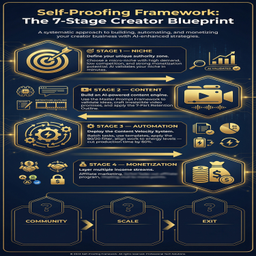
Is AI Killing Creativity? The 7-Stage Framework Debate
Is AI killing creativity? Or is it the single greatest unlock for independent creators in the last decade? In this episode of The Self-Proofing Roundtable, host Alex is joined by Jordan — a faceless YouTube creator who built three channels from scratch — and Dr. Maya Chen, an AI researcher and content strategist with five years studying creator economics. Together, they debate and break down the 7-Stage Self-Proofing Framework: a sequential, AI-powered blueprint designed for faceless creators who want to validate ideas, automate their workflow, and scale their income — without ever showing their face. The 7 Stages covered in this episode: 🎯 Niche — Replace guesswork with AI-validated demand research 📹 Content — Use the Video Promise Formula (Pain × Confusion × Desire) ⚙️ Automation — The Content Velocity System: Batching, Templates, 80/20, Energy Alignment 💰 Monetization — Layer income with affiliates, digital products, brand deals & memberships 📈 Growth — The 7-Part Retention Framework: Hook, Stakes, Promise, Curiosity, Validation, Loop Closure, Action 🛠️ Systems — The 5-Step AI Co-Writing Workflow that takes you from 0% to 80%, then human filter to 100% 🚀 Scale — Go from 1 channel & 4 videos/month to 3 channels & 16 pieces of content — with fewer hours Whether you're a beginner thinking about starting a faceless channel or a creator stuck in the burnout loop, this roundtable delivers the honest, data-backed debate you need to hear. 💡 The framework isn't overnight success. It's a system that compounds — slowly at first, then all at once.
Contact Self-Proofing: Ai, Money & You. The Roundtable.
- Guest appearances
- Books guests
Based on episode analysis; this does not confirm that the show is currently accepting guests.
Host of Self-Proofing: Ai, Money & You. The Roundtable.?
Claim your podcast to manage its listing and keep your show details accurate.
Pod Engine is an independent podcast discovery and analytics service and is not affiliated with or endorsed by this podcast. Artwork and show content belong to their owners. Full legal notice.
Explore this show
Podcast research with Pod Engine