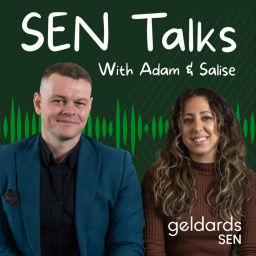
SEN Talks, from the team at Geldards SEN. Join solicitors Adam Friel and Salise Dourmoush as they discuss issues around special educational needs and the law.
Episode 64: Part 1 - SEND reform, specialist packages and the future of EHCPs
What could the proposed SEND reforms mean for children, families and schools, and what could be lost if individual rights and support are changed?
In this episode of SEN Talks, Adam and Salise are joined by Sharon Smith, Director at Special Needs Jungle, to discuss her experiences as a parent, researcher and SEND campaigner, as well as the wider changes currently being considered for the SEND system.
Sharon talks about the history and work of Special Needs Jungle, which was created to give parents accessible, independent information about the SEND system and has developed into an important source of analysis and commentary on SEND policy and reform.
The conversation looks at the proposals for reform and why, although some of the aims may sound positive, there are concerns about how they could work in practice.
Topics discussed include:
• the proposed changes to SEND support and EHCPs
• concerns around specialist provision packages
• the importance of specified, individualised and legally enforceable provision
• whether greater standardisation risks overlooking individual needs
• the potential impact of moving responsibility towards schools
• concerns around parents having to challenge their child’s school directly
• the importance of early intervention
• mainstream inclusion for children with more complex needs
• how relationships between parents and schools affect outcomes
• the importance of recognising when a child is struggling before difficulties escalate
• whether outcomes for children receiving SEND support are being properly measured
Sharon also shares her experiences as the parent of a daughter with Down’s syndrome who remained in mainstream education.
She describes a particularly difficult period during year 5 when her daughter began experiencing significant anxiety around school. She stopped wanting to attend, hid under tables in the classroom and became frightened outside school.
Once the headteacher became aware of what was happening, changes were made to her support, timetable and school experience, alongside a nurture programme designed to rebuild her confidence.
By year 6, she was enjoying school again.
The discussion highlights why recognising distress early, listening to families and understanding the individual child can be so important, particularly when difficulties at school are too easily attributed to the child rather than the environment around them.
The episode also considers whether reforms intended to reduce conflict within the SEND system could instead shift disputes towards relationships between parents and schools, and what this could mean for families who are understandably reluctant to challenge the people caring for their child every day.
Credits: Post-production editing by Goldson Photography - https://www.goldsonphotography.co.uk/ (https://www.goldsonphotography.co.uk/)
Edited by Dreamlancers.
Music is 'Sunshine' by lemonmusicstudio.
21 Sept 2026
Episode 63: What does inclusion really mean for children with SEND?
What does meaningful inclusion look like for children and young people with special educational needs and disabilities?
In this episode of SEN Talks, we are joined by Charlotte Hadfield, Head of Education at 3PB Barristers, to discuss inclusion in mainstream education and the recent inclusive education estates guidance.
The guidance encourages mainstream schools to consider how their physical environments could become more inclusive, including through changes such as quiet spaces, improved acoustics and lighting, and specialist areas within schools.
But creating t raises a much wider question: does being educated in a mainstream school necessarily mean that a child feels included?
During the episode, we discuss the opportunities these adaptations could create for some children, while also considering their limitations for children and young people with more complex needs.
The conversation covers:• what the new guidance could mean for mainstream schools• the difference between physical inclusion and meaningful inclusion• how inclusion bases and specialist units work in practice• whether some children may still require specialist provision• the pressures facing schools and local authorities• the importance of considering each child’s individual needs• the cost and availability of specialist and residential placements• whether greater investment in local specialist provision could form part of the solution• how the concept of inclusion in SEND education may be changing Charlotte also shares a memorable analogy involving guinea pigs and a tropical fish to explain why placing a child in the same environment as their peers does not necessarily create meaningful inclusion.
We also discuss the idea of “corridor kids”, children who may technically attend a mainstream school but spend significant amounts of time outside the classroom or working separately from their peers.
The episode considers both the potential benefits of making mainstream education more inclusive and the importance of recognising that no single model of education will be appropriate for every child.
Listen to the full episode for a detailed discussion of inclusion, specialist provision and what future SEND reform could mean for children, families and schools.
Credits: Post-production editing by Goldson Photography - https://www.goldsonphotography.co.uk/.... Edited by Dreamlancers.Music is 'Sunshine' by lemonmusicstudio. Want more from Geldards SEN? Be sure to follow our social media channels! All links here: https://linktr.ee/geldardssen... Website: https://www.geldards.com/children-and... us on social media: @GeldardsSEN on Instagram, Facebook & YouTube.
1 Jun 2026
Episode 62: Understanding neurodiversity in criminal law
In this episode of SEN Talks, we are joined by Stephanie Roe, Director of Roe Lawyers, to discuss the relationship between neurodiversity and the criminal justice system.
Stephanie shares her experience representing neurodiverse children, young people and adults in criminal cases, explaining what can happen when someone with autism, ADHD or other vulnerabilities comes into contact with the police.
We explore:
what happens after an arrest
the importance of informing police about vulnerabilities
reasonable adjustments in custody
the role of defence solicitors and appropriate adults
why neurodiverse individuals can be more vulnerable within the justice system
communication difficulties, impulsivity and sensory overload
consent, coercion and misunderstandings in criminal cases
the importance of jury trials
rehabilitation, support and reducing reoffending
This episode offers practical insight for parents, carers, professionals and anyone supporting neurodiverse young people.If you would like advice about your child’s educational support in England or Wales, our team offers free initial consultations.Credits: Post-production editing by Goldson Photography - https://www.goldsonphotography.co.uk/... (https://www.youtube.com/redirect?event=video_description&redir_token=QUFFLUhqbEZ4U3dHNXFiRXRtOFJ1Vi1OSUZtVXlvbGpYd3xBQ3Jtc0tteFpXVXBPejBUenpZTXZjM1NMbXcyT2stbS1Zc2Z0bHMtOTMzcGxrS1RacHIwTFlsNVdRc1MxVVp6Mm10TFNtNXMyakJvZWU1b3pYOHF5Y3N0UVpRNmlWa1BIVG8yeUJTeTU3NDUzMktvcXhkbnRrdw&q=https%3A%2F%2Fwww.goldsonphotography.co.uk%2F...&v=atynJhR919k). Edited by Dreamlancers.Music is 'Sunshine' by lemonmusicstudio. Want more from Geldards SEN? Be sure to follow our social media channels! All links here: https://linktr.ee/geldardssen.. (https://www.youtube.com/redirect?event=video_description&redir_token=QUFFLUhqbFBHWFAzczZZQkdUZzBSWlNCMlpmNjRMMXpHd3xBQ3Jtc0tsOTdTTWdNazZxOXVXRzQ3YTVBUEpjMThPRlNqNXpJMTNTcmcwMVREUVp3UTdEV3QxYVFseWt0cDZfQjYyamNNQzI3eTNib2pXV1ZKT1lNTVhFN0ZpQ05VTDBPdElTbk9ncE5PQkFrUmdCU0RqaGhPNA&q=https%3A%2F%2Flinktr.ee%2Fgeldardssen%E2%81%A0%E2%81%A0%E2%81%A0%E2%81%A0%E2%81%A0%E2%81%A0%E2%81%A0%E2%81%A0..&v=atynJhR919k). Website: https://www.geldards.com/children-and... (https://www.youtube.com/redirect?event=video_description&redir_token=QUFFLUhqblE3ckVqYW05RGR3cFVxeEUwbnRRS2E3eUstZ3xBQ3Jtc0trV1lvTVBfZURLRmxiU1c4TUgxa3g4SDdJVzhlczhqLXZEd003ZWdteEEwOUlOb1FlNGJXSi15YXlYSTZMSmotSmlhOXFUTGJ3SjB1ZlRMbDlIZWNrTmdxOEFDS19qcEp0TTlVcFBoUXdYaGwxMUhvbw&q=https%3A%2F%2Fwww.geldards.com%2Fchildren-and....Follow&v=atynJhR919k) us on social media: @GeldardsSEN on Instagram, Facebook & YouTube.
Reach and audience
Public platform figures. Ratings count people who left a rating, not total listeners.
Spotify
4.9 / 5
17 ratings
Podcast Authority Score: 35 / 100
A composite of feed quality, social presence, YouTube performance and engagement. Read the methodology.
Quality
39
Social presence
0
YouTube
0
Engagement
77
Host of SEN Talks?
Claim your podcast to manage its listing and keep your show details accurate.
Pod Engine is an independent podcast discovery and analytics service and is not affiliated with or endorsed by this podcast. Artwork and show content belong to their owners. Full legal notice.
Explore this show Podcast research with Pod Engine