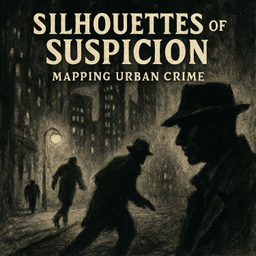
About Silhouettes of Suspicion Mapping Urban Crime Graph
Each city pulses with its own criminal rhythm, shaped by transgression and justice in equal measure. Silhouettes of Suspicion charts these urban crime patterns through meticulous analysis and compelling storytelling, examining real cases, criminal behavior patterns, and law enforcement responses across major metropolitan areas. Combining investigative narrative with expert insight from forensic specialists and criminal justice professionals, the show illuminates how cities fight back against their darkest impulses.
The Impact of Economic Disparities on Crime Trends in Cities
Exploring the intricate relationship between economic disparities and crime trends reveals how financial inequality shapes urban environments and influences criminal behavior. This discussion examines how neighborhoods with stark economic divides often experience heightened crime rates, while those with more equitable resources tend to foster safer communities. We analyze specific case studies from cities like San Francisco, Detroit, and Atlanta, where economic conditions have directly correlated with crime statistics. The narrative includes insights from economists, sociologists, and community leaders who discuss the role of access to education, employment opportunities, and social services in mitigating crime. We also explore innovative community programs aimed at addressing these disparities and their potential to reduce crime rates over time. By understanding the economic underpinnings of crime, we can better grasp the systemic issues that contribute to urban violence and the pathways toward sustainable solutions.
14 Sept 2026
The Role of Urban Design in Shaping Crime Patterns
Exploring the intricate relationship between urban design and crime, this discussion highlights how the physical layout of a city influences criminal behavior and law enforcement strategies. We analyze specific architectural features, public spaces, and urban planning decisions that can either deter or facilitate criminal activity. Interviews with urban planners, criminologists, and community activists reveal how thoughtful design can create safer environments, while neglect can lead to increased vulnerability. We also examine case studies from cities that have successfully implemented design changes to reduce crime rates, discussing the principles of Crime Prevention Through Environmental Design (CPTED) and how they can be applied in various contexts. This episode challenges listeners to consider how the spaces we inhabit shape our interactions and safety, ultimately questioning whether crime is an inevitable outcome of urban life or a challenge that can be addressed through intentional design.
16 Aug 2026
Future of Urban Crime and the Technological Transformation of Criminal Investigation
As American cities face evolving crime patterns and law enforcement agencies adopt new technologies—from predictive policing algorithms to facial recognition systems to real-time crime centers—the relationship between criminal behavior, urban geography, and investigative capacity is being fundamentally transformed. This concluding episode synthesizes insights from previous investigations to examine how emerging technologies will reshape urban crime and law enforcement in coming decades. We analyze predictive policing systems that use historical crime data to forecast future crime locations, examining both their potential to prevent crime and their risks of perpetuating historical biases embedded in training data. The narrative includes interviews with technologists, criminologists, and civil liberties advocates who debate whether technological solutions can address crime rooted in social and economic conditions. We examine real-time crime centers that integrate data from multiple sources—surveillance cameras, license plate readers, gunshot detection systems—to create comprehensive crime monitoring systems. The episode explores the privacy implications of these surveillance technologies, and the question of whether comprehensive monitoring creates safer cities or simply more controlled ones. We also analyze how criminal organizations adapt to new technologies, examining the arms race between law enforcement innovation and criminal adaptation. The narrative includes discussion of emerging crime categories enabled by new technologies—deepfakes, cryptocurrency theft, drone-based surveillance—and how law enforcement is developing investigative capacity to address them. The episode concludes by examining the fundamental question of whether cities can achieve safety through technological means alone, or whether crime reduction ultimately requires addressing the underlying social and economic conditions that generate criminal behavior. We synthesize the patterns revealed across the series to suggest that understanding urban crime requires understanding both individual criminal behavior and the systemic conditions that enable it.
Reach and audience
Public platform figures. Ratings count people who left a rating, not total listeners.
Spotify
4.3 / 5
18 ratings
Contact Silhouettes of Suspicion Mapping Urban Crime Graph
Guest appearances
Books guests
Based on episode analysis; this does not confirm that the show is currently accepting guests.
Host of Silhouettes of Suspicion Mapping Urban Crime Graph?
Claim your podcast to manage its listing and keep your show details accurate.
Pod Engine is an independent podcast discovery and analytics service and is not affiliated with or endorsed by this podcast. Artwork and show content belong to their owners. Full legal notice.
Explore this show Podcast research with Pod Engine