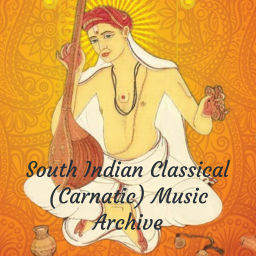
About South Indian Classical (Carnatic) Music Archive: Classes / Lessons
This podcast is a complement to http://www.shivkumar.org/music/ and Youtube channel (https://www.youtube.com/user/shivkuma100/videos) by an amateur and hobbyist for fellow amateurs, self-learners, music enthusiasts with an interest in south indian classical music (carnatic music). This podcast explores details about compositions: word-by-word meanings and musical aesthetics (gamakas etc) as seen by a fellow amateur to promote music appreciation.
Full Notation: www.shivkumar.org/music
dArini telusukoNTi
Ragam: Shuddha
Saveri {22nd Melakartha Janyam}
ARO: S R2
M2 P D2 S ||
AVA: S
D2 P M1 R2 S ||
Talam: Adi
(2 kalai)
Composer: Tyagaraja
Swami
Version: M
S Subbalakshmi (Youtube: https://www.youtube.com/watch?v=nK0tg4pLcng (https://www.youtube.com/watch?v=nK0tg4pLcng)
)
Lyrics / Meanings
Courtesy: Thyagaraja Vaibhavam (https://thyagaraja-vaibhavam.blogspot.com/2008/07/thyagaraja-kriti-daarini-thelusukonti.html (https://thyagaraja-vaibhavam.blogspot.com/2008/07/thyagaraja-kriti-daarini-thelusukonti.html)
)
YouTube Class:
MP3 Audio
Class: http://www.shivkumar.org/music/darinitelusukonti-class.mp3 (http://www.shivkumar.org/music/darinitelusukonti-class.mp3)
Pallavi:
dArini telusukoNTi
tripura
sundari ninnE SaraN(a)NTi
Anupallavi:
mAruni janakuDaina mA daSaratha
kumAruni sOdari dayA-pari mOksha (dArini)
caraNam 1
amba tri-jagad-ISvari mukha jita vidhu
bimba Adi puramuna nelakonna
kanak(A)mbari nammina-vArik(a)bhIshTa
varambul(o)sagu dIna lOka rakshaki
ambuja bhava puruhUta sanandana
tumburu nAradul(a)nduru nIdu
padambunu kOri sadA
nity(A)nand(A)mbudhilOn(O)lalADuc(u)NDE (dArini)
1 Jan 2025
dAsharathI nI rNamu (Class / Lesson) - Thodi - Adi (2 kalai) - Tyagaraja
Full Notation: www.shivkumar.org/music
dAsharathI nI rNamu
Ragam: Thodi {8th Melakartha Ragam}
ARO: S R1 G2 M1 P D1 N2 S ||
AVA: S N2 D1 P M1 G2 R1 S ||
Talam: Adi
Composer: Tyagaraja Swami
Version: M S Subbalakshmi (Youtube: https://www.youtube.com/watch?v=wHR0_eMIIJc (https://www.youtube.com/watch?v=wHR0_eMIIJc))
Lyrics: Lakshman Ragde
Meanings: Thyagaraja Vaibhavam
YouTube Class: https://youtu.be/rhM7d0YX04Q (https://youtu.be/rhM7d0YX04Q)
MP3 Audio
Class: http://www.shivkumar.org/music/dasarathi-thodi-class.mp3 (http://www.shivkumar.org/music/dasarathi-thodi-class.mp3)
Pallavi:
dAsharathI
nI rNamu dIrpa nA taramA parama pAvana nAma
Anupallavi:
AshadIra
dUra dEshamulanu prakAshimpa jEsina rasika shirOmaNi
Charanam:
bhaktilEni
kavijAla varEnyulu bhAva meruga lErani kalilOna jani
bhukti
mukti galgunani kIrtanamula bOdhincina tyAgarAja karArcita
Meaning: (Courtesy: Thyagaraja Vaibhavam: http://thyagaraja-vaibhavam.blogspot.com/2008/11/thyagaraja-kriti-daasarathi-nee-rinamu.html (http://thyagaraja-vaibhavam.blogspot.com/2008/11/thyagaraja-kriti-daasarathi-nee-rinamu.html)
and ChatGPT plus)
In the kRti ‘dASarathI nI RNamu’ – rAga tODi (tALa Adi), SrI tyAgarAja
tells SrI rAma that he would ever remain indebted to Him for initiating him in
bhakti.
Sahityam: dAsharathI nI rNamu dIrpa nA taramA parama pAvana
nAma
Meaning: O Lord rAma – son of daSaratha
(dASarathI)! O Lord with a name (nAma) that sanctifies (pAvana)! Is Your (nI)
debt (RNamu) redeemable (dIrpa taramA) by me (nA)?
dAsharathI:
(Son of Dasharatha) Referring to Lord Rama.
nI: Your.
rNamu: Debt.
dIrpa: To
relieve or dispel.
nA: My.
taramA: Will
you.
parama:
Supreme.
pAvana:
Purifier.
nAma: Name.
Sahityam: AshadIra dUra dEshamulanu prakAshimpa jEsina rasika
shirOmaNi
Meaning: O Excellent (SirOmaNi) (literally crown
jewel) of connoisseurs (rasika) of music who, to the fulfillment (tIra) of my
desire (ASa), made me shine (prakASimpa jEsina) (even) in distant (dUra) lands
(dESamulanu)!
O dASarathI!
O Lord with a name that sanctifies! Is Your debt redeemable by me?
AshadIra:
Without tiring.
dUra:
Distant.
dEshamulanu:
In countries.
prakAshimpa:
Illuminate or make famous.
jEsina:
Having done.
rasika:
Connoisseur or enthusiast.
shirOmaNi:
Crown jewel.
"bhaktilEni kavijAla varEnyulu bhAva
meruga lErani kalilOna jani":
"The best among poets, devoid of
devotion, cannot understand the true emotions that arise in this Kali Yuga."
O Lord worshipped (arcita) by the very
hands (kara) (karArcita) of this tyAgarAja, who -realising that (ani) those who are excellent (varENyulu) in poesy (kavi jAla) bereft (lEni) of devotion (bhakti), would not understand (eruga lEru) (lErani) the emotional state (bhAvamu),having born
(jani) in this kali yuga (kalilOna),
bhaktilEni:Without devotion.
kavijAla:Poets.
varEnyulu:The best or the choicest.
bhAva:Emotion or sentiment.
meruga: Knowor understand.
lErani: Unable to.
kalilOna: InKaliyuga
jani: Born orarise.
bhukti mukti galgunani kIrtanamula bOdhincina
tyAgarAja karArcita
Tyagaraja, who taught praises that
provide both material enjoyment and liberation, worshipped you with his
hands."
Tyagaraja refers to himself here, noting his own role in composing songs that offer both
worldly pleasures (bhukti) and spiritual liberation (mukti). He expresses his
devotion through physical worship and the composition of these devotional
songs.
O Lord worshipped (arcita) by the very
hands (kara) (karArcita) of this tyAgarAja, who -taught (bOdhincina) (to the World) compositions (OR chanting of names) (kIrtanamula)singing of which would (ani) confer (kalgunu) (kalgunani) both Worldly enjoyments (bhukti) and also emancipation (mukti)!
bhukti: Material enjoyment.
mukti: Liberation.
galgunani:Having.
kIrtanamula:Praises.
bOdhincina:Taught or enlightened.
tyAgarAja:Tyagaraja.
karArcita:Worshipped by hand.
Full Notation: www.shivkumar.org/music
Sarasija Nabha Sodhari
Ragam: Naga
Gandhari {20th Melakartha Janyam}
ARO: S R2 M1 G2 R2 M1 P D1 , N2 S ||
(or M1 P N2 N2 S )
AVA: S N2 D1 P M1 , G2 , R2 G2 (R1) S ||
Talam: Rupakam
Composer: Muthuswamy Dikshitar
Version: Ram Kaushik (Youtube
Original)
Lyrics Courtesy: Lakshman Ragde
Meanings Courtesy: Guru Guha Vaibhavam: https://guru-guha.blogspot.com/2008/10/dikshitar-kriti-sarasija-nabha-sodari.html (https://guru-guha.blogspot.com/2008/10/dikshitar-kriti-sarasija-nabha-sodari.html)
Youtube Class / Lesson: https://www.youtube.com/watch?v=kjzCVpqzsSg (https://www.youtube.com/watch?v=kjzCVpqzsSg)
MP3 Class / Lesson: http://www.shivkumar.org/music/sarasijanabha-sodhari-class.mp3 (http://www.shivkumar.org/music/sarasijanabha-sodhari-class.mp3)
Pallavi:
sarasija nAbha sOdari Sankari pAhi mAm
Anupallavi:
varadAbhaya kara kamalE SaraNAgata vatsalE
caraNam:
parandhAma prakIrtitE
paSu pASa vimOcitE
pannagAbharaNa yutE
nAga gAndhArI pUjitAbja padE
sadAnanditE (https://guru-guha.blogspot.com/2008/10/dikshitar-kriti-sarasija-nabha-sodari.html#V1)sampadE
madhyama kAla sAhityam:
vara guru guha janani mada Samani
mahishAsura mardini manda gamani
mangaLa vara pradAyini
Meaning: (Courtesy: Guru Guha Vaibhavam):
https://guru-guha.blogspot.com/2008/10/dikshitar-kriti-sarasija-nabha-sodari.html (https://guru-guha.blogspot.com/2008/10/dikshitar-kriti-sarasija-nabha-sodari.html)
Pallavi
sarasija
nAbha sOdari - O sister of
Vishnu (who has a lotus springing from his navel)!
Sankari - O wife of Shiva (Shankara),
pAhi mAm -
Protect me!
Anupallavi
varada-abhaya
kara kamalE - O one whose lotus-like
hands gesture granting of boons and freedom from fear!
SaraNa-Agata
vatsalE - O one tenderly
affectionate to those who have come seeking refuge!
CaraNam
paraM-dhAma
prakIrtitE - O one renowned as the
supreme abode (housing the universe)!
paSu pASa
vimOcitE - O one who
liberates creatures from bondage!
pannaga-AbharaNa
yutE - O one in the company of
Shiva (who wears snakes as ornaments)!
nAga gAndhArI
pUjita-abja padE - O one whose lotus-feet are worshipped by Nagagandhari Raga!
sadA
nanditE - O
ever-blissful one!
sampadE - O supreme wealth
(precious to your devotees)!
vara guru
guha janani - O mother of the
eminent Guruguha!
mada
Samani - O one who
extinguishes arrogance!
mahisha-asura
mardini - O slayer of the
buffalo-demon Mahishasura!
manda
gamani - O one with a
languorous (graceful) gait!
mangaLa vara
pradAyini - O giver of auspicious
boons!
Comments:
This Kriti is
in the eighth (Sambodhana Prathama)
Vibhakti
The name ‘parandhAma’ is found in the Lalita
Sahasranama
The names
‘padmanAbha sahOdarI’, ‘paSu pASa vimOcinI’ and ‘ mada nASinI’ are found
in the Lalita Sahasranama, similar to the epithets here
Reach and audience
Public platform figures. Ratings count people who left a rating, not total listeners.
Apple Podcasts (US)
5.0 / 5
7 ratings
Spotify
5.0 / 5
40 ratings
Podcast Authority Score: 54 / 100
A composite of feed quality, social presence, YouTube performance and engagement. Read the methodology.
Quality
74
Social presence
0
YouTube
0
Engagement
85
Contact South Indian Classical (Carnatic) Music Archive: Classes / Lessons
Guest appearances
Does not typically book guests
Based on episode analysis; this does not confirm that the show is currently accepting guests.
Host of South Indian Classical (Carnatic) Music Archive: Classes / Lessons?
Claim your podcast to manage its listing and keep your show details accurate.
Pod Engine is an independent podcast discovery and analytics service and is not affiliated with or endorsed by this podcast. Artwork and show content belong to their owners. Full legal notice.
Explore this show Podcast research with Pod Engine