- 21
- Episodes
- 2024
- First episode
About Sparks
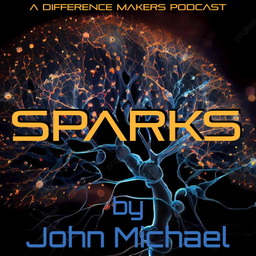
Sparks, my friends, are those glimmers of inspiration that dance upon the edges of our minds. They are the thoughts and ideas that flutter around the realm of faith, neuroscience and marketplace leadership like fireflies on a summer night. Not yet fully formed, not fully explored, but brimming with potential. differencemakers.substack.com (https://differencemakers.substack.com/s/sparks?utm_medium=podcast)
- Publisher
- A difference makers podcast by John Michael
- Category
- education · religion & spirituality
- Language
- en
- Explicit
- No
- First episode
- 3 Sept 2024
- Latest episode
- 20 Nov 2025
Latest episodes
21 episodes in the feed.
20 Nov 2025
My Name for God Was “Fix-It”
For most of my life, my name for God was “Fix-It.” That wasn’t His name, of course, but it was mine for Him, a reflection of my own broken operating system. My world was built on performance, a relentless, grinding pressure to solve every problem. My mind was a Gantt chart of anxieties, each task a dependency for the next, with no room for grace or error. Professionally, I was the one with the answers. Personally, I was the designated crisis manager. My sense of self-worth wasn’t just tied to my ability to fix things; it was my ability to fix things. The emotional cost of this existence was staggering: a low-grade, humming exhaustion that had become the background noise of my life. The Breaking Point The breaking point arrived on a Tuesday, under the unforgiving glare of fluorescent conference room lights. I was leading a presentation for a project that was already behind schedule and over budget (a project I had personally guaranteed I could salvage). As I clicked through the slides, a senior stakeholder interrupted with a pointed question about a data discrepancy I hadn’t anticipated. My usual toolkit of confident deflections and quick-thinking solutions was empty. My mind went blank. The silence in the room felt physical, a heavy blanket smothering me. My voice, when I finally found it, was thin and uncertain. The rest of the meeting was a blur of polite but firm critiques, each one a small, sharp cut. I left the room not with a plan, but with the cold, visceral sting of public failure. The flush of embarrassment on my neck felt hotter than the lukewarm coffee I clutched in my trembling hands. This kind of failure feels like being trapped in a small, windowless room where the walls are papered with your own inadequacies. It’s a profoundly universal pain. It is the fear of being seen as you are (unprepared, insufficient, fundamentally not enough) and being found wanting. In that moment, I was not a competent professional or a reliable friend; I was only the sum of my most recent, spectacular failure. My entire identity, built on the shifting sands of accomplishment, had been washed away by a single tide of disapproval. The pressure I carried wasn’t leading to what you might call “good success.” It was a hollow, frantic striving that left no room for peace. An internal monologue looped endlessly: If I just work harder, plan better, anticipate more, I can get ahead of it. I can fix this. But the “this” was always changing: a project, a strained relationship, a financial worry. The constant vigilance was eroding my inner life, preventing any real contentment. I was running a race with no finish line, and the only fuel was my own diminishing adrenaline. I hit bottom not in a dramatic, cinematic explosion, but in the quiet of my car in the parking garage after that disastrous meeting. I rested my forehead against the steering wheel, the cheap plastic cool against my skin. There were no tears, only a profound and unsettling emptiness. The frantic energy was gone, replaced by a still, quiet clarity. For the first time, I wasn’t trying to figure out how to fix the project, or my reputation, or my gnawing anxiety. I was simply admitting defeat. The words formed silently, not as a prayer or a plea, but as a simple statement of fact: I can’t keep doing this. It was in that moment of surrender that a new, unbidden question surfaced, a quiet whisper hinting at a search for a completely different way. A New Search Begins That moment of surrender in the parking garage became a doorway. Desperate for a framework for life not built on the flimsy scaffolding of my own strength, I began searching. I wasn’t looking for a new technique for success; I was looking for a new foundation for my soul. This search began a fundamental shift in my understanding, moving me from seeing God as a distant, abstract concept (a cosmic “Fix-It” vending machine) to a knowable, relational person whose character was waiting to be discovered. The catalyst came from an unlikely place: a podcast I listened to while walking my spaniel. My dog stopped abruptly to investigate a particularly interesting patch of grass, yanking me out of my thoughts just as the speaker was discussing the names of God in the Old Testament. A single idea cut through the noise. She explained that “in the Old Testament times, a name was not only identification, but an identity as well.” She continued, stating that “the meanings behind God’s names reveal the central personality and nature of the One who bears them.” This was entirely new to me. I had always thought of “God” as a single, monolithic name, a title for a powerful but ultimately unknowable being. The true “Aha” moment came when she began to unpack a specific name: El Roi. She explained that this name, which means “The God Who Sees Me,” emerged from Hagar’s story of despair in the book of Genesis. Hagar was an Egyptian slave, marginalised and unseen, who in a moment of profound isolation met God in the wilderness. The speaker noted that God’s character, revealed in this name, includes seeing “the hurting, the unseen, and the marginalised.” The words struck me with the force of a physical blow. In the sterile quiet of that conference room, in the shame-filled echo of the parking garage, I had felt utterly unseen. The idea that there was a God whose very character included seeing me in my private failure (not to judge, but simply to see) was revolutionary. It was the first crack of light in my self-imposed prison. My initial resistance was immediate and cynical. How can simply knowing a name change my actual problems? I thought. This feels like a word game, not a real solution. My project is still a mess, and my reputation is still tarnished. It seemed too simple, too esoteric. My “fix-it” brain demanded a tangible, five-step plan, not an ancient Hebrew title. But as I began to explore, I started to grasp the principle at work. I learned that God reveals different aspects of His character through different names, each tailored to a specific human need or divine action. I saw the contrast between Elohim, the powerful, transcendent Creator from the first verse of Genesis who spoke worlds into existence, and the profoundly personal El Roi. The God of Genesis 1 felt intimidating, a cosmic force far removed from my daily anxieties. But the God of Hagar’s story was intimate, attentive, and present. My entire life had been a failed attempt to be my own Elohim. The relief of El Roi was in the permission to stop creating my own worth and simply be seen in my brokenness. I decided to lean into the discomfort. I would try to engage with this new understanding, to see if there was more to it than just words. I committed to a small, quiet experiment: to learn the identity behind the names. Testing Faith with Sticky Notes Intellectual understanding is one thing; lived reality is another. For this new belief to be more than a comforting theory, it had to be tested with small, concrete actions. Transformation doesn’t happen through mental assent alone. It requires vulnerable, real-world application. I knew I had to move this discovery from my head to my heart, and the only way to do that was to act on it, even if I felt foolish. Following a piece of advice I’d read to meditate on a name, I started with a ridiculously small first step. Instead of my usual morning routine of grabbing my phone and immediately diving into a cascade of emails and problems to be solved, I decided to spend just three minutes focusing on a single name of God. I wrote one name in black ink on a bright yellow sticky note and placed it on my monitor. It felt strange, but it was a start. My first real test came a few days later. An unexpected bill arrived in the mail, triggering the familiar spiral of financial anxiety. My heart rate quickened, my mind began racing, and the old “fix-it” panic surged. I immediately started calculating, budgeting, and catastrophising. But then, I caught myself. I looked at the sticky note on my desk. That day’s name was Jehovah Jireh. I closed my eyes, took a deep breath, and whispered it out loud. “Jehovah Jireh.” The LORD Will Provide, a promise from Abraham’s story in Genesis. The bill didn’t magically vanish. No cheque appeared in the mail. But something inside me shifted. The frantic, clawing energy that always accompanied financial stress was replaced by a tangible sense of calm. The knot in my stomach loosened. It was a feeling of profound wholeness, a quiet assurance that even in the middle of the unresolved problem, I was secure. I later learned there was a name for that feeling, too: Jehovah Shalom, “The LORD Is Peace,” a name Gideon gave an altar in the book of Judges. It wasn’t the absence of a storm, but a deep, internal peace within the storm. This internal change began to affect my external world. I had a difficult conversation looming with a colleague whose work had been subpar. My old approach would have been to prepare a list of their failings and a strategic plan to “fix” their performance. A fixer enters a room with a plan of attack. A shepherd enters with a posture of guidance. Praying to Jehovah Raah, The Lord My Shepherd, a name found in Psalm 23, dismantled my agenda and replaced it with His. This simple act changed my entire posture. I walked in not as a manager ready to confront, but as a “friend” or “companion” seeking to understand. The conversation was still hard, but my compassion replaced my combativeness. The connection between us improved, even if the performance issue wasn’t fully resolved in that single meeting. I have to be honest: this practice wasn’t a magic pill. The pull of my old “fix-it” habits was incredibly strong. More than once, I found myself deep into a panic spiral before I even remembered to call on one of God’s names. The work was far from over. This new path was promising, but I was about to learn that true, sustainable change required a much deeper surrender. The Crash and True Surrender True transformation is not measured by the thrill of initial success, but by how we respond to the inevitable setbacks. My new practice of meditating on God’s names gave me moments of profound peace, but it had not yet fundamentally changed my identity. I was still a “fixer” who had learned a new coping mechanism. The journey from a new habit to a new self was about to be tested by fire. “The Crash” came during a high-stakes negotiation. The pressure was immense, the timeline was aggressive, and millions of dollars were on the line. I told myself this situation was different, too important for the “soft” approach. This required the old me, the hammer that saw every problem as a nail. All my new, gentle practices evaporated. I reverted completely to my old, self-reliant “fix-it” mode. I worked eighteen-hour days, micromanaged my team, and relied solely on my own wits and willpower. And I failed. The deal fell through in a way that was both painful and public, and I felt as if all my progress had been a lie. I was right back where I started: exhausted, ashamed, and alone. In the aftermath, I confessed my failure to a mentor. I told him I felt like a fraud, that my spiritual practice was just a flimsy bandage on a wound that would never heal. He listened patiently, then asked a question that changed everything. “Who do you think you’re working for?” His question echoed in my mind, sending me back to my reading where the answer lay waiting in a dense theological text. There, I found the Greek word for Lord: Kúrios, which means “Lord” or “Master.” And crucially, I learned that the correlate of Kúrios is doũlos (the Greek word for “slave”). That’s when the deepest, most counter-intuitive truth finally broke through. I had been treating God as a consultant, bringing Him names and problems, hoping He’d grant me peace or provide a solution. But the true nature of the relationship was not partnership; it was ownership. I finally understood Jesus’s words in the Gospel of John, where He explains that “everyone who commits sin is the slave of sin.” His promise that “the truth will make you free” wasn’t a declaration of personal independence; it was an act of emancipation. As the apostle Paul explains in his letter to the Romans, Christ manumits us from our bondage to sin, not so we can become our own masters, but so we can willingly become “slaves of righteousness” (enslaved to God). The irony was stunning: my lifelong quest for independence had been the cruelest form of slavery, while this willing “enslavement” was the only true freedom and rest I had ever known. My life looks different now. I still face problems, big and small. But my primary posture is no longer one of frantic problem-solving. It is one of submission. I now understand that God isn’t just my provider or my peace; He is my Adonai, my Lord and Master. The truth that began in the Hebrew title Adonai found its ultimate, personal expression in the Greek Kúrios. Meditating on His names is no longer a technique to get something from Him; it is an act of worship to the One I belong to. This posture of willing “slavery” has brought a contentment and a peace (Jehovah Shalom) that my self-reliant striving never could. I am not my own; I was bought with a price. If you, like me, have been trying to fix it all on your own, I want to extend a warm, personal invitation. Stop. Let go. I invite you to take one simple, small step. Learn just one of God’s names. Perhaps start with El Roi, the God who already sees you, right where you are, more perfectly and lovingly than you can imagine. Discover the character of the One who isn’t waiting for you to fix yourself, but is simply waiting to be known. This is a public episode. If you would like to discuss this with other subscribers or get access to bonus episodes, visit differencemakers.substack.com (https://differencemakers.substack.com?utm_medium=podcast&utm_campaign=CTA_1)
10 Nov 2025
Our New “Kingdom Lens Podcast” (And a Deep Dive on Romans 12:2)
We are so excited to share a pilot episode of a brand new project: The What’s Better Today? Kingdom Lens Podcast. For a while now, we’ve been exploring what it means to be “Apprentices of the Way” - not just reading the Bible, but letting it fundamentally reshape how we see everything. That’s where the Kingdom Lens Meditation comes in. It’s a framework we’ve been developing to help us get deeper revelation from scripture. The premise is simple: the Kingdom of God is almost always the complete reverse of the world’s common sense. The Kingdom is: * 🔄 Back to Front: It reverses what the world values (success, strength, wisdom). * 🔁 Inside Out: It starts with the heart, not just external behaviour. * 🔃 The Other Way Up: It exalts the humble and finds strength in weakness. * 🫥 Invisible: It works beneath the surface, quietly and spiritually, not in flashy, obvious ways. In this new video podcast, we’re taking this lens and applying it to key passages to see what new truths emerge. We Need Your Feedback! This first episode is a pilot. We’re testing the format, the style, and the whole concept. We’re posting this to Substack, YouTube and the Sparks podcast to invite you - our regular subscribers, followers, and listeners - to be part of the creation process. Please watch or listen and let us know what you think in the comments! * Does this “Kingdom Lens” framework resonate with you? * Does the conversational format work? * What insights did it spark for you? We can’t wait to hear your thoughts. Part 2: The Kingdom Lens Meditation on Romans 12:2 So, what does this look like in practice? In the pilot, we did a deep dive on Romans 12:2. It’s a verse many of us know, but when you look at it through the Kingdom Lens, it hits differently. Here are the verses we started with: (ESV) Do not be conformed to this world, but be transformed by the renewal of your mind, that by testing you may discern what is the will of God, what is good and acceptable and perfect. (TPT) Stop imitating the ideals and opinions of the culture around you, but be inwardly transformed by the Holy Spirit through a total reformation of how you think. This will empower you to discern God’s will as you live a beautiful life, satisfying and perfect in his eye. Here is the guided meditation we walked through, using the Kingdom Lens. We invite you to sit with these prompts yourself. 🔄 Back to Front The Principle: The Kingdom reverses what the world values. It directly confronts worldly wisdom, success, and strength. Ask Yourself: * What assumptions or cultural norms does this passage directly challenge? (e.g., “Everyone thinks this way, so it must be fine.”) * How does the command to “be transformed” flip the world’s expectation to “just fit in”? * What is the “common sense” response to culture? How does the Kingdom contradict that? 🔁 Inside Out The Principle: God starts with the heart. External behaviour isn’t the main thing - internal alignment is. Ask Yourself: * What heart posture is this passage pointing to or correcting? * What’s your immediate internal response (emotional, mental, spiritual) to the idea of a “total reformation of how you think”? Does it expose any intellectual pride? * Does this passage reveal integrity in you, or does it expose a contradiction between what you say you believe and how you actually think? 🔃 The Other Way Up The Principle: The humble are exalted, the proud are brought low. Weakness, servanthood, and dependence are Kingdom strengths. Ask Yourself: * What power structures (in the world or in yourself) are being challenged here? * How does this passage confront pride, entitlement, or our deep-seated self-reliance? * Where is the invitation to surrender your own “brilliant” intellect to the wisdom of the Kingdom? 🫥 Invisible The Principle: The Kingdom often works beneath the surface. It’s hidden, slow-growing, and spiritual - not flashy or obvious. Ask Yourself: * What deeper spiritual reality (like the unseen battle for our minds) is being revealed? * What’s easily missed in this passage? (e.g., The TPT version says this empowers us to live a life “satisfying and perfect in his eyes,” not in our own or the world’s). * Where might God be working quietly to “renew” your mind in a way that isn’t loud or obvious? 🚪 Lies Exposed / Truth Revealed The Principle: Every Kingdom encounter confronts a deception with a truth. Transformation happens when we name the lie and receive the truth. Ask Yourself: * What false belief or cultural script is this passage directly confronting? * What lie have you believed (e.g., “I can straddle both worlds; I can be conformed just a little bit and still be transformed”)? * What is the non-negotiable truth God is offering in its place? (e.g., “I must choose.”) * What does obedience to this truth actually look like today? 🙏 Integration & Application After walking through the lens, we land here. This is our takeaway. * My Kingdom Insight: Surrender is so much easier once I lay my intellectual pride at the foot of the cross. * My Prayer This Week: Lord, help me lay aside my pride. Help me to seek your Kingdom first - your love, joy, peace, and righteousness - in all things. * An Invitation: Who could you share this with? We wanted to share it with you, our readers, especially as we think about the “fixed mindset” that believes in its own superiority. Our intellect, great as it is, is nothing without God. “The Kingdom of God is within you.” (Luke 17:21) Let us know your thoughts on the podcast and on this meditation in the comments below! Until next time, keep exploring. This is a public episode. If you would like to discuss this with other subscribers or get access to bonus episodes, visit differencemakers.substack.com (https://differencemakers.substack.com?utm_medium=podcast&utm_campaign=CTA_1)
5 Oct 2025
The Reviews Are In
Five days ago, The Insiders launched into the world. The reviews are already telling a story I hoped for but didn’t dare expect. As professionals, we’re bombarded with content promising transformation, breakthrough insights, and life-changing revelations. Most deliver neither entertainment nor genuine change. But something different is happening with early readers of The Insiders, and their responses reveal why this story is resonating in ways that surprise even me. “Is starting as a Mirror to the daily life of many when then soon the Roller Coaster starts going deeper and deeper into emotions, reflecting back and forth to reveal at the end the ‘interesting’ twist. An absolutely wonderful book, definitely worth reading and then reading it again.” This reader captured something I’ve been trying to articulate for months. The Insiders doesn’t just tell you about transformation—it mirrors your own mental processes back to you through characters whose struggles feel intimately familiar. “A smart mix of sci-fi adventure and real world insight. Beneath the spaceships and drama, it’s really about choice. Pressure and breaking old patterns. Really entertaining story, but what really stays with you are the lessons on resilience and transformation.” The Mirror Effect What’s fascinating about these early responses is how readers are discovering layers I embedded intentionally but wasn’t sure would land. The story operates simultaneously as entertainment and as a diagnostic tool for your own mental patterns. When you read about Bran’s exile to the basement, you’re not just following a fictional character’s journey—you’re exploring your own relationship with shame, setbacks, and the voice that tells you you’re not good enough. When Captain Higgs struggles to maintain authority whilst managing competing voices from her crew, you’re witnessing your own daily battle between strategic thinking and reactive responses. The “mirror to daily life” effect happens because every character represents actual functions happening in your brain right now. Walter’s threat assessments, Candi’s optimistic solutions, TiGer’s breakthrough insights—these aren’t just creative metaphors. They’re accurate representations of how your mind actually processes challenges, opportunities, and decisions. The Roller Coaster of Recognition The “roller coaster” one reader described isn’t just plot tension, it’s the emotional journey of self-recognition. You start reading about a spaceship crew and gradually realise you’re reading about yourself. The deeper you go, the more personal it becomes. This is why readers are saying it’s “worth reading again.” The first read is for the story. The second read is for the insights about your own mental landscape that you missed while being entertained by the adventure. Professional development rarely works this way. Most business books tell you what to think. Most fiction entertains without transforming. The Insiders does something different… it shows you how you already think, then gives you tools to think differently. The Science of Story-Based Learning There’s solid neuroscience behind why this approach works. When you read about characters facing challenges, your mirror neurons fire as if you’re experiencing their journey yourself. Your brain doesn’t distinguish between lived experience and vividly imagined experience when it comes to forming new neural pathways. This is why Jesus taught through parables rather than lectures. Stories don’t just convey information - they provide experiential templates for transformation. When you read about Bran learning to trust different voices in his head, your brain processes that as practice for your own decision-making patterns. The “real world insight” readers are discovering happens because the story gives you a safe space to experiment with new ways of thinking. You can explore Bran’s choices without the risk of your own consequences, then apply those insights to your actual challenges. What Stays With You The second reviewer nailed something crucial: “what really stays with you are the lessons on resilience and transformation.” This isn’t accidental. Every character arc, every conflict, every resolution models actual strategies for mental well-being and conscious choice. When Walter floods the ship with stress responses, you’re learning how your own threat detection system works, and how to acknowledge its warnings without letting them drive all your decisions. When Candi maintains optimism despite setbacks, you’re discovering how possibility-focused thinking literally rewires your brain for resilience. The professional applications are immediate because the characters represent the same mental processes you use in every workplace challenge. Understanding how your mind actually works under pressure transforms how you approach everything from difficult conversations to strategic planning. The Choice Architecture Both reviewers highlighted choice as the central theme, and this reveals the book’s deepest purpose. In our current cultural moment, we’re constantly told what to think, how to feel, and which voices deserve our attention. The Insiders does something radically different, it shows you how to recognise which voices are speaking and choose which ones deserve your trust. This isn’t just personal development, it’s cognitive sovereignty. The ability to observe your own mental processes, understand how they work, and make conscious choices about which patterns to strengthen. In a world designed to manipulate your attention and responses, this becomes a form of rebellion. The Unexpected Twist The “interesting twist” readers are discovering isn’t just a plot device—it’s the moment you realise the spaceship represents your own mind. That revelation reframes everything you’ve read and everything you thought you knew about your own mental landscape. This is why readers are saying they want to read it again immediately. Once you understand the metaphor, you want to revisit every scene with new awareness of what it reveals about your own capacity for growth, choice, and transformation. Why This Matters Now In our age of information overload and attention fragmentation, we need stories that don’t just entertain but actually equip us for the choices that matter most. Stories that mirror our struggles whilst modelling solutions. Stories that respect both our intelligence and our need for genuine transformation. The early reviews suggest The Insiders is filling that need. Readers are finding entertainment that transforms, science fiction that illuminates science fact, and characters whose journeys provide templates for their own growth. If you’ve been wondering whether this story is worth your time, the early readers have answered that question. But more importantly, they’ve revealed that this isn’t just a book you read - it’s a mirror you look into, a roller coaster you experience, and a toolkit you carry forward into your own transformation journey. The Insiders is available now. Your mental spaceship awaits its captain. What’s one area where you’re ready to break old patterns and choose differently? This is a public episode. If you would like to discuss this with other subscribers or get access to bonus episodes, visit differencemakers.substack.com (https://differencemakers.substack.com?utm_medium=podcast&utm_campaign=CTA_1)
Contact Sparks
- Guest appearances
- Does not typically book guests
Based on episode analysis; this does not confirm that the show is currently accepting guests.
Host of Sparks?
Claim your podcast to manage its listing and keep your show details accurate.
Pod Engine is an independent podcast discovery and analytics service and is not affiliated with or endorsed by this podcast. Artwork and show content belong to their owners. Full legal notice.
Explore this show
Podcast research with Pod Engine