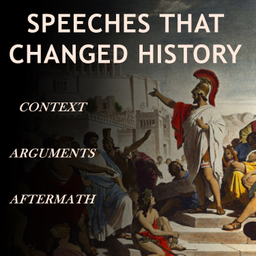
The purpose of this channel is to reanimate historic speeches by reading and performing them aloud, giving a voice once again to the words that changed our world.
To truly appreciate these speeches, we must understand the world they were spoken in. That is why we dive deep into the high stakes and complex backgrounds of each moment, ensuring that when the speech begins, you aren’t just listening to a text, you are experiencing it as if you were there.
Together, we investigate the history behind them, the arguments within them, and the consequences that followed.
For contact and feedback: speechesthatchangedhistory@gmail.com (mailto:speechesthatchangedhistory@gmail.com)
With the Speeches of the Peloponnesian War Series over, I give a short update on what to expect moving forward. While the next series is being researched and produced, I will keep posting on the new channel on youtube: Rhetorica Historia. Thank you for listening.
11 Aug 2026
15. The End of the Sicilian Expedition and Nicias
In the harbour at Syracuse, Nicias tries to save an army that is already lost.
It is 413 BC. The Sicilian Expedition, once the proudest undertaking of the Athenian empire, lies in ruins before the walls of Syracuse. The fleet is trapped. The men are starving, diseased, surrounded. And it falls to Nicias, a general who never wanted this war, to find the words that might carry his soldiers out alive.
He fails. But the speech survives preserved by Thucydides (Book 7) as one of the most harrowing moments in the History of the Peloponnesian War — and in it we hear something rarer than triumph: a man asking doomed men to hope anyway, because the alternative is to stop being men at all.
This episode traces Nicias' final address on the shore at Syracuse, the retreat and slaughter that followed, and why historians still mark this catastrophe as the moment Athens' golden age began its irreversible decline.
Part of the series on the Peloponnesian War and the speeches that shaped it
Sources: Thucydides, History of the Peloponnesian War, Book 7 (Crawley/Mynott translations); Kagan, The Peloponnesian War; Hornblower's commentary.
4 Aug 2026
14. The Harbor That Became a Cage - Nicias at Syracuse
In 413 BC, the greatest navy Greece had ever built found itself trapped in a harbor in Sicily the exit sealed by a wall of enemy ships, the camp starving, the sea that built Athens' empire turned into a cage. This episode traces how the Sicilian Expedition collapsed step by step Alcibiades' defection, the Spartan officer who flipped a losing siege, a lunar eclipse that cost Athens its one chance to escape and arrives at the speech a reluctant, dying general gave to send forty thousand men into the fight that would end Athens' golden age. Nicias' address before the last sea-battle (Thucydides 7.61–64) is one of the most studied passages in the History: a moment when both the man and his city run out of anything to count on but hope.
28 Jul 2026
13. Alcibiades' Speech in Sparta - The Art of Betrayal
Exiled, condemned, and hunted by his own city, Alcibiades did the unthinkable: he walked into the assembly of Sparta, Athens' deadliest enemy, and told them exactly how to win the war. It should have been the plea of a desperate fugitive. Instead, it became one of the most chillingly brilliant speeches in ancient history.
In this episode, we take that speech apart piece by piece. How did a man with no army, no city, and every reason to be distrusted talk the most powerful military state in Greece into doing precisely what he wanted? We follow his moves in real time, how he disarmed a hostile room, turned himself from defendant into authority, frightened Sparta with a vision of total conquest, and handed them the two blows that would break Athens: a commander for Syracuse, and the fortress at Decelea. And then, the most audacious stroke of all, how he redefined betrayal itself as the truest form of patriotism.
Featuring the speech in full (Thucydides, Book 6), with analysis on the rhetoric of treason and the question that still unsettles us: when your country wrongs you, what do you owe it? Part of our series on the fall of Athens and the speeches that changed
21 Jul 2026
12. Nicias Against Sicily - How to Lose a Debate You're Right About
In 415 BC, Athens was about to make the most dangerous decision in its history and one man stood up to stop it. Nicias was everything Alcibiades was not: cautious, honest, deeply experienced, and genuinely good. He could see the catastrophe coming more clearly than anyone in the assembly. And he had one last idea for how to prevent it.
This is the story of his famous speech against the Sicilian Expedition, and the stunning, unintended consequence it produced. We put you in the room for the moment it all turned, then break down one of history's great rhetorical ironies: how a man who was right about everything still lost and what his failure teaches us about persuasion, fear, and reading a crowd. Featuring the speech in full (Thucydides, Book 6), with analysis drawing on Donald Kagan.
Why is being right so often not enough?
Music by Kevin McLoed, songs include: "Trio for Violin and Viola" and "Devastation and Revenge"
All Licensed under Creative Commons: By Attribution 4.0 License.
14 Jul 2026
11. The Athenian Gamble - Alcibiades and the Road to Sicily
In 415 BC, Athens debated the most ambitious gamble in its history: a vast expedition to conquer Sicily. Standing against it was caution itself. Standing for it was the most dazzling, dangerous man of his generation Alcibiades. Aristocrat, celebrity, spendthrift, and political genius, he had inherited every advantage Athens could offer, and a hunger for glory that no fortune could satisfy.
This is the story of the speech he gave to win the city over one of the most seductive arguments ever made in a democratic assembly. We set Alcibiades against his rival Nicias, walk through the real reasons behind the expedition, and break down exactly how his rhetoric worked: how he turned his own extravagance into a credential, redefined caution as cowardice, and made a reckless adventure sound like Athenian tradition itself. Featuring the speech in full (Thucydides, Book 6), with analysis drawing on Donald Kagan, W. R. Connor, and Jacqueline de Romilly.
Why was this speech so hard to argue against and what does it teach us about how great powers talk themselves into disaster?
Music by Kevin McLoed, songs include: "Trio for Violin and Viola" and "Devastation and Revenge"
All Licensed under Creative Commons: By Attribution 4.0 License.
7 Jul 2026
10. "The Strong Do What They Can..." - The End of Athenian Virtue? (The Melian Dialogue)
"The strong do what they can and the weak suffer what they must."
416 BC. Athens sends envoys to the neutral island of Melos with an ultimatum: surrender or die. What follows is one of history's most chilling debates, a brutally honest argument about power, justice, and survival, stripped of every illusion.
In this episode we walk through the road to Melos, perform the full dialogue, and unpack the massacre that followed, the moment Athenian virtue gave way to naked force, and a grim warning of the disaster waiting in Sicily.
Part of our ongoing Peloponnesian War series on the moral unraveling of Athens. New episodes regularly, follow so you don't miss what comes next.
Music by Kevin McLoed, songs include: "Trio for Violin and Viola", "Oppressive Gloom" and "Cryptic Sorrow"
All Licensed under Creative Commons: By Attribution 4.0 License.
30 Jun 2026
9. Calculated Mercy - Diodotus Against Cleon (The Mytilenean Debate)
In 427 BC, Athens voted to massacre the entire population of Mytilene, and then voted again. This is the story of that second vote, and what is meant.
The Mytilenean Debate is one of the most important political exchanges in ancient history. Thucydides records it in full in Book 3 of his History of the Peloponnesian War: a confrontation between Cleon, the most powerful demagogue in Athens, and Diodotus, an unknown figure who appears once, delivers one of the most sophisticated arguments in ancient Greek political thought, and then disappears from the historical record entirely.
Diodotus didn't argue that killing thousands of innocent people was wrong. He argued it was bad strategy. Facing an assembly still hot with rage, post-plague, post-Pericles, and deep into the first years of the Peloponnesian War, he knew that mercy couldn't survive the room, so he dressed it up as imperial self-interest.
This episode unpacks what Diodotus actually argued, what he was really doing beneath the surface, and what the debate reveals about the moral transformation of Athenian democracy under the pressure of war, empire, and the politics of fear.
23 Jun 2026
8. Cleon and the Vote for Massacre - What Came After Pericles? (The Mytilenean Debate)
Pericles is dead and after him a more sinister politician fills the vacuum.
428 BC. Three years of plague. Three years of Spartan soldiers burning the countryside. Then news arrived: Mytilene, Athens' trusted ally, has betrayed them.
Athens moved quickly and managed to force the city to surrender. What would they do with the prisoners? The assembly voted for massacre. Every man on the island executed. Every woman and child enslaved. A ship was dispatched the same day with the order.
Then Athens slept. And in the morning, changed its mind.
A second assembly was called. Cleon the loudest and most feared voice in Athens, rose to defend the original verdict. Before a single opponent could speak, he told the assembly exactly what kind of person would dare to disagree. It was a trap laid in plain sight.
16 Jun 2026
7. Pericles' Last Speech - The End of an Era (How the Plague of Athens Changed Everything)
The plague had come.
Athens was already crowded beyond anything it had been built to sustain thousands of refugees from the Attic countryside packed behind the walls. Into that compression came a pestilence unlike anything in living memory.
And alongside the dying bodies, something else began to break down, namely the social fabric itself.
Estimates suggest as many as a hundred thousand people died. Possibly a quarter of the entire population of Attica.
The city that had trusted Pericles and had abandoned farms, endured the burning of the countryside, and believed his promise that patience would prevail. They now turned on him. And all the grief and fury of Athens landed on the man who had led them here.
So Pericles called an assembly. For the last time.
In this episode we hear his final speech, a remarkable and unsettling piece of oratory that does not offer comfort but instead closes off every alternative to continuing the war. We analyse what Pericles is really doing beneath the surface, examine his extraordinary admission that the Athenian empire was, by his own description, a tyranny, and ask what it means that the man who gave the Funeral Oration gave this speech one year later.
And we ask what Athens would become without him.
9 Jun 2026
6. Pericles' Funeral Oration - Performed in Full (Modern Translation)
Episode 6 in the Speeches of the Peloponnesian War series.
The Funeral Oration of Pericles with modern translation (Book 2, Chapters 35-46).
Athens. Winter, 431 BC. The first year of the Peloponnesian War is over.
The bones of the dead have been carried through the city. The coffins have been lowered. And Pericles steps forward to speak.
If you want the full historical context and rhetorical analysis, that is in episode 5.
Sources:
Thucydides. (1874). History of the Peloponnesian War (R. Crawley, Trans.). Longmans, Green and Co. (Original work written ca. 431–404 BC)
Music:
"Heavy Heart" Kevin MacLeod (incompetech.com (http://incompetech.com)) Licensed under Creative Commons: By Attribution 4.0 License
"Strings Impromptu Number 1" Kevin MacLeod (incompetech.com (http://incompetech.com)) Licensed under Creative Commons: By Attribution 4.0 License
"Lost Time" Kevin MacLeod (incompetech.com (http://incompetech.com)) Licensed under Creative Commons: By Attribution 4.0 License
"Final Count" Kevin MacLeod (incompetech.com (http://incompetech.com)) Licensed under Creative Commons: By Attribution 4.0 License
"Trio for Violin and Viola" Kevin MacLeod (incompetech.com (http://incompetech.com)) Licensed under Creative Commons: By Attribution 4.0 License
9 Jun 2026
5. Pericles' Funeral Oration - Did He Describe Athens or Invent It?
Episode 5 in the Speeches of the Peloponnesian War series.
The war had begun. Sparta had burned the Attic countryside. Thousands of Athenians had abandoned their farms and crowded inside the city walls at Pericles' instruction. The anger toward him was real, raw, and barely contained.
That winter, Athens buried its dead. And by tradition, a man chosen by the city stepped forward to speak over the open graves.
Athens chose Pericles.
What followed was not a conventional eulogy. It was one of the most extraordinary pieces of political oratory ever delivered, and 2,500 years later, it still is.
Pericles did not dwell on grief. He did not catalogue victories. Instead he described Athens — not as a set of laws or institutions, but as a philosophy made into a state. A democracy where merit, not birth, determined a man's standing. Where private life was genuinely private and public life was genuinely open. A city, he said, that was a school to all of Greece.
In this episode we hear the full funeral oration, analyse the extraordinary craft behind it, and ask the question that scholars have been arguing about ever since — was Pericles describing Athens, or constructing it?
Sources:
Kagan, D. (2003). The Peloponnesian War. Viking Penguin.
Thucydides. (1874). History of the Peloponnesian War (R. Crawley, Trans.). Longmans, Green and Co. (Original work written ca. 431–404 BC)
Music:
"Heavy Heart" Kevin MacLeod (incompetech.com (http://incompetech.com)) Licensed under Creative Commons: By Attribution 4.0 License
"Strings Impromptu Number 1" Kevin MacLeod (incompetech.com (http://incompetech.com)) Licensed under Creative Commons: By Attribution 4.0 License
"Lost Time" Kevin MacLeod (incompetech.com (http://incompetech.com)) Licensed under Creative Commons: By Attribution 4.0 License
"Final Count" Kevin MacLeod (incompetech.com (http://incompetech.com)) Licensed under Creative Commons: By Attribution 4.0 License
"Trio for Violin and Viola" Kevin MacLeod (incompetech.com (http://incompetech.com)) Licensed under Creative Commons: By Attribution 4.0 License
2 Jun 2026
4. No Concessions - Did Pericles Make the Right Call?
Episode 4 in the Speeches of the Peloponnesian War series.
Sparta had sent three messengers to Athens. Each carried demands. Each was sent home with a refusal.
The first invoked an ancient religious curse, a veiled attempt to expel Pericles himself from Athens through sacred procedure rather than military force. Athens saw through it immediately.
The second carried a list of concrete grievances — lift the Megarian Decree, abandon the siege of Potidaea, respect the autonomy of Aegina. Even within Athens, some argued these were reasonable demands. But Pericles reframed the question entirely: It was about who governed Athens. Was it Athens or Sparta?
The third messenger carried no list at all. Just one sentence. Leave the Greeks free. It was not an offer. It was a position that had hardened past the point of negotiation.
Athens called an assembly. Many speakers rose. Then Pericles spoke.
His answer was no. On every count, no. Not because the specific demands were worth a war, but because yielding to any of them would tell every ally in the Delian League that Athenian resolve had a pressure point — and once that was known, the empire would begin to quietly dissolve.
He then outlined a strategy that must have been genuinely hard for many Athenians to accept. No great battles. No decisive engagements. Just endurance and the quiet hope that Athens could outlast Sparta's will to fight.
Was he right? And could Athens hold together long enough to find out?
26 May 2026
3. Corinth's Ultimatum - The Speech That Cornered Sparta
Episode 3 in the Speeches of the Peloponnesian War series.
Corinth had lost Epidamnus. Failed at Sybota. Watched its volunteers trapped inside the walls of Potidaea while Sparta did nothing. Its patience was gone.
So Corinth called a meeting. And the invitation went wide — any city with a grievance against Athens was welcome. They came from across the Greek world, one by one, each with their own account of Athenian pressure applied quietly, carefully, never quite crossing a line that could be called a line.
Then Corinth rose to speak.
What followed was one of the most devastating pieces of political rhetoric to survive from the ancient world.
Then they turned on Sparta directly. Your caution, they said, has become a strategic liability. Your inaction is the problem. And if you will not lead, we will find allies who will.
It was a speech designed to leave Sparta no exit. And it worked.
In this episode we hear the Corinthian ultimatum, analyse what made it so rhetorically devastating, and ask the question that Thucydides himself never quite answers — by the time Corinth sat down, was there anyone left in that room who genuinely wanted peace.
19 May 2026
2. The Warning - Did Athens Make the Right Choice?
Episode 2 in the Speeches of the Peloponnesian War series.
Athens had heard Corcyra's case. A powerful fleet. A strategic alliance. A warning that war with Sparta was coming regardless. It was a compelling argument but Corinth had been sitting there listening to every word, and now it was their turn to speak.
In this episode we hear the Corinthian reply: A careful, methodical dismantling of everything Corcyra had just argued. A case built on law, on history, and on a debt of gratitude Athens owed but had not yet repaid.
Both sides had made serious arguments. Both were legally defensible. And when the first day of debate ended,
On the second day, Athens voted, but for a compromise. Not a full alliance, that would be too provocative. Instead a defensive pact. Ten ships.
It was a careful decision. A cautious one. And according to Thucydides, it changed nothing — because the real cause of what was coming was never legal or diplomatic. It was fear. The fear that a rising power inevitably inspires in those who watch it grow.
Music by Kevin McLoed, songs include: "Trio for Violin and Viola", "Teller of Tales", and "Devastation and Revenge".
All Licensed under Creative Commons: By Attribution 4.0 License.
12 May 2026
1. The Spark - The Epidamnian Affair and the Double Embassy
Episode 1 in the Speeches of the Peloponnesian War series.
In the autumn of 433 BC, two delegations arrived in Athens uninvited, unexpected, and desperate. One came to ask for an alliance. The other came to prevent it.
What the Athenian assembly decided that day would set in motion a war that killed hundreds of thousands, erased cities from the map, and ended the Greek golden age.
But to understand that decision, we first need to understand the world it shattered. A world of proud, independent city-states. A world that had once stood united against the Persian Empire and then turned on itself. A world held together by a fragile treaty, a drawn line across the Greek world.
This is where the Peloponnesian War begins. Not in Athens or Sparta, but in a small, obscure city on the edge of the Ionian Sea that most Greeks couldn't place on a map. A city called Epidamnus.
In this first episode we follow the chain of events, a civil war, an oracle's instruction, a naval battle, and a desperate embassy to Athens. that forced the most powerful city in Greece to make a choice it could not take back.
The series on the speeches of the Peloponnesian War begins here.
Music by Kevin McLoed, songs include: "Trio for Violin and Viola", "Desert City", "Tabuk", Hero Down" and "Devastation and Revenge"
All Licensed under Creative Commons: By Attribution 4.0 License.
12 May 2026
0. The Speeches of the Peloponnesian War Series: Sources & Translations
As a short note before we enter the narrative of the series, we address our sources and translations of the sources.
8 May 2026
Purpose: The Reanimation of Greatness
Introduction to the project. I intend to reanimate the greatest speeches of history. Welcome
Reach and audience
Public platform figures. Ratings count people who left a rating, not total listeners.
Spotify
5.0 / 5
11 ratings
Contact Speeches That Changed History
Guest appearances
Does not typically book guests
Based on episode analysis; this does not confirm that the show is currently accepting guests.
Host of Speeches That Changed History?
Claim your podcast to manage its listing and keep your show details accurate.
Pod Engine is an independent podcast discovery and analytics service and is not affiliated with or endorsed by this podcast. Artwork and show content belong to their owners. Full legal notice.
Explore this show Podcast research with Pod Engine