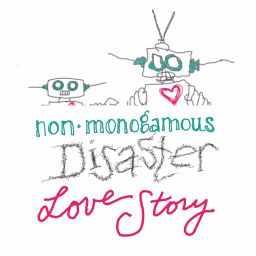
Steve and Whyla's Non-monogamous Disaster Love Story
Steve and Whyla
5.0from 1 ratings
- 19
- Episodes
- 1
- Ratings
- Monthly
- Cadence
- 2022
- First episode
About Steve and Whyla's Non-monogamous Disaster Love Story
A married woman and her dodo bird boyfriend making their way in the world. stevexwhyla.substack.com (https://stevexwhyla.substack.com?utm_medium=podcast)
- Publisher
- Steve and Whyla
- Category
- health & fitness · society & culture
- Language
- en
- Explicit
- Yes
- First episode
- 27 Apr 2022
- Latest episode
- 28 Jul 2026
Latest episodes
19 episodes in the feed.
28 Jul 2026
Fantasy, Part Deux
A continuation of our exploration of fantasy and reality. New to the mix: imagination. Sources mentioned in the episode: The Fantastic Imagination (https://apilgriminnarnia.com/2017/08/30/the-fantastic-imagination/) by Brenton Dickieson Overview of Russell Webster’s work (https://www.k-state.edu/today/announcement/?id=1017) on fantasy and absorption As mentioned in the episode, watch this space, or one immediately adjacent, for audio smut, should that be something you’re potentially into. This is a public episode. If you would like to discuss this with other subscribers or get access to bonus episodes, visit stevexwhyla.substack.com (https://stevexwhyla.substack.com?utm_medium=podcast&utm_campaign=CTA_1)
17 Mar 2026
Fantasy Pushing (in the Bushing)
The episode also cites (pushes?) "Luke's Fantasy", from The Erotic Mind by Jack Morin, Ph.D., as first discussed in Episode 10. It is reproduced with permission here: I’m at home in my apartment watching TV in my gym shorts when the doorbell rings. I can’t believe my eyes when a gorgeous fox is standing there. She’s my new neighbor and just stopped by to say hello. I eagerly invite her in. She’s drop-dead gorgeous in a silky nightgown that reveals every curve. Her waist is narrow, her hips wide and shapely. I watch her ass sway as she walks to my sofa. Long, auburn hair swoops down, partially covering the milky skin of her cleavage. I can’t help staring at nipples which show clearly through her gown. I’m fumbling for words when she slides closer to me and plays with my chest and stomach with her long fingernails. I pull her closer still as she grabs my dick. I feel a shiver go through her body. I invite her to the bedroom and lift the gown over her head, revealing an even more incredible body than I expected. She rips off my shorts and we fall into bed, fucking with uncontrollable abandon. She loves it when I plunge into her juicy pussy. Before I know it she’s coming wildly, screaming. Her reaction turns me on so much that I thrust faster and faster, coming, coming until I collapse on top of her, spent. After I calm down, I watch her slip into her gown, shake out her hair, and walk toward the door. “See ya later, neighbor, I AM OFF TO HAVE MORE SEX WITH ANY OTHER MAN WHO IS HOME,” she whispers as the door closes behind her. [all caps text, and emphasis, Steve's] This is a public episode. If you would like to discuss this with other subscribers or get access to bonus episodes, visit stevexwhyla.substack.com (https://stevexwhyla.substack.com?utm_medium=podcast&utm_campaign=CTA_1)
10 Nov 2025
Go See Alice
Here are the articles we reference in this episode: In An Oversexed Age, More Guys Take a Pill By Warren St. John The New York Times December 14, 2003 https://www.nytimes.com/2003/12/14/style/in-an-oversexed-age-more-guys-take-a-pill.html (https://www.nytimes.com/2003/12/14/style/in-an-oversexed-age-more-guys-take-a-pill.html) ‘I was really struggling to get it up’: Why younger men are turning to Viagra By Ben Bryant The Independent August 4, 2022 https://www.the-independent.com/life-style/health-and-families/viagra-sildenafil-erectile-dysfunction-young-men-b2137943.html (https://www.the-independent.com/life-style/health-and-families/viagra-sildenafil-erectile-dysfunction-young-men-b2137943.html) 'They Take It Before Going To A Club': Why Viagra Is Being Used By A New Generation No longer just a drug for older men, Viagra is being used recreationally by boys in their prime. By Sophie Gallagher (https://www.huffingtonpost.in/author/sophie-gallagher) Huffington Post (UK) Apr 3, 2019 https://www.huffpost.com/archive/in/entry/they-take-it-before-going-to-a-club-why-viagra-is-being-used-by-a-new-generation_in_5ca4aae7e4b0ed0d780f3c83 (https://www.huffpost.com/archive/in/entry/they-take-it-before-going-to-a-club-why-viagra-is-being-used-by-a-new-generation_in_5ca4aae7e4b0ed0d780f3c83) How Erectile Dysfunction Pills Hooked Younger Guys The little blue pill isn’t a silver bullet for what ails young people’s sex live By Hayley MacMillen Elemental/Medium.com (http://Medium.com) Sept. 26, 2018 https://elemental.medium.com/how-erectile-dysfunction-pills-hooked-younger-guys-e8875a1c6067 (https://elemental.medium.com/how-erectile-dysfunction-pills-hooked-younger-guys-e8875a1c6067) Can ED Drugs Really Help Your Sex Life? Harvard Medical School January 9, 2025 https://www.health.harvard.edu/mens-health/can-ed-drugs-really-help-your-sex-life (https://www.health.harvard.edu/mens-health/can-ed-drugs-really-help-your-sex-life) The Little-Blue-Pill Problem By Hannah Pittard The Cut/New York Magazine June 27, 2025 https://www.thecut.com/article/how-viagra-changed-sex-for-older-women.html (https://www.thecut.com/article/how-viagra-changed-sex-for-older-women.html) This is a public episode. If you would like to discuss this with other subscribers or get access to bonus episodes, visit stevexwhyla.substack.com (https://stevexwhyla.substack.com?utm_medium=podcast&utm_campaign=CTA_1)
19 Jun 2025
A visit to the internet sex store
Steve and Whyla explore an internet sex store, seeking arousal and stimulation, but ultimately find the experience rather limited.
29 Mar 2025
Give her the D (chord)
On the purported kinship between gay men, and straight women—the supposedly unifying experience of clucking and head-shaking at the antics of our men. Can’t live with ‘em, can’t live without ‘em, amirite? But what if there is no genuine solidarity there, because the pertinent fact is not whether you get with men, but whether you get to be a man? Whether, in fact, when you fall under the male gaze, he deems you fully human, or… not. Things referenced in the episode: Our continued parasocial relationship with Dan Savage (https://savage.love/), who makes a lot of claims that women act as they do around men because “They fear male violence” and why this misses this mark, and why it’s actually worse than that, and why even a gay man can’t understand that, because the gay bit is always subordinate to the man bit. Kaitlin Prest’s brutal and excellent podcast series “No (https://www.theheartradio.org/no-episodes),” from 2017. Christoph Hein’s 1982 novel The Distant Lover (https://www.goodreads.com/book/show/2624735). Marie Howe’s poem “Sixth Grade (https://anotherhand.livejournal.com/56734.html)” from her book What the Living Do. Jacqueline Novak’s comedy special Get On Your Knees (https://www.netflix.com/title/81240800) This is a public episode. If you would like to discuss this with other subscribers or get access to bonus episodes, visit stevexwhyla.substack.com (https://stevexwhyla.substack.com?utm_medium=podcast&utm_campaign=CTA_1)
6 Jan 2025
Book Club: More is Less
It’s been a rough year, and Steve noted that we managed to put out only one episode in all of 2024 (though I, peronally, put out substantially more often than that, as Steve will tell you). We are striving to make episodes more regularly in 2025, but for now, please enjoy our book club mashup of Erica Jong’s Fear of Flying, and Molly Roden Winter’s More: A Memoir of Open Marriage. Thanks for reading Steve and Whyla's Non-monogamous Disaster Love Story! Subscribe for free to receive new posts and support our work. This is a public episode. If you would like to discuss this with other subscribers or get access to bonus episodes, visit stevexwhyla.substack.com (https://stevexwhyla.substack.com?utm_medium=podcast&utm_campaign=CTA_1)
17 Mar 2024
Book Club: Wifey
I don't know what we expected, but it wasn't this. I suppose we ought to have anticipated the limited imagination of 1970s suburban New Jersey, but we simply could not. This is a public episode. If you would like to discuss this with other subscribers or get access to bonus episodes, visit stevexwhyla.substack.com (https://stevexwhyla.substack.com?utm_medium=podcast&utm_campaign=CTA_1)
21 Nov 2023
Reading the (im)personal ads
Really only one reference on this one, but it’s a ponderous tome: Leonard Cohen’s book of poems, “Book of Longing (https://www.leonardcohen.com/book/book-longing).” This is a public episode. If you would like to discuss this with other subscribers or get access to bonus episodes, visit stevexwhyla.substack.com (https://stevexwhyla.substack.com?utm_medium=podcast&utm_campaign=CTA_1)
16 Oct 2023
Hetero Stranger Danger
Show Notes, in order of appearance in the episode: Betty Martin’s book The Art of Receiving and Giving (https://wheelofconsentbook.com/) and some other ways (https://bettymartin.org/videos/) to encounter her work. Christine Emba’s book Rethinking Sex: a Provocation (https://www.penguinrandomhouse.com/books/622579/rethinking-sex-by-christine-emba/) Thomas Moore’s book Meditations: On the Monk Who Dwells in Daily Life (https://www.harpercollins.com/products/meditations-thomas-moore?variant=32208286056482) Maia Kobabe’s book Gender Queer (https://www.simonandschuster.com/books/Gender-Queer-A-Memoir/Maia-Kobabe/9781549304002) Chapter 3 (https://blackandeducation.org/stories/2019/10/21/chapter-3-narrative-of-the-life-of-frederick-douglass) of Narrative of the Life of Frederick Douglass, an American Slave (https://en.wikipedia.org/wiki/Narrative_of_the_Life_of_Frederick_Douglass,_an_American_Slave) Kaitlin Prest’s The Heart podcast — “No” series (https://www.theheartradio.org/no-episodes) Lux Alptraum’s book Faking It (https://bust.com/lux-alptraum-faking-it/) Peggy Orenstein’s book Girls and Sex (https://www.peggyorenstein.com/main-st) An example of a woman (Ashley Cobb) who loved her ho phase and recommends it appears on Shan Boodram’s Lovers and Friends in an episode (https://www.iheart.com/podcast/1304-lovers-and-friends-with-s-87117442/episode/84-the-truth-about-freaky-women-121152170/) about freaky women, and Madonna/whore complexes. Always plenty of references to Whyla’s love/hate relationship with Dan Savage’s Savage Lovecast (https://savage.love/) This is a public episode. If you would like to discuss this with other subscribers or get access to bonus episodes, visit stevexwhyla.substack.com (https://stevexwhyla.substack.com?utm_medium=podcast&utm_campaign=CTA_1)
25 Aug 2023
Book Club: The Erotic Mind
We’ve got some sources on this one. The book under consideration is The Erotic Mind (https://www.harpercollins.com/products/the-erotic-mind-jack-morin?variant=32128771457058) by Jack Morin. Stealing the show from Jack is Audre Lorde, with her Uses of the Erotic (https://uk.sagepub.com/sites/default/files/upm-binaries/11881_Chapter_5.pdf). As usual, we also were thinking about Dan Savage (https://savage.love/)’s media empire, and about the focus-on-the-female sexology of Emily Nagoski (https://www.pushkin.fm/podcasts/come-as-you-are). Thanks also to the dirty mags Steve and Whyla encountered as adolescents—in the woods, under beds, in bathroom cabinets. Steve’s formative publication tended to be Penthouse, whilst Whyla encountered the more niche and lesser known Gent and Juggs. We also mention Morin’s appearance in the DVD The Better Sex Guide to Anal Pleasure (https://www.adultdvdmarketplace.com/dvd_view_63239.html), which is very worth watching. This is a public episode. If you would like to discuss this with other subscribers or get access to bonus episodes, visit stevexwhyla.substack.com (https://stevexwhyla.substack.com?utm_medium=podcast&utm_campaign=CTA_1)
11 Feb 2023
Envisioning the ritual threeway
This is a public episode. If you would like to discuss this with other subscribers or get access to bonus episodes, visit stevexwhyla.substack.com (https://stevexwhyla.substack.com?utm_medium=podcast&utm_campaign=CTA_1)
17 Jan 2023
The joys of informal bigamy
This is a public episode. If you would like to discuss this with other subscribers or get access to bonus episodes, visit stevexwhyla.substack.com (https://stevexwhyla.substack.com?utm_medium=podcast&utm_campaign=CTA_1)
11 Aug 2022
New rules: no rules
Whyla and I live in Antarctica. You may be asking, Steve, whatever do you mean? Are you saying that you two are in a cold, ice-covered desert, bereft of sunlight for months, dominated by fierce, hostile winds, a fragile ecosystem inhospitable to most life, frustrating human habitation of any duration, though with capable wifi and networking to support regular podcasts? No, no. I mean it as a figure of speech. Oh, you may ask on reconsideration, Steve, you didn’t mean it literally? Correct. How could I mean that literally? Really! So, Steve, you might then query, You’re saying that your relationship is like living in a cold, ice-covered desert, bereft of sunlight for months, dominated by fierce, hostile winds, a fragile ecosystem inhospitable to most life, treacherous tundra frustrating human habitation of any duration, though with capable wifi and networking to support regular podcasts? Yes! Wait. Your badgering questions make me see that this metaphor is already proving quite unsuitable, not unlike Antarctica itself. Whyla and I have a great time with each other. Life with Whyla is a bright and sunny and fun and funny, and whimsical, with jokes ambling about like a penguin parade. It’s an adventure into unknown, untrammeled territory, but exciting, and full of fresh air. Though it was hard to reach, we have come to be in a rare, special place, personally experienced by very, very few. Imagine a unique place on Earth, like, um…uhm… Hmm. Antarctica is an image of anarchy, of the absence of government as we know it. No laws, no law enforcement. No external power to set rules and mete out sanctions when someone doesn’t comply. No courts and sentences and prisons. No boundaries strictly enforced. Rules simply do not rule. But its anarchy is not simply chaos, collision, suffering, madness — Human sacrifice! Dogs and cats living together! Mass hysteria! There is still geology and wildlife to be respected by the governments and humans that agree to tread there, and the need for cooperation and harmony, for negotiation and consensus, for ongoing monitoring and taking care — to deter conflict, to prevent loss, to repair damage when it’s done. I’m in Antarctica with Whyla. Neither of us legislates about how the other is to act, or what form the relationship is to have. This was true from the beginning, in our checkered past and up through the present. We have been figuring out what we are to each other, how best to be with each other, personally, and without rules. Certainly without rules, restrictions, regulations, commandments, conventions from society. After a long period in which Whyla and Witt discussed, meditated, deliberated on the possibility of fidelity without exclusivity in their marriage, Whyla and I connected, and I became an other not forsaken. And from the start, neither of us expected monogamy in our relationship. Monogamy is, by conventional measure, the rule and boundary for romantic, partnered relationships. It seems to carry so much weight, in its presumed dignity and the merit it conveys; monogamy is simply good for people, and good people are monogamous. And in the weight of the hammer that will come down on those who deviate from it (in the so-so-many ways to stray) — grave peril to one’s moral worth and reputation, and mortal danger to the relationship, says society. And monogamy as a rule carries so much weight in the sense of doing so much of the heavy lifting of relating, in the relationship. From some angles, it even appears so fundamental and necessary as to be the relationship — certainly if, by conventional measure, the relationship dies without it. Exclusivity stands for dignity, for respect, for trust, for care, for the union between two persons; it’s worth pondering how — and how well — it stands in for those things. Is monogamy the same as, or inseparable from, recognition and care between partners? If not, we may be free of monogamy and the rules and boundaries that attend it (Go, polyamory! Just don’t use that word around Whyla.). But if we are not in the realm of rules, enforcement, fatal punishment for breaking them, where are we? What comes with this anarchic — this Antarctic — freedom? In other words, what’s the best use of it? As Whyla has said, the question of what non-monogamy practically means — whether and how I engage with another than her, or how she engages another than Witt and me — is not essentially different from any other aspect of the relationship. It would be, should be something that begins with individual reflection about wants and needs, as well as what is good for oneself, and it continues with reflection on what is good for the other partner, their needs and wants at that time. A weighty and worthy undertaking already, calling for mindfulness and responsibility. And trust and communication, in talking to and listening to each other about whether and how to proceed, and in continuing the discussion, the wellness checks, if and as the engagement with another would continue. This is what care would look like, its form, though not really a rule, as something external and automatic. Care is complex work, with emotional heavy lifting. It calls for flexibility and awareness of timing and of situations, and the ability and commitment to repair any damage one does. Such it is in sustaining and nourishing the relationship. In the unconventional form of our love, there are no simple social roles to fall back on, no regime of monogamy to do the labor, to define the roles and actions, to enforce them with penalties. There is only each other. Why does society have such a large PR campaign for monogamy but not one for providing care? Maybe “monogamy” is not simply flatfooted abstinence education, but instead social shorthand for devotion and attention and investment in each other. But if so, let’s write it out. Actually, Whyla and I recently did so. Our couples therapist gave us a communication exercise, the worksheet “Frustration Conversion to Need/Behavior Change Request.” After savoring the lyrical lilt of that title, we each began converting. Specifically, we wrote letters to each other identifying the other’s behavior that evokes frustration, fears, memories of earlier injuries and hurts, and then declaring one’s own needs, in the form of three changes in the other’s behavior. These requested changes had to be specific, as well as manageable, achievable, relevant, and time-related [and yearned-for, prompt, authentic, nurturing, tested, and simple. But as a mnemonic, SMARTYPANTS proved a little unwieldy, so we kept it to the first five.] Writing these love work orders to each other was itself work, in both introspection and trust and vulnerability, truly emotional heavy lifting. Whyla had to face her reluctance to appear needy or appeal for help, and I had to confront my mighty feelings of guilt and self-blame, my dread of punishment and expulsion, which her list of frustrations and fears echoed and amplified in my mind. With honesty and resolve, we presented our important asks to each other, behaviors to stay in touch, to reassure, to show appreciation and enjoyment, to try and to do, again and again. And we’ve begun the changes, the new modes, the forming habits. Are we legislating our relationship? Are the new behaviors the new “rules”? Among other limitations, laws and rules in relationships don’t reach in to animate someone, to provide energy and motive, for behaving better toward one’s partner. And legislating raises the risk of focusing one’s attention and energy on the rule itself, as if compliance is sufficient (just as punishment for non-compliance suggests that suffering and separateness are sufficient — believe me, I know this one). The good of the persons in the relationship, the quality of intimacy, the fun, the mutual support, the feeling that each is giving and receiving enough from the other — it’s love and commitment that really govern these, as a rule cannot. So Whyla and I don’t legislate. Are we reckless outlaws? Mail us your thoughts at: Penguin Post Office, General Delivery. ____ This is a public episode. If you would like to discuss this with other subscribers or get access to bonus episodes, visit stevexwhyla.substack.com (https://stevexwhyla.substack.com?utm_medium=podcast&utm_campaign=CTA_1)
24 Jul 2022
A steadfast and sure horniness
Witt and I went away for a weekend, and in a little hippie food co-op, I picked up one of those free alternative newspapers. It had a “missed connections” type section, and I read over the messages, and all the hopelessness of strangers seeking to reach other strangers they’d briefly encountered in the world. I started to feel unnerved as I read, and scanned for why. Most of the messages were from men to women, and as I re-read them, I saw how many hewed to the same basic script: “[I saw you/you looked at me/you smiled] when we were both at the [gas station/laundromat/dump] and had I not been so [caught off guard/tongue-tied/dazzled] I would have hit on you. Please write to me so I can hit on you now.” In almost no cases had these people exchanged even a syllable. These men were taking standard female socialization (make eye contact, smile, don’t be a bitch when you pass by men) for an invitation, for a come on. These women were just trying to get a coffee or cat food or pick up a prescription and here are men, concocting fantasy encounters about them entirely off their physical attributes. I am an enthusiastic student of men. In many ways, they are my favorite kind of people. I am exclusively sexually attracted to men, and so my erotic energies hum around them, when they hum. As I understand it, from my studies of men, male sexuality often means a constant thrum of energy. If not all-the-time horniness, there’s at least a baseline arousability that never really goes away. They are attuned to visual stimuli, and need not much more than the sight of a body that attracts them to launch their sexual imaginations. I remember constant horniness from my youth, but it feels distant from me now. And never did my imagination fire solely off the sight of an attractive man. It always needed more story, some context. My sense of this general difference between the sexes feels supported by reports from trans men who have medically transitioned. These men have traveled in more than one hormonal country, and when they start their testosterone regimens, frequently report spikes in how often they think about sex, and the urgency and persistence of their sex drive. Our society has a tendency to derogate male desire. I understand why, since men commit so much sexual violence, and we then make the leap to thinking their sex drive itself is violent. But taking the parts apart, there is no reason to think this is so. Our society cultivates violence in men. Sexual, non-sexual, any old kind. This is terrible, but also shows how the violence is neither limited nor intrinsic to their libidos. I love male sex drive. I am female sexed, with a female hormonal makeup, female cyclicity. There’s a roundedness to my libido, a waxing and waning, but even at its perigee, when I swing closest to their way of being, it never has the same insistence as those of the two men I keep about. Theirs is a sex drive, urge, spontaneously arising. It’s a kind of craving, and though it can’t be reduced to only the urge to penetrate, there is, I understand, a clear directionality, erectionality, an insertional wish. They have a clearly vectored desire. I am deeply grateful for this. My desire works so differently. Outside of adolescence, and the very early days of a new relationship, I no longer feel that kind of drive. Sometimes, I feel myself withdrawn from my skin surface and into my mind, like a monk in retreat. At those times, my mind is cleared for other things, and when my men come rapping at the monastery door with their urges for me, I find myself pacific, willing to aid them, but aloof, wrapped in gray linen robes, my head shaved. Other times, I feel my erotic spirit move back out into my limbs, my skin. I feel myself in contact with the world again and I want to rub up against it. Still, it’s rare that I feel a full-on, hard-on wish to fuck. I can, at these times, step into the current of male desire and let it carry me along. It’s a power source I can hook into, a deep aquifer I can drop into when the ground is parched and surface water scarce. When I can let go of ideas that my cyclic, subtle, sometimes cryptic sexuality is somehow inferior to men’s, I can trust the interplay between the two and be borne along until I, too, am fully immersed in it. What to make of my veneration of male sex drive, my sense of it as an awesome and holy force, and my unease and discomfort at the men writing into the missed connections feature with their longings and urges? When I think about how I wish straight men understood these desires in light of women’s experiences of the world, I would want to tell them this: “Your horniness is beautiful and powerful, but it is not necessarily dyadic, even if it seems like it is. When you see a woman, and you feel that surge inside you, and the film reel of all the things you’d like to do starts playing in your head, understand that you have this response so often and to so many people because it isn’t really about them, specifically. They may trigger it, visually, but what happens in you after that is coming from the inexhaustible spring of your beautiful sexual imagination. Understand this, and understand that this is common for men. Understand, thus, that women are constantly being looked at by men in this way, and men are then unfolding capacious fantasies all around them, everywhere. And then men are thinking these fantasies mean they should act, to hit on the woman that incited this feeling in them. And there are so. many. men.” As Steve said, he felt generic, being subject to all the male horniness he encountered on the hookup apps. And on the level I mean, about men’s general arousability, and their responsiveness to visual stimuli, the objects of that attention are generic. It’s like the advice not to go grocery shopping when you’re hungry. If you are ravenous, all sorts of things will incite your fantasies of eating. All manner of weird foods will suddenly captivate you. You will not possess any discernment, and will come home with a bizarre and overlarge collection of things that, once you have eaten, will strike you as very strange, and possibly regrettable. But the fact is, when you are ravenous, whatever you eat at that moment, be it a Twinkie, or some pimento olives wrapped in a Kraft single, or a delicately flaked baklava, will amaze and delight your senses. It will be the most delicious thing you ever ate. Not because of the particular merits of the food, but because of how deeply you wanted food. What a pleasure those appetites and desires are, the anticipation of fulfilling them, the fantasies you can concoct of what dish you will choose when you are able to sate yourself. I have been reading a book called “Meditations” by a one-time Catholic monk named Thomas Moore. Writing about having taken a vow of celibacy, and then of being released from it when he left the Servite order, he wrote, We can all take the vow of chastity in the midst of a vibrant sex life. The beauty of being with one person sexually is fed by saying no to others, by not giving too much attention to sexual longing, by sublimating in imagination without repression, by finding that the world itself is a sex partner. This week, feeling exhausted and in need of emotional rest, I went to the treehouse in the woods out back of our house. I had been sitting silently for an hour when I saw a red squirrel working his way through the trees toward me. I heard scrabbling on the tree trunk by my head, but didn’t think it could possibly be the squirrel approaching so close until I saw his head peer around the corner at me, about two feet away, at my eye level. Cocking his head back and forth, he examined me, and then, straddling a branch, jittered his furred ball sack along its surface, marking the territory before going along his way. A few minutes later, to my utter disbelief, a gray squirrel came up the same trunk and peered around it the same way. His head was blocky and his muzzle soot-gray colored, like he’d been fossicking in a dead fire. He too sized me up and then jumped to the high branch. I could see his scrotum swaying over my head. “Great,” I thought, “I’m subject to the male gaze even among the rodents.” Considering these strange encounters later, it made complete sense that both the squirrels were male, and it’s breeding season, and they are swelled and swirling with testosterone. It’s an outwardly directed hormone. It makes a mind seek out the world, whether to fuck, or fight, or find out. It’s a mind ready to engage. And while you may not be able to harness that energy, if you can at least learn to hold on to its mane, it can carry you to some astonishing places. This is a public episode. If you would like to discuss this with other subscribers or get access to bonus episodes, visit stevexwhyla.substack.com (https://stevexwhyla.substack.com?utm_medium=podcast&utm_campaign=CTA_1)
7 Jul 2022
You are not polyamorous and so are we
A few weeks ago, I was riding with Whyla as she drove with her teenage son (for convenience’s sake, I’ll refer to him as Ted Whylason). We were on the way to pick up a friend of his; she was driving them to the White Mountains, where the boys were to do an ambitious, all-day run. After the friend got settled, I introduced myself to him, as is only proper. For a nanosecond and with a neutrino of panic, I wondered, exactly how do I identify myself? Who was I? What was I doing there in the car? What is that beautiful house? Where does that highway go to? I supposed that some relational statement was in order. “I’m Ted Whylason’s mom’s boyfriend, in a polyamorous arrangement between Whyla and me, with the consent of Whyla’s husband, Witt. Ted [whom I’ll also refer to as Ted Wittson] knows about this and he’s ok with it, too. We’re riding in a car, not a nuclear missile.” I decided against this. It would have been a mouthful. Plus, speaking of relations, I was in the front seat and the friend was in the back, and my neck already hurt. So I instead I said, “I’m Steve.” I figured, my name is ID enough, at least, for an introduction to someone. I easily and simply attach myself to it, as a statement of self-standing independence, as we each do with our names, although they’re assigned to us by our parents, though at age five I insisted to my mother that I be known as Steve, which at the time she assented to with outward gravitas and inward bemusement, waiting me out until I reconciled myself to my birth name, which is not Steve, which for anonymity’s sake I now again choose as my name. #irony I didn’t identify myself to Ted W. Wittson’s friend by my relation to Whyla or to anything else. The friend would have to form an impression of me in some other way, in a context particular to him and how I related to him, which was mainly that I was polite, cooked food, and loaned him and Ted my Theragun, a sophisticated percussive massage device coveted by hard-charging athletes like those two. Identifying simply by one’s name seems both minimal and expansive. A name is a kind of place-holder for the person, for the individual, for the self. Thinking of oneself and presenting oneself by one’s name doesn’t cast oneself in a category or a type, or a function or relation. In itself, such an ID doesn’t reveal much, but it also doesn’t box one in. Perhaps it gets at the deep truth of being human more than…well, being a thing or being a way. Being seems to imply fixity, permanence, situation — especially a situation of being stuck in the amber of common nouns — and seems to obscure that each of us is an individual, and can act, change, choose. None of these things with perfect simplicity, of course — we are thrown into this life, set with wings and weights we didn’t make, and we exist among others, wanting to know and be known, to have security and rest, existentially, psychically. And justice is a natural concern. Defending oneself against the powerful; ameliorating large and pervasive wrongs in society — these require collective action, presenting a common cause, asserting oneself as part of a group. So the inclination to identify oneself with a category, a type, a greater something — not to present oneself simply as an individual — can’t be fully or fairly avoided. Still, it seems that keeping one’s ID restrained, and averting an over-nominalization of oneself (and life) — leaves room for more personal experiences and interpersonal exchanges, enabling them to have whatever form best fits them. To do and have more, to know oneself and get to know others better, identify less. Or go negative! Whyla considers herself non-monogamous (that is, as a description of the situation she has chosen). A stylish stylist, she regards the trendy term “polyamorous” with a mixture of scorn and bemusement (in a 9:1 ratio). She would never identify herself that way — it’s absurd to identify a person with a relationship structure, with something outside oneself that is actually quite contingent (Could one reasonably be polyamorous while actually single, alone on the proverbial desert island?). Plus, if an identity is meant to distinguish, then “polyamory” fails, since most people have multiple loving, intimate relationships with several others (parents, children, friends) at the same time, with no special ID. And, on the timeline of a lifetime, consider that each person typically has multiples of romantic partners, no matter when in the continuum “the one” comes along. No swans among us (and even bereaved swans move on to others). If monogamy, as a relationship structure and an idea, means attachment to “my one and only” — exclusivity in feelings, attention, time shared, emotional support, sexual desire, imagination, expression — maybe most of us are non-monogamous. Perhaps nothing more as well as nothing less — non-monogamous rather than polyamorous. To keep identification minimal (though the minimum is also fundamental), one could describe oneself, acknowledge in oneself, excitability, curiosity about who’s out there, and how it might feel in their company. And then, introspection with oneself, discussion and deliberation with current or potential relationship partners about what, if anything, to do about that excited curiosity. The result, unlike an identity, may vary across time and persons. Some people, in some situations, may actually end up in a polyamorous arrangement. Like Whyla! For all the gustatory revolt that that term provokes in her, she does polyamory very, very well! This is true not only in the ordinary aspect noted above — she loves her family and friends, to whom she gives generously of her time and attention. Whyla also loves in the romantic, erotic, ineffably special way that constitutes, to a simple-minded etymologist like me (Whyla being the entymologist), the “amory.” She does for me, talks with me, writes to me, listens to me, leans on me, shares with me, cares for me, sexes it up with me, makes me feel good to be me — she makes me feel loved, amply and uniquely. And she does the same for Witt. If anyone could describe herself as polyamorous (or at least duamorous — biamorous — ambiamorous?), it is she. Extending herself and opening herself as she does requires an extraordinary degree of self-inquiry, self-knowledge, self-acceptance, and the trust and confidence to bring herself to me. Curiosity, communication, care — she’s shows how these are the soil for each of her love relationships, and so for both. Not that her balancing act is easy. Time and attention are always finite, always scarce resources, and she needs to distribute them to herself too, in this triad. It’s tough. It takes skill. As the mayor of Blithedale, I thought I was polyamorous by the time Whyla and I met. I supposed that polyamory was easy, and put myself in that category. I had met with success in dating and various hookups with acquaintances, which, by that stage of my life, addled me - after decades-long sexual deprivation, insecurity about my attractiveness, and failed relationships, it felt a furlough from prison to the carnival. The era of app-enabled photo-and-text-based connections was fortunate for an insecure introvert who was seeking physical and psychic fulfillment of some kind. Conditions looked favorable for this new era to keep on rolling. I thought that my presentation, my mode — charming in flirtation, pleasant, and agreeable in conversation, technically proficient and in control in sex — was sufficient. I identified myself with those aspects, because it seemed enough for me to be liked, enough to enable sexual adventures, enough to meet my urges and inclinations. But as I romped I didn’t pause for introspection, questions, curiosity, counsel from friends. These might have exposed some deep cracks in me, in my sense of worth, in my ability to be still, in my capacity to be present and really present myself to the women I was engaging with. Pauses would also have exposed barriers to recognizing each woman as herself, and not by stereotypes I imposed on them by sexism or by notions I imposed on myself about chivalry and relations between the sexes. And still buried in me was the longstanding belief that my libido was shameful and base, my interest in variety frivolous, and my uncertainty and inexperience about intimacy and commitment, contemptible. To allay this anxiety and distress, to be publicly acceptable, follow the strict orders - present boyfriend and serious romantic relationship right away. Or else. Or else what, I didn’t pause to consider. Driven by haste against healthy doubt, stillness, curiosity — enabled by the apps’ handiness and parade of hotties — dressed in my charming costume — drunk with the idea that women I was attracted to found me attractive — propped up by the notion that in these liberated times, concurrent love affairs in broad daylight were an acceptable and even chic lifestyle — I engaged woman after woman, starting friendly and fun, though inevitably imposing the bizarre bloated boyfriend experience that was Steve. I acted as if relationships were easy and free — free of awkward, difficult, emotional discussions about how much connection and how much freedom I wanted, how much of myself I was willing and eager to share, free of having to address the inevitable question about distribution of time and attention, free of the hard work of being candid about the presence and care I could and could not provide. These things are a challenge to attend to with any two persons. They require self-knowledge and trust, and an ethos of honesty, acceptance, commitment, mindfulness. In my state of severe emotional arrested development at the time, I was incapable. Sanity, sense, sobriety, had I had or would have heeded any of them, counseled a verrrry slow procession in getting to know others, personally and, especially, carnally. In truth, I should have turned inward, staying there until I was ready to turn outward, to be present with myself and to be intimate with anyone, and certainly before trying to be intimate with anyones. As for what I actually did in my frenzy, I got emotionally and sexually involved with three women successively and concurrently — the woman I’d been dating since the previous summer, Whyla whom I met in the fall, and, later, a third woman I met in the winter — and I had a hookup with yet another woman who, though quite into me physically, was altogether uninterested in boyfriend Steve [a fact that Whyla routinely pointed out], though that didn’t keep my inner script from ordering me to offer the deal, or else I’d be a cad. This state of affairs at times resembled an Elvis Presley comedy, if Elvis had been emotionally spastic, burned the sets down, and drove himself and his three paramours speeding off a cliff. I thought I was polyamorous, a virtuoso of love, like one of those vaudeville entertainers spinning plates on poles, one after another after another. However, truth, as ever, is fundamental, and, for me, lands, as usual, like that thing that hit Earth and made the moon. In truth, I was hidden, to myself and others, fearful of intimacy, on guard against knowing and being known, loving and being loved. I was polyarmorous. Now there’s an identity! Maybe if I had identified that way, the psychological rigor of identification might have restrained me from relationships, and thus spared several people some serious grief. But, however tumultuous the experiences and however great my sense of guilt, I have been trying to grow and learn by it all. And if I had such a hermetic past, I wouldn’t have met Whyla! Nor would I have, through her patience, wisdom, openness, support, forbearance, forgiveness, been able to learn how to accept and be accepted, to love and be loved. And that includes me toward myself. Maybe I am polyamorous after all. This is a public episode. If you would like to discuss this with other subscribers or get access to bonus episodes, visit stevexwhyla.substack.com (https://stevexwhyla.substack.com?utm_medium=podcast&utm_campaign=CTA_1)
12 Jun 2022
Monogamy had its perks
There are planets that orbit two stars. This was in my mind as I cast around for a metaphor, for a way to explain myself, traveling to meet up with a man who was not my husband, but with my husband’s full knowledge and consent. For a few months, I dropped out of my life once a week and into the snug burrow of Steve’s place on the ocean, on the bristled chin of a headland shaped like a pig’s head. At the beginning, I stayed overnight once a week, eating, fucking, talking, sleeping with our limbs entangled, or spine to spine, neatly. Rarely, we emerged from this hibernaculum; once we went to the grocery store, having run out of food. I was giddy when we surfaced, walking beside him in public, performing quotidian chores, standing close to him and brushing his shoulder with mine. All the shoppers kept to their own tasks, choosing bananas and comparing the price per fluid ounce on laundry detergents. Steve worried someone would notice the wedding band on my hand, the lack of one on his, and figure us out. I knew that no one pays that much attention to anyone else around them, but wished they would. If they chanced to glance at us, wouldn’t they see how luminous we were? How incandescent? My phone figured out the pattern, and on the right day, would suggest Steve’s address to me unbidden, with a note about how traffic was light, and that it would take me 26 minutes to arrive. The trip back home the next day traversed the marshes, the coastal plain, and then climbed imperceptibly into the oak-hemlock woods where I live in a small Cape, Puritan white, clapboard and trim. Each time, on the drive home from Steve’s, I had a sensation of sloughing, as if he were coming off me like a dust cloud. I couldn’t focus on the news or a podcast much in those months, so I listened to music, coming and going, on my travels. Sometimes, as I approached either place, I would wish the drive were a little longer. Long enough to finish the song, long enough for me to stay in the liminal space between, not to have arrived yet, to be fully and only with myself. I ferried between places, serving as both passenger and ferryman, and I wondered who was placing the coin in my mouth to pay my passage. Whichever space I enter, the stars I orbit, there is a man there. Sometimes they would converge, Steve coming to our house, and we all shared a meal together. I would stand in my kitchen while Steve cooked for us, and Witt stood in the doorway, both diffident, keeping a respectful distance from me for the other’s sake. Two male animals, sniffing. I was the vertex between them, the hinge it opens and closes on, watching them, wondering who’s thinking what, who is right now imagining how the bodies fit together, the parts, the sex. After dinner, Witt would head up to bed while Steve and I sat together on the couch, or had respectfully muffled sex in the basement. There is no accepted structure for this. Judgment is heaped on this. We tell friends, and some suck their teeth and tell us they don’t understand. Some cry, convinced the bonds of our marriage are dissolving. Some grin. One morning at home, I looked down at the table where I was drinking my coffee and saw an opaque, sparkle-rimmed circle. It was the dried splash where my miserable tears had fallen the night before, when Witt looked at me and said, weakly joking, “So I’m just the old pair of shoes?” and I sobbed, having spent the entire day holed up with Steve, the shiny new pair that pinch. Melancholy bleeds in at both ends. Our stories, our songs, our poems, are hyperbolic, singular. One and only, a solitary pinnacle, once in a lifetime. How can I convey the dimensions of either love without this language? But to deploy it would be faithless, untrue. I orbit them both. The character of every love is particular. For a while, I am buoyant with Steve, but sadness starts to overlap the gunwales of my little boat. First, it is the ordinary sadnesses, the list of things I can never be to him; there are decades of history we cannot share, and, at best, a few decades left that we can. We won’t know each other fifty years when it’s all over, no matter what. I can’t be his high school sweetheart, first love, present for the afflictions visited on the crucified teenage heart. We won’t ever be together in a darkened ultrasound room watching the shade of the quickening organism we begat. Then there are the absurd sadnesses, like when, while listening to him speak of a now ended relationship, I grew mournful that he would never speak wistfully of me that way, because I was certain we would always cleave to each other, that I would never be his past lover. The weeks pass and the sadness laps at me higher, more often. I hold myself in reserve, keeping a perimeter. I think of my soul, my heart, my self as the glass cabinet in my house where I keep curiosities: turtle shells, birds’ nests, a rabbit skull, a knuckle of driftwood barnacled and burred. I fear he will rummage in it if I admit him fully, that I will find it a mess, and not be entirely sure whether something is missing—a vertebra or feather he pocketed and spirited away. I cannot make myself trust him. His imagination wanders, he is never slaked, spent. He seeks novel attentions, begins making awful decisions, admits he’s been callous. Traveling between houses, I feel like a trapeze artist, released into space. When I reach Steve’s, I brace for his grip, his catch on my forearms. Our timing is not practiced; my shoulders jolt in their sockets when we meet. Going home again to Witt, I slip from the air easily, painlessly, full trusting. I don’t look down. Steve makes more terrible decisions, risking not my heart only, but denying me my bodily autonomy and safety. We miss our catch, and I freefall. I strain the metaphor, thinking for several days what Witt is then. If he is the catcher on the other trapeze, then there’s nothing for him to do as I fall. And if he is the net below, then we were never flying together to begin with. If he is one of the doubled stars, and I am hurtling, centripetal, out of orbit, he cannot follow me. At night, I worked on the sweater I was knitting for Witt over the early months of my relationship with Steve. Every stitch is a knot made by my fingers, a whole, man-sized garment made by organizing a continuous strand against entropy. And then I have it, the metaphor. Lying in our bed that night, we are each whole, separate, continent. We are the trapeze artists after all, but it’s our marriage that is the net. We made it, knotting it sure at each corner, in the more than two decades we’ve trusted each other, loved, been lovers. Steve is learning the knots now. He didn’t have a history like mine, but he’s a quick study and we’re making our own net now. The sadnesses are new and different ones than they were early on. My wishes are impossible—that I be entirely with Witt, and entirely with Steve. Instead, among the three of us, someone is always missing someone. I am always missing one of them. If this arrangement had been described to me at the outset, I don’t know if I’d have accepted it. Instead, it happened bit by bit, knot by knot. Relationships declare themselves regardless of what constraints or labels you think you can place on them. I could not keep things casual with Steve. I wanted the whole thing. We are still finding out what shape things will take. I trust the net better now, wherever I am in the air, whatever formation. We fly, sometimes joined, sometimes solitary, and if one of us falls, the net will receive us, give beneath our weight, ease us back again, shaken, but determined again to climb the ladder up to the sky. This is a public episode. If you would like to discuss this with other subscribers or get access to bonus episodes, visit stevexwhyla.substack.com (https://stevexwhyla.substack.com?utm_medium=podcast&utm_campaign=CTA_1)
29 May 2022
What price liberation
I generally don’t listen to the podcasts after we record them. The production and editing requirements are minimal — splicing in the theme music [and occasional sound effect] at the introduction, conclusion, and break after the conversation. But in doing those small tasks, I have to listen to bits of that conversation, and as I have, I’ve formed a particular mental impression of my voice, and often my judgment has been...less than favorable. It has seemed to me to be soft, reticent, even sheepish — an inevitable expression, I imagine, of my sense of guilt and mortification at the ugly conduct I engaged in, that we hold up to the light and look at. The snippets I’ve listened to, and my memory of the live recording sessions themselves, lead me to perceive that in talking, my voice lacks the volume, the confidence, the personality and vocal presence that I admire, that is the ideal I pursue in the voice acting and narration I do on the side. Those recordings are scripted, though, not spontaneous conversation, and they are, by their nature, contrived. I’m putting something on — clothing, characters, a show. This podcast, by contrast, is emphatically nonfiction about me — about Whyla and me, recounting how we have been and being how we are. Honesty and candor are the point. And while we — Whyla we!— hope that the podcast is engaging and entertaining, and though it’s not goal-less, it should be guileless. Whyla assures me, I have vocal presence enough. I try to be present, emotionally and mentally, and I hope it’s apparent, because it’s real. Whyla has a natural presence, a comfort in her own skin, an honesty and acceptance about and affection toward herself, and this , I believe, enables her to give herself (and give of herself) as she does so smashingly in our relationship (and in all her relationships). Accordingly, her vocal presence is, as you can tell, dynamic and undeniable. It’s an inspiration. For me, presence is not only the aim in the conversations we record, but also in the entire relationship with Whyla, and in my own life, generally. Presence, habitation, inhabiting space. Having a place to live in, and living in it, metaphorically but also actually. The previous episode was about space and its use — the dreary sex basement to which I led Whyla the first time she visited me, and the dreary (and worse) sex I to which I subjected her (and myself). As I’ve reflected further on the event, and on the discussion in the podcast, one large theme has resounded in my thoughts and feelings — so large and looming and obvious that at the time it should have crashed down on my head like the piano or safe raining on the hapless bulldog in that old MGM cartoon. I had assigned — consigned — sex to the the lowest, darkest, coldest room in my house, a room that I had never furnished in any meaningful or aesthetic way when I moved in. It had become, once I moved in, mainly a repository of furniture — chiefly a futon, that I brought with me, into the house — family real estate that had been furnished by the previous occupant, but not occupied by them for years. The room’s chief advantage was, I thought at the time, room. There was space enough to move about, to set the futon to be either couch or bed, and thereby to have sex. And so I turned it into the sex room. Whyla was not the first woman I brought there, and with whom I engaged in sex that ended up being technical, mechanical, impersonal, largely silent, porn-derived, pantomiming a script dictated by one part of me to the rest of me, and to my sex partners. What might have been occasions for sex’s joy or zest, for a fun exercise of lust, were dampened by my (at least) dissociating often during the act, weighed down by anxiety and fear and sense of uncertainty and isolation about sudden intimacy with a stranger; though I was driving it, I felt couldn’t speak to it, or speak at it, to call for a human pause. By the time of Whyla’s and my trip to the cold cave, I had been in the habit of compartmentalizing sex and my emotions about it, restricting them to a room with no special decor, no design for living, for I didn’t live in it — I made no use of it ordinarily. My practical residence, the place where I lived, where I cooked and served food and ate and talked and listened to music and looked out the window, was in the two floors above (including the bedroom where Whyla and I cuddled, with joy, after fleeing the dark dungeon). Outside that, disintegrated but still within the house, was the sex chamber. I went there as I thought I must, without then questioning whether I had to, or examining it after the fact. To examine my use of the room would have been to examine the what and why and with whom and even the whether of sex, and I was unable to. I couldn’t go there, but I had gone to the room. And there, I wasn’t there. It was no place. The dreary sex basement was, then, a way of confining, of closing off, anyway of being with difficult emotions about sex — and of being humane, a human being, during sex with my partners. Since then, and with Whyla’s patient intervention, I have begun to search into my thoughts and feelings about sex — my shame about it, my needs, wants, fears, inhibitions, hopes, excitements — to shine a light on them, to identify them, write them down, voice them, learn to be with them, without treating any simply as iron commands. To form an outlook on sex — its personal and interpersonal aspects — that is sensible and humane. And to have fun with it! Also by Whyla’s intercession — and her dedication to vibrant and personal home decor — the former sex basement is now integrated into the house as a dedicated yoga and exercise room. It’s sexual, at least subtly, with lust simmering as we spy each other performing various asanas (or as I think of them, especially as Whyla is in Downward Facing Dog, ass-a-nas). Speaking of integration and confinement and expansion, a few reflections —at last! — on the actual topic of this episode of the podcast. The sex work scenario, as Whyla and I call that transactional frolicking, is something that we’ve done across the house. It has not been confined to any one room(though in the delightful haze of the encounters, I vaguely imagine that we’re rendezvous-ing in a high-priced hotel room). It’s regular and frequent.The offer is a standing (or, as it were, kneeling, or reclining) one, and as long as we’ve paid off Vice, it’s possible for us to meet in the sex market whenever and wherever. We do it at home, and I feel at home doing it. It’s a blast. And as I mentioned in the conversation, it operates to usefully compartmentalize, confine my worries, distractions, inhibitions — borne of shame and guilt and rejection — about my worthiness or unworthiness for sex. Such mental habits deserve to be shed and shut away, though I am not yet able to do that easily on my own. The sex work scenario does, though —it puts them in a faraway room and locks the door, and I hop, skip, and jump past them (and onto Whyla’s bones). It lets me be present. Physically —bodily as well as spatially — it’s the express elevator up from the dreary sex basement. This is a public episode. If you would like to discuss this with other subscribers or get access to bonus episodes, visit stevexwhyla.substack.com (https://stevexwhyla.substack.com?utm_medium=podcast&utm_campaign=CTA_1)
13 May 2022
The disillusionment of a hetero-optimist
I had a colleague once who expressed a fervent wish not to be straight. She was an anthropologist, with broad knowledge of human societies, and she’d decided that, in ours, there was no hope for happiness as long as she was entangled with men. “I’ve tried extremely hard to be a lesbian, to will myself to be one,” she said. “Spiritually, politically, I think I’m there. But then I see a picture of Jason Momoa and I know I’m doomed.” Hers is a common affliction: one strain of what Asa Seresin calls “heteropessimism (https://thenewinquiry.com/on-heteropessimism/).” Whether this theoretical framework is really about heterosexuality, or more about men in particular, or an insurmountable chasm of misunderstanding between men and women is not entirely clear. In my understanding, it seems like it’s another word for the deep wound misogyny carves in us. Before I met Steve, I was aware that men are trash in a somewhat abstract way. My own husband (whom we call Witt on this podcast) could not, and did not, escape male socialization, to be sure. He thus suffers from his kind’s lack of aggressive and early training from childhood in care, emotional labor, and the capacity to offer simple presence (rather than trying to fix things.) I, on the other hand, had all of those things instilled in me as part of my own upbringing in this society. Further, I internalized the belief that everyone else’s needs, and even their preferences, should be met and exceeded before turning to my own. As a result, Witt and I sometimes drag along each other, feeling the friction of our difference in these respects. We met and got together so young, however, that in some profound ways we formed each other, outside and in defiance of so many of our culture’s strictures. The sexuality we built together, in an era mostly before internet porn, was personal, an outgrowth of channeling our riotous adolescent horniness into each other. We dry humped and reached down each other’s pants in every dim corner and low traffic stairwell we could find. It was our own invention, and we were still close enough to childhood that it had the accreted feeling of the worlds that kids co-create together. It was that world that I launched from when I met Steve, and within a week, decided to have sex with him. I expected the sex would be fair to middling. Maybe even kinda bad. I was prepared for this because my idea of good sex was probably not possible with a near stranger: built on trust, communication, and experience of each other, it seemed literally impossible that our first go around would be what I consider good. I figured if we kept at it, it would get good and then better with time and practice, and at least it would be exciting that first time, to counterbalance the weirdness of getting naked with a person I barely knew. I took a picture of myself in the mirror at work, bundled in hat and scarf, before I went to meet Steve at his house. I think of that picture now, half-jokingly, as the last time the hetero-optimist was ever seen alive: When what happened happened, when Steve suddenly closed the distance between us while I was standing in his kitchen mid-sentence, when he clamped my face in his hands and sealed his mouth on mine, I thought, “Oh, is this passion?” and I willed myself to like it. It felt like it should feel momentous, kissing someone for the first time, but I felt puzzled. I didn’t leave my body, but I felt myself shift to someplace deeper, farther away from my skin’s surface, and from there I would observe everything that came after. I have always done this—this retreating within myself. It’s how I think of my introversion: a lot of the time, I scramble up a ladder into my own head, pull shut the trapdoor behind me, and peer out my attic window eyes at what’s going on. I had this response to sex with Steve. I was not distressed by it; I felt weirdly calm as he did things and I thought, “So this is one of those men who does not ask consent for anything. Interesting.” It didn’t occur to me to object to anything we were doing as we worked our way through the standard porn script—oral, oral, finger-banging, intercourse in the standard positions, finish up. I felt sort of numb for some of it. Some of it was moderately uncomfortable. I didn’t suggest anything different because there weren’t any specific acts I wished we’d do instead. All I had was a sense of how I wanted to feel about it all, and that just doesn’t seem like it stands up in the face of a man with a clear agenda of items to check off. So I gave up hoping to feel a certain way and helped him work on the checklist. You’re probably wondering when things got better enough for me to stay with him. After all, this all happened two and a half years ago. The fact is, I endured months of this alienating sex before I said anything at all, and things did not get immediately better after that either. I can’t blame prior experiences for my low expectations; sex with my husband is reliably joyous, connected, life-affirming. It was, perversely, those experiences, and my resultant optimism about straight men that led me to tolerate so much mistreatment from Steve. I just thought it had to get better. I was operating from the bare minimum expectation of consent when I hooked up with Steve, and when he did not meet even that standard, I settled for something even more impoverished. It didn’t feel like a choice I made. He enacted scripts he’d seen in porn, and I accepted his direction. Now, I think a lot about the arguments Christine Emba makes (https://www.nytimes.com/2022/04/07/opinion/sex-consent-dating-boundaries.html) about what we should expect of sex partners, even casual ones. I know now that I should not have moved so quickly into having sex with Steve. But I also hate that that is true. I wanted to do him from the first time I saw him. I was exuberant, my insides leaping up inside me at the prospect. I was wildly unprepared for how he would quash that, constrain me, box me up and force me into his shame strangled and sexist straight-jacket, pardon the pun. But there were glimmers of something else from the outset. When that first sad sex bout was over, we went upstairs to his bedroom, and laid down together, limbs entangled, and we both fell asleep. Tucked into him, I drifted, warmed, dissolved. We should have started there. We should have stayed there a long time. We’re doing now what we should have done then, and mostly, my optimism remains. If nothing else, I don’t share the heterofatalism that is the most severe of this family of conditions—where one ceases to believe anything can get better. I think straightness can get better. I think we can maybe queer it, maybe gender bend it, maybe massage it into something looser. At work last week, I was using the porta-potty outside the job site and regarding the graffiti. It was mostly carved into the plastic walls and was mostly words. “Crackheads welcome” stood out to me. There was also artwork of a lady, depicted, inexplicably, under a gay slur carved in all caps. I didn’t have my phone, so I couldn’t take a picture, but when I got home, I reproduced it as best I could for Witt, and later Steve too. I couldn’t remember how her arms were arranged, or exactly what her face was like, but I was pretty certain she’d had curly hair, so I drew her like that. Her defining feature, anyway, was an enormous vulva that opened her nearly from stem to stern. A vague dot at the top of it might have been a clitoris, or might have been her navel. Her labia were a prominent w hanging down like a scrotum. There was a touching quality to the crudeness of it; the outsized genitals looking almost like naive forced perspective from the point of view of someone crouched between her legs. Or like a cortical homunculus (https://en.wikipedia.org/wiki/Cortical_homunculus), a model visualizing how much brain real estate our sensory systems occupy by showing a little manikin with a giant head— bulging eyes, lips, lolling tongue — and giant hands. I was back on that same job site this week, and went to see the artwork again, and see if I’d remembered her face and hair and mouth roughly right. I got my phone out, laughing a little to myself at the project. And then the hetero-optimist banged up hard against reality again. I know some really, really good men. I believe in their deep capacity to love, and care, and nurture. But sometimes, I feel doubt. Maybe men are always much worse than I think, because, listener, when I looked down at her to take her picture, I discovered she had no head at all. This is a public episode. If you would like to discuss this with other subscribers or get access to bonus episodes, visit stevexwhyla.substack.com (https://stevexwhyla.substack.com?utm_medium=podcast&utm_campaign=CTA_1)
27 Apr 2022
The gentle art of hotwifery
For the first several months of our acquaintance, I didn’t know that Steve thought I was a hotwife. I also am not sure when I learned what a hotwife is. When Steve met my husband for the first time, they had coffee together at an Aroma Joe’s. When my husband came home, he told me, “He definitely seems into you. He kept bringing up your body though. It was kind of weird.” In retrospect, it makes sense in light of the hotwife miscue. My husband thought he was meeting a man I was dating, and yes, fucking, but whom I was interested in as a whole human person. By the time of their meeting, I was well along in the process of falling in love with Steve. Unbeknownst to me, however, he thought we were enacting a kink. After my conversation with Steve for this episode, I got to thinking about why he ever assumed I was a hotwife. It just struck me as such a specific thing to think. The brief definition of it, according to Urban Dictionary (https://www.urbandictionary.com/define.php?term=Hotwife), appears simple, but contains a snarl of potentially conflicting meanings. The first line of the definition, “A married woman who is allowed and/or encouraged by her husband to pursue sexual relationships with other individuals,” elides and flattens with that ‘and-slash-or’. For the husband, ‘and/or’ could mean everything from grudging, semi-coerced permission, to high arousal at the prospect. There are animal names and categories for everyone involved, depending on their role; the wife is a vixen, and her extramarital partner a bull. The husband gets to be different kinds of animals—he’s a cuckold if he gets off on humiliation, and he’s a stag if he just digs watching someone else fuck his wife. His feelings are central to what this dynamic is. Everyone else’s feelings are mostly irrelevant. It’s not that I don’t believe there are plenty of women who extremely get off on this dynamic, it’s just that if she does or doesn’t is immaterial to the practice of hotwifery. The second line of Urban Dictionary’s definition reads, “Often, these relationships are in pursuit of fulfilling the husband's/couple's fantasies.” (by all means, also do explore how UD defines ‘husband’ and ‘couple’). “Husband’s/couple’s”: there’s another slash doing a lot of work. Hotwifery, then, may be the husband’s fantasy, or the magically, mutually aligned fantasy of an entity known as “the couple.” Despite the definition mentioning husbands who are simply “allowing” their wives to have sex with other people, that’s not really how this works. If it’s purely the wife’s wish to fuck other people, and her husband is not in any way aroused by it, then she may indeed be extremely hot, and a wife, but she is certainly not a hotwife. This is when I began to understand why Steve’s assumption actually made sense. In his mind, the only way a married woman would be on a dating app, seeking new connections, up to and including the sexual, was that her husband not only tolerated it, he got off on it. What husband would permit this kind of obvious humiliation, loss, and torment, if they were not eroticized for him? My husband and I have been together since we were teenagers. I used to ponder why, in my lifetime, I had not suffered the degree of male harassment that so many women have to deal with. Men did not generally hit on me, and though I was glad about that, I wondered why, since most (young) women report being fairly awash in come-ons and worse. Was it my androgyny, or that I tend to read ‘lesbian’ to most people? It can’t be that, because, alas, being a lesbian never saved anyone from male sexual attention. Was it that I’m such a homebody and introvert and teetotaler that I never went to bars or clubs or really anywhere where men might hit on me? Probably partly, but men hit on women everywhere, all the time. Thinking back over my life, I realize how many instances there have been when boys or men did hit on me. It was always in a wistful, “it can never be” sort of way. Every time, from high school on, these male persons would say, “Listen, I know you have a boyfriend/fiance/husband, so it’s not possible, but I want you to know…” and then they’d profess their attraction/love/forlorn hope. Never in those instances did any of them ask what I wanted. It was all over before it began because I was already someone else’s property. I have not been single since I was fourteen, and this meant I was constantly under a male’s protection, and that is the only forcefield that other men universally respect, so, they left me largely alone. Steve’s assumption, in light of all that, makes sense to me now. How else, but as an extension of my husband’s libido, could I be out in the world, dating and having sex with other people? There had to be something in it for him. In Steve’s mind, as in our collective, social mind, no husband would put up with it if it were solely his wife’s desire, her agency, her freedom, her happiness driving it. There is an archaic term, wittol, long fallen out of use, for a man who knows about his wife’s outside sexual relations and does not object. In some definitions, he ‘tolerates’ it, in others, he ‘submits’ to it, in others ‘acquiesces,’ and in others, ‘condones.’ Those words all have different emotional textures, but to flatten them all out, a wittol is, essentially, ok with it. He’s not turned on by it, but neither is he distressed. The language itself has largely lost track of the existence of such husbands, but mine is one. It’s a long story for another time, how we spent a year talking, turning the idea over and over, handing it back and forth between us, before we both felt secure and ready for me to pursue romantic or sexual partners outside our marriage. There are animal forms all over the kink, fetish, and general sexual realms. Stag, vixen, bull, unicorn. My husband is a rarer beast than any of these, and one that Steve’s imagination could not conceive, in the early months of our relationship: a husband who wanted my happiness, for me to be fully myself, and who would make sacrifices toward those ends. To the question “What’s in it for you?” he gave an unimaginable answer, “Only her joy, her freedom.” What animal would I be, then, given that I don’t see myself in what I know of the existing sexual menagerie? A seemingly strange avatar, but I think a deep sea anglerfish. Seemingly strange, until you consider how she is lit from within, bearing her own beacon before her. She is herself utterly, haloed, and beloved. This is a public episode. If you would like to discuss this with other subscribers or get access to bonus episodes, visit stevexwhyla.substack.com (https://stevexwhyla.substack.com?utm_medium=podcast&utm_campaign=CTA_1)
Reach and audience
Public platform figures. Ratings count people who left a rating, not total listeners.
- Apple Podcasts (US)
- 5.0 / 5
- 1 ratings
Podcast Authority Score: 36 / 100
A composite of feed quality, social presence, YouTube performance and engagement. Read the methodology.
- Quality
- 60
- Social presence
- 0
- YouTube
- 0
- Engagement
- 30
Contact Steve and Whyla's Non-monogamous Disaster Love Story
- Guest appearances
- Books guests
Based on episode analysis; this does not confirm that the show is currently accepting guests.
Host of Steve and Whyla's Non-monogamous Disaster Love Story?
Claim your podcast to manage its listing and keep your show details accurate.
Pod Engine is an independent podcast discovery and analytics service and is not affiliated with or endorsed by this podcast. Artwork and show content belong to their owners. Full legal notice.
Explore this show
Podcast research with Pod Engine