- 22
- Episodes
- Monthly
- Cadence
- 2024
- First episode
About Storytelling For Social Impact
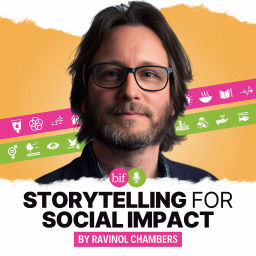
How do we tell stories that actually change things? Storytelling for Social Impact explores how stories can influence what people understand, care about and ultimately do. Host Ravinol Chambers talks with leading thinkers, changemakers, business leaders and storytellers about the ideas shaping our world, the stories we need to tell about them, and what it really takes to create meaningful change. From sustainability and systems change to business, leadership, social impact and communications, these are thoughtful, candid conversations with people doing important work and challenging conventional thinking. If you’re trying to create positive change through your work, this podcast will give you fresh perspectives on how to communicate it, build support for it and make it matter.
- Publisher
- Ravinol Chambers
- Category
- business · education · society & culture
- Language
- en
- Explicit
- No
- First episode
- 25 Aug 2024
- Latest episode
- 1 Nov 2026
Latest episodes
22 episodes in the feed.
1 Nov 2026
E21 What IF Nature Had A Seat At The Table? with Charmian Love
House of Hackney - Nature On The Board (https://www.houseofhackney.com/pages/nature-our-director) Natura - Beauty & Sustainability (https://ri.natura.com.br/en/) Charmian Love - Linkedin (https://www.linkedin.com/in/charmian-love/) Ravinol on Linkedin (https://www.linkedin.com/in/ravchambers/) Be Inspired Films - Purpose Driven Video Production Agency (https://www.beinspiredfilms.co.uk) What If Nature Had a Seat at the Table? What would change if businesses gave nature and future generations a voice in the decisions shaping our world? In this episode, Ravinol Chambers speaks with Charmian Love, co-founder of B Lab UK and a leading voice in regenerative business, about reimagining the relationship between business, society and the natural world. From helping launch the B Corp movement in the UK to representing Mother Nature and future generations on the board of House of Hackney, Charmian has spent much of her career challenging conventional ideas about how business should operate. Together, they explore what it means to move beyond sustainability towards regeneration, the lessons emerging from Natura’s work in the Brazilian Amazon, and how storytelling can help shift the beliefs and behaviours that shape our economic systems. The conversation also ventures into deeper territory: our relationship with nature, the importance of imagination and optimism, and why meaningful change in the world may begin with changing how we see ourselves and our place within it. Chapters & Timestamps 00:00 – The early days of the B Corp movement 03:45 – Rejecting the binary: Why profit and purpose can coexist 06:30 – Embracing paradox and learning to live with uncertainty 10:50 – Devagar: Why things take the time they take 12:00 – Beyond sustainability: The shift towards regenerative business 22:00 – The power of storytelling to humanise complex ideas 24:00 – Reconnecting with nature and remembering that we are nature 30:00 – House of Hackney: Giving Mother Nature a seat on the board 33:00 – Why radical change means getting back to our roots 35:00 – Measuring what matters: Nature, people and financial performance 39:00 – What would make a business worth keeping for future generations? 45:00 – The challenge of building regenerative businesses within today’s economy 47:00 – Natura and the Amazon: Making regeneration economically viable 49:30 – Following the sunflowers: How positive examples inspire change 51:30 – Storytelling as a tool for systems change 53:00 – Creating identity, belonging and movements through storytelling 57:00 – What Brazilian culture can teach us about connection and creativity 59:00 – Hope without denial: Imagining a better future 63:00 – Climate fiction and the power of imagining possible futures 65:30 – Art, music and finding meaning in complexity 69:00 – Why imagination needs the freedom to explore without fear of failure 71:00 – Charmian’s forthcoming book with John Elkington 72:00 – Inner transformation: The personal dimension of systems change 74:00 – Ten breaths instead of a photograph: Practising connection with nature 76:00 – Embodiment, meditation and finding our place in the natural world 80:30 – Where to connect with Charmian and explore her work Resources and organisations mentioned Organisations and initiatives B Lab and the B Corp movement House of Hackney Natura and Natura Ingredients Saïd Business School, University of Oxford Ellen MacArthur Foundation Lawyers for Nature Books and ideas The Good Ancestor – Roman Krznaric The Ministry for the Future – Kim Stanley Robinson New York 2140 – Kim Stanley Robinson The Deluge – Stephen Markley Doughnut Economics – Kate Raworth The Three Horizons framework The Symbiocene Heliotropism Climate fiction (Cli-Fi) Podcasts Outrage + Optimism About Storytelling for Social Impact Hosted by Ravinol Chambers, filmmaker and founder of Be Inspired Films, Storytelling for Social Impact explores how stories shape change, business and society. Through conversations with leading thinkers, changemakers, business leaders and storytellers, the podcast explores the ideas shaping our world, the stories we need to tell about them, and what it takes to create meaningful change. About Be Inspired Films Be Inspired Films helps purpose-driven organisations turn flagship events, campaigns and brand films into long-term momentum. From cinematic films and documentaries to podcasts, animation and live events, they help organisations communicate important ideas, connect with audiences and inspire meaningful action. Find out more: www.beinspiredfilms.co.uk
3 Oct 2026
E20 The Story We Tell About Politics Is Making It Worse with Lisa Witter
Lisa Witter on LinkedIn (https://www.linkedin.com/in/lwitter/) Apolitical - Redesigning public institutions for the age of AI (https://apolitical.co/en) Better Politics Foundation (https://www.betterpolitics.foundation/) Be Inspired Films - Purpose Driven Storytelling & Creative Video Agency (https://www.beinspiredfilms.co.uk) - Award-winning social-purpose Video Production Agency bringing out the heart in stories that matter. We make creative content for ambitious clients that inspires the optimism and bravery needed to solve the world’s biggest challenges. Ravinol on Linkedin (https://www.linkedin.com/in/ravchambers/) Lisa Witter has spent more than 30 years working inside politics and political leadership around the world. She is co-founder and CEO of the Better Politics Foundation, working with a network of organisations across 55 countries to help build better political leadership. At a time when trust in politics is falling and political division is growing, Lisa believes one of the biggest problems we face is the story we tell about politics itself. We talk about why constantly describing politics and politicians as broken may become a self-fulfilling prophecy, how that story drives good people away, and what a different kind of politics might look like. We get into the difference between authentic political storytelling and spin, why belonging and possibility are so powerful, what Lisa learned about persuasion from running for president on a reality TV show, and why finding common ground doesn’t mean abandoning what you believe. Lisa also shares what she has learned from working with political leaders around the world, why the qualities that get someone to the top of politics aren’t necessarily the qualities they need once they get there, and why self-reflection, curiosity and a genuine desire to serve matter so much. And ultimately, why despite everything happening in politics today, she remains hopeful. In this episode 01:00 | Looking for the shimmer From new mothers and couples kissing in the street to New Yorker cartoons, Lisa explains why she deliberately looks for small moments of humanity, humour and joy. 07:00 | Why people matter as much as institutions Lisa chooses SDG 16 and explains why strong institutions alone aren’t enough. Leadership, the people inside those institutions and the often overlooked question of how change actually happens matter enormously. 11:00 | Has pragmatism become a dirty word? As politics becomes more polarised, compromise gets harder. Lisa explains why she describes herself as a radical centrist and why compromise can sometimes be a deeply constructive position. 16:30 | Does politics have a storytelling problem? If we constantly tell ourselves that politics is dirty, broken and full of terrible people, who will choose to enter it? Lisa argues that our collective story about politics may actually be helping create the politics we complain about. 21:00 | What would a better story about politics look like? Rather than politicians positioning themselves as the answer, Lisa explores a more human model of political leadership, where leaders facilitate, listen and help people become part of creating change themselves. 26:00 | Belonging, possibility and the stories that move us forward Why leaders shouldn’t promise utopia, how small improvements can create genuine progress, and why giving people a sense of belonging and possibility can move them from fear towards action. 30:30 | Political storytelling or political spin? Is there really an objective difference? We explore authenticity, morality, cognitive bias and the uncomfortable reality that we judge the same communication very differently depending on whether we agree with the person delivering it. 36:00 | What Lisa learned from running for president on reality TV Lisa shares a remarkable experiment in political communication: real-time audience testing showed her that persuasion wasn’t simply about confidence or having the strongest argument. The order in which you communicate matters, and finding genuine common ground can completely change how people hear what comes next. 43:30 | What makes a great political leader? Drawing on the Better Politics Foundation’s Hall of Fame and decades of working with political leaders, Lisa identifies three qualities that repeatedly stand out: self-reflection, curiosity and pro-social values. 48:00 | The skills that get you elected aren’t necessarily the skills you need to lead Political systems reward particular abilities on the journey to the top. But once someone gets there, the job changes. We explore the tension between conviction and reflection, certainty and humility, and why leadership requires knowing when to turn each quality up or down. 53:00 | Do we need to support the people who lead us better? Lisa explains why she has changed her thinking from simply training political leaders to paying much more attention to who enters politics in the first place, their sense of “enoughness”, and the extraordinary psychological pressures politicians face once in office. 58:00 | Why Apolitical Foundation became Better Politics Foundation A fascinating lesson in reducing cognitive load. Lisa explains why they abandoned a name that needed explaining for one that immediately communicates the mission, while also inviting a much bigger question: what does better politics actually mean? 1:02:00 | The stories we tell ourselves Some of the most powerful stories aren’t the ones we tell other people. They’re the ones running inside our own heads. Lisa explains why those internal stories shape how we lead, how we respond to the world and what we believe is possible. 1:06:00 | What gives Lisa hope about the future of politics? Across the world, people are still getting up every day and trying to make politics better, despite the criticism, lack of resources and even threats they face. Lisa has little time for simply complaining. Her hope lies with the people doing the work.
6 Sept 2026
E19 Has Sustainability Run Out of Steam? with John Elkington
John's Substack - Rewilding Markets (https://johnelkington.substack.com/) Home - Countercurrent (https://countercurrent.earth/) Volans – The Business of Business is Change (https://volans.com/) John Elkington – A world authority on corporate responsibility and sustainable development. (https://johnelkington.com/) Ravinol on Linkedin (https://www.linkedin.com/in/ravchambers/) Purpose Driven Storytelling Agency & Video Production Company (https://www.beinspiredfilms.co.uk/) John Elkington has spent more than 50 years thinking about sustainability, business and how systems change. He coined the term Triple Bottom Line, has written more than 20 books and advises businesses and leaders around the world. But this conversation is much more about what comes next than what came before. John believes the next 10–15 years could bring more change than the previous 50. We talk about why the sustainability movement has become tired and overcomplicated, why the pushback against ESG may actually be useful, and why he believes we’re moving from an era of “soft sustainability” into something much harder. We get into Donald Trump and the breakdown of the old order, AI and the dangers of technological races, why individual action still matters but can’t deliver system change alone, who gets to shape the story of our future, and the kind of leadership we may need for what comes next. Most importantly, John explains why he’s optimistic, even while expecting the years ahead to be extremely challenging. In this episode 00:01 — Curiosity as a way of life At 77, John says he feels like he’s only getting started. What keeps him curious, and why nature still gives him disproportionate joy. 00:12 — Has sustainability run out of steam? John thinks the movement has become tired, complacent and too complicated. And surprisingly, he sees the backlash against it as an opportunity. 00:17 — Why real system change rarely happens gradually We talk about the shocks that have transformed societies throughout history, and why John expects far greater change over the next 10–15 years than we’ve seen in the previous 50. 00:25 — The end of soft sustainability Being responsible, reporting progress and making voluntary commitments won’t be enough. John explains what he means by the shift from “soft” to “hard” sustainability. 00:34 — AI, technological races and running through the red lights What happens when everyone believes they have to win? We explore AI, the race for technological dominance and what history tells us about technologies developing faster than our ability to understand their consequences. 00:39 — Have we given people responsibility without power? From The Green Consumer Guide to today’s calls for system change: did asking millions of individuals to make better choices actually work? 00:43 — Why we’re addicted to magical solutions There is rarely one technology, policy or idea that suddenly fixes everything. John explains why meaningful change is much messier, slower and more experimental. 00:48 — Who gets to shape the future? How do we give nature, future generations and marginalised communities a genuine voice without simply telling their stories for them? 00:52 — Where are the leaders we need? Why strong leadership and good values so rarely appear together, what John sees in leaders such as Mark Carney, and why our political systems may need much deeper reinvention. 00:58 — The future isn’t waiting for us Climate impacts we once imagined our grandchildren dealing with are already arriving. John explains why time literacy matters and why leadership ultimately depends on telling people the truth while still giving them a believable way forward.
Podcast Authority Score: 8 / 100
A composite of feed quality, social presence, YouTube performance and engagement. Read the methodology.
- Quality
- 16
- Social presence
- 0
- YouTube
- 0
- Engagement
- 0
Contact Storytelling For Social Impact
- Guest appearances
- Books guests
Based on episode analysis; this does not confirm that the show is currently accepting guests.
Host of Storytelling For Social Impact?
Claim your podcast to manage its listing and keep your show details accurate.
Pod Engine is an independent podcast discovery and analytics service and is not affiliated with or endorsed by this podcast. Artwork and show content belong to their owners. Full legal notice.
Explore this show
Podcast research with Pod Engine