- 24
- Episodes
- 2025
- First episode
- 318K
- YouTube views
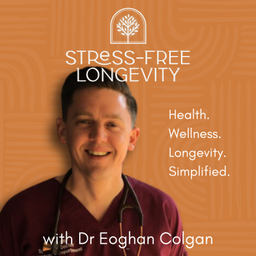
About Stress-Free Longevity
Feeling overwhelmed by conflicting health advice? Join Dr. Eoghan Colgan and leading scientists as they cut through the noise to uncover what really works. We explore the science behind life’s essential pillars, finding simpler paths to wellness. No rigid rules – just clear, evidence-based insights you can trust. For curious minds seeking better ways to live well.
- Publisher
- Dr Eoghan Colgan
- Category
- health & fitness
- Language
- en
- Explicit
- Yes
- First episode
- 7 Feb 2025
- Latest episode
- 2 Jul 2026
Latest episodes
24 episodes in the feed.
2 Jul 2026
Episode 24: Understanding Environmental Toxins with Professor Alistair Boxall
Episode Overview IProfessor Alastair Boxall, an environmental scientist who has monitored chemical pollution across more than 230 rivers in over 100 countries, helps us separate genuine risk from needless worry when it comes to environmental toxins. Prof. Boxall explains why detecting a chemical is not the same as it being dangerous, what really slips through our drinking water treatment, and why some of the biggest threats — like antimicrobial resistance and pet flea treatments — receive far less attention than they should. Rather than fuelling fear, this interview offers a calm, evidence-based framework for understanding what matters and the practical steps that genuinely reduce your exposure. It's a refreshing antidote to the alarming headlines, grounded in decades of real-world monitoring. Key 'Environmental Toxins' Insights: Detection Isn't Danger: Modern instruments can detect hundreds or thousands of chemicals in a single water sample, but only a tiny fraction occur at levels capable of causing harm. Increasingly sensitive testing scares people without necessarily revealing real risk. Tap Water Often Beats Bottled: UK drinking water treatment is genuinely good, removing most river contaminants. Bottled water carries its own problems — plastic additives that leach in, and far higher microplastic levels than tap water. The Three Biggest Concerns: Of all the contaminants Prof. Boxall studies, PFAS ("forever chemicals"), antibiotics driving antimicrobial resistance, and aquatic insecticides worry him most — not the microplastics that dominate headlines. Antimicrobial Resistance Is a Silent Pandemic: Antibiotics detected almost everywhere in the global environment may be selecting for resistant bacteria that re-enter human populations. AMR was linked to an estimated 1.2 million deaths globally in 2019. Pet Flea Treatments Are an Overlooked Threat: With 22 million cats and dogs in the UK now routinely treated monthly, highly toxic insecticides like imidacloprid are entering rivers and harming the invertebrates that keep waterways healthy. Environmental risk isn't even assessed in their approval. Microplastics Are Over-Hyped: While not harmless, much of the alarming microplastics-and-health coverage rests on weak science. Robust research is still needed before we know whether they truly pose a risk to human health. Lead Piping Still Matters in Older Homes: Houses built before the 1970s may still have lead pipes. Running the tap each morning to clear water that sat overnight significantly reduces chronic exposure. Want the complete framework? Get The Vital 3 Method guide free — the evidence-based system for sustainable health after 40. Download the Free Guide Expert 'Environmental Toxins' Takeaways Reframe scary headlines by remembering that detecting a chemical says nothing about whether it's present at a harmful level Reconsider bottled water — it offers no proven safety advantage over UK tap water and carries more microplastics If you live in a pre-1970s home, run the tap each morning before drinking to flush water that has been sitting in potentially lead-containing pipes Research any water filter before buying — different filters remove different things (lead, PFAS, hardness), so match the filter to your actual concern Wash or peel fruit and vegetables, since chemical residues concentrate in the peel rather than the flesh Avoid swimming in rivers for a few days after heavy rainfall, when storm overflows discharge sewage and bacteria; check live overflow maps where available Choose locally sourced, varied food and reduce reliance on factory-farmed products to lower both your exposure and the wider environmental chemical burden Think before applying pet flea treatments routinely — consider whether monthly preventive dosing is necessary, as these chemicals migrate into the environment after use Walk or cycle instead of driving where you can, reducing traffic-related air pollution that contributes to the UK's "pollute-ome" About Our Guest Professor Alastair Boxall is a Professor of Environmental Science specialising in the occurrence, fate, and effects of chemical contaminants in the natural environment. His research has included global monitoring of pharmaceutical pollution across more than 230 rivers in 104 countries, alongside pioneering work on PFAS, antimicrobial resistance, and the emerging environmental risks of pet flea treatments. His work informs how scientists and regulators understand the real-world risks posed by environmental toxins. Visit Professor Boxall's Academic Profile (https://www.york.ac.uk/environment-geography/people/alistair-boxall/) Watch the 'Environmental Toxins' Interview 'Environmental Toxins' Resources Key Research Discussed: Pharmaceutical Pollution of the World's Rivers (PNAS, 2022) — Prof. Boxall's global study of 258 rivers across 104 countries, showing the worst pollution in low- and middle-income regions. https://www.pnas.org/doi/10.1073/pnas.2113947119 (https://www.pnas.org/doi/10.1073/pnas.2113947119) Trifluoroacetic Acid (TFA) in UK Surface Waters (University of York / Fidra, 2025) — Found TFA at 98% of sites tested, with Glasgow's River Kelvin the second-highest level ever recorded globally. https://www.york.ac.uk/news-and-events/news/2025/research/forever-chemicals-river/ (https://www.york.ac.uk/news-and-events/news/2025/research/forever-chemicals-river/) Relevant Organisations: Environment Agency — Monitors the ecological and chemical status of England's rivers. https://www.gov.uk/government/organisations/environment-agency (https://www.gov.uk/government/organisations/environment-agency) Drinking Water Inspectorate — Regulates UK drinking water quality; consumer advice on tap water, filters, and lead. https://www.dwi.gov.uk/ (https://www.dwi.gov.uk/) Food Standards Agency — Monitors food for chemical contaminants against safe levels. https://www.food.gov.uk/ (https://www.food.gov.uk/) National Storm Overflow Hub (Water UK) — Live map of storm overflow discharges; check before river swimming after rain. https://www.streamwaterdata.co.uk/pages/the-national-storm-overflow-hub (https://www.streamwaterdata.co.uk/pages/the-national-storm-overflow-hub) It's not about willpower A doctor's guide to healthy living and making it stick What's inside Why healthy living matters for you and your loved ones The actions that make a difference - not 100 biohacks that don't! My exact program that helped me lose 14kg in weight, reverse my metabolic age, and feel in the best shape of my life Tips on using AI to supercharge your lifestyle changes First Name Please enter your name. Email Address Please enter a valid email address. Send me the Free PDF! Please check your email for further instructions. Check your junk mail if you cannot find the email in the next few minutes. Something went wrong. Please check your entries and try again. I will not share your details with any third party Additional Interviews Are you interested in other expert interviews on health, wellness and longevity topics? Click on the links below to discover more. Sleep The most under-rated life pillar of all! Sleep Content Exercise The foundation of lasting health Exercise Content Nutrition The fuel that shapes your wellbeing Nutrition Content The post Episode 24: Understanding Environmental Toxins with Professor Alistair Boxall (https://stressfreelongevity.com/podcast/understanding-environmental-toxins/) first appeared on Stress-Free Longevity (https://stressfreelongevity.com).
31 Mar 2026
Episode 23: Understanding Microplastics with Professor Richard Thompson
Episode Overview Professor Richard Thompson — the marine biologist who coined the term "microplastics" — reveals what three decades of research have uncovered about these microscopic particles now found in our food, water, and air. Prof. Thompson explains how microplastics move from the environment into our bodies, why the chemicals associated with them pose a growing threat to human health, and what practical steps we can all take to reduce our exposure. Key 'Microplastics' Insights: The Scientist Who Named the Problem: Prof. Thompson published the first paper using the term "microplastics" in Science in 2004. There are now over 7,000 scientific publications on the topic. Microplastics Are Literally Everywhere: Microscopic plastic particles have been found on every continent, 4,000 metres deep in the ocean, and in Arctic ice cores — often in greater quantities in remote locations than near major cities. Your Kitchen Air Is a Bigger Source Than Your Fish Supper: The quantity of microplastics in your kitchen air during meal preparation exceeds the amount present in the fish itself. Household dust is a major source of human exposure. 16,000 Chemicals, 4,000 Potentially Harmful: Over 16,000 chemicals are associated with plastic production, more than 4,000 of which are known to be potentially harmful — yet very few are regulated. The Health Costs May Equal the Entire Plastic Market: Research suggests that global health costs from plasticizer chemicals alone could match the entire annual value of the plastics industry. Today's Plastic Items Are Tomorrow's Microplastics: Even if all pollution stopped today, microplastic levels would continue rising for decades as existing large items fragment into smaller pieces. Want the complete framework? Get The Vital 3 Method guide free — the evidence-based system for sustainable health after 40. Download the Free Guide Expert 'Microplastics' Takeaways Reduce single-use plastic where possible — carry a refillable bag, water bottle, and coffee cup Drink tap water instead of bottled water where it's safe to do so Refuse unnecessary plastic packaging in shops, restaurants, and bars — consumer resistance sends a powerful market signal Check which plastics your local authority actually accepts for recycling, as this varies significantly between areas Wash synthetic clothes less frequently — half of all fibre emissions come from everyday wear rather than laundering Maintain car tyres properly, as each set releases roughly 4–5kg of microplastic dust into the environment before replacement Recognise that individual changes alone cannot solve this — the biggest impact comes from better product design, stronger policy, and industry accountability About Our Guest Professor Richard Thompson OBE is a marine biologist at the University of Plymouth who coined the term "microplastics" in his landmark 2004 paper in Science. He is co-coordinator of the Scientists' Coalition for an Effective Plastics Treaty, a network of 400 scientists bringing independent evidence to global policy negotiations. Visit Professor Thompson's Academic Profile (https://www.plymouth.ac.uk/staff/richard-thompson) Watch the 'Gut-Brain Connection' Interview 'Microplastics' Resources Key Research Discussed: Thompson et al. 2004, "Lost at Sea: Where Is All the Plastic?" (Science) — The landmark paper coining the term "microplastics": https://www.science.org/doi/10.1126/science.1094559 (https://www.science.org/doi/10.1126/science.1094559) Thompson et al. 2024, "Twenty Years of Microplastic Pollution Research — What Have We Learned?" (Science) — The 20-year review paper: https://www.science.org/doi/10.1126/science.adl2746 (https://www.science.org/doi/10.1126/science.adl2746) Relevant Organisations: Scientists' Coalition for an Effective Plastics Treaty: https://ikhapp.org/scientistscoalition/ (https://ikhapp.org/scientistscoalition/) Marine Conservation Society: https://www.mcsuk.org/ (https://www.mcsuk.org/) It's not about willpower A doctor's guide to healthy living and making it stick What's inside Why healthy living matters for you and your loved ones The actions that make a difference - not 100 biohacks that don't! My exact program that helped me lose 14kg in weight, reverse my metabolic age, and feel in the best shape of my life Tips on using AI to supercharge your lifestyle changes First Name Please enter your name. Email Address Please enter a valid email address. Send me the Free PDF! Please check your email for further instructions. Check your junk mail if you cannot find the email in the next few minutes. Something went wrong. Please check your entries and try again. I will not share your details with any third party Additional Interviews Are you interested in other expert interviews on health, wellness and longevity topics? Click on the links below to discover more. Sleep The most under-rated life pillar of all! Sleep Content Exercise The foundation of lasting health Exercise Content Nutrition The fuel that shapes your wellbeing Nutrition Content The post Episode 23: Understanding Microplastics with Professor Richard Thompson (https://stressfreelongevity.com/podcast/understanding-microplastics/) first appeared on Stress-Free Longevity (https://stressfreelongevity.com).
17 Mar 2026
Episode 22: Understanding the Gut-Brain Connection with Professor John Cryan
Episode Overview Professor John Cryan — Vice President for Research at University College Cork and a pioneer of microbiome-gut-brain science — reveals how trillions of gut microbes directly influence your mood, stress resilience, and long-term brain health. From coining the term "psychobiotic" to leading research linking gut bacteria to social behaviour and neurodegenerative disease, Prof. […] The post Episode 22: Understanding the Gut-Brain Connection with Professor John Cryan (https://stressfreelongevity.com/podcast/understanding-the-gut-brain-connection/) first appeared on Stress-Free Longevity (https://stressfreelongevity.com).
Who has been a guest on Stress-Free Longevity
Names identified in recent episode analyses. Showing up to five guests.
- Professor Michelle Harvie
- Professor Russell Foster
- Professor Marc Jones
Reach and audience
Public platform figures. Ratings count people who left a rating, not total listeners.
- YouTube views
- 318,184
- Score snapshot 15 Sept 2025
Podcast Authority Score: 45 / 100
A composite of feed quality, social presence, YouTube performance and engagement. Read the methodology.
- Quality
- 55
- Social presence
- 0
- YouTube
- 86
- Engagement
- 0
Contact Stress-Free Longevity
- Guest appearances
- Books guests
Based on episode analysis; this does not confirm that the show is currently accepting guests.
Host of Stress-Free Longevity?
Claim your podcast to manage its listing and keep your show details accurate.
Pod Engine is an independent podcast discovery and analytics service and is not affiliated with or endorsed by this podcast. Artwork and show content belong to their owners. Full legal notice.
Explore this show
Podcast research with Pod Engine