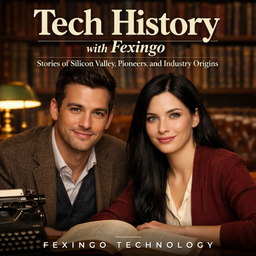
About Tech History with Fexingo: Stories of Silicon Valley, Pioneers, and Industry Origins
Lucas and Luna explore the hidden backstories of technology's defining moments — from the founding of Fairchild Semiconductor to the rise of the graphical user interface. Each episode takes a single company, product, or figure from Silicon Valley lore and examines the decisions, market pressures, and serendipity that shaped it. They ask: What did Intel's Andy Grove actually believe about operational discipline? How did Atari's culture of chaos birth both Steve Jobs and Nolan Bushnell's downfall? Why did Xerox PARC invent the future and fail to own it? Expect number-literate conversation that treats history not as a museum, but as a working toolkit for understanding today's tech landscape. Lucas brings the archival detail and journalistic rigor; Luna presses on the strategic lessons that still echo. This show is for founders, engineers, and product leaders who want to learn from the original mistakes and breakthroughs — not sanitized myths, but the messy, data-rich reality. By the end, you'll see the iPhone, the cloud, and AI not as inevitabilities, but as one possible path among many.
#SiliconValleyHistory #FairchildSemiconductor #Intel #Atari #XeroxPARC #SteveJobs #AndyGrove #GUI #Microprocessor #StartupCulture #TechPioneers #InnovationFailures #BusinessHistory #TechnologyPodcast #FexingoBusiness #BusinessPodcast #TechHistory #LucasAndLuna
Keep every episode free: buymeacoffee.com/fexingo (https://buymeacoffee.com/fexingo)
In 1978, a small team at VisiCorp released VisiCalc, the first program to make the personal computer useful for business. Before this tool, financial modeling required manual recalculation or mainframe time that was expensive and slow. This episode traces how the spreadsheet transformed corporate finance from a clerical burden into a strategic weapon, enabling rapid scenario analysis and changing how decisions were made in boardrooms forever. We look at the specific mechanics of cell referencing, the cultural shift in accounting departments, and why this single software application justified the purchase of thousands of Apple II computers overnight.
#VisiCalc #PersonalComputer #BusinessSoftware #FinancialModeling #SiliconValleyHistory #AppleII #TechOrigins #AccountingTech #ProductivityTools #CorporateStrategy #DataAnalysis #SoftwareEvolution #FexingoBusiness #BusinessPodcast #TechHistory #InnovationStories #OfficeAutomation #EconomicImpact
Keep every episode free: buymeacoffee.com/fexingo (https://buymeacoffee.com/fexingo)
10 Oct 2026
How The Floppy Disk Saved A Factory Floor
In this episode of Tech History with Fexingo, Lucas and Luna trace the unlikely origin of the floppy disk to a desperate engineering problem at IBM in the early nineteen eighties. They explore how two engineers, Ray Wilson and David Noble, created the three-and-a-half-inch format not for computers, but to store CNC machine instructions for manufacturing robots. The story reveals how a rigid plastic shell solved a critical reliability issue on factory floors, inadvertently creating the decade's dominant data storage medium that outlasted the very machines it was built for.
#FloppyDisk #IBMHistory #TechOrigins #SiliconValleyStories #CNCMachines #DataStorage #RayWilson #DavidNoble #ManufacturingTech #ThreeHalfInch #BusinessPodcast #FexingoBusiness #TechHistory #EngineeringPioneers #ComputerHardware #IndustrialAutomation #FexingoTech #BusinessHistory
Keep every episode free: buymeacoffee.com/fexingo (https://buymeacoffee.com/fexingo)
9 Oct 2026
How The Dot Matrix Printer Changed Office Life
Before the laser printer, there was the dot matrix. In this episode of Tech History with Fexingo, Lucas and Luna explore how the noisy, tractor-fed impact printer became the backbone of early corporate data processing. We look at the specific engineering challenges of moving from teletype to high-speed ink-jet alternatives, and why businesses stuck with the loud, messy dot matrix for decades. You will learn about the economics of carbonless paper, the rise of continuous feed forms, and the pivotal role these machines played in the transition from mainframe-centric to decentralized office computing around 1975.
#DotMatrixPrinter #TechHistory #SiliconValleyOrigins #OfficeTechnology #ComputerHardware #BusinessPodcast #FexingoBusiness #PrintersAndPrinting #CorporateComputing #ImpactPrinting #ContinuousPaper #1970sTech #EngineeringHistory #LaserPrinterAlternatives #DataProcessing #LucasAndLuna #TechInnovation #OfficeCulture
Keep every episode free: buymeacoffee.com/fexingo (https://buymeacoffee.com/fexingo)
Contact Tech History with Fexingo: Stories of Silicon Valley, Pioneers, and Industry Origins
Guest appearances
Does not typically book guests
Based on episode analysis; this does not confirm that the show is currently accepting guests.
Host of Tech History with Fexingo: Stories of Silicon Valley, Pioneers, and Industry Origins?
Claim your podcast to manage its listing and keep your show details accurate.
Pod Engine is an independent podcast discovery and analytics service and is not affiliated with or endorsed by this podcast. Artwork and show content belong to their owners. Full legal notice.
Explore this show Podcast research with Pod Engine