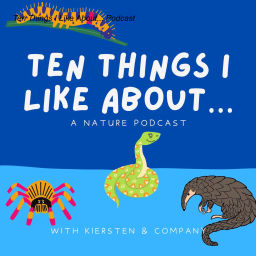
Ten Things I Like About... Podcast
Hosted by Kiersten · Kiersten Gibizov
5.0from 6 ratings
- 143
- Episodes
- 6
- Ratings
- Weekly
- Cadence
- 2022
- First episode
About Ten Things I Like About... Podcast
This is a 10 minute, 10 episode podcast about unknown or misunderstood wildlife.
- Publisher
- Kiersten Gibizov
- Category
- education · kids & family · science
- Language
- en
- Explicit
- No
- First episode
- 14 Sept 2022
- Latest episode
- 5 Feb 2026
Latest episodes
143 episodes in the feed.
5 Feb 2026
Tuatara: Diet and Dentition
Summary: You are what you eat, right? Find out what tuatara eat and how they eat it in the seventh episode of Tuatara. For my hearing impaired followers, a complete transcript of this podcast follows the show notes on Podbean Show Notes: “Tuatara” Royal Ontario Museum, https://collections.rom.on.ca “Microstructure of dental hard tissues and bone in the Tuatara denture, Sphenodon punctatus,” by J.A. Kierser, T. Tkatchenko, M. C. Dean, M. E. H. Jones, and N. J. Nelson. Front Oral Biol. 2009:13:80-85. https://pubme.ncbi.nlm.nih.gov/19828975 Music written and performed by Katherine Camp Transcript (Piano music plays) Kiersten - This is Ten Things I Like About…a ten minute, ten episode podcast about unknown or misunderstood wildlife. (Piano music stops) Kiersten - Welcome to Ten Things I Like About… This is a podcast about misunderstood or unknown creatures in nature. Some we’ll find right out side our doors and some are continents away but all are fascinating. This podcast will focus ten, ten minute episodes on different animals and their amazing characteristics. Please join me on this extraordinary journey, you won’t regret it. We have made it to the seventh episode of Tuatara and the seventh thing I like about these super cool reptiles is their diet and dentition. We have hinted a bit about what they eat but today we’ll take a closer look at what that is specifically and how their teeth help. Let’s start with food. Tuatara are carnivores. They eat mainly invertebrates like worms and arthropods such as beetles, millipedes, spiders, and weta. Weta are insects native to New Zealand that look similar to crickets but like crickets on steroids. Weta have big bodies, spiny legs, and tusks. They look kind of like a cricket and a warthog had a baby. The majority of the tuatara diet is made up of invertebrates but they will also eat lizards, seabird eggs and chicks, and occasionally they venture in to cannibalism and will eat young tuatara. Because of this, juvenile tuatara are active during the day while adult tuatara are active at night. I mean, really, if your relatives might eat you at night, then who wouldn’t want to avoid them. Humans that live on the islands where tuatara are found always know when they’ve been hunting because they will see headless birds. Definitely not something you want to come across on a relaxing walk in nature. Why is this the indicator of the tuatara? The tooth pattern of the tuatara is unique. Just like almost everything else about them. They have two incisor like teeth in front of their top jaw. And they have three rows of teeth (I was not able to find an actual count but am guessing it’s around 85 teeth). One row of teeth lines the bottom jaw and two rows line the top jaw. The bottom row of teeth fit neatly into the two upper rows of teeth when the jaw is closed. Wait for it, we almost have our answer. The jaw motion of the tuatara is also unique. Instead of an up and down motion, like chewing, they have a forward and backward motion, like sawing. And there it is! This is why the birds that tuatara hunt are missing heads. They saw them off with their unique teeth. Hah! Didn’t see that coming did you? Besides the unique pattern of teeth, the structure of their teeth is also unique. They have acrodont teeth which means they are rootless and attached directly to the bone of the jaw. They kind of emerge from the actual bone. This is unlike any other reptile teeth alive today. The teeth are serrated which helps with the sawing motion. Tuatara cannot replace lost or cracked teeth. Once the tooth is gone, it is gone. As tuatara age their teeth wear down from use. They are eating crunchy invertebrates and bony vertebrates, so they do take a beating. Tuatara can live for up to 100 years, so the older tuatara have to switch their diet to softer prey as their teeth wear down. Now for a long time, we thought they didn’t have real teeth. We thought they were just bony protrusions that stuc
29 Jan 2026
Tuatara: Living Fossil
Summary: The term “living fossil” is a bit controversial but does it fit the tuatara? Join Kiersten to find out. For my hearing impaired followers, a complete transcript of this podcast follows the show notes on Podbean Show Notes: “New study shows modern tuatara are little changed from 190 million year old ancestors.” Harvard University Department of Organismic and Evolutionary Biology, March 2022. https://www.oeb.harvard.edu/news Music written and performed by Katherine Camp Transcript (Piano music plays) Kiersten - This is Ten Things I Like About…a ten minute, ten episode podcast about unknown or misunderstood wildlife. (Piano music stops) Kiersten - Welcome to Ten Things I Like About… This is a podcast about misunderstood or unknown creatures in nature. Some we’ll find right out side our doors and some are continents away but all are fascinating. This podcast will focus ten, ten minute episodes on different animals and their amazing characteristics. Please join me on this extraordinary journey, you won’t regret it. The sixth thing I like about the tuatara is how long they have lived. Just like another animal we have talked about, the coelacanth, the tuatara appears in the fossil record from way back in time. The first time we see the tuatara in the fossil record is during the Jurassic period. Now, of course, a certain book and movie series has made this a very popular time in Earth’s history, so you may be familiar with this time period. It is famous for being the age of dinosaurs, at least some of the most popular and recognizable dinosaurs. The term living fossil has been tossed around in reference to the tuatara, as well as the coelacanth, but this term is controversial. It is quite the romantic phrase actually. To think that an animal is so well adapted to the world it lives in that is hasn’t changed since the first time it appeared on this planet is a notion that a lot of us want to believe, but is it true? The first major problem with this concept, is that there is no real definition of what makes an animal or plant a living fossil. Charles Darwin coined the term “living fossil” in 1859. According to Darwin’s definition a living fossil is a species or group of species that is so little changed that it provides an insight into earlier, now extinct, forms of life. A living fossil can also be described as an organism that has remained relatively unchanged over millions of years, or one that has no, or very few, close surviving relatives. It certainly sounds like we have stumbled on another controversy here. In the last episode we answered the question of whether the tuatara is a lizard or not. Spoiler here, listeners, if you haven’t heard the previous episode and you don’t want a spoiler to this question, stop listening now and go back and listen to last week’s episode. With that warning, let’s move on. We have established that tuatara are not lizards, they are reptiles but not lizards for various reasons. Shall we jump into the next controversial question then? Are tuatara living fossils? Let’s look at Darwin’s definition first. How much have tuatara changed since they first appeared in the fossil record? A 2022 study from Harvard University’s Department of Organismic and Evolutionary Biology may give us some insight. Tuatara are the last remnant of the Rhynchocephalians. These reptiles peaked in abundance in the Jurassic period. Then they disappeared from the fossil record. Two researchers were looking through the archives in the Harvard Museum of Comparative Zoology and came across something that had been sitting in the drawers for decades, a tuatara fossil. This fossil was discovered in northern Arizona in the Kayenta Formation of the United States in 1982. Professor Stephanie Pierce and postdoctoral fellow Tiago Simoes jumped into examining this forgotten fossil. They used micro-CT scans to examine the fossil in three dimension. Then they digitally pieced the puzzle together revealing a f
21 Jan 2026
Tuatara: Lizard or Not a Lizard?
Summary: Is the tuatara a lizard? We have hinted at it for a few episodes. Join Kiersten to find out if the tuatara is or is not a lizard. For my hearing impaired followers, a complete transcript of this podcast follows the show notes on Podbean Show Notes: “It’s not a lizard or a dinosaur: the tuatara is something else entirely,” by Bec Crew. Australian Geographic, https://www.australiangeographic.com.au “New study shows modern tuatara are little changed from 190 million year old ancestors.” Harvard University Department of Organismic and Evolutionary Biology. https://www.oeb.harvard.edu Parietal Eye, https://www.sciencedirect.com/topics/veterinary-science-and-veterinary-medicine/parietal-eye Music written and performed by Katherine Camp Transcript (Piano music plays) Kiersten - This is Ten Things I Like About…a ten minute, ten episode podcast about unknown or misunderstood wildlife. (Piano music stops) Kiersten - Welcome to Ten Things I Like About… This is a podcast about misunderstood or unknown creatures in nature. Some we’ll find right out side our doors and some are continents away but all are fascinating. This podcast will focus ten, ten minute episodes on different animals and their amazing characteristics. Please join me on this extraordinary journey, you won’t regret it. During the last few episodes of tuatara, I have asked the question of whether the tuatara is a lizard or not a lizard. Today we are going to answer that question. The fifth thing I like about the tuatara is the unusual quirks that make them a unique reptile. We have established that the tuatara is in an order of reptiles all by itself, Order Rhynchocephalia. This means that they have no living relatives. That in itself doesn’t mean they are not lizards, it just means they are not related to any living lizards. So let’s look at a few more attributes of the tuatara that will help us answer our question. In the last episode we discussed the third eye, or parietal eye of the tuatara. Now other species of reptiles, mainly lizards, have a third eye as well. Certain iguanas, skinks, and monitors have a parietal eye, but their third eye is primitive and is not visibly seen at any stage of their development. The basics of the eye are there but it is hidden under a scale. The tuatara’s eye is much more developed and is exposed in young hatchlings. For more in depth discussion of the tuatara’s this eye, please listen to the previous episode. There are several things about the tuatara’s skeleton that also sets it apart from lizards. One is the teeth. The tuatara has three rows of teeth. One row in the lower jaw and two in the upper jaw. When the tuatara bits down the lower teeth fit into the groove between the two rows of upper teeth. That is very unusual and as far as we currently know, no other reptile has a tooth formation like this. The teeth are fused to the jaw and have no roots, which is unlike most lizard teeth. Tuatara teeth are not replaced during their lifetime and as they age and their teeth wear down, they have to switch to softer prey. Another strange and interesting thing about the tuatara’s jaw is that when it eats the jaw doesn’t open and close in the typical chewing motion of most animals. It moves forwards and backwards slicing their prey like a saw. Locals of the islands where tuatara live always know when the reptiles have been hunting because they find birds with their heads sawed off. Another unique attribute of the tuatara skull is the complete lower temporal bar that closes the lower temporal fenestra. The temporal fenestra is the opening in the skull behind the eye socket. Most modern lizards do not have a complete temporal bar. Researchers believe the complete bar in the tuatara is used to stabilize the skull during biting. It’s a unique jaw motion and it makes sense that the skull needs a bit more support. As we travel down the skeleton of the tuatara we see some more unique features. The spine is made up of ho
Reach and audience
Public platform figures. Ratings count people who left a rating, not total listeners.
- Apple Podcasts (US)
- 5.0 / 5
- 2 ratings
- Spotify
- 5.0 / 5
- 4 ratings
Podcast Authority Score: 29 / 100
A composite of feed quality, social presence, YouTube performance and engagement. Read the methodology.
- Quality
- 35
- Social presence
- 0
- YouTube
- 0
- Engagement
- 60
Contact Ten Things I Like About... Podcast
- Guest appearances
- Does not typically book guests
Based on episode analysis; this does not confirm that the show is currently accepting guests.
Questions about Ten Things I Like About... Podcast
Who hosts Ten Things I Like About... Podcast?
Kiersten host the show. Published by Kiersten Gibizov.
How often do new episodes come out?
The show publishes weekly, based on its RSS feed.
Does Ten Things I Like About... Podcast take guests?
The show does not typically feature guests, based on episode analyses.
Host of Ten Things I Like About... Podcast?
Claim your podcast to manage its listing and keep your show details accurate.
Pod Engine is an independent podcast discovery and analytics service and is not affiliated with or endorsed by this podcast. Artwork and show content belong to their owners. Full legal notice.
Explore this show
Podcast research with Pod Engine